From Surf Wiki (app.surf) — the open knowledge base
Footprints (composition)
1966 musical work by Wayne Shorter
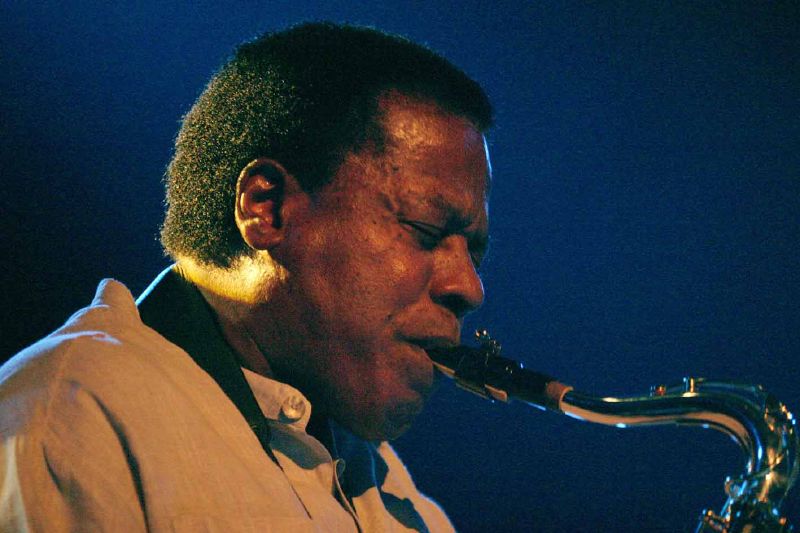
1966 musical work by Wayne Shorter
"Footprints" is a jazz standard composed by saxophonist Wayne Shorter and first recorded for his album Adam's Apple in 1966. The first commercial release of the song was a different recording on the Miles Davis album Miles Smiles recorded later in 1966, but released earlier. It has become a jazz standard.
Rhythm
Although often written in or , it is not a jazz waltz because the feel alternates between simple meter and compound meter. On Miles Smiles, the band playfully explores the correlation between African-based (or ) and . Drummer Tony Williams freely moves from swing, to the three-over-two cross rhythm—and to its correlative.
The ground of four main beats is maintained throughout the piece. The bass switches to at 2:20. Ron Carter’s figure is known as tresillo in Afro-Cuban music and is the duple-pulse correlative of the figure. This may have been the first overt expression of systemic, African-based cross-rhythm used by a straight ahead jazz group. During Davis’s first trumpet solo, Williams shifts to a jazz ride pattern while Carter continues the bass line.
The following example shows the and forms of the bass line. The slashed noteheads indicate the main beats (not bass notes), where one ordinarily taps their foot to "keep time."
: { \relative c, \new Staff \new voice { \clef bass \time 12/8 \key c \minor \set Score.tempoHideNote = ##t \tempo 4 = 100 \stemDown \override NoteHead.style = #'cross \repeat volta 2 { es4. es es es } } \new voice { \set Score.tempoHideNote = ##t \tempo 4 = 100 \time 12/8 \stemUp \repeat volta 2 { c'4 g'8~ g c4 es4.~ es4 g,8 } \bar ":|." } \new Staff \new voice { \clef bass \time 12/8 \key c \minor \set Staff.timeSignatureFraction = 4/4 \scaleDurations 3/2 { \set Score.tempoHideNote = ##t \tempo 8 = 100 \stemDown \override NoteHead.style = #'cross \repeat volta 2 { es,4 es es es } } } \new voice \relative c' { \time 12/8 \set Staff.timeSignatureFraction = 4/4 \scaleDurations 3/2 { \set Score.tempoHideNote = ##t \tempo 4 = 100 \stemUp \repeat volta 2 { c,8. g'16~ g8 c es4~ es8. g,16 } \bar ":|." } } }
Harmony
Harmonically, "Footprints" takes the form of a 12-bar C minor blues, but this is masked not only by its triple time signature but by its avant garde turnaround. In the key of C minor, a normal turnaround would be Dm7(5), G7, Cm7. But Shorter doubles the harmonic rhythm of the turnaround, and the progression reads: Fm9(5), F7(11), E9(5), A7(9), Cm7. In jazz jam sessions and for educational purposes, players often choose D7(11) D7(11) Cm7 as turnaround, which also fits with the original melody.
Notable covers
- Kenny Barron included the composition in his 2004 studio album Images.
References
References
- (11 March 2011). "The Studio Recordings of the Miles Davis Quintet, 1965-68". [[Oxford University Press]].
- (13 February 2019). "Stories of Standards: "Footprints" by Wayne Shorter". [[KUVO]].
- (2021). "The Jazz Standards: A Guide to the Repertoire". [[Oxford University Press]].
- (2019). "The Philosophy of Rhythm: Aesthetics, Music, Poetics". [[Oxford University Press]].
- "Footprints" ''Miles Smiles'' (Miles Davis). Columbia CD (1967).
- Peñalosa, David (2010: 43). ''The Clave Matrix; Afro-Cuban Rhythm: Its Principles and African Origins''. Redway, CA: Bembe Inc. {{ISBN. 1-886502-80-3.
- (2005). "Jazz Composition and Arranging". Thomson/Schirmer.
- {{allMusic. Thom. Jurek
This article was imported from Wikipedia and is available under the Creative Commons Attribution-ShareAlike 4.0 License. Content has been adapted to SurfDoc format. Original contributors can be found on the article history page.
Ask Mako anything about Footprints (composition) — get instant answers, deeper analysis, and related topics.
Research with MakoFree with your Surf account
Create a free account to save articles, ask Mako questions, and organize your research.
Sign up freeThis content may have been generated or modified by AI. CloudSurf Software LLC is not responsible for the accuracy, completeness, or reliability of AI-generated content. Always verify important information from primary sources.
Report