From Surf Wiki (app.surf) — the open knowledge base
Foibe massacres
Mass killings and ethnic cleansing against Italians and pro-Italian Slavs
Mass killings and ethnic cleansing against Italians and pro-Italian Slavs
| Field | Value | |||
|---|---|---|---|---|
| title | Foibe massacres | |||
| native_name | it | |||
| sl | ||||
| hr | ||||
| partof | the Allied war crimes during World War II in Yugoslavia | |||
| map | Foibe seats.png | |||
| map_caption | Locations of some of the foibe | |||
| location | Julian March, Kvarner, Dalmatia (Italy and Yugoslavia) | |||
| target | * Local ethnic Italians (Istrian and Dalmatian Italians) | |||
| *Members of fascist military and police forces<ref name | ":4" | |||
| * Italian, German, Croat and Slovene anti-communists against the regime of Josip Broz Tito, presumed to be associated with fascism, Nazism and collaboration with Axis{{sfn | Rumici | 2002 | p | 350}} |
| date | 1943–1945 | |||
| type | * Ethnic cleansing against local Italians (Istrian Italians and Dalmatian Italians) | |||
| fatalities | Estimates range from 3,000 to 5,000 killed, according to other sources 11,000 or 20,000; 4,000 deported | |||
| perpetrators | * Yugoslav Partisans | |||
| assailants | ||||
| numparts | ||||
| dfens | ||||
| website |
sl hr
- Members of fascist military and police forces
- Italian, German, Croat and Slovene anti-communists against the regime of Josip Broz Tito, presumed to be associated with fascism, Nazism and collaboration with Axis
- Preventive purge of real, potential or presumed opponents of Titoism
- Reprisal killings
- OZNA The foibe massacres (; ; ), or simply the foibe, refers to ethnic cleansing, mass killings and deportations both during and immediately after World War II, mainly committed by Yugoslav Partisans and OZNA in the then-Italian territories of Julian March (Karst Region and Istria), Kvarner and Dalmatia, against local Italians (Istrian Italians and Dalmatian Italians) and Slavs, primarily members of fascist and collaborationist forces, and civilians opposed to the new Yugoslav authorities, and Italian, German, Croat and Slovene anti-communists against the regime of Josip Broz Tito, presumed to be associated with fascism, Nazism, collaboration with Axis and preventive purge of real, potential or presumed opponents of Titoism.
The term refers to some victims who were thrown alive into the foibe (from Italian: ), deep natural sinkholes characteristic of the Karst Region. In a wider or symbolic sense, some authors used the term to apply to all disappearances or killings of Italian and Slavic people in the territories occupied by Yugoslav forces. Others included deaths resulting from the forced deportation of Italians, or those who died while trying to flee from these contested lands.
There is academic consensus that these attacks were state terrorism and ethnic cleansing against local Italians (Istrian Italians and Dalmatian Italians), including Italian anti-fascist militias and civilians. Other historians claim that this was not ethnic cleansing, and that instead it needs to be understood in the context of the collapse of power structures of oppression: that of the fascist state in 1943, and the Nazi-fascist one of the Adriatic coast in 1945. Italian and German reports mention members of local fascist militias as the primary victims in 1943. Among documented victims from Trieste in 1945, 80% were members of fascist and collaborationist forces, 97% were males, while of the 3% female victims at least half were Slovene. Victims also included unarmed and uninvolved civilians, killed in a preventive purge of real, potential or presumed opponents of Titoism, killed along with native anti-fascist autonomists — including the leadership of Italian anti-fascist partisan organizations, opposed to Yugoslav annexation, and leaders of Fiume's Autonomist Party, Mario Blasich and Nevio Skull, who supported local independence from both Italy and Yugoslavia – resulting in the purge in the city of Fiume, where at least 650 were killed during and after the war by Yugoslav units, tried for war crimes before military courts.
The estimated number of foibe victims is disputed, varying from hundreds to thousands, according to some sources 11,000 or 20,000. Many foibe victim lists are deficient, with repeated names, victims of fascist or German forces, victims killed in combat, or who were still alive or died in completely different circumstances. Italians and Germans also used foibe to dispose of victims. Italian historian Raoul Pupo estimates 3,000 to 4,000 total victims, across all areas of former Yugoslavia and Italy from 1943 to 1945, noting that estimates of 10,000 to 12,000 must also include those killed or missing in combat, and states victim numbers of 20,000 to 30,000 are "pure propaganda". Historians note that it is difficult to determine the ethnicity of victims, since fascist authorities forcibly Italianized people's names, however of documented victims from Italian-majority Trieste, at least 23% were either Slavs or had at least one Slavic parent.
The foibe massacres were followed by the Istrian–Dalmatian exodus, which was the post-World War II exodus and departure of local ethnic Italians (Istrian Italians and Dalmatian Italians) from the Yugoslav territory of Istria, Kvarner, the Julian March, lost by Italy after the Treaty of Paris (1947), as well as Dalmatia, towards Italy, and in smaller numbers, towards the Americas, Australia and South Africa. According to various sources, the exodus is estimated to have amounted to between 230,000 and 350,000 Italians. A joint Italian-Slovene commission noted that the majority of the exodus happened in the early 1950s, more than five years after the massacres, when it was clear these parts would become permanently Yugoslav, and that the exodus had multiple causes, including war-caused economic hardship and general repressive policies in the immediate postwar years.
The events were part of larger reprisals in which tens-of-thousands of Slavic collaborators of Axis forces were killed in the aftermath of WWII, following a brutal war in which some 800,000 Yugoslavs, the vast majority civilians, were killed by Axis occupation forces and collaborators, with Italian forces committing war crimes. Historians put the events in the context of broader postwar violence in Europe, including in Italy, where the Italian resistance and others killed an estimated 12,000 to 26,000 Italians, usually in extrajudicial executions, the great majority in Northern Italy, just in April and May 1945, while some 12 to 14.5 million ethnic Germans were expelled from Central and Eastern Europe, with a death toll of 500,000 to 2.5 million.
Origin and meaning of the term
The name was derived from a local geological feature, a type of deep karst sinkhole called foiba. The term includes by extension killings and "burials" in other subterranean formations, such as the Basovizza "foiba", which is a mine shaft.
In Italy the term foibe has, for some authors and scholars, taken on a symbolic meaning; for them it refers in a broader sense to all the disappearances or killings of Italian people in the territories occupied by Yugoslav forces. According to author :
It is well known that the majority of the victims didn't end their lives in a Karst cave, but met their deaths on the road to deportation, as well as in jails or in Yugoslav concentration camps.
The terror spread by these disappearances and killings eventually caused the majority of the Italians of Istria, Fiume, and Zara to flee to other parts of Italy or the Free Territory of Trieste. Raoul Pupo wrote:[...] the horrible death in a cave [...] became the very representation of a barbaric and obscure violence hanging over as a potential doom of an entire community. This is the image that settles in the memory of contemporaries, and become an obsession in moments of political and national uncertainty. This has the power to condition appreciably the choices of the people, such as the one by Istrians that decide to leave their lands assigned to Yugoslav sovereignty [...]
Background
Main article: Istria, History of Dalmatia, Istrian Italians, Dalmatian Italians
From Roman era to early history
.jpg)
Roman Dalmatia was fully Latinized by 476 AD when the Western Roman Empire disappeared. In the Early Middle Ages, the territory of the Byzantine province of Dalmatia reached in the North up to the river Sava, and was part of the Praetorian prefecture of Illyricum. In the middle of the 6th and the beginning of the 7th century, the Slavic migrations to the Balkans began, which caused the Romance-speaking population, descendants of Romans and Illyrians (speaking Dalmatian), to flee to the coast and islands. The hinterland, semi-depopulated by the Barbarian Invasions, Slavic tribes settled. The Dalmatian cities retained their Romance culture and language in cities such as Zadar, Split, and Dubrovnik. Their own Vulgar Latin, developed into Dalmatian, a now extinct Romance language. These coastal cities (politically part of the Byzantine Empire) maintained political, cultural and economic links with Italy, through the Adriatic Sea. On the other side communications with the mainland were difficult because of the Dinaric Alps. Due to the sharp orography of Dalmatia, even communications between the different Dalmatian cities, occurred mainly through the sea. This helped Dalmatian cities to develop a unique Romance culture, despite the mostly Slavicized mainland.
Historian Theodor Mommsen wrote that Istria (included in the Regio X Venetia et Histria of Roman Italy since Augustus) was fully romanized in the 5th century AD. Between 500 and 700 AD, Slavs settled in Southeastern Europe (Eastern Adriatic), and their number ever increased, and with the Ottoman invasion Slavs were pushed from the south and east. This led to Italic people becoming ever more confined to urban areas, while some areas of the countryside were populated by Slavs, with exceptions in western and southern Istria which remained fully Romance-speaking.
By the 11th century, most of the interior mountainous areas of northern and eastern Istria (Liburnia) were inhabited by South Slavs, while the Romance population continued to prevail in the south and west of the peninsula. Linguistically, the Romance inhabitants of Istria were most probably divided into two main linguistic groups: in the north-west, the speakers of a Rhaeto-Romance language similar to Ladin and Friulian prevailed, whereas in the south the natives most probably spoke a variant of Dalmatian. One modern claim suggests the original language of the romanized Istrians survived the invasions, this being Istriot, which was spoken by some near Pula.
Via conquests, the Republic of Venice, between the 9th century and 1797, extended its dominion to coastal parts of Istria and Dalmatia. Thus Venice invaded and attacked Zadar multiple times, especially devastating the city in 1202 when Venice used the crusaders, on their Fourth Crusade, to lay siege, then ransack, demolish and rob the city, the population fleeing into countryside. Pope Innocent III excommunicated the Venetians and crusaders for attacking a Catholic city. The Venetians used the same Crusade to attack the Dubrovnik Republic, and force it to pay tribute, then continued to sack Christian Orthodox Constantinople where they looted, terrorized, and vandalized the city, killing 2.000 civilians, raping nuns and destroying Christian Churches, with Venice receiving a big portion of the plundered treasures.
The coastal areas and cities of Istria came under Venetian Influence in the 9th century. In 1145, the cities of Pula, Koper and Izola rose against the Republic of Venice but were defeated, and were since further controlled by Venice. On 15 February 1267, Poreč was formally incorporated with the Venetian state. Other coastal towns followed shortly thereafter. The Republic of Venice gradually dominated the whole coastal area of western Istria and the area to Plomin on the eastern part of the peninsula. Dalmatia was first and finally sold to the Republic of Venice in 1409 but Venetian Dalmatia was not fully consolidated from 1420.
From the Middle Ages onwards, numbers of Slavic people near and on the Adriatic coast were ever increasing, due to their expanding population and due to pressure from the Ottomans pushing them from the south and east. This led to Italic people becoming ever more confined to urban areas, while the countryside was populated by Slavs, with certain isolated exceptions. In particular, the population was divided into urban-coastal communities (mainly Romance speakers) and rural communities (mainly Slavic speakers), with small minorities of Morlachs and Istro-Romanians.
Republic of Venice influenced the neolatins of Istria and Dalmatia until 1797, when it was conquered by Napoleon: Capodistria and Pola were important centers of art and culture during the Italian Renaissance. Istria and Dalmatia were then aggregated to the Napoleonic Kingdom of Italy in 1805, and annexed to the Illyrian Provinces in 1809 (for some years also the Republic of Ragusa was included, since 1808). From the Middle Ages to the 19th century, Italian and Slavic communities in Istria and Dalmatia had lived peacefully side by side because they did not know the national identification, given that they generically defined themselves as "Istrians" and "Dalmatians", of "Romance" or "Slavic" culture.
Austrian Empire
After the fall of Napoleon (1814), Istria, Kvarner and Dalmatia were annexed to the Austrian Empire. Many Istrian Italians and Dalmatian Italians looked with sympathy towards the Risorgimento movement that fought for the unification of Italy. However, after the Third Italian War of Independence (1866), when the Veneto and Friuli regions were ceded by the Austrians to the newly formed Kingdom Italy, Istria and Dalmatia remained part of the Austro-Hungarian Empire, together with other Italian-speaking areas on the eastern Adriatic. This triggered the gradual rise of Italian irredentism among many Italians in Istria, Kvarner and Dalmatia, who demanded the unification of the Julian March, Kvarner and Dalmatia with Italy. The Italians in Istria, Kvarner and Dalmatia supported the Italian Risorgimento: as a consequence, the Austrians saw the Italians as enemies and favored the Slav communities of Istria, Kvarner and Dalmatia. Before 1859, Italian was the language of administration, education, the press, and the Austrian navy; people who wished to acquire higher social standing and separate from the Slav peasantry became Italians. In the years after 1866, Italians lost their privileges in Austria-Hungary, their assimilation of the Slavs came to an end, and they found themselves under growing pressure by other rising nations; with the rising Slav tide after 1890, italianized Slavs reverted to being Croats.
Austrian rulers found use of the racial antagonism and financed Slav schools and promoted Croatian as the official language, and many Italians chose voluntary exile. During the meeting of the Council of Ministers of 12 November 1866, Emperor Franz Joseph I of Austria outlined a wide-ranging project aimed at the Germanization or Slavization of the areas of the empire with an Italian presence:
In 1909, Italian lost its status as the official language of Dalmatia in favor of Croatian: thus Italian could no longer be used in the public and administrative sphere.
Istrian Italians were more than 50% of the total population of Istria for centuries, while making up about a third of the population in 1900. Dalmatia had a local Italian-speaking population (Dalmatian Italians) of 20% in 1816, mostly concentrated in its maritime cities. In Dalmatia, there was a constant decline of the Italian-speaking population, in a context of repression that also took on violent connotations. During this period, Austrians carried out an aggressive anti-Italian policy through a forced Slavization of Dalmatia. According to Austrian census, the Italian-speaking Dalmatians formed 12.5% of the population in 1865. In the 1910 Austro-Hungarian census, Istria had a population of 57.8% Slavic-speakers (Croat and Slovene), and 38.1% Italian speakers. For the Austrian Kingdom of Dalmatia, (i.e. Dalmatia), the 1910 numbers were 96.2% Slavic speakers and 2.8% Italian speakers. In Rijeka the Italians were the relative majority in the municipality (48.61% in 1910), and in addition to the large Croatian community (25.95% in the same year), there was also a fair Hungarian minority (13.03%). According to the official Croatian census of 2011, there are Italians in Rijeka (equal to 1.9% of the total population).
The Italian-speaking population in Dalmatia was concentrated in the major coastal cities. In the city of Split in 1890 there were 1,971 Dalmatian Italians (9% of the population), in Zadar 7,672 (27%), in Šibenik 1,090 (5%), in Kotor 646 (12%) and in Dubrovnik 356 (3%). In other Dalmatian localities, according to Austrian censuses, the number of Italian-speaking population experienced a decrease: in the twenty years 1890–1910, in Rab they went from 225 to 151, in Vis from 352 to 92, in Pag from 787 to 23, completely disappearing in almost all inland locations.
While Slavic-speakers made up 80-95% of the Dalmatia populace, only Italian language schools existed until 1848, and due to restrictive voting laws, the Italian-speaking aristocratic minority retained political control of Dalmatia. Only after Austria liberalised elections in 1870, allowing more majority Slavs to vote, did Croatian parties gain control. Croatian finally became an official language in Dalmatia in 1883, along with Italian. Yet minority Italian-speakers continued to wield strong influence, since Austria favoured Italians for government work, thus in the Austrian capital of Dalmatia, Zara, the proportion of Italians continued to grow, making it the only Dalmatian city with an Italian majority.
In 1905, a dispute arose in the Austrian Imperial Council over whether Austria should pay for Dalmatia. It has been argued that in the conclusion of the April Laws is written "given by Banus Count Keglevich of Bužim", which explained the historical affiliation of Dalmatia to Hungary. Two years later Dalmatia elected representatives to the Austrian Imperial Council. In 1909, Italian lost its status as the official language of Dalmatia in favor of Croatian only; previously, both languages were recognized. Thus, Italian could no longer be used in the public and administrative sphere.
World War I and its aftermath

In 1915, Italy abrogated its alliance and declared war on the Austro-Hungarian Empire, leading to bloody conflict mainly on the Isonzo and Piave fronts. Britain, France and Russia had been "keen to bring neutral Italy into World War I on their side. However, Italy drove a hard bargain, demanding extensive territorial concessions once the war had been won". In a deal to bring Italy into the war, under the London Pact, Italy would be allowed to annex not only Italian-speaking Trentino and Trieste, but also German-speaking South Tyrol, Istria (which included large non-Italian communities), and the northern part of Dalmatia including the areas of Zadar (Zara) and Šibenik (Sebenico). Mainly Italian Fiume (present-day Rijeka) was excluded.
Dalmatia was a strategic region during World War I that both Italy and Serbia intended to seize from Austria-Hungary. Italy joined the Triple Entente Allies in 1915 upon agreeing to the Treaty of London that guaranteed Italy the right to annex a large portion of Dalmatia in exchange for Italy's participation on the Allied side. From 5–6 November 1918, Italian forces were reported to have reached Vis, Lastovo, Šibenik, and other localities on the Dalmatian coast. By the end of hostilities in November 1918, the Italian military had seized control of the entire portion of Dalmatia that had been guaranteed to Italy by the Treaty of London and by 17 November had seized Rijeka as well creating the first Governorate of Dalmatia. In 1918, Admiral Enrico Millo declared himself Italy's Governor of Dalmatia. Famous Italian nationalist Gabriele D'Annunzio supported the seizure of Dalmatia, and proceeded to Zadar in an Italian warship in December 1918. However, in spite of the guarantees of the Treaty of London to Italy of a large portion of Dalmatia and Italian military occupation of claimed territories of Dalmatia, during the peace settlement negotiations of 1919 to 1920, the Fourteen Points of Woodrow Wilson that advocated self-determination of nations took precedence, with Italy only being permitted to annex Zadar from Dalmatia, while the rest of Dalmatia was to be part of Yugoslavia.
At the end of World War I, the Austrian Empire disintegrated, and Dalmatia was again split between the Kingdom of Serbs, Croats and Slovenes (later the Kingdom of Yugoslavia) which controlled most of it, and the Kingdom of Italy which held small portions of northern Dalmatia around Zadar and the islands of Cres, Lošinj, and Lastovo. Italy entered World War I in a territorial gamble, mostly to gain Dalmatia. But Italy got only a small part of its pretensions, so Dalmatia mostly stayed Yugoslav.
Despite the fact that there were only a few thousand Italian-speakers in Dalmatia after the constant decrease that occurred in previous decades, Italian irredentists continued to lay claim to all of Dalmatia. In 1927 Italy signed an agreement with the Croatian fascist, terrorist Ustaše organization. The Ustaše agreed that once they gained power, they will cede to Italy additional territory in Dalmatia and the Bay of Kotor, while renouncing all Croatian claims to Istria, Rijeka, Zadar and the Adriatic Islands.
Between 31 December 1910 and 1 December 1921, Istria lost 15.1% of its population. The last survey under the Austrian empire recorded 404,309 inhabitants, which dropped to 343,401 by the first Italian census after the war. While the decrease was certainly related to World War I and the changes in political administration, emigration also was a major factor. In the immediate post-World War I period, Istria saw an intense migration outflow. Pula, for example, was badly affected by the drastic dismantling of its massive Austrian military and bureaucratic apparatus of more than 20,000 soldiers and security forces, as well as the dismissal of the employees from its naval shipyard. A serious economic crisis in the rest of Italy forced thousands of Croat peasants to move to Yugoslavia, which became the main destination of the Istrian exodus.
In 1922, the territory of the former Kingdom of Dalmatia was divided into two provinces, the Oblast of Split and the Oblast of Dubrovnik. In 1929, the Littoral Banovina, a province of the Kingdom of Yugoslavia, was formed. Its capital was Split, and it included most of Dalmatia and parts of present-day Bosnia and Herzegovina. The southern parts of Dalmatia were in Zeta Banovina, from the Bay of Kotor to Pelješac peninsula including Dubrovnik. In 1939, Littoral Banovina was joined with Sava Banovina (and with smaller parts of other banovinas) to form a new province named the Banovina of Croatia. The same year, the ethnic Croatian areas of the Zeta Banovina from the Bay of Kotor to Pelješac, including Dubrovnik, were merged with a new Banovina of Croatia.
Due to a lack of reliable statistics, the true magnitude of Istrian emigration during that period cannot be assessed accurately. Estimates provided by varying sources with different research methods show that about 30,000 Istrians migrated between 1918 and 1921. Most of them were Austrians, Hungarians and Slavic citizens who used to work for the Austro-Hungarian Empire.
Slavs under Italian Fascist rule

After World War I, under the Treaty of Rapallo between the Kingdom of Serbs, Croats and Slovenes (later Kingdom of Yugoslavia) and the Kingdom of Italy (12 November 1920), Italy obtained almost all of Istria with Trieste, the exception being the island of Krk and part of Kastav commune, which went to the Kingdom of Serbs, Croats and Slovenes. By the Treaty of Rome (27 January 1924) Italy took Rijeka as well, which had been planned to become an independent state.
In these areas, there was a forced policy of Italianization of the population in the 1920s and 1930s. In addition, there were acts of fascist violence not hampered by the authorities, such as the torching of the Narodni dom (National House) in Pula and Trieste carried out at night by Fascists with the connivance of the police (13 July 1920). The situation deteriorated further after the annexation of the Julian March, especially after Benito Mussolini came to power (1922). In March 1923 the prefect of the Julian March prohibited the use of Croatian and Slovene in the administration, whilst their use in law courts was forbidden by Royal decree on 15 October 1925.
The activities of Croatian and Slovenian societies and associations (Sokol, reading rooms, etc.) had already been forbidden during the occupation, but specifically so later with the Law on Associations (1925), the Law on Public Demonstrations (1926) and the Law on Public Order (1926). All Slovenian and Croatian societies and sporting and cultural associations had to cease every activity in line with a decision of provincial fascist secretaries dated 12 June 1927. On a specific order from the prefect of Trieste on 19 November 1928 the Edinost political society was also dissolved. Croatian and Slovenian co-operatives in Istria, which at first were absorbed by the Pula or Trieste Savings Banks, were gradually liquidated.
At the same time, the Kingdom of Yugoslavia attempted a policy of forced Croatisation against the Italian minority in Dalmatia. The majority of the Italian Dalmatian minority decided to transfer in the Kingdom of Italy.
World War II

During World War II, in 1941, Nazi Germany, Fascist Italy, Hungary, and Bulgaria occupied Yugoslavia, redrawing their borders to include former parts of the Yugoslavian state. A new Nazi puppet state, the Independent State of Croatia (NDH), was created. With the Treaties of Rome, the NDH agreed to cede to Italy Dalmatian territory, creating the second Governorate of Dalmatia, from north of Zadar to south of Split, with inland areas, plus nearly all the Adriatic islands and Gorski Kotar. Italy then annexed these territories, while all the remainder of southern Croatia, including the entire coast, were placed under Italian occupation. Italy also appointed an Italian, Prince Aimone, Duke of Aosta, as king of Croatia.
Italy proceeded to Italianize the annexed areas of Dalmatia. Place names were Italianized, and Italian was made the official language in all schools, churches and government administration. All Croatian cultural societies were banned, while Italians took control of all key mineral, industrial and business establishments. Italian policies prompted resistance by Dalmatians, many joined the Partisans. This led to further Italian repressive measures – shooting of civilian hostages, burning of villages, confiscation of properties. Italians took many civilians to concentration camps – altogether, some 80,000 Dalmatians, 12% of the population, passed through Italian concentration camps.
]]
Many Croats moved from the Italian-occupied area and took refuge in the satellite state of Croatia, which became the battleground for a guerrilla war between the Axis and the Yugoslav Partisans. Following the surrender of Italy in 1943, much of Italian-controlled Dalmatia was liberated by the Partisans, then taken over by German forces in a brutal campaign, who then returned control to the puppet Independent State of Croatia. Vis Island remained in Partisan hands, while Zadar, Rijeka, Istria, Cres, Lošinj, Lastovo and Palagruža became part of the German Operationszone Adriatisches Küstenland. The Partisans took Dalmatia in 1944, and with that Zadar, Rijeka, Istria, Cres, Lošinj, Lastovo and Palagruža became reunited with Croatia. After 1945, most of the remaining Dalmatian Italians fled the region (350,000 Italians escaped from Istria and Dalmatia in the Istrian-Dalmatian exodus). Currently there are only 300 Dalmatian Italians in the Croatian Dalmatia and 500 Dalmatian Italians in coastal Montenegro. After World War II, Dalmatia became part of the People's Republic of Croatia, part of the Federative People's Republic of Yugoslavia.
The territory of the former Kingdom of Dalmatia was divided between two federal republics of Yugoslavia and most of the territory went to Croatia, leaving only the Bay of Kotor to Montenegro. When Yugoslavia dissolved in 1991, those borders were retained and remain in force. During the Croatian War of Independence, most of Dalmatia was a battleground between the Government of Croatia and the Yugoslav People's Army (JNA), which aided the proto-state of Serbian Krajina, with much of the northern part of the region around Knin and the far south around, but not including, Dubrovnik being placed under the control of Serb forces. Croatia did regain the southern territories in 1992 but did not regain the north until Operation Storm in 1995. After the war, a number of towns and municipalities in the region were designated Areas of Special State Concern.
After armistice and after the end of the war

The massacres occurred in two waves, the first taking places in the interlude between the Armistice of Cassibile and the German occupation of Istria in September 1943, and the second after the Yugoslav occupation of the region in May 1945. Victims of the first wave numbered in the hundreds, whereas those of the second wave in the thousands. The first wave of killings is widely regarded as a disorganized, spontaneous series of revenge killings by Slovenes and Croats after twenty years of Fascist oppression, as well as "jacquerie" against Italian landowners and more broadly the Italian elite in the region; these killings targeted members of the Fascist Party, their relatives (as in the famous case of Norma Cossetto), Italian landowners, policemen and civil servants of all ranks, considered as symbols of Italian oppression. The scope and nature of the second wave is much more disputed; Slovene and Croat historians, as well as Italian historians such as Alessandra Kersevan and Claudia Cernigoi, characterize it as another wave of revenge killings against Fascist collaborators and members of the armed forces of the Italian Social Republic, whereas Italian historians such as Raoul Pupo, Gianni Oliva and Roberto Spazzali argue that this was the result of a deliberate Titoist policy aimed at spreading terror among the Italian population of the region and eliminating anyone who opposed Yugoslav plans of annexing Istria and the Julian March, including anti-Fascists. After the re-occupation of Istria by Axis forces in September 1943, following the first wave of killings, the fire brigade of Pola, under the command of Arnaldo Harzarich, recovered 204 bodies from the foibe of the region. Between 1945 and 1948, Italian authorities recovered a total 369 corpses from foibe in the Italian-controlled part of the Free Territory of Trieste (Zone A), and another 95 were recovered from mass graves in the same area; these included also bodies of German soldiers killed in the closing days of the war and hastily buried in these cavities. Foibe located in the Yugoslav-controlled part of the Free Territory of Trieste, as well as in the rest of Istria, were never searched as this territory was now under Yugolav control.
Great controversy has surrounded the foiba of Basovizza, one of the most famous foibe (and unlikely called as such, as it was not a natural foiba but a disused mine shaft). Newspaper reports from the postwar era claimed anywhere from 18 to 3,000 victims in this foiba alone, but Trieste authorities refused to fully excavate it, citing financial constraints. At the end of the war, local villagers had thrown the bodies of dead German soldiers (killed in a battle fought in the vicinity in the closing days of the war) and horses into the mine shaft, which after the war had also been used as a garbage dump by the authorities of the Free Territory of Trieste. After the war the Basovizza foibe was used by the Italian authorities as a garbage dump. Thus no Italian victims were ever recovered or determined at Basovizza. In 1959 the pit was sealed and a monument erected, which later became the central site for the annual foibe commemorations.
At the Plutone foibe near Bazovizza, members of the Trieste Steffe criminal gang killed 18 people. For this the leader of the gang, Giovanni Steffe, and three others were arrested by the Yugoslav forces. Steffe and Carlo Mazzoni were killed by the Yugoslav forces while trying to escape. Three members of the gang, all from Trieste, were later convicted by Italian courts to 2 to 5 years in jail for the killings. Altogether some 70 trials were held in Italy from 1946 to 1949 for the killings, some ending in acquittals or amnesties, others with heavy sentences.
In 1947, British envoy W. J. Sullivan wrote of Italians arrested and deported by Yugoslav forces from around Trieste: Alongside a large number of Fascists, however, among those killed were also anti-Fascists who opposed the Yugoslav annexation of the region, such as Socialist Licurgo Olivi and Action Party leader Augusto Sverzutti, members of the Committee of National Liberation of Gorizia; in Trieste, the same fate befell Resistance leaders Romano Meneghello (posthumously awarded a Silver Medal of Military Valor for his Resistance activities) and Carlo Dell'Antonio. In Fiume (where at least 652 Italians were killed or disappeared between 3 May 1945 and 31 December 1947, according to a joint Italian-Croat study), Autonomist Party leaders Mario Blasich, Joseph Sincich and Nevio Skull were among those executed by the Yugoslavs soon after the occupation, as was anti-Fascist and Dachau survivor Angelo Adam. Priests were also targeted by the new Yugoslav Communist authorities, as in the case of Francesco Bonifacio. Out of 1,048 people who were arrested and executed by the Yugoslavs in the province of Gorizia in May 1945, according to a list drafted by a joint Italian-Slovene commission in 2006, 470 were members of the military or police forces of the Italian Social Republic, 110 were Slovene civilians accused of collaborationism, and 320 were Italian civilians.
The foibe massacres ethnic cleansing, mass killings and deportations both during and immediately after World War II, mainly committed by Yugoslav Partisans and OZNA in the then-Italian territories of Julian March (Karst Region and Istria), Kvarner and Dalmatia, against local Italians (Istrian Italians and Dalmatian Italians) and Slavs, primarily members of fascist and collaborationist forces, and civilians opposed to the new Yugoslav authorities, and Italian, German, Croat and Slovene anti-communists against the regime of Josip Broz Tito, presumed to be associated with fascism, Nazism, collaboration with Axis and reventive purge of real, potential or presumed opponents of Titoism
The foibe massacres were followed by the Istrian–Dalmatian exodus, which was the post-World War II expulsion and departure of local ethnic Italians (Istrian Italians and Dalmatian Italians) from the Yugoslav territory of Istria, Kvarner, the Julian March, lost by Italy after the Treaty of Paris (1947), as well as Dalmatia, towards Italy, and in smaller numbers, towards the Americas, Australia and South Africa. According to various sources, the exodus is estimated to have amounted to between 230,000 and 350,000 Italians leaving the areas in the aftermath of the conflict. From 1947, after the war, Italians were subject by Yugoslav authorities to less violent forms of intimidation, such as nationalization, expropriation, and discriminatory taxation, which gave them little option other than emigration. According to the census organized in Croatia in 2001 and that organized in Slovenia in 2002, the Italians who remained in the former Yugoslavia amounted to 21,894 people (2,258 in Slovenia and 19,636 in Croatia).
The remaining Italians
According to the census organized in Croatia in 2001 and that organized in Slovenia in 2002, the Italians who remained in the former Yugoslavia amounted to 21,894 people (2,258 in Slovenia and 19,636 in Croatia). The number of speakers of Italian is larger if taking into account non-Italians who speak it as a second language.

]]
In addition, since the dissolution of Yugoslavia, a significant portion of the population of Istria opted for a regional declaration in the census instead of a national one. As such, more people have Italian as a first language than those having declared Italian.
In 2001, about 500 Dalmatian Italians were counted in Dalmatia. In particular, according to the official Croatian census of 2011, there are 83 Dalmatian Italians in Split (equal to 0.05% of the total population), 16 in Šibenik (0.03%) and 27 in Dubrovnik (0.06%). According to the official Croatian census of 2021, there are 63 Dalmatian Italians in Zadar (equal to 0.09% of the total population). According to the official Montenegrin census of 2011, there are 31 Dalmatian Italians in Kotor (equal to 0.14% of the total population).
The number of people resident in Croatia declaring themselves Italian almost doubled between 1981 and 1991 censuses (i.e. before and after the dissolution of Yugoslavia). The daily newspaper La Voce del Popolo, the main newspaper for Italians of Croatia, is published in Rijeka/Fiume.
Official bilingualism
_bilingual.jpg)
Italian is co-official with Slovene in four municipalities in the Slovenian portion of Istria: Piran (), Koper (), Izola () and Ankaran (). In many municipalities in the Croatian portion of Istria there are bilingual statutes, and Italian is considered a co-official language. The proposal to raise Italian to a co-official language, as in the Croatian portion of Istria, has been under discussion for years.
In various municipalities of Croatian Istria, census data shows that significant numbers of Italians still live in Istria, such as 51% of the population of Grožnjan/Grisignana, 37% at Brtonigla/Verteneglio, and nearly 30% in Buje/Buie. In the village there, it is an important section of the "Comunità degli Italiani" in Croatia. Italian is co-official with Croatian in nineteen municipalities in the Croatian portion of Istria: Buje (), Novigrad (), Izola (), Vodnjan (), Poreč (), Pula (), Rovinj (), Umag (), Bale (), Brtonigla (), Fažana (), Grožnjan (), Kaštelir-Labinci (), Ližnjan (), Motovun (), Oprtalj (), Višnjan (), Vižinada () and Vrsar ().
Education and Italian
Slovenia
Beside Slovene-language schools, there are also preschools, primary schools, lower secondary schools, and upper secondary schools with Italian as the language of instruction in Koper/Capodistria, Izola/Isola and Piran/Pirano. At the state-owned University of Primorska, however, which is also established in the bilingual area, Slovene is the only language of instruction (although the official name of the university includes the Italian version, too).
Croatia

Beside Croatian-language schools, in Istria there are also preschools in Buje/Buie, Brtonigla/Verteneglio, Novigrad/Cittanova, Umag/Umago, Poreč/Parenzo, Vrsar/Orsera, Rovinj/Rovigno, Bale/Valle, Vodnjan/Dignano, Pula/Pola and Labin/Albona, as well as primary schools in Buje/Buie, Brtonigla/Verteneglio, Novigrad/Cittanova, Umag/Umago, Poreč/Parenzo, Vodnjan/Dignano, Rovinj/Rovigno, Bale/Valle and Pula/Pola, as well as lower secondary schools and upper secondary schools in Buje/Buie, Rovinj/Rovigno and Pula/Pola, all with Italian as the language of instruction.
The city of Rijeka/Fiume in the Kvarner/Carnaro region has Italian preschools and elementary schools, and there is an Italian Secondary School in Rijeka. The town of Mali Lošinj/Lussinpiccolo in the Kvarner/Carnaro region has an Italian preschool.
In Zadar, in Dalmatia/Dalmazia region, the local Community of Italians has requested the creation of an Italian preschool since 2009. After considerable government opposition, with the imposition of a national filter that imposed the obligation to possess Italian citizenship for registration, in the end in 2013, it was opened hosting the first 25 children. This preschool is the first Italian educational institution opened in Dalmatia after the closure of the last Italian school, which operated there until 1953.
Since 2017, a Croatian primary school has been offering the study of the Italian as a foreign language. Italian courses have also been activated in a secondary school and at the faculty of literature and philosophy.
Number of victims
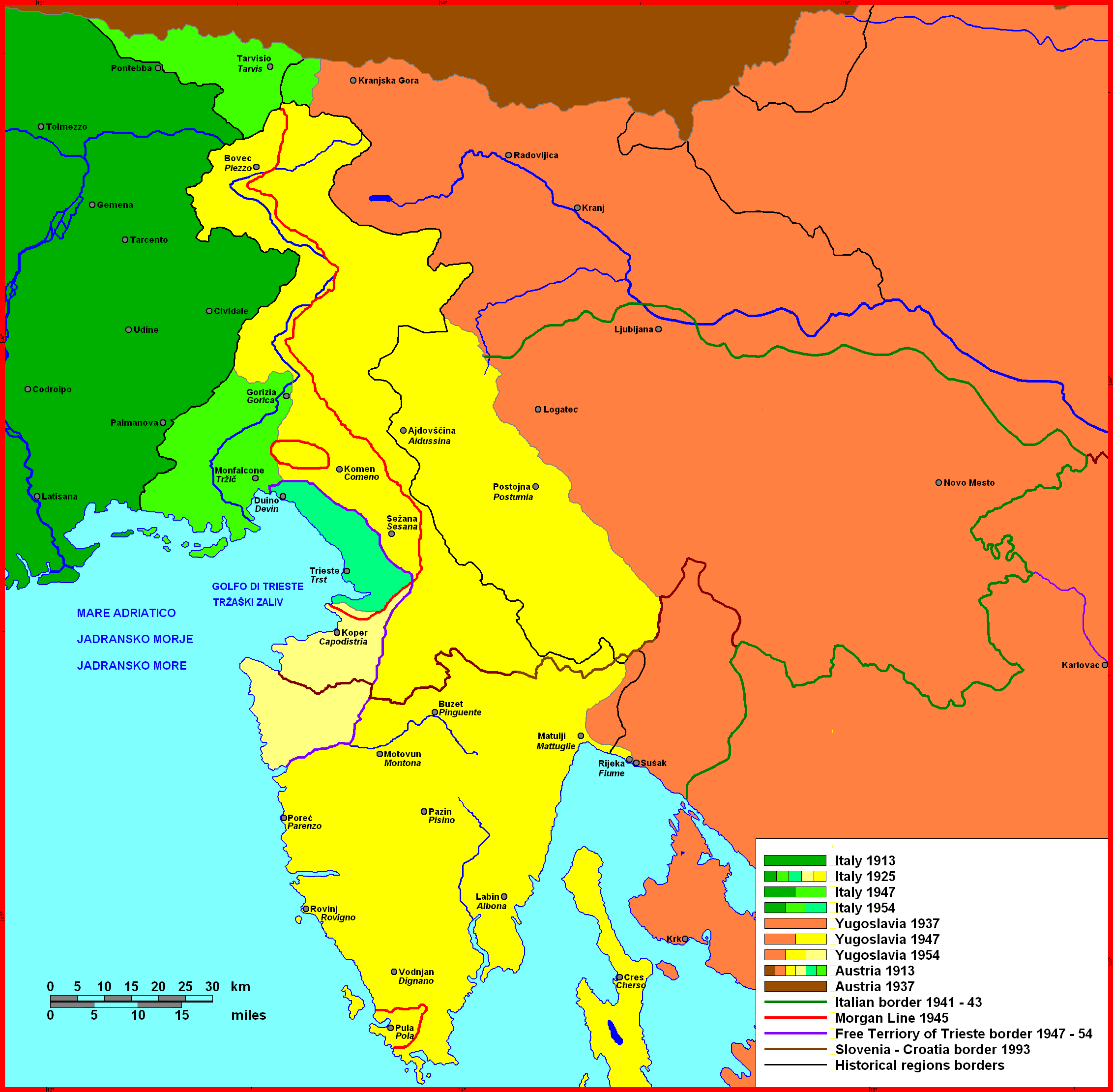
]]
The number of those killed or left in foibe during and after the war is still unknown; it is difficult to establish and a matter of controversy. Estimates range from hundreds to twenty thousand. According to data gathered by a joint Slovene–Italian historical commission established in 1993, "the violence was further manifested in hundreds of summary executions—victims were mostly thrown into the Karst chasms (foibe)—and in the deportation of a great number of soldiers and civilians, who either wasted away or were killed during the deportation".
Historians Raoul Pupo and Roberto Spazzali have estimated the total number of victims at about 5,000, and note that the targets were not "Italians", but military and repressive forces of the Fascist regime, and civilians associated with the regime. More recently, Pupo has revised the total victims estimates to 3,000 to 4,000. Italian historian Guido Rumici estimated the number of Italians executed, or died in Yugoslav concentration camps, as between 6,000 and 11,000, while Mario Pacor estimated that after the armistice about 400 to 500 people were killed in the foibe and about 4,000 were deported, many of whom were later executed. Other sources claim 20,000 victims.
It was not possible to extract all the corpses from the foibe, some of which are deeper than several hundred meters; some sources are attempting to compile lists of locations and possible victim numbers. Between October and December 1943, the fire brigade of Pola, helped by mine workers, recovered a total of 159 victims of the first wave of mass killings from the foibe of Vines (84 bodies), Terli (26 bodies), Treghelizza (2 bodies), Pucicchi (11 bodies), Villa Surani (26 bodies), Cregli (8 bodies) and Carnizza d'Arsia (2 bodies); another 44 corpses were recovered in the same period from two bauxite mines in Lindaro and Villa Bassotti. More bodies were sighted, but not recovered.
The most famous Basovizza foiba, was investigated by English and American forces, starting immediately on 12 June 1945. After 5 months of investigation and digging, all they found in the foiba were the remains of 150 German soldiers and one civilian killed in the final battles for Basovizza on 29–30 April 1945. The Italian mayor, Gianni Bartoli continued with investigations and digging until 1954, with speleologists entering the cave multiple time, yet they found nothing. Between November 1945 and April 1948, firefighters, speleologists and policemen inspected foibe and mine shafts in the "Zone A" of the Free Territory of Trieste (mainly consisting in the surroundings of Trieste), where they recovered 369 corpses; another 95 were recovered from mass graves in the same area. At the time, no inspections were carried out either in the Yugoslav-controlled "Zone B", or in the rest of Istria.
Other foibe and mass graves were investigated in more recently in Istria and elsewhere in Slovenia and Croatia; for instance, human remains were discovered in the Idrijski Log foiba near Idrija, Slovenia, in 1998; four skeletons were found in the foiba of Plahuti near Opatija in 2002; in the same year, a mass grave containing the remains of 52 Italians and 15 Germans, most likely all military, was discovered in Slovenia, not far from Gorizia; in 2005, the remains of about 130 people killed between the 1940s and the 1950s were recovered from four foibe located in northeastern Istria.
Investigations

After the war, inspector Umberto de Giorgi, who was State Police marshal under fascist and Nazi rule, led the Foibe Exploration Team. Between 1945 and 1948 they investigated 71 foibe locations on the Italian side of the border. 23 of these were empty, in the rest they discovered some 464 corpses. These included soldiers killed during the last battles of the war. Among the 246 identified corpses, more than 200 were military (German, Italian, other), and some 40 were civilians, of the latter, 30 killed after the war.
Due to claims of hundreds having been killed and tossed into the Basovizza mineshaft, in August–October 1945 British military authorities investigated the shaft, ultimately recovering 9 German soldiers, 1 civilian and a few horse cadavers. Based on these results the British suspended excavations. Afterwards the city of Trieste used the mineshaft as a garbage dump. Despite repeat demands from various right-wing groups to further excavate the shaft, the government of Trieste, led by the Christian Democratic mayor Gianni Bartoli, declined to do so, claiming among other reasons, lack of financial resources. In 1959 the shaft was sealed and a monument erected, thus becoming the center of the annual foibe commemorations.
Only a few trials were held, including that of the Trieste Zoll-Steffe criminal gang, for the killing of 18 people in the Plutone foibe in May 1945. Afterwards, Yugoslav authorities arrested the gang members and took them to Ljubljana, with two killed along the way while trying to escape, and the others convicted before a military tribunal. Additional members of the gang were brought before an Italian court in Trieste 1947, and were convicted and sentenced to prison for 2–3 years for their role in the Plutone killings.
In 1949 a trial was held in Trieste for those accused of killing Mario Fabian, a torturer in the "Collotti gang", a fascist squad that during the war killed and tortured Slovene and Italian antifascists, and Jews. Fabian was taken from his home on 4 May 1945, then shot and tossed into the Basovizza shaft. He is the only known Italian victim of Basovizza. His executioners were at first condemned, but later acquitted. The historian Pirjevec notes that the head of the gang, Gaetano Collotti, was awarded a medal by the Italian government in 1954, for fighting Slovene partisans in 1943, despite the fact that Collotti and his gang had committed many crimes while working for the Gestapo, and was killed by Italian partisans near Treviso in 1945.
In 1993 a study titled Pola Istria Fiume 1943–1945 by Gaetano La Perna provided a detailed list of the victims of Yugoslav occupation (in September–October 1943 and from 1944 to the very end of the Italian presence in its former provinces) in the area. La Perna gave a list of 6,335 names (2,493 military, 3,842 civilians). The author considered this list "not complete".
A 2002 joint report by Rome's Society of Fiuman studies (Società di Studi Fiumani) and Zagreb's Croatian Institute of History (Hrvatski institut za povijest) concluded that from Fiume and the surrounding area "no less than 500 persons of Italian nationality lost their lives between 3 May 1945 and 31 December 1947. To these we should add an unknown number of 'missing' (not less than a hundred) relegated into anonymity due to missing inventory in the Municipal Registries together with the relevant number of victims having ... Croatian nationality (who were often, at least between 1940 and 1943, Italian citizens) determined after the end of war by the Yugoslav communist regime."
In March 2006, the border municipality of Nova Gorica in Slovenia released a list of names of 1,048 citizens of the Italian city of Gorizia (the two cities belonged until the Treaty of Paris of 1947 to the same administrative body) who disappeared in May 1945 after being arrested by the Partisan 9th Corps. According to the Slovene government, "the list contains the names of persons arrested in May 1945 and whose destiny cannot be determined with certainty or whose death cannot be confirmed".
Alleged motives

It has been alleged that the killings were part of a purge aimed at eliminating potential enemies of communist Yugoslav rule, which would have included members of German and Italian fascist units, Italian officers and civil servants, parts of the Italian elite who opposed both communism and fascism (including the leadership of Italian anti-fascist partisan organizations and the leaders of Fiume's Autonomist Party, including Mario Blasich and Nevio Skull), Slovenian and Croatian anti-communists, collaborators, and radical nationalists.
Pupo claims that the primary targets of the purges were repressive forces of the Fascist regime, and civilians associated with the regime, including Slavic collaborators, thus:*With regard to the civilian population of Venezia Giulia the Yugoslav troops did not behave at all like an army occupying enemy territory: nothing in their actions recalls the indiscriminate violence of Red Army soldiers in Germany, on the contrary, their discipline seems in some ways superior even to that of the Anglo-American units.*Since Yugoslav troops did not behave like an occupying army, this partly contradicts the numerous academic authors and institutional figures — both in Italy and abroad — who recognized an ethnic cleansing against local Italians (Istrian Italians and Dalmatian Italians).
Another reason for the killings was retribution for the years of Italian repression, forced Italianization, suppression of Slavic sentiments and killings performed by Italian authorities during the war, not just in the concentration camps (such as Rab and Gonars), but also in reprisals often undertaken by the fascists.
According to Fogar and Miccoli there is the need to put the episodes in 1943 and 1945 within [the context of] a longer history of abuse and violence, which began with Fascism and with its policy of oppression of the minority Slovenes and Croats and continued with the Italian aggression on Yugoslavia, which culminated with the horrors of the Nazi-Fascist repression against the Partisan movement.
Gaia Baracetti notes that some representations of foibe, such as a miniseries on Italian television, are replete with historical inaccuracies and stereotypes, portraying Slavs as "merciless assassins", similar to fascist propaganda, while "largely ignoring the issue of Italian war crimes". Others, including members of Italy's Jewish community, have objected to Italian right-wing efforts to equate the foibe with the Holocaust, via historical distortions which include exaggerated foibe victim claims, in an attempt to turn Italy from a perpetrator in the Holocaust, to a victim. Other authors assert that the post-war pursuit of the 'truth' of the foibe, as a means of transcending Fascist/Anti-Fascist oppositions and promoting popular patriotism, has not been the preserve of right-wing or neo-Fascist groups. Evocations of the 'Slav other' and of the terrors of the foibe made by state institutions, academics, amateur historians, journalists, and the memorial landscape of everyday life were the backdrop to the post-war renegotiation of Italian national identity.
Pamela Ballinger in her book, History in Exile: Memory and Identity at the Borders of the Balkans, wrote:
An Italian-Slovene commission, namely the Slovenian-Italian historical-cultural commission (), wrote in its 2000 report that the Italian exodus had multiple causes.
The report by the mixed Italian-Slovenian commission describes the circumstances of the 1945 killings as follows:
Following the war the Yugoslav government pursued a policy of "Slav-Italian brotherhood" and Italian workers came to Yugoslavia to help with rebuilding. Relations worsened in 1948 when Yugoslavia broke with Stalin, while the Italian Communist Party supported the Soviet Union. Border disputes, postwar economic deprivations and the initial totalitarian nature of the Yugoslav government, made life difficult for all. All this led to what was until then a limited exodus, to much broader exodus following 1950. The commission was re-established in 2007 with the official name of Mixed Italian-Slovene Commission for the Maintenance of the State Border.
Post-War
The foibe have been a neglected subject in mainstream political debate in Italy, Yugoslavia and former-Yugoslav nations, only recently garnering attention with the publication of several books and historical studies. It is thought that after World War II, while Yugoslav politicians rejected any alleged crime, Italian politicians wanted to direct the country's attention toward the future and away from the idea that Italy was, in fact, a defeated nation.
So, the Italian government tactically "exchanged" the impunity of the Italians accused by Yugoslavia for the renunciation to investigate the foibe massacres. Italy never extradited or prosecuted some 1,200 Italian Army officers, government officials or former Fascist Party members accused of war crimes by Yugoslavia, Ethiopia, Greece and other occupied countries and remitted to the United Nations War Crimes Commission. On the other hand, Belgrade didn't insist overmuch on requesting the prosecution of alleged Italian war criminals.
Re-emergence of the issue
These killings were the beginning of organized against local Italians (Istrian Italians and Dalmatian Italians). Silvio Berlusconi's coalition government brought the issue back into open discussion. The Italian Parliament (with the support of the vast majority of the represented parties) made 10 February National Memorial Day of the Exiles and Foibe, first celebrated in 2005 with exhibitions and observances throughout Italy (especially in Trieste). The occasion is held in memory of innocents killed and forced to leave their homes, with little support from their home country. In Carlo Azeglio Ciampi's words: "Time has come for thoughtful remembrance to take the place of bitter resentment." Moreover, for the first time, leaders from the Italian left, such as Walter Veltroni, visited the Basovizza foiba and admitted the culpability of the Left in covering up the subject for decades.
Nowadays, a large part of the Italian left acknowledges the nature of the foibe massacres, as attested by some declarations of Luigi Malabarba, senator for the Communist Refoundation Party, during the parliamentary debate on the institution of the National Memorial Day:
Italian president Giorgio Napolitano took an official speech during celebration of the "Memorial Day of Foibe Massacres and Istrian-Dalmatian exodus" in which he stated: The Croatian President Stipe Mesić immediately responded in writing, stating that:
The incident was resolved in a few days after diplomatic contacts between the two presidents at the Italian foreign ministry. On 14 February, the Office of the President of Croatia issued a press statement:
In Italy, Law 92 of 30 March 2004 declared 10 February as a Day of Remembrance dedicated to the memory of the victims of Foibe and the Istrian-Dalmatian exodus. The same law created a special medal to be awarded to relatives of the victims: :[[File:366px Ribbon bar medal to the relatives of the victims of foibe killings.svg|100px]] Medal of Day of Remembrance to relatives of victims of foibe killings
In February 2012, a photo of Italian troops killing Slovene civilians was shown on public Italian TV as if being the other way round. When historian Alessandra Kersevan, who was a guest, pointed out to the television host Bruno Vespa that the photo depicted the killings of some Slovenes rather than Italians, the host did not apologize. A diplomatic protest followed.
In the media
- Il Cuore nel Pozzo, a 2005 TV movie focusing on the escape of a group of children from Tito's partisans.
- **, a 2018 film directed by Maximiliano Hernando Bruno and starring Geraldine Chaplin, Sandra Ceccarelli, and Franco Nero.
Note: Many books have been written about the foibe, and results, interpretations and estimates of victims can in some cases vary largely according to the point of view of the author. Since most of the foibe currently lie outside Italian territory, no formal and complete investigation could be carried out during the years of the Cold War, and books could be of a speculative or anecdotal nature. For a complete list, see and .
References
- Siviero, Tommi. (27 December 2022). "Italian Right Stirs Up Grievances About Yugoslavs' WWII 'Foibe Massacres'".
- Zamparutti, Louise. (1 April 2015). "Foibe literature: documentation or victimhood narrative?". Human Remains and Violence.
- Pupo, Raoul. (15 May 2021). "Le foibe giuliane".
- Micol Sarfatti. (11 February 2013). "Perché quasi nessuno ricorda le foibe?".
- Troha, Nevenka. (2014). "Nasilje vojnih in povojnih dni". Inštitut za novejšo zgodovino.
- (10 February 2021). "Foibe, oggi è il Giorno del Ricordo: cos'è e perché si chiama così". [[GEDI Gruppo Editoriale]].
- (20 May 1997). "In Trieste, Investigation of Brutal Era Is Blocked".
- (22 November 2018). "Italy film recalls pain of forgotten WWII massacres".
- ''Il tempo e la storia: Le Foibe'', Rai tv, Raoul Pupo
- Società di Studi Fiumani-Roma, Hrvatski Institut za Povijest-Zagreb ''[http://www.archivi.beniculturali.it/DGA-free/Sussidi/Sussidi_12.pdf Le vittime di nazionalità italiana a Fiume e dintorni (1939–1947)] {{webarchive. link. (31 October 2008). 88-7125-239-X, p. 190. "''Therefore, the largest number of Italians from Rijeka and the former Kvarner province died immediately after the end of the Second World War, were tried before military courts and accused of war crimes"''
- "Le foibe e il confine orientale".
- Siviero, Tommi. (27 December 2022). "Italian Right Stirs Up Grievances About Yugoslavs' WWII 'Foibe Massacres'".
- (15 May 2021). "Saggio di Pupo".
- Società di Studi Fiumani-Roma, Hrvatski Institut za Povijest-Zagreb ''[http://www.archivi.beniculturali.it/DGA-free/Sussidi/Sussidi_12.pdf Le vittime di nazionalità italiana a Fiume e dintorni (1939–1947)] {{webarchive. link. (31 October 2008). 88-7125-239-X, p. 190. "''Therefore, the largest number of Italians from Rijeka and the former Kvarner province died immediately after the end of the Second World War, were tried before military courts and accused of war crimes"''
- "Le foibe e il confine orientale".
- (20 April 1997). "In Trieste, Investigation of Brutal Era Is Blocked". [[The New York Times]].
- Boscarol, Francesco. (10 February 2019). "'Foibe, fascisti e comunisti: vi spiego il Giorno del ricordo': parla lo storico Raoul Pupo [Interviste]".
- Iggers, Georg G.. (2007). "The Many Faces of Clio: cross-cultural Approaches to Historiography, Essays in Honor of Georg G. Iggers". Berghahn Books.
- (10 February 2014). "Il Giorno del Ricordo".
- (5 February 2019). "L'esodo giuliano-dalmata e quegli italiani in fuga che nacquero due volte".
- {{lang. de. Ingo Haar, "Herausforderung Bevölkerung: zu Entwicklungen des modernen Denkens über die Bevölkerung vor, im und nach dem Dritten Reich". ''"Bevölkerungsbilanzen" und "Vertreibungsverluste". Zur Wissenschaftsgeschichte der deutschen Opferangaben aus Flucht und Vertreibung'', Verlag für Sozialwissenschaften 2007. 978-3-531-15556-2, p. 278 {{in lang. de
- The [[Deutsches Historisches Museum. German Historical Museum]] puts the figure at 600,000, maintaining that the figure of 2 million deaths in the previous government studies cannot be supported.[http://www.dhm.de/lemo/html/wk2/kriegsverlauf/massenflucht Die Flucht der deutschen Bevölkerung 1944/45], dhm.de; accessed 6 December 2014.{{in lang. de
- Kammerer, Willi. "Narben bleiben die Arbeit der Suchdienste — 60 Jahre nach dem Zweiten Weltkrieg". Berlin Dienststelle 2005}}the foreword to the book was written by German President {{lang.
- {{lang. de. Christoph Bergner, Secretary of State in [[Germany]]'s Bureau for Inner Affairs, [https://web.archive.org/web/20080210034644/http://www.dradio.de/dlf/sendungen/kulturheute/569560 outlines the stance of the respective governmental institutions] in {{lang. de. [[Deutschlandfunk]] on 29 November 2006,
- [http://www.bpb.de/geschichte/nationalsozialismus/dossier-nationalsozialismus/39587/die-vertreibung-der-deutschen "Bundeszentrale für politische Bildung, Die Vertreibung der Deutschen aus den Gebieten jenseits von Oder und Neiße"], bpb.de; accessed 6 December 2014.{{in lang. de
- Other photos from the footage can be seen in Giorgio Pisanò, ''Storia della Guerra Civile in Italia 1943–1945'', Milan, FPE, 1965
- [[Theodor Mommsen]] in his book "The Provinces of the Roman Empire"
- Theodore Mommsen. ''The Provinces of the Roman Empire''.Chapter I.
- "Demography and the Origins of the Yugoslav Civil War".
- Bartolj, Jaka. "The Olive Grove Revolution".
- [http://xoomer.virgilio.it/arupinum/menuistrioto.html Istrioto, the indigenous language of southern Istria (in Italian)] xoomer.virgilio.it{{deadlink. (December 2024)
- Alvise Zorzi, ''La Repubblica del Leone. Storia di Venezia'', Milano, Bompiani, 2001, ISBN 978-88-452-9136-4., pp. 53–55 (in italian)
- Sethre, Janet. (2003). "The Souls of Venice". McFarland.
- (November 2023). "Historic overview-more details". [[Istria County]]}}{{Dead link.
- John Mason Neale, [https://archive.org/details/notese00neal/page/76 ''Notes Ecclesiological & Picturesque on Dalmatia, Croatia, Istria, Styria, with a visit to Montenegro''], pg. 76, J.T. Hayes – London (1861)
- "Dalmatia history".
- Hammel, E. A.. (February 1993). "Demography and the Origins of the Yugoslav Civil War". Anthropology Today.
- "Region of Istria: Historic overview-more details".
- Bartolj, Jaka. "The Olive Grove Revolution".
- "Italian islands in a Slavic sea". Arrigo Petacco, Konrad Eisenbichler, ''A tragedy revealed'', p. 9.
- [http://www.istrianet.org/istria/illustri/index.htm Prominent Istrians] www.istrianet.org
- ""L'Adriatico orientale e la sterile ricerca delle nazionalità delle persone" di Kristijan Knez; La Voce del Popolo (quotidiano di Fiume) del 2/10/2002".
- (7 March 2016). "L'ottocento austriaco".
- "Trieste, Istria, Fiume e Dalmazia: una terra contesa".
- ''Die Protokolle des Österreichischen Ministerrates 1848/1867. V Abteilung: Die Ministerien Rainer und Mensdorff. VI Abteilung: Das Ministerium Belcredi'', Wien, Österreichischer Bundesverlag für Unterricht, Wissenschaft und Kunst 1971
- ''Die Protokolle des Österreichischen Ministerrates 1848/1867. V Abteilung: Die Ministerien Rainer und Mensdorff. VI Abteilung: Das Ministerium Belcredi'', Wien, Österreichischer Bundesverlag für Unterricht, Wissenschaft und Kunst 1971, vol. 2, p. 297. Citazione completa della fonte e traduzione in Luciano Monzali, ''Italiani di Dalmazia. Dal Risorgimento alla Grande Guerra'', Le Lettere, Firenze 2004, p. 69.
- (1993). "Homo scribens: Perspektiven der Schriftlichkeitsforschung". Walter de Gruyter.
- (1970). "Dalmazia". [[Treccani]].
- "Istrian Spring".
- {{Cite EB1911
- (1970). "Dalmazia". [[Treccani]].
- Deranez, Raimondo. (1919). "Particolari del martirio della Dalmazia". Stabilimento Tipografico dell'Ordine.
- Angelo Filipuzzi. (1966). "La campagna del 1866 nei documenti militari austriaci: operazioni terrestri". [[University of Padova]].
- "Spezialortsrepertorium der österreichischen Länder I-XII, Wien, 1915–1919".
- "Spezialortsrepertorium der österreichischen Länder I-XII, Wien, 1915–1919".
- "Croatian Bureau of Statistics".
- Perselli, Guerrino. (1993). "I censimenti della popolazione dell'Istria, con Fiume e Trieste e di alcune città della Dalmazia tra il 1850 e il 1936". Centro di Ricerche Storiche - Rovigno, Unione Italiana - Fiume, Università Popolare di Trieste, Trieste-Rovigno.
- "Beč kao magnet".
- Stenographische Protokolle über die Sitzungen des Hauses der Abgeordneten des österreichischen Reichsrates, Ausgaben 318–329, [https://books.google.com/books?ei=R2vYT6XNK8vP4QTwtdilAw&hl=de&id=AlAyAQAAMAAJ&dq=Keglevich Seite 29187], Austria, Reichsrat, Abgeordnetenhaus, published 1905.
- (1970). "Dalmazia". [[Treccani]].
- "First World War.com – Primary Documents – Italian Entry into the War, 23 May 1915".
- "First World War.com – Primary Documents – Treaty of London, 26 April 1915".
- Giuseppe Praga, Franco Luxardo. ''History of Dalmatia''. Giardini, 1993. Pp. 281.
- Paul O'Brien. ''Mussolini in the First World War: the Journalist, the Soldier, the Fascist''. Oxford, England, UK; New York, New York, USA: Berg, 2005. Pp. 17.
- A. Rossi. ''The Rise of Italian Fascism: 1918–1922''. New York, New York, USA: Routledge, 2010. Pp. 47.
- Hehn, Paul N.. (26 September 2005). "A Low, Dishonest Decade: The Great Powers, Eastern Europe and the Economic Origins of World War II". A&C Black.
- "Dossier: Islam in Europe, European Islam".
- "Contro Operazione Foibe" di Giorgio Rustia
- (10 February 2013). "Trieste, quando erano gli italiani a fare pulizia etnica".
- [http://razor.arnes.si/~mkralj/istra-history/e-periodtotal.html A Historical Outline Of Istria] {{webarchive. link. (11 January 2008 , razor.arnes.si. accessed 30 December 2015.)
- "Italiani di Dalmazia: 1919–1924" di Luciano Monzali
- "Il primo esodo dei Dalmati: 1870, 1880 e 1920 – Secolo Trentino".
- "Partenze da Zara".
- Dizdar, Zdravko. (15 December 2005). "Italian Policies Toward Croatians In Occupied Territories During The Second World War". Review of Croatian History.
- Knittel, Susanne C.. (15 December 2014). "The Historical Uncanny: Disability, Ethnicity, and the Politics of Holocaust Memory". Fordham Univ Press.
- Cernigoi, Claudia. (2018). ""Operazione Plutone": le inchieste sulle foibe triestine". Kappa Vu.
- "Il Piccolo".
- [https://web.archive.org/web/20081031131611/http://www.archivi.beniculturali.it/DGA-free/Sussidi/Sussidi_12.pdf Le vittime di nazionalità italiana a Fiume e dintorni (1939–1947)] www.archivi.beniculturali.it
- Markham, James M.. (6 June 1987). "Election Opens Old Wounds in Trieste". [[The New York Times]].
- Ballinger, Pamela. (7 April 2009). "Genocide: Truth, Memory, and Representation". Duke University Press.
- Tesser, Lynn. (2013). "Ethnic Cleansing and the European Union". Springer.
- Ballinger, Pamela. (2003). "History in Exile: Memory and Identity at the Borders of the Balkans". Princeton University Press.
- Anna C. Bramwell. (1988). "Refugees in the Age of Total War". University of Oxford Press.
- "Državni Zavod za Statistiku".
- "Popis 2002".
- "Državni Zavod za Statistiku".
- "Popis 2002".
- "Central Bureau of Statistics".
- "Central Bureau of Statistics".
- "STANOVNIŠTVO PREMA NACIONALNOJ, ODNOSNO ETNIČKOJ PRIPADNOSTI PO OPŠTINAMA".
- Jahn, Jens-Eberhard. (1999). "The political, ethnic and linguistic borders of the upper Adriatic after the dissolution of Yugoslavia". Poznań Studies in Contemporary Linguistics.
- [https://groups.google.com/group/free.it.discussioni.istria.fiume.dalmazia/browse_thread/thread/b4942420981e6c9b?hl=it Government use of the Italian language in Rijeka] groups.google.com
- "SAS Output". dzs.hr.
- "Comunità Nazionale Italiana, Unione Italiana".
- "LA LINGUA ITALIANA E LE SCUOLE ITALIANE NEL TERRITORIO ISTRIANO".
- "Byron: the first language school in Istria".
- [https://groups.google.com/group/free.it.discussioni.istria.fiume.dalmazia/msg/d51366dd1c197047 Reazioni scandalizzate per il rifiuto governativo croato ad autorizzare un asilo italiano a Zara] groups.google.com
- [http://www.anvgd.it/index.php?option=com_content&task=view&id=4451&Itemid=111 Zara: ok all'apertura dell'asilo italiano] www.anvgd.it
- [http://ilpiccolo.gelocal.it/trieste/cronaca/2013/10/13/news/aperto-pinocchio-primo-asilo-italiano-nella-citta-di-zara-1.7911897 Aperto “Pinocchio”, primo asilo italiano nella città di Zara] ilpiccolo.gelocal.it
- "L'italiano con modello C a breve in una scuola di Zara".
- "Elenco delle foibe note". Digilander.libero.it.
- Tommaso, Vincenzo De. (11 May 2008). "Foibe: revisionismo di Stato e amnesie della Repubblica: atti del Convegno "Foibe, la verità, contro il revisionismo storico" : Sesto San Giovanni (Mi), 9 febbraio 2008". Associazione Culturale CdP.
- [http://www.nonluoghi.info/2015/02/foibe-bilancio-e-reinterpretazione/ Foibe, bilancio e rilettura], nonluoghi.info, February 2015; accessed 17 March 2016.
- "Jože Pirjevec: Dobri divjaki so postali nevarni barbari".
- [http://ricerca.gelocal.it/ilpiccolo/archivio/ilpiccolo/2005/02/19/IS_09_FINI.html?refresh_ce Sono 130 i corpi riemersi da quattro foibe istriane], gelocal.it; accessed 17 March 2016.{{in lang. it
- "Il Piccolo 27".
- "Foibe: notizie varie.".
- "Archivio Corriere della Sera".
- (3 June 2011). "Alla foiba di Montenero d'Idria".
- Cernigoi, Claudia. (June 2014). "Il rapporto dell'ispettore de Giorgi sulle "foibe", 10 febbraio 1947".
- (2009). "Foibe: una storia d'Italia". G. Einaudi.
- Dato, Gaetano. (2013). "Foiba of Basovizza: the Pit, the Monument, the Memory, and the Unknown Victim. 1945–1965.". Časopis za povijest Zapadne Hrvatske.
- Cernigoi, Claudia. (2018). ""Operazione Plutone": le inchieste sulle foibe triestine". Kappa Vu.
- "La regina di "Villa Triste" L'ebrea sopravvissuta alle torture".
- Gaetano La Perna, ''Pola Istria Fiume 1943–1945'', Mursia, 1993
- Gaetano La Perna, ''Pola Istria Fiume 1943–1945'', Mursia, 1993, p. 452
- p. 95: ''"Si può comunque affermare con assoluta certezza che a Fiume, per mano di militari e della polizia segreta (OZNA prima e UDBA poi), ... non meno di 500 persone di nazionalità italiana persero la vita fra il 3 maggio (1945) e il 31 dicembre 1947. A questi dovremmo aggiungere un numero imprecisato di di "scomparsi" (non meno di un centinaio) che il mancato controllo nominativo nell'anagrafe storica comunale ci costringe a relegare nell'anonimato insieme al consistente numero, ... , di vittime di nazionalità croata (che spesso ebbero, almeno tra il 1940 e il 1943, anche la cittadinanza italiana) determinate a guerra finita dal regime comunista jugoslavo.".'' [http://www.archivi.beniculturali.it/DGA-free/Sussidi/Sussidi_12.pdf Pubblicazioni Degli Archivi Di Stat O Sussidi 12] {{webarchive. link. (31 October 2008 Le vittime di nazionalità italiana a Fiume e dintorni (1939–1947)- Žrtve talijanske nacionalnosti u Rijeci i okolici (1939–1947))
- [http://digilander.libero.it/lefoibe/deportati_gorizia.pdf L’Elenco Dei Mille Deportati In Slovenia Nel 1945 – marzo 2006], libero.it, March 2006.
- (8 March 2006). "Clarification of the Ministry of Foreign Affairs of the Republic of Slovenia relating to the names of deportees in 1945". [[Ministry of Foreign Affairs (Slovenia).
- Gian Luigi Falabrino. "Il punto sulle foibe e sulle deportazioni nelle regioni orientali (1943–45)".
- Ghiglione, Giorgio. (19 October 2021). "Mussolini's Heirs Equate World War II Killings of Italians With the Holocaust".
- (1999). "Italian fascism: history, memory, and representation". Palgrave Macmillan.
- Ballinger, Pamela. "History in Exile: Memory and Identity at the Borders of the Balkans". Press.princeton.edu.
- (2007). ["Poročilo slovensko – italijanske zgodovinsko – kulturne komisije The Report of the Slovene-Italian Historical-Cultural Commission".
- "Articolo su un sito dell'A.N.P.I.".
- Marco Ottanelli. "La verità sulle foibe".
- Crimini di Guerra. "La mancata estradizione e l'impunità dei presunti criminali di guerra italiani accusati per stragi in Africa e in Europa".
- (10 January 2014). "La questione dei crimini di guerra italiani nei Balcani".
- Luigi Malabarba. (11 March 2004). "Declaration of Vote".
- Presidenza della Repubblica, Giorgio Napolitano, official speech for the celebration of "Giorno del Ricordo" Quirinal on 10 February 2007 [http://www.quirinale.it/elementi/Continua.aspx?tipo=Discorso&key=930 integral text from official website of the Italian President Bureau]
- Napolitano, Giorgio. (10 February 2007). "Official speech for the celebration of "Giorno del Ricordo"". Presidency of the Italian Republic.
- Fraser, Christian. (14 February 2007). "Italy-Croatia WWII massacre spat". BBC News.
- (13 February 2007). "Article". International Herald Tribune.
- (17 February 2007). "Article". la Repubblica.
- "LEGGE 30 marzo 2004, n. 92".
- (15 February 2012). "Article". [[RTV Slovenia]].
- [http://www.rai.tv/dl/RaiTV/programmi/media/ContentItem-1784a3df-aa07-4bcd-a5ab-1be49cfa2899.html?refresh_ce#p=0 Il giorno del ricordo – Porta a Porta], from Rai website; accessed 26 September 2015.
This article was imported from Wikipedia and is available under the Creative Commons Attribution-ShareAlike 4.0 License. Content has been adapted to SurfDoc format. Original contributors can be found on the article history page.
Ask Mako anything about Foibe massacres — get instant answers, deeper analysis, and related topics.
Research with MakoFree with your Surf account
Create a free account to save articles, ask Mako questions, and organize your research.
Sign up freeThis content may have been generated or modified by AI. CloudSurf Software LLC is not responsible for the accuracy, completeness, or reliability of AI-generated content. Always verify important information from primary sources.
Report