From Surf Wiki (app.surf) — the open knowledge base
Flyting
Exchange of insults in the form of verse
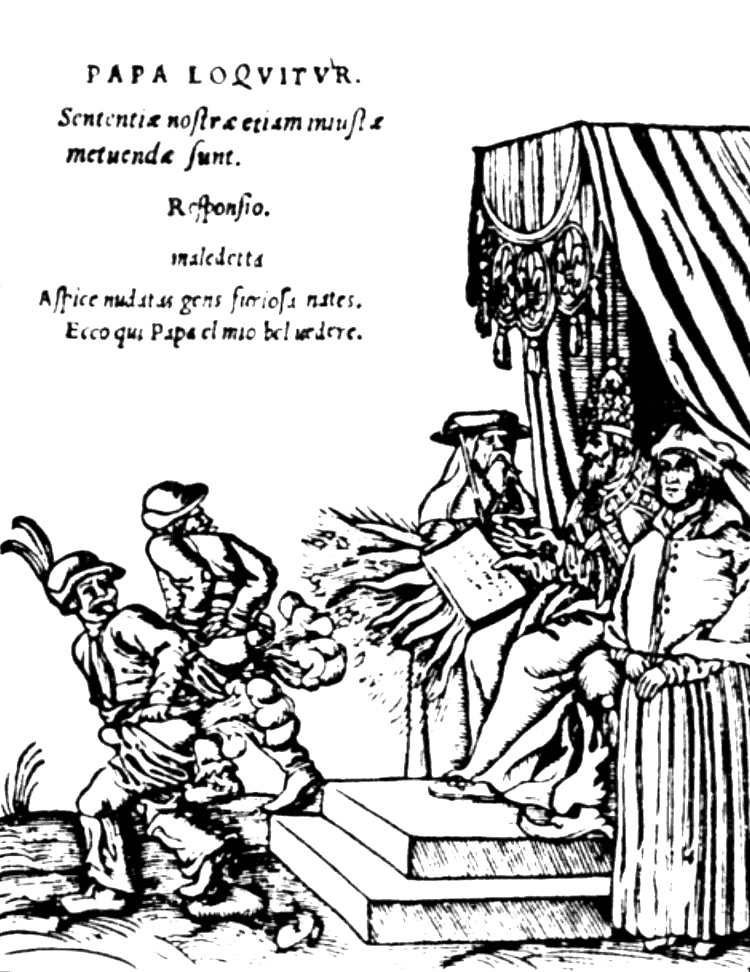
Exchange of insults in the form of verse
Flyting or fliting (Classical Gaelic: immarbág, , "counter-boasting") is a contest consisting of the exchange of insults between two parties, often conducted in verse.
Etymology
The word flyting comes from the Old English verb flītan meaning 'to quarrel', made into a gerund with the suffix -ing. Attested from around 1200 in the general sense of a verbal quarrel, it is first found as a technical literary term in Scotland in the sixteenth century. The first written Scots example is William Dunbar, The Flyting of Dunbar and Kennedie, written in the late fifteenth century.
Description
it was with thy sister thou hadst such a son hardly worse than thyself.
Royatouslie, lyke ane rude rubatour Ay fukkand lyke ane furious fornicatour
Thersites: The plague of Greece upon thee, thou mongrel beef-witted lord! Flyting is a ritual, poetic exchange of insults practiced mainly between the 5th and 16th centuries. Examples of flyting are found throughout Scots, Ancient, Medieval and Modern Celtic, Old English, Middle English and Norse literature involving both historical and mythological figures. The exchanges would become extremely provocative, often involving accusations of cowardice or sexual perversion.
Norse literature contains stories of the gods flyting. For example, in Lokasenna the god Loki insults the other gods in the hall of Ægir. In the poem Hárbarðsljóð, Hárbarðr (generally considered to be Odin in disguise) engages in flyting with Thor.
In the confrontation of Beowulf and Unferð in the poem Beowulf, flytings were used as either a prelude to battle or as a form of combat in their own right.
In Anglo-Saxon England, flyting would take place in a feasting hall. The winner would be decided by the reactions of those watching the exchange. The winner would drink a large cup of beer or mead in victory, then invite the loser to drink as well.
The 13th-century poem The Owl and the Nightingale and Geoffrey Chaucer's Parlement of Foules contain elements of flyting.
Flyting became public entertainment in Scotland in the 15th and 16th centuries, when makars would engage in verbal contests of provocative, often sexual and scatological but highly poetic abuse. Flyting was permitted despite the fact that the penalty for profanities in public was a fine of 20 shillings (over £300 in prices) for a lord, or a whipping for a servant. James IV and James V encouraged "court flyting" between poets for their entertainment and occasionally engaged with them. The Flyting of Dumbar and Kennedie records a contest between William Dunbar and Walter Kennedy in front of James IV, which includes the earliest recorded use of the word shit as a personal insult. In 1536 the poet Sir David Lyndsay composed a ribald 60-line flyte to James V after the King demanded a response to a flyte.
Flytings appear in several of William Shakespeare's plays. Margaret Galway analysed 13 comic flytings and several other ritual exchanges in the tragedies. Flytings also appear in Nicholas Udall's Ralph Roister Doister and John Still's Gammer Gurton's Needle from the same era.
While flyting died out in Scottish writing after the Middle Ages, it continued for writers of Celtic background. Robert Burns parodied flyting in his poem, "To a Louse", and James Joyce's poem "The Holy Office" is a curse upon society by a bard. Joyce played with the traditional two-character exchange by making one of the characters representing society as a whole.
Similar practices
Hilary Mackie has detected in the Iliad a consistent differentiation between representations in Greek of Achaean and Trojan speech, where Achaeans repeatedly engage in public, ritualized abuse: "Achaeans are proficient at blame, while Trojans perform praise poetry."
Taunting songs are present in the Inuit culture, among many others. Flyting can also be found in Arabic poetry in a popular form called naqā’iḍ, as well as the competitive verses of Japanese Haikai.
Echoes of the genre continue into modern poetry. Hugh MacDiarmid's poem A Drunk Man Looks at the Thistle, for example, has many passages of flyting in which the poet's opponent is, in effect, the rest of humanity.
Flyting is similar in both form and function to the modern practice of freestyle battles between rappers and the historic practice of the Dozens, a verbal-combat game representing a synthesis of flyting and its Early Modern English descendants with comparable African verbal-combat games such as Ikocha Nkocha.
In the Finnish epic Kalevala, the hero Väinämöinen uses the similar practice of kilpalaulanta (duel singing) to defeat his opponent Joukahainen.
Notes
References
- "Nicht Bapst: nicht schreck uns mit deim ban, Und sey nicht so zorniger man. Wir thun sonst ein gegen wehre, Und zeigen dirs Bel vedere"
- Edwards Jr, Mark U.. (2004-11-19). "Luther's Last Battles: Politics and Polemics 1531-46". Fortress Press.
- Vivian Mercier. (1962). "The Irish Comic Tradition". [[Oxford University Press]].
- Parks, Ward. (1986). "Flyting, Sounding, Debate: Three Verbal Contest Genres". Poetics Today.
- {{Cite OED. Fliting. 71711
- "Dictionaries of the Scots Language:: DOST :: flyting".
- (1979). "The Poems of William Dunbar".
- "Flyting | Scottish verbal contest | Britannica".
- Sayers, William. (1991). "Serial Defamation in Two Medieval Tales: The Icelandic Ölkofra Þáttr and The Irish Scéla Mucce Meic Dathó". Oral Tradition.
- Byock, Jesse. (1983). "Feud in the Icelandic Saga". University of California Press.
- Clover, Carol J.. (1980). "The Germanic Context of the Unferþ Episode". Speculum.
- ''Quaestio: selected proceedings of the Cambridge Colloquium in Anglo-Saxon, Norse, and Celtic'' Volumes 2–3, pp. 43–44, University of Cambridge, 2001.{{ISBN?
- Geoffrey Hughes. (2006). "An encyclopedia of swearing : the social history of oaths, profanity, foul language, and ethnic slurs in the English-speaking world". M.E. Sharpe.
- Galway, Margaret. (1935). "Flyting in Shakspere's Comedies". The Shakespeare Association Bulletin.
- "flyting." ''Merriam Webster's Encyclopedia of Literature''. Springfield, MA: Merriam-Webster, 1995. ''Literature Resource Center''.
- Mackie, Hilary Susan. (1996). "Talking Trojan: Speech and Community in the Iliad". Rowmann & Littlefield.
- Mackie 1996:83.
- Johnson, Simon. (2008-12-28). "Rap music originated in medieval Scottish pubs, claims American professor". Telegraph Media Group.
This article was imported from Wikipedia and is available under the Creative Commons Attribution-ShareAlike 4.0 License. Content has been adapted to SurfDoc format. Original contributors can be found on the article history page.
Ask Mako anything about Flyting — get instant answers, deeper analysis, and related topics.
Research with MakoFree with your Surf account
Create a free account to save articles, ask Mako questions, and organize your research.
Sign up freeThis content may have been generated or modified by AI. CloudSurf Software LLC is not responsible for the accuracy, completeness, or reliability of AI-generated content. Always verify important information from primary sources.
Report