From Surf Wiki (app.surf) — the open knowledge base
Fluoroform
| NFPA-H = 2 | NFPA-F = 0 | NFPA-R = 0 | NFPA-S =
Fluoroform, or trifluoromethane, is the chemical compound with the formula . It is a hydrofluorocarbon as well as being a part of the haloforms, a class of compounds with the formula (X = halogen) with C3v symmetry. Fluoroform is used in diverse applications in organic synthesis. It is not an ozone depleter but is a greenhouse gas.
Synthesis
About 20 million kg per year are produced industrially as both a by-product of and precursor to the manufacture of Teflon. :
It is also generated biologically in small amounts apparently by decarboxylation of trifluoroacetic acid.
Historical
Fluoroform was first obtained by Maurice Meslans in the violent reaction of iodoform with dry silver fluoride in 1894.{{cite journal|title = Recherches sur quelques fluorures organiques de la série grasse|author = Meslans M. M.
Industrial applications
is used in the semiconductor industry in plasma etching of silicon oxide and silicon nitride. Known as R-23 or HFC-23, it was also a useful refrigerant, sometimes as a replacement for chlorotrifluoromethane (CFC-13) and is a byproduct of its manufacture.
When used as a fire suppressant, the fluoroform carries the DuPont trade name, FE-13. is recommended for this application because of its low toxicity, its low reactivity, and its high density. HFC-23 has been used in the past as a replacement for Halon 1301(CFC-13B1) in fire suppression systems as a total flooding gaseous fire suppression agent.
Organic chemistry
Fluoroform is weakly acidic with a pKa = 25–28 and quite inert. Attempted deprotonation results in defluorination to generate and difluorocarbene (). Some organocopper and organocadmium compounds have been developed as trifluoromethylation reagents.
Fluoroform is a precursor of the Ruppert-Prakash reagent , which is a source of the nucleophilic anion.
Greenhouse gas
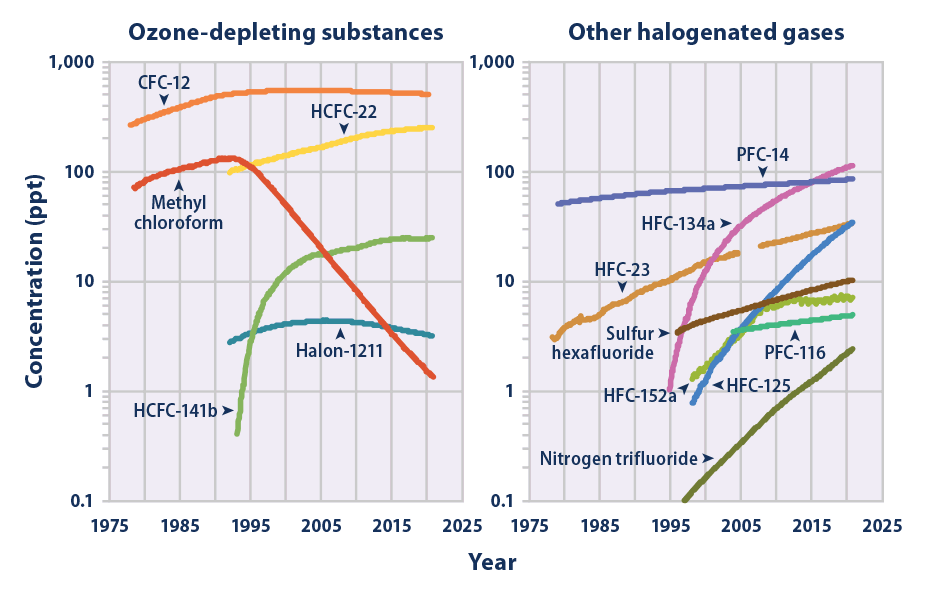
is a potent greenhouse gas. A ton of HFC-23 in the atmosphere has the same effect as 11,700 tons of carbon dioxide. This equivalency, also called a 100-yr global warming potential, is slightly larger at 14,800 for HFC-23. The atmospheric lifetime is 270 years.
HFC-23 was the most abundant HFC in the global atmosphere until around 2001, when the global mean concentration of HFC-134a (1,1,1,2-tetrafluoroethane), the chemical now used extensively in automobile air conditioners, surpassed those of HFC-23. Global emissions of HFC-23 have in the past been dominated by the inadvertent production and release during the manufacture of the refrigerant HCFC-22 (chlorodifluoromethane).
Substantial decreases in HFC-23 emissions by developed countries were reported from the 1990s to the 2000s: from 6-8 Gg/yr in the 1990s to 2.8 Gg/yr in 2007.
However, research in 2024 strongly indicates that the HFC-23 emission decrease is much less than has been reported and does not meet the internationally agreed Kigali Amendment of 2020.
The UNFCCC Clean Development Mechanism provided funding and facilitated the destruction of HFC-23.
Developing countries have become the largest producers of HCFC-23 in recent years according to data compiled by the Ozone Secretariat of the World Meteorological Organization. Emissions of all HFCs are included in the UNFCCCs Kyoto Protocol. To mitigate its impact, can be destroyed with electric plasma arc technologies or by high temperature incineration.{{cite journal|author=Han, Wenfeng|author2=Li, Ying|author3=Tang, Haodong|author4=Liu, Huazhang
Additional physical properties
| Property | Value |
|---|---|
| Density (ρ) at -100 °C (liquid) | 1.52 g/cm3 |
| Density (ρ) at -82.1 °C (liquid) | 1.431 g/cm3 |
| Density (ρ) at -82.1 °C (gas) | 4.57 kg/m3 |
| Density (ρ) at 0 °C (gas) | 2.86 kg/m3 |
| Density (ρ) at 15 °C (gas) | 2.99 kg/m3 |
| Dipole moment | 1.649 D |
| Critical pressure (pc) | 4.816 MPa (48.16 bar) |
| Critical temperature (Tc) | 25.7 °C (299 K) |
| Critical density (ρc) | 7.52 mol/l |
| Compressibility factor (Z) | 0.9913 |
| Acentric factor (ω) | 0.26414 |
| Viscosity (η) at 25 °C | 14.4 μPa.s (0.0144 cP) |
| Molar specific heat at constant volume (CV) | 51.577 J.mol−1.K−1 |
| Latent heat of vaporization (lb) | 257.91 kJ.kg−1 |
References
Literature
References
- GHS: [https://gestis.dguv.de/data?name=038260 GESTIS 038260]
- ShivaKumar Kyasa. (2015). "Fluoroform (CHF3)". Synlett.
- G. Siegemund. (2005). "Fluorine Compounds, Organic".
- Kirschner, E., Chemical and Engineering News 1994, 8.
- Henne A. L.. (1937). "Fluoroform". [[Journal of the American Chemical Society]].
- (2011-12-28). "Direct Cupration of Fluoroform". Journal of the American Chemical Society.
- Rozen, S.; Hagooly, A. "Fluoroform" in Encyclopedia of Reagents for Organic Synthesis (Ed: L. Paquette) 2004, J. Wiley & Sons, New York. {{doi. 10.1002/047084289X.rn00522
- (2012-12-07). "Taming of Fluoroform: Direct Nucleophilic Trifluoromethylation of Si, B, S, and C Centers". Science.
- Forster, P.. (2007). "Changes in Atmospheric Constituents and in Radiative Forcing.".
- (2010). "Recent increases in global HFC-23 emissions". Geophysical Research Letters.
- Cuff, Madeleine. (3 Jan 2025). "Global treaty is failing to curb ultra-potent greenhouse gas emissions".
- (2024-12-21). "Emissions of HFC-23 do not reflect commitments made under the Kigali Amendment". Communications Earth & Environment.
- "Data Access Centre".
- [https://www.nytimes.com/2012/08/09/world/asia/incentive-to-slow-climate-change-drives-output-of-harmful-gases.html ''Profits on Carbon Credits Drive Output of a Harmful Gas''] August 8, 2012 New York Times
- [https://www.nytimes.com/interactive/2012/08/09/world/subsidies-for-a-global-warming-gas.html ''Subsidies for a Global Warming Gas'']
This article was imported from Wikipedia and is available under the Creative Commons Attribution-ShareAlike 4.0 License. Content has been adapted to SurfDoc format. Original contributors can be found on the article history page.
Ask Mako anything about Fluoroform — get instant answers, deeper analysis, and related topics.
Research with MakoFree with your Surf account
Create a free account to save articles, ask Mako questions, and organize your research.
Sign up freeThis content may have been generated or modified by AI. CloudSurf Software LLC is not responsible for the accuracy, completeness, or reliability of AI-generated content. Always verify important information from primary sources.
Report