From Surf Wiki (app.surf) — the open knowledge base
Flower child
1960s neologism associated with Hippies
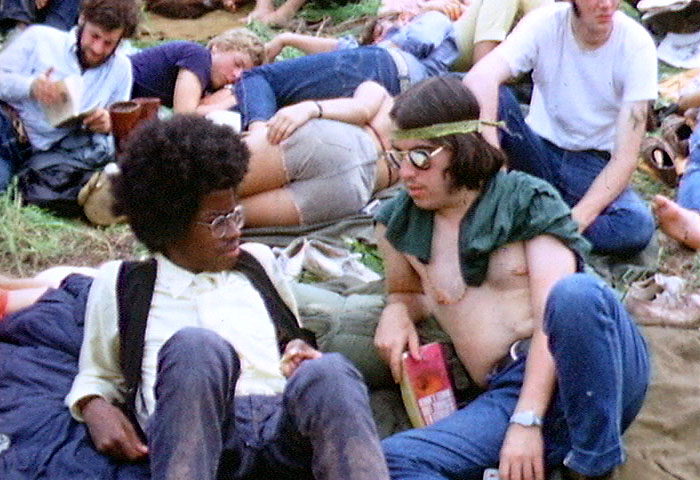
1960s neologism associated with Hippies
Flower child is a term coined by Californian disc jockey Lord Tim Hudson who stated "Anyone aged between 15 and 30 is a flower child". The term was later adopted by Sky Saxon of American rock band the Seeds who were managed by Hudson. He persuaded the band to write songs such as "March of the Flower Children" on their album Future (1967). The term "flower child" was then applied broadly to the hippie subculture by the mass media. It was the custom of "flower children" to wear and distribute flowers or floral-themed decorations to symbolize ideals of universal belonging, peace, and love. Flower children were also associated with the flower power political movement, which originated in ideas written by Allen Ginsberg in 1965.
Etymology
According to Shindig! magazine, the term "flower child" was coined by Californian DJ Lord Tim Hudson in 1967. Hudson stated "Anyone aged between 15 and 30 is a flower child". The term was later adopted by musician Sky Saxon of American rock band the Seeds who were managed by Hudson. He persuaded the band to write songs such as "March of the Flower Children" on their album Future (1967). At the time, Hudson claimed to have invented the term "flower power" as well and later stated "Seed music is the original Flower Power music".
History
In 1965, American Beat poet Allen Ginsberg advocated the giving of flowers as a means of peaceful protest. Images of flower-wielding protesters at the 1967 Pentagon March, such as Marc Riboud's image of Jan Rose Kasmir titled The Ultimate Confrontation: The Flower and the Bayonet and Bernie Boston's Pulitzer Prize–nominated photograph Flower Power, popularized the association of flowers with the counterculture movement of the 1960s. Hippies embraced the symbolism by dressing in clothing with embroidered flowers and vibrant colors, wearing flowers in their hair, and distributing flowers to the public, becoming known as flower children.
San Francisco
John Phillips of The Mamas & the Papas wrote the song "San Francisco (Be Sure to Wear Flowers in Your Hair)" for his friend Scott McKenzie to promote the Monterey Pop Festival that Phillips was helping to organize. Released on May 13, 1967, the song's lyrics urged visitors to San Francisco to "wear some flowers in your hair", in keeping with the festival's billing as "three days of music, love, and flowers". The song was a popular hit, reaching number 4 on the music chart in the United States and number 1 in the United Kingdom and most of Europe, and became an unofficial anthem for hippies, flower power and the flower child concept.
Summer of Love
Main article: Summer of Love
After the January 14, 1967 Human Be-In organized by artist Michael Bowen (among other things, announcements told participants to bring flowers), as many as 100,000 young people from all over the world flocked to San Francisco's Haight-Ashbury district, Berkeley, and other Bay Area cities during the Summer of Love in search of different value systems and experiences. After the Monterey Pop Festival in June of 1967, the Summer of Love became a watershed event in the development of a worldwide 1960s counterculture when newly recruited flower children returned home at the end of the summer, taking with them new styles, ideas, and behaviors and introducing them in all major cities of the U.S. and western Europe.
References
Bibliography
References
- "The Seeds: Children of the Future".
- Alchemist, Monocled. (2024-05-14). "Marcia Strassman: The Flower Children Movement of 1967".
- Powell, Austin. (2009-07-24). "March of the Flower Children".
- "Lord Tim Hudson Songs, Albums, Reviews, Bio & ...".
- [https://www.pbs.org/wnet/americanmasters/allen-ginsberg-about-allen-ginsberg/613/ "Allen Ginsberg"], American Masters, Public Broadcasting System, pbs.org, retrieved 30-04-2009
- (1997). "Guide to the Allen Ginsberg Papers: Biography/Administrative History". Stanford University.
- Tony Perry, [https://www.latimes.com/archives/la-xpm-1997-04-06-mn-46040-story.html "Poet Allen Ginsberg Dies at 70"], ''[[Los Angeles Times]]'', April 06, 1997
- Curry, Andrew. (April 2004). "Flower Child". [[Smithsonian Magazine]].
- Bernie Boston, [https://web.archive.org/web/20121013211302/http://media.washingtonpost.com/wp-dyn/content/photo/2007/03/17/PH2007031701303.html "Flower Power"], ''The Washington Evening Star'', October 21, 1967
- Rennay Craats, ''History of the 1970s'', Weigl Publishers, 2001, p. 36. {{ISBN. 1-930954-29-8.
- Eddi Fiegel. (2006). "Dream a Little Dream of Me: The Life of 'Mama' Cass Elliot". Pan Books.
- "U.K. Number Ones 1960-69". Rockmine Archives.
- Whitburn, Joel. (2004). "The Billboard Book of Top 40 Hits: Eighth Edition". Record Research.
- McClellan, Dennis. (August 21, 2012). "Scott McKenzie dies at 73". Los Angeles Times.
- Gene Anthony. (1980). "The Summer of Love: Haight-Ashbury at Its Highest". Last Gasp.
- "Allen Cohen".
- (1983). "Prometheus Rising". Falcon Press.
- Spence, Iain (2012). ''The Hare Hypothesis''. Bast's Blend. {{asin. B009E2YUJM.
This article was imported from Wikipedia and is available under the Creative Commons Attribution-ShareAlike 4.0 License. Content has been adapted to SurfDoc format. Original contributors can be found on the article history page.
Ask Mako anything about Flower child — get instant answers, deeper analysis, and related topics.
Research with MakoFree with your Surf account
Create a free account to save articles, ask Mako questions, and organize your research.
Sign up freeThis content may have been generated or modified by AI. CloudSurf Software LLC is not responsible for the accuracy, completeness, or reliability of AI-generated content. Always verify important information from primary sources.
Report
Social analysis
In his book, Prometheus Rising, the philosopher Robert Anton Wilson suggested that the flower children could be viewed in Jungian terms as a collective social symbol representing the mood of friendly weakness. In 1995, The Sekhmet Hypothesis extended Wilson's idea into other pop cultural trends with other youth movements being compared to the moods of hostile weakness, friendly strength and hostile strength.