From Surf Wiki (app.surf) — the open knowledge base
Flexor hallucis brevis muscle
Muscle in sole of the foot that leads to the big toe
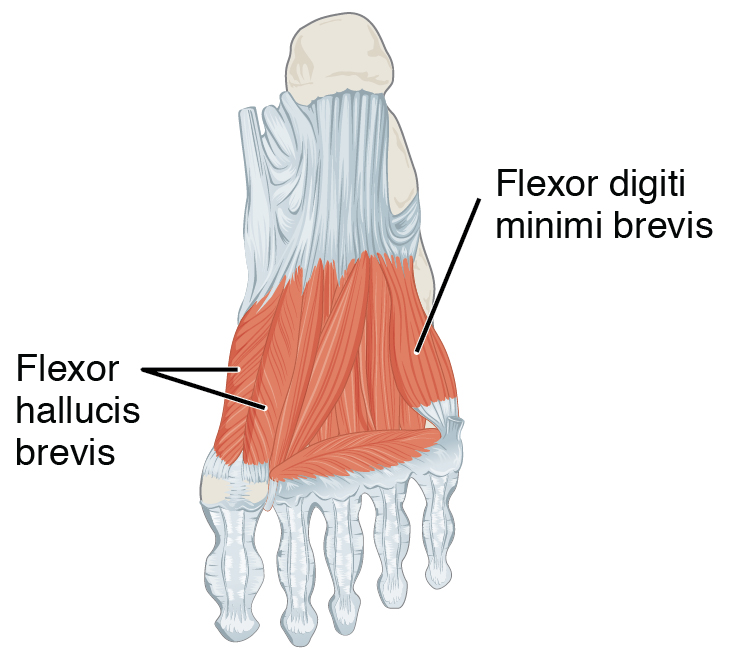
Muscle in sole of the foot that leads to the big toe
| Field | Value |
|---|---|
| Name | Flexor hallucis brevis muscle |
| Latin | musculus flexor hallucis brevis |
| Image | Musculus flexor hallucis brevis.png |
| Caption | Muscles of the sole of the foot. Third layer. (Flexor hallucis brevis visible at left.) |
| Origin | Plantar aspect of the cuneiforms, plantar calcaneocuboid ligament, long plantar ligament |
| Insertion | **Medial Head**: Medial sesamoid bone of the metatarsophalangeal joint, proximal phalanx of great toe. **Lateral head**: Lateral sesamoid bone of the metatarsophalangeal joint, proximal phalanx of great toe |
| Action | Flex hallux |
| Antagonist | Extensor hallucis longus muscle |
| Nerve | Medial plantar nerve |
Flexor hallucis brevis muscle is a muscle of the foot that flexes the big toe.
Structure
Flexor hallucis brevis muscle arises, by a pointed tendinous process, from the medial part of the under surface of the cuboid bone, from the contiguous portion of the third cuneiform, and from the prolongation of the tendon of the tibialis posterior muscle which is attached to that bone. It divides in front into two portions, which are inserted into the medial and lateral sides of the base of the first phalanx of the great toe, a sesamoid bone being present in each tendon at its insertion. The medial portion is blended with the abductor hallucis muscle previous to its insertion; the lateral portion (sometimes described as the first plantar interosseus) with the adductor hallucis muscle. The tendon of the flexor hallucis longus muscle lies in a groove between the two. Its tendon usually contains two sesamoid bones at the point under the first metatarsophalangeal joint.
Innervation
The medial and lateral head of the flexor hallucis brevis is innervated by the medial plantar nerve. Both heads are represented by spinal segments S1, S2.
Variation
Origin subject to considerable variation; it often receives fibers from the calcaneus or long plantar ligament. Attachment to the cuboid bone sometimes wanting. Slip to first phalanx of the second toe.
Function
Flexor hallucis brevis flexes the first metatarsophalangeal joint, or the big toe. It helps to maintain the medial longitudinal arch. It assists with the toe-off phase of gait providing increased push-off.
Clinical significance
Sesamoid bones contained within the tendon of flexor hallucis brevis muscle may become damaged during exercise.
Additional images
Image:Gray269.png|Bones of the right foot. Plantar surface. File:Slide1ABA.JPG|Flexor hallucis brevis muscle File:Slide8ABA.JPG| Flexor hallucis brevis muscle
References
References
- Requejo, S. M.. (2017-01-01). "Chapter 76 - Common Orthopedic Foot and Ankle Dysfunctions". Elsevier.
This article was imported from Wikipedia and is available under the Creative Commons Attribution-ShareAlike 4.0 License. Content has been adapted to SurfDoc format. Original contributors can be found on the article history page.
Ask Mako anything about Flexor hallucis brevis muscle — get instant answers, deeper analysis, and related topics.
Research with MakoFree with your Surf account
Create a free account to save articles, ask Mako questions, and organize your research.
Sign up freeThis content may have been generated or modified by AI. CloudSurf Software LLC is not responsible for the accuracy, completeness, or reliability of AI-generated content. Always verify important information from primary sources.
Report