From Surf Wiki (app.surf) — the open knowledge base
Flechette
Pointed, fin-stabilized steel projectile
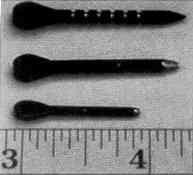
Pointed, fin-stabilized steel projectile
A flechette or fléchette ( ) is a pointed, fin-stabilized steel projectile. The name comes from French fléchette (from flèche), meaning "little arrow" or "dart". They have been used as ballistic weapons since World War I. Delivery systems and methods of launching flechettes vary, from a single shot to thousands in a single explosive round. The use of flechettes as antipersonnel weapons has been controversial; however, in war, it is not prohibited by the Hague Convention.
Air-dropped
The weapons were designed to be dropped from an aircraft. They contained no explosive charge but as they fell they developed significant kinetic energy making them lethal and able to easily penetrate soft cover such as jungle canopy, several inches of sand or light armor.

During World War I, flechettes were dropped from aircraft to attack infantry and were able to pierce helmets.
Also during World War II, a version of the flechette with feathers was dropped, and now resides in the Imperial War Museum.

Later the U.S. used Lazy Dog bombs, which are small, unguided kinetic projectiles typically about 1.75 in in length, 0.5 in in diameter, and weighing about 0.7 oz. Lazy Dog munitions were simple and cheap; they could be dropped in huge numbers in a pass. Though their effects were often no less indiscriminate than other projectiles, they did not leave unexploded ordnance (UXO) that could be active years after a conflict ended. Lazy Dog projectiles were used primarily during the Korean and Vietnam Wars.
Small-arms ammunition
Main article: Needlegun


The excellent ballistic performance and armor-piercing potential of flechettes have made the development and integration of this class of munition attractive to small-arms manufacturers. A number of attempts have been made to field flechette-firing small arms.
Work at Johns Hopkins University in the 1950s led to the development of the direct injection antipersonnel chemical biological agent (DIACBA), where flechettes were grooved, hollow pointed, or otherwise milled to retain a quantity of chemical or biological warfare agent to be delivered through a ballistic wound. The initial work was with the nerve agent VX, which had to be thickened to deliver a reliable dose. Eventually this was replaced by a highly toxic carbamate insecticide. The US Biological Program also had a microflechette to deliver either botulinum toxin A or saxitoxin, the M1 biodart, which resembled a 7.62 mm rifle cartridge. The USSR had the AO-27 rifle as well as the APS amphibious rifle, and other countries have their own flechette rounds.
A number of prototype flechette-firing weapons were developed as part of the long-running Special Purpose Individual Weapon (SPIW) project. The Steyr-Mannlicher ACR rifle was a prototype flechette-firing assault rifle built for the US Army's Advanced Combat Rifle program of 1989–90.
A variation of the flechette addressing its difficulties is the SCMITR, developed as part of the Close Assault Weapon System, or CAWS, project. Selective-fire shotguns were used to fire flechettes designed to retain the exterior ballistics and penetration of standard flechettes, but increase wounding capacity through a wider wound path.
Shotguns
During the Vietnam War the United States employed 12-gauge combat shotguns using flechette loads. These plastic-cased shells were issued on a limited trial basis during the Vietnam War. Cartridges manufactured by the Western Cartridge Company contained 20 flechettes, each 18.5 mm long and weighing 7.3 gr; Federal Cartridge Company rounds contained 25. The flechettes were packed in a plastic cup with granulated white polyethylene to maintain alignment with the bore axis, and supported by a metal disk to prevent penetration of the over-powder wad during acceleration down the bore. The tips of the flechettes were exposed in the Federal cartridges, but concealed by a conventional star crimp in WCC's cartridges. The flechettes demonstrated flatter trajectories over longer ranges than spherical buckshot, but combat effectiveness did not justify continued production.
Rocket and artillery use
Smaller flechettes were used in special artillery shells called "beehive" rounds (so named after the very distinctive whistling buzz made by thousands of flechettes flying downrange at supersonic speeds) and intended for use against troops in the open – a ballistic shell packed with flechettes was fired and set off by a mechanical time fuse, scattering flechettes in an expanding cone.
During the Vietnam War 105 mm howitzer batteries and tanks (90 mm guns) used flechette rounds to defend themselves against massed infantry attacks. The ubiquitous 105 mm M40 recoilless rifle was primarily used as an anti-tank weapon. However, it could also be used in an anti-personnel role with the use of flechette rounds. The widely used Carl Gustaf 8.4 cm recoilless rifle also uses an Area Defence Munition designed as a close-range anti-personnel round. It fires 1,100 flechettes over a wide area. The US Air Force used 2.75 in rockets with WDU-4/A flechette warheads.
The 70 mm Hydra 70 rocket currently in service with the US Armed forces can be fitted with an anti-personnel (APERS) warhead containing 1,179 flechettes. They are carried by attack helicopters such as the AH-64 Apache and the AH-1 Cobra.
Israel-Palestine conflict
Israeli authorities have reportedly used flechettes in Gaza since at least 2001. That year, Israeli officials stated that "The Israeli military obtained these weapons from the USA after the 1973 war and we have thousands of old shells in warehouses." B'Tselem documented nine Palestinians including four children who were killed by the IDF using flechettes between 2001 and 2003. In April 2003 Israel High Court rejected a petition to ban flechettes. A 2009 fact finding mission of amnesty found two persons killed by flechettes and some more wounded. In the Goldstone Report, the UN also investigated Israel's use of flechettes, describing this ammunition as unsuitable for use in residential areas, but concluding that Israel's usage was not proscribed by international law. The Israeli High Court of Justice has rejected the argument that flechette munitions are by their nature indiscriminate and maintains that subject to the general requirements of the rules of armed conflict their use is legal.
Russo-Ukrainian war
Flechettes have been used during the Russian invasion of Ukraine, where samples of the projectiles were recovered in the mass graves in Bucha, Ukraine. A witness described munitions bursting overhead and littering the area with 3 cm flechettes. A British munitions expert reviewed photographs of the flechettes and concluded that they likely came from a 3Ш1 (flèchette) 122 mm artillery round. A speaker for the Ukrainian Ground Forces stated that Ukraine's military does not use shells with flechettes.
References
Bibliography
References
- (15 April 2025). "Declaration (IV,3) concerning Expanding Bullets. The Hague, 29 July 1899".
- (12 September 2014). "Dropping Darts From An Aeroplane".
- (3 March 2018). "WWI Flechettes – The troop piercing arrows dropped from planes onto German trenches".
- "feathered flechette".
- ''Bulletin of the Atomic Scientists'' May 1975 Vol. 31, No. 5 – 48 pages, "... using deliberately contaminated shrapnel or multiple-flechette – 'beehive' – munitions, as in the now defunct DIACBA development program of the US Army ..."
- Margiotta, Franklin D.. (1996). "Brassey's Encyclopedia of Land Forces and Warfare". Brassey's.
- (1975). "Arms Uncontrolled". Harvard University Press for Stockholm International Peace Research Institute.
- Di Maio, Vincent J.M.. (1999). "Gunshot Wounds". CRC Press.
- Canfield, Bruce N. "Vietnam-Era Military Shotshells" ''[[American Rifleman]]'' July 2015 p. 44
- (6 March 2011). "Peace group slams sale of Swedish 'meat grinder' ammunition".
- Parsch, Andreas. (2024-08-02). "Air-Launched 2.75-Inch Rockets".
- "Hydra-70 Rocket System - Army Technology". Army Technology.
- "Dart bombs 'killed four Palestinians'". BBC.
- "Israel using flechette shells in Gaza". The Guardian.
- Rodan, Steve. (22 May 2001). "Israel's military debates use of flechette round". Janes Information Services.
- (2011). "Flechette Shells: an illegal weapon".
- (2003-03-27). "Physicians for Human Rights v. Doron Almog—O.C. Southern Command".
- Barak, Eitan. (2011). "Deadly Metal Rain: The Legality of Flechette Weapons in International Law. A Reappraisal Following Israel's Use of Flechettes in the Gaza Strip (2001-2009)". Brill Nijhoff.
- (2009-01-27). "Israeli army used flechettes against Gaza civilians".
- (2009-12-15). "Israel-opt fuelling Conflict: Foreign Arms Supplies to Israel/Gaza". amnesty international.
- (2009-11-25). "Report of the United Nations Fact Finding Mission on the Gaza Conflict". UN Human Rights Council.
- "Dozens of Bucha civilians were killed by metal darts from Russian artillery". The Guardian.
- "Lethal darts were fired into a Ukrainian neighborhood by the thousands". Washington Post.
This article was imported from Wikipedia and is available under the Creative Commons Attribution-ShareAlike 4.0 License. Content has been adapted to SurfDoc format. Original contributors can be found on the article history page.
Ask Mako anything about Flechette — get instant answers, deeper analysis, and related topics.
Research with MakoFree with your Surf account
Create a free account to save articles, ask Mako questions, and organize your research.
Sign up freeThis content may have been generated or modified by AI. CloudSurf Software LLC is not responsible for the accuracy, completeness, or reliability of AI-generated content. Always verify important information from primary sources.
Report