From Surf Wiki (app.surf) — the open knowledge base
Flag of the United Arab Emirates
none

none
| Field | Value |
|---|---|
| Name | United Arab Emirates (U.A.E) |
| Image | Flag of the United Arab Emirates.svg |
| Use | 111111 |
| Symbol | |
| Proportion | 1:2 |
| Adoption | |
| Design | A horizontal tricolour of green, white and black with a vertical quarter width red bar at the hoist |
| Designer | Abdulla Mohammed Al Maainah |
The national flag of the United Arab Emirates contains the pan-Arab colors red, green, white, and black. It was designed in 1971 by Abdullah Mohammed Al Maainah, who was 19 years old at that time, and was adopted on 2 December 1971 after winning a nationwide flag design contest. The main theme of the flag's four colors is the sovereignty and unity of the Arab states.
Merchant ships may fly the alternative civil ensign, a red flag with the national flag in the canton. The airline Emirates uses the UAE flag as part of their livery.
All seven emirates use the federal flag interchangeably as the flag of the emirate, however, with the exception of Fujairah, all also emirates have separate flags (though some emirates share the same flag).
Design
Construction sheet
.svg)
Colors and Symbolisim
The red stripe represents energy and the sacrifices made by the people for their nation, the green stands for growth and prosperity, the black stands for dignity, and the white stripe represents peace and purity.
| Colors | Green | White | Black | Red | Meaning | Standard shades |
|---|---|---|---|---|---|---|
| *Plains of the Emirates* | *The Acts of the Emirates* | *The Battles and Dark Times of the Emirates* | *The Emirati Swords* | |||
| **PANTONE** | `PANTONE® 348` | `n/a` | `PANTONE® BLACK` | `PANTONE® 186` | ||
| **CMYK** | `100/0/100/15` | `0/0/0/0` | `10/0/0/100` | `0/92/77/22` | ||
| **RGB** | `0/115/47` | `255/255/255` | `0/0/0` | `200/16/46` | ||
| **Hexadecimal** | `#00843D` | `#FFFFFF` | `#000000` | `#C8102E` |
Gallery
File:Civil Ensign of the United Arab Emirates.svg|Alternative civil ensign. (Flag ratio: 1:2)
File:Flag of the UAE Armed Forces.svg|Flag of the United Arab Emirates Armed Forces
File:Flag of the UAE Army.svg|Flag of the United Arab Emirates Army
File:Flag of the President of the United Arab Emirates.svg|Flag of the president of the United Arab Emirates
File:Flag of the President of the United Arab Emirates (1973-2008).svg|Flag of the president of the United Arab Emirates (1973–2008)
File:Fin_Flash_of_the_United_Arab_Emirates_–_Low_Visibility.svg|Fin Flash of the United Arab Emirates Air Force (low visibility)
File:Flag_of_the_United_Arab_Emirates_Air_Force.svg|Flag of the United Arab Emirates Air Force
Flag of the United Arab Emirates Navy.png|Flag of the United Arab Emirates Navy
Historical flags
File:Red flag.svg|Flag of the Hinawi (the Bani Yas – Abu Dhabi and Dubai, and Fujairah) and Ghafiri (Umm Al Quwain and Ajman) tribal confederations prior to 1820 File:Military standard of the House of Al Qasimi.svg| (Sharjah and Ras Al Khaimah) prior to 1820 File:Flag of Sharjah.svg|Flag of the Emirate of Kalba (1921–1952) File:Flag of the Trucial States.svg|Flag of the Trucial States Council (1968–1971) File:Flag of the United Arab Emirates (3-2).svg|Flag of the United Arab Emirates (1971–2006)
Flag of each emirate
Each of the seven emirates within the United Arab Emirates belonged to either the Hinawi or Ghafiri tribal confederations; both had a red banner representing the Hashemite dynasty and allegiance to the prophet Muhammad. The Qawasim, although part of the Ghafiri, had their own flag (a green, white, and red banner) which used to distinguish them as a maritime power. In 1820, after the British Empire campaign on Ras Al Khaimah, six out of the seven emirates signed the General Maritime Treaty with the British Empire, which compelled them to be under the British Protectorate rule and protection in the region. A white segment was imposed, to be added to each emirate's flag. At the time, Fujairah, not recognized as an emirate by the British and thus not a signatory of the 1820 general treaty, continued to use its plain red flag.
On 6 November 1975, Sheikh Sultan bin Muhammad Al-Qasimi took down the British-imposed flag, the White Pierced Red flag, from Sharjah, stating:
After defeating the Al-Qawasim tribe, the British occupiers gave the Qawasim this flag to replace their own flag, which used to have three horizontal colours: green, white and red from top to bottom, with a Quranic inscription 'A victory from Allah and an imminent conquest' on the white part. The loss of our national flag occurred on Saturday 8 January 1820. So what I have done now is restore dignity to the citizens of Sharjah of today and to the citizens of Sharjah of the past, all of whom have been forced to salute the flag of the very aggressors who had removed our own flag, a flag that had symbolized the struggle of Al-Qawasim.
On 15 November 1975, Ajman, Umm Al Quwain, and Fujairah followed suit and replaced their flags with the federation flag. Soon after, the flags of the other emirates were lowered and the UAE flag was raised.
Abu Dhabi

The flag of Abu Dhabi is a red flag with a white rectangle at the top-left corner. According to the 1820 General Maritime Treaty with the British, in times of war a full red flag would be used by the Bani Yas (Abu Dhabi and Dubai). Although per the treaty, Abu Dhabi was supposed to fly the White Pierced Red Trucial States flag, in practice it continued to fly a plain red flag. Percy Cox, the British Colonial Office administrator in the Middle East, was unsuccessful in convincing Zayed bin Khalifa Al Nahyan to adopt the Trucial States flag, which, Zayed argued, represented the Al Qawasim tribal federation. Abu Dhabi later adopted a red flag with a top left white rectangle to distinguish it from the surrounding emirates.
Ajman and Dubai


The flags of Ajman and Dubai are identical. They are both plain red with a white bar at the hoist, i.e. closest to the flag staff. The flag is known as the White Red Halved and was adopted as an alternative to the Sharjah and Ras Al Khaimah White Pierced Red by the Emirate of Dubai and Ajman to distinguish their authority from the Al Qawasim in defiance of the bonds of the 1820 General Maritime Treaty with the British. To the British, this flag was titled as Trucial Coast Flag No.1 and Abu Dhabi and Umm Al Quwain were also expected to adopt it. According to the treaty, in times of war a full red flag would be used by the Bani Yas (Abu Dhabi and Dubai) and a full white flag by Ajman.
The Shihuh of Musandam Peninsula (Ruus Al Jibal) also had a similar flag.
Fujairah
.svg)
.svg)

Before 1952, the flag of Fujairah was plain red. Fujairah did not sign the general treaty in 1820 with the British and therefore continued using its red plain flag. From 1952 to 1961, the emirate's name was added to the flag, and a red flag with a white Arabic calligraphy of the emirate name () was adopted as an ensign to distinguish it from the surrounding emirates. In 1975, the plain red flag was abolished and the national flag of the United Arab Emirates is now used for official purposes.
Ras al-Khaimah
Ras Al Khaimah and Sharjah

The flags of Ras Al Khaimah and Sharjah are identical as they are ruled by two branches of the same house. The flags have a large red rectangle on a white background. The flag, known as the White Pierced Red flag, was the intended flag for all the Trucial States according to the 1820 Maritime Treaty with the British. It was widely attributed to the Al Qawasim tribal federation. Percy Cox, the British Colonial Office administrator in the Middle East, was unsuccessful in convincing the rest of the emirates' Sheikhs to adopt it. To the British, this flag was titled as Trucial Coast Flag No. 2. According to the treaty, in times of war the original Al Qassimi flag (green, white and red flag) was to be used by the Qawasim.
Umm Al Quwain
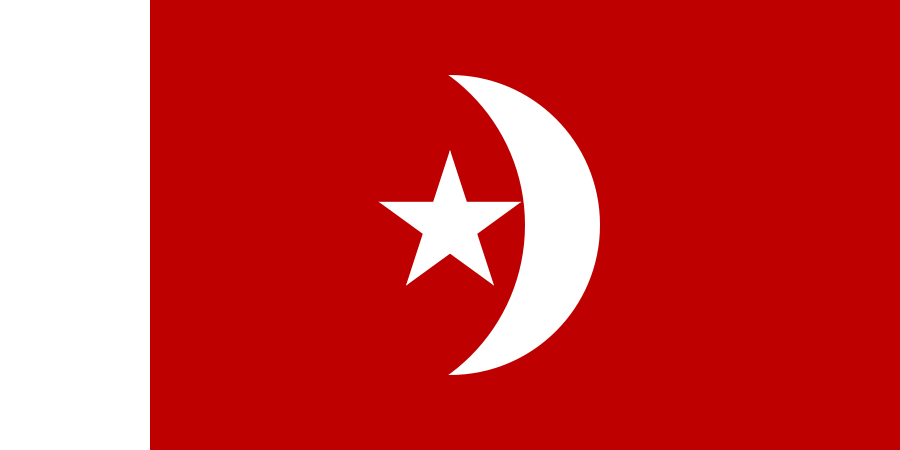
The flag of Umm Al Quwain consists of a red background, a white bar at the hoist similar the flags of Ajman and Dubai, and a large white star and crescent in the center, a symbol of Islam representing allegiance to the Islamic world. The Umm Al Quwain flag was supposed to be the same White Red Halved flag as the one used by both Dubai and Ajman, but a star and crescent were added to distinguish it from the other emirates.

Notes
References
References
- Farooqui, Mazhar. (October 28, 2021). "Meet the Emirati diplomat who designed UAE's flag as a teenager". [[Khaleej Times]].
- "History of the United Arab Emirates Flag".
- (2024-11-07). "The UAE Flag Colors: Why Each Color Has Special Meaning - Dreamer Fashions".
- "THE UNITED ARAB EMIRATES FLAG".
- "United Arab Emirates Flag and Official Portraits Guidelines For Federal Entities and Embassies".
- (2007). "Complete Flags of the World". Smithsonian Handbooks.
- Al Qassimi, Sultan bin Mohammad. (2012). "Taking the Reins: The Critical Years, 1971-1977". A & C Black Business Information and Development.
- . (30 March 2017). ["Coll 30/15 'Anthems and Flags of Various States. Bahrein [Bahrain], Koweit [Kuwait], Muscat, Asir, Yemen, Qatar, Trucial, Oman' [61r] (107/261)"](https://www.qdl.qa/en/archive/81055/vdc_100042699662.0x00006e). *British Library: India Office Records and Private Papers*.
- . (30 March 2017). ["Coll 30/15 'Anthems and Flags of Various States. Bahrein [Bahrain], Koweit [Kuwait], Muscat, Asir, Yemen, Qatar, Trucial, Oman' [61r] (103/261)"](https://www.qdl.qa/en/archive/81055/vdc_100042699662.0x00006a). *British Library: India Office Records and Private Papers*.
- Hawley, Donald. "The Trucial States". Twayne Publishers, New York, 1970. pp. 326-7.
- . (21 April 1932). ["Coll 30/15 'Anthems and Flags of Various States. Bahrein [Bahrain], Koweit [Kuwait], Muscat, Asir, Yemen, Qatar, Trucial, Oman' [61r] (151/261)"](https://www.qdl.qa/en/archive/81055/vdc_100042699662.0x00009a). *British Library: India Office Records and Private Papers*.
- . (30 March 2017). ["Coll 30/15 'Anthems and Flags of Various States. Bahrein [Bahrain], Koweit [Kuwait], Muscat, Asir, Yemen, Qatar, Trucial, Oman' [61r] (57/261)"](https://www.qdl.qa/en/archive/81055/vdc_100042699662.0x00003c). *British Library: India Office Records and Private Papers*.
- . (21 April 1932). ["Coll 30/15 'Anthems and Flags of Various States. Bahrein [Bahrain], Koweit [Kuwait], Muscat, Asir, Yemen, Qatar, Trucial, Oman' [61r] (111/261)"](https://www.qdl.qa/en/archive/81055/vdc_100042699662.0x000072). *British Library: India Office Records and Private Papers*.
- (1988). "Arabian Boundaries: Primary Documents". Archive Editions.
- . (4 June 1932). ["Coll 30/15 'Anthems and Flags of Various States. Bahrein [Bahrain], Koweit [Kuwait], Muscat, Asir, Yemen, Qatar, Trucial, Oman' [61r] (121/261)"](https://www.qdl.qa/en/archive/81055/vdc_100042699662.0x00007c). *British Library: India Office Records and Private Papers*.
- . (30 March 2017). ["Coll 30/15 'Anthems and Flags of Various States. Bahrein [Bahrain], Koweit [Kuwait], Muscat, Asir, Yemen, Qatar, Trucial, Oman' [61r] (113/261)"](https://www.qdl.qa/en/archive/81055/vdc_100042699662.0x000074). *British Library: India Office Records and Private Papers*.
This article was imported from Wikipedia and is available under the Creative Commons Attribution-ShareAlike 4.0 License. Content has been adapted to SurfDoc format. Original contributors can be found on the article history page.
Ask Mako anything about Flag of the United Arab Emirates — get instant answers, deeper analysis, and related topics.
Research with MakoFree with your Surf account
Create a free account to save articles, ask Mako questions, and organize your research.
Sign up freeThis content may have been generated or modified by AI. CloudSurf Software LLC is not responsible for the accuracy, completeness, or reliability of AI-generated content. Always verify important information from primary sources.
Report