From Surf Wiki (app.surf) — the open knowledge base
Flag of Scotland
none

none
| Field | Value |
|---|---|
| Name | Scotland |
| Nickname | {{ubl |
| Image | Flag of Scotland.svg |
| Use | 111000 |
| Symbol | |
| Proportion | Mass-produced versions tend towards 1:2 or 2:3 (3:5 shown) |
| Adoption | 1542 |
| (Standardised in 2003) | |
| Design | A blue (Pantone 300 recommended) field on which a white saltire extends to the corners of the flag. In Blazon, *Azure, a saltire Argent*. |
| Image2 | Flag of Scotland (Union Jack colours and proportion).png |
| Nickname2 | As a component of the Union Jack |
| Adoption2 | 1606 |
| Design2 | A dark blue (Pantone 280 specified) field |
| Proportion2 | 1:2 (British Army 3:5) |
|St Andrew's Cross |The Saltire (Standardised in 2003)
The flag of Scotland (; , also known as St Andrew's Cross or the Saltire) is the national flag of Scotland, which consists of a white saltire over a blue field. The Saltire, rather than the Royal Standard of Scotland, is the correct flag for all private individuals and corporate bodies to fly. It is also, where possible, flown from Scottish Government buildings every day from 8:00 am until sunset, with certain exceptions.
Use of the flag is first recorded with the illustration of a heraldic flag in Sir David Lyndsay of the Mount's Register of Scottish Arms, . It is possible that this is based on a precedent of the late 15th century, the use of a white saltire in the canton of a blue flag reputedly made by Queen Margaret, wife of James III (1451–1488). It is considered to be the oldest flag in Europe.
Design
The heraldic term for an X-shaped cross is a 'saltire', from the old French word saultoir or salteur (itself derived from the Latin saltatorium), a word for both a type of stile constructed from two cross pieces and a type of cross-shaped stirrup-cord. In heraldic language, the Scottish flag may be blazoned azure, a saltire argent. The tincture of the Saltire can appear as either silver (argent) or white. However, the term azure does not refer to a particular shade of blue.
Throughout the history of fabric production natural dyes have been used to apply a form of colour, with dyes from plants, including indigo and woad, having dozens of compounds whose proportions may vary according to soil type and climate; therefore giving rise to variations in shade. In the case of the Saltire, variations in shades of blue have resulted in the background of the flag ranging from sky blue to navy blue. When incorporated as part of the Union Flag during the 17th century, the dark blue applied to Union Flags destined for maritime use was possibly selected on the basis of the durability of darker dyes, with this dark blue shade eventually becoming standard on Union Flags both at sea and on land. Some flag manufacturers selected the same navy blue colour trend of the Union Flag for the Saltire itself, leading to a variety of shades of blue being depicted on the flag of Scotland.
These variations in shade eventually led to calls to standardise the colour of Scotland's national flag, and in 2003 a committee of the Scottish Parliament met to examine a petition that the Scottish Executive adopt the Pantone 300 colour as a standard (this blue is of a lighter shade than the Pantone 280 of the Union Flag). Having taken advice from a number of sources, including the office of the Lord Lyon King of Arms, the committee recommended that the optimum shade of blue for the Saltire be Pantone 300. Recent versions of the Saltire have therefore largely converged on this official recommendation (Pantone 300 is #005EB8 as a web colour).
| Scheme | Blue | White |
|---|---|---|
| Pantone | 300 C | White |
| Web colour | #005EB8 | #FFFFFF |
| RGB | 0, 94, 184 | 255, 255, 255 |
| CMYK | 72-35-0-28 | 0-0-0-0 |
The flag proportions are not fixed but 3:5 is most commonly used, as with other flags of the countries of the United Kingdom (flag manufacturers themselves may adopt alternative ratios, including 1:2 or 2:3). Lord Lyon King of Arms states that 4:5 is suitable. The ratio of the width of the bars of the saltire in relation to the width of the field is specified in heraldry in relation to shield width rather than flag width. However, this ratio, though not rigid, is specified as one-third to one-fifth of the width of the field.
Flag of Scotland (traditional).svg| Saltire with sky blue field File:Flag of Scotland (navy blue).svg| Saltire with navy blue field
History
According to legend, the use of the Saltire as the flag of Scotland originated on the eve of the Battle of Athelstaneford in 832. The 1320 Declaration of Arbroath cites Scotland's conversion to Christianity by St. Andrew, "the first to be an Apostle". Depiction of the saint being crucified on a decussate cross was seen on seals in Scotland from 1180 onwards and was used on a seal of the Guardians of Scotland, dated 1286. Bishop William de Lamberton (r. 1297–1328) also used the crucified figure of the saint in his seal.

The saltire (decussate cross, diagonal cross) was used as a field sign in the medieval period without any connection to Saint Andrew. The connection between the field sign and the legendary mode of crucifixion of the saint may originate in Scotland, in the late 14th century. The Parliament of Scotland decreed in 1385 that every Scottish and French soldier (fighting against the English under Richard II) "shall have a sign before and behind, namely a white St. Andrew's Cross".
James Douglas, 2nd Earl of Douglas at the Battle of Otterburn (1388) reportedly used a pennon with a saltire at the hoist. Similarly, white saltire was shown in the canton of the "Blue Blanket of the Trades of Edinburgh", reputedly made by Queen Margaret, wife of James III (1451–1488). This is the flag of the Incorporated Trades of Edinburgh, and the focal point of the Riding of the Marches ceremony held in the city each year.
Use of the white "Sanct Androis cors" on blue as a naval flag is recorded for 1507, for the carrack Great Michael. As a heraldic flag, the white saltire on a blue field is first shown in 1542, in the armorial of David Lyndsay. Here, the royal arms are supported by two unicorns, each holding the saltire banner.
Protocol
Use by the Scottish Government
The Scottish Government has ruled that the Saltire should, where possible, fly on all its buildings every day from 8am until sunset. An exception is made for United Kingdom "national days", when on buildings where only one flagpole is present the Saltire shall be lowered and replaced with the Union Flag. Such flag days are standard throughout the United Kingdom, with the exception of Merchant Navy Day (3 September) which is a specific flag day in Scotland during which the Red Ensign of the Merchant Navy may be flown on land in place of either the Saltire or Union Flag.
A further Scottish distinction from the UK flag days is that on Saint Andrew's Day (30 November) the Union Flag will only be flown where a building has more than one flagpole; the Saltire will not be lowered to make way for the Union Flag where a single flagpole is present. If there are two or more flagpoles present, the Saltire may be flown in addition to the Union Flag but not in a superior position. This distinction arose after Members of the Scottish Parliament complained that Scotland was the only country in the world where the potential existed for the citizens of a country to be unable to fly their national flag on their country's national day. In recent years, embassies of the United Kingdom have also flown the Saltire to mark St Andrew's Day. Many bodies of the Scottish Government use the flag as a design basis for their logo. For example, Safer Scotland's emblem depicts a lighthouse shining beams in a saltire shape onto a blue sky. Other Scottish bodies, both private and public, have also used the saltire in similar ways.
Use by military institutions on land
The seven British Army Infantry battalions of the Scottish Division, plus the Scots Guards and Royal Scots Dragoon Guards regiments, use the Saltire in a variety of forms. Combat and transport vehicles of these Army units may be adorned with a small, (130x80mm approx.), representation of the Saltire; such decals being displayed on the front and/or rear of the vehicle (on tanks these may also be displayed on the vehicle turret). In Iraq, during both Operation Granby and the subsequent Operation Telic, the Saltire was seen to be flown from the communications whip antenna of vehicles belonging to these units. Funerals, conducted with full military honours, of casualties of these operations in Iraq, plus those killed in operations in Afghanistan, have also been seen to include the Saltire being draped over the coffin of the deceased on such occasions.
In the battle for "hearts and minds" in Iraq, the Saltire was again used by the British Army as a means of distinguishing troops belonging to Scottish regiments from other coalition forces, in the hope of fostering better relations with the civilian population in the area south west of Baghdad. Leaflets were distributed to Iraqi civilians, by members of the Black Watch, depicting troops and vehicles set against a backdrop of the Saltire.
Immediately prior to, and following, the merger in March 2006 of Scotland's historic infantry regiments to form a single Royal Regiment of Scotland, a multi-million-pound advertising campaign was launched in Scotland in an attempt to attract recruits to join the reorganised and simultaneously rebranded "Scottish Infantry". The recruitment campaign employed the Saltire in the form of a logo; the words "Scottish Infantry. Forward As One." being placed next to a stylised image of the Saltire. For the duration of the campaign, this logo was used in conjunction with the traditional Army recruiting logo; the words "Army. Be The Best." being placed beneath a stylised representation of the Union Flag. Despite this multi-media campaign having had mixed results in terms of overall success, the Saltire continues to appear on a variety of Army recruiting media used in Scotland.

Other uses of the Saltire by the Army include the cap badge design of the Royal Regiment of Scotland, which consists of a (silver) Saltire, surmounted by a (gilt) lion rampant and ensigned with a representation of the Crown of Scotland (this same design, save for the Crown, is used on both the Regimental flag and tactical recognition flash of the Royal Regiment of Scotland). The badge of the No. 679 (The Duke of Connaught's) Squadron Army Air Corps bears a Saltire between two wreaths ensigned 'Scottish Horse', an honour they received in 1971 which originated through their links with the Royal Artillery. The Officer Training Corps units attached to universities in Edinburgh and Glasgow, plus the Tayforth University OTC, all feature the Saltire in their cap badge designs.
The Fleet Air Arm of the Royal Navy adorned three of their aircraft with the Saltire. Specifically, the Westland Sea King Mk5 aircraft of HMS Gannet, operating in the Search and Rescue (SAR) role from Royal Naval Air Station Prestwick, Ayrshire, displayed a Saltire decal on the nose of each aircraft.
Although not represented in the form of a flag, the No. 602 (City of Glasgow) Squadron of the Royal Auxiliary Air Force uses the Saltire surmounted by a lion rampant as the device shown on the squadron crest. The station crest of the former RAF Leuchars, Fife, also showed the Saltire, in this case surmounted by a sword. The crest of the former RAF East Fortune, East Lothian, also showed a sword surmounting the Saltire, however, unlike Leuchars, this sword was shown inverted and the station crest of the former RAF Turnhouse, Edinburgh, showed a Saltire surmounted by an eagle's head. The East of Scotland Universities Air Squadron crest features a Saltire surmounted by an open book; the book itself being supported by red lions rampant.
General use
In Scotland, the Saltire can be flown at any time by any individual, company, local authority, hospital or school without obtaining express consent. Many local authorities in Scotland fly the Saltire from Council Buildings. However, in 2007 Angus Council approved a proposal to replace the Saltire on Council Buildings with a new Angus flag, based on the council's coat of arms. This move led to public outcry across Scotland with more than 7,000 people signing a petition opposing the council's move, leading to a compromise whereby the Angus flag would not replace but be flown alongside the Saltire on council buildings.
In the United Kingdom, owners of vehicles registered in Great Britain have the option of displaying the Saltire on the vehicle registration plate, in conjunction with the letters "SCO" or alternatively the word "Scotland". In 1999, the Royal Mail issued a series of pictorial stamps for Scotland, with the '2nd' value stamp depicting the Flag of Scotland. In Northern Ireland, sections of the Protestant community routinely employ the Saltire as a means of demonstrating and celebrating their Ulster-Scots heritage.

Incorporation into the Union Flag
Main article: Union Jack
The Saltire is one of the key components of the Union Flag which, since its creation in 1606, has appeared in various forms following the Flag of Scotland and Flag of England first being merged to mark the Union of the Crowns, an event occurred in 1603 when James VI, King of Scots, acceded to the thrones of both England and Ireland upon the death of Elizabeth I of England. The proclamation by King James, made on 12 April 1606, which led to the creation of the Union Flag states:
However, in objecting strongly to the form and pattern of Union Flag designed by the College of Arms and approved by King James, whereby the cross of Saint George surmounted that of Saint Andrew, regarded in Scotland as a slight upon the Scottish nation, a great number of shipmasters and ship-owners in Scotland took up the matter with John Erskine, 19th Earl of Mar, and encouraged him to send a letter of complaint, dated 7 August 1606, to James VI, via the Privy Council of Scotland, stating:
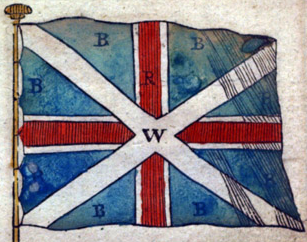
Despite the drawings described in this letter as showing drafts of the two new patterns, together with any royal response to the complaint which may have accompanied them, having been lost, (possibly in the 1834 Burning of Parliament), other evidence exists, at least on paper, of a Scottish variant whereby the Scottish cross appears uppermost. Whilst, in the absence of evidence to the contrary, this design is considered by most vexillologists to have been unofficial, there is reason to believe that such flags were employed during the 17th century for use on Scottish vessels at sea. This flag's design is also described in the 1704 edition of The Present State of the Universe by John Beaumont, Junior, which contains as an appendix The Ensigns, Colours or Flags of the Ships at Sea: Belonging to The several Princes and States in the World.
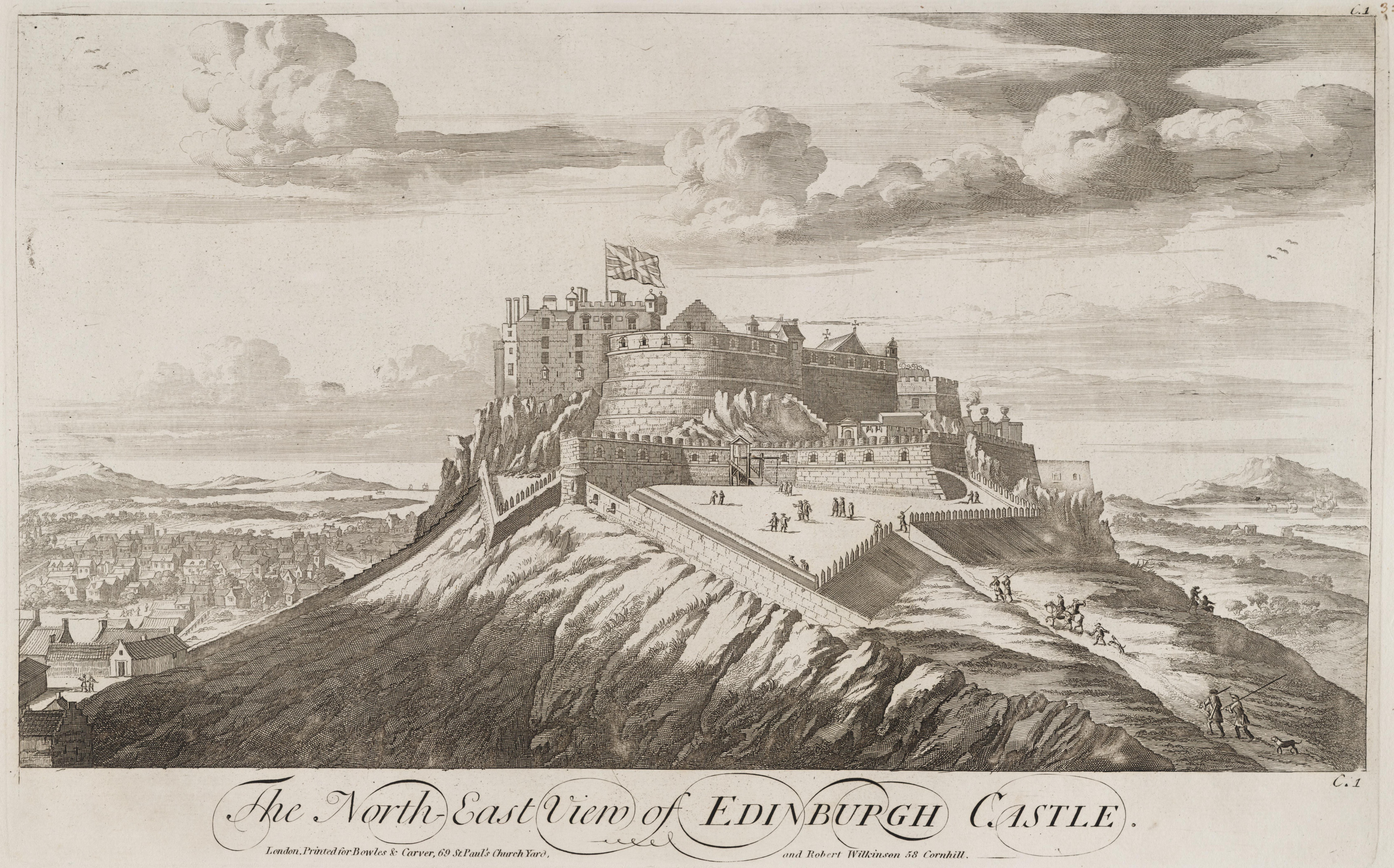
On land, evidence suggesting use of this flag appears in the depiction of Edinburgh Castle by John Slezer, in his series of engravings entitled Theatrum Scotiae, . Appearing in later editions of Theatrum Scotiae, the North East View of Edinburgh Castle engraving depicts the Scotch (to use the appropriate adjective of that period) version of the Union Flag flying from the Castle Clock Tower.
A reduced view of this engraving, with the flag similarly detailed, also appears on the Plan of Edenburgh, Exactly Done. However, on the engraving entitled North Prospect of the City of Edenburgh the detail of the flag, when compared to the aforementioned engravings, appears indistinct and lacks any element resembling a saltire. The reduced version of the North Prospect ..., as shown on the Plan of Edenburgh, Exactly Done, does however display the undivided arm of a saltire and is thereby suggestive of the Scottish variant.
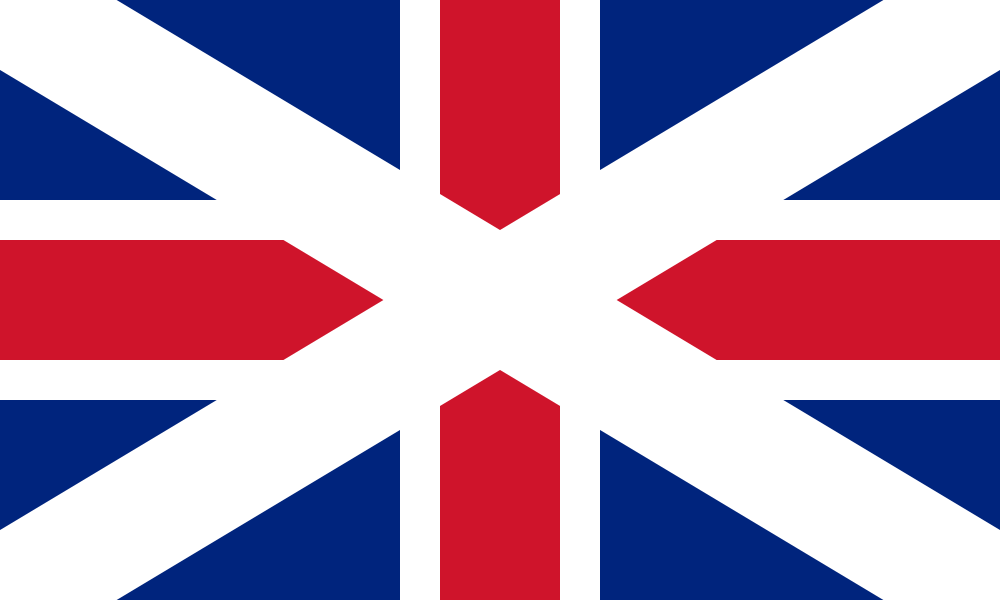
On 17 April 1707, just two weeks prior to the Acts of Union coming into effect, Sir Henry St George, Garter King of Arms, presented several designs to Queen Anne and her Privy Council for consideration as the flag of the soon to be unified Kingdom of Great Britain. At the request of the Scots representatives, the designs for consideration included that version of Union Flag showing the Cross of Saint Andrew uppermost; identified as being the "Scots union flagg as said to be used by the Scots". However, Queen Anne and her Privy Council approved Sir Henry's original effort (pattern "one") showing the Cross of Saint George uppermost.
From 1801, in order to symbolise the union of the Kingdom of Great Britain with the Kingdom of Ireland a new design, which included the St Patrick's Cross, was adopted for the flag of the United Kingdom of Great Britain and Ireland. A manuscript compiled from 1785 by William Fox, and in possession of the Flag Research Center, includes a full plate showing "the scoth union" flag with the addition of the cross of St. Patrick. This could imply that there was still some insistence on a Scottish variant after 1801.
Despite its unofficial and historic status the Scottish Union Flag continues to be produced by flag manufacturers, and its unofficial use by private citizens on land has been observed. In 2006 historian David R. Ross called for Scotland to once again adopt this design in order to "reflect separate national identities across the UK". However, the 1801 design of the Union Flag remains the official flag of the entire United Kingdom of Great Britain and Northern Ireland.
File:Godspeed replica.jpg|right|upright|Replica of 17th century English ship Godspeed, with conjoined Union flag in her “main-toppe” and "Red Crosse" of "South Britaine" in her “fore-toppe”. File:Scottish Union Flag - detail.JPG|Scottish Union Flag. An unofficial variant used in the Kingdom of Scotland during the 17th century, following the Union of the Crowns in 1603. File:Châté Lîzabé Couleu d'la Grande Brétangne c (reverse).jpg|Union Flag used in the Kingdom of England from 1606 and, following the Acts of Union, the flag of the Kingdom of Great Britain from 1707 to 1800. File:Union flag.jpg|Union Flag since 1801, including the Cross of Saint Patrick, following the Act of Union between the Kingdom of Great Britain and Kingdom of Ireland. File:Development of The Union Jack.gif|Component flags of the Flag of the United Kingdom: Saint George's Cross, Saltire of St Andrew and Saint Patrick's Saltire.
Royal Standard of Scotland
Main article: Royal Banner of Scotland

The Royal Standard of Scotland, also known as the Banner of the King of Scots or more commonly the Lion Rampant of Scotland, is the Scottish Royal Banner of Arms. Used historically by the King of Scots, the Royal Standard of Scotland differs from Scotland's national flag, the Saltire, in that its correct use is restricted by an Act of the Parliament of Scotland to only a few Great Officers of State who officially represent The Sovereign in Scotland. However, a 1934 Royal Warrant for George V's silver jubilee which authorised waving of hand-held versions continues to be relied upon by fans at sports events and other public occasions. It is also used in an official capacity at Royal residences in Scotland when the Sovereign is not present.
In Unicode
In 2017, the Unicode Consortium approved emoji support for the flag of Scotland, alongside the flags of England and Wales, in Unicode version 10.0 and Emoji version 5.0. This was following a proposal from Jeremy Burge of Emojipedia and Owen Williams of BBC Wales in March 2016,
The flag is implemented using the regional indicator symbol sequence , so 🏴 requires a total of 7 code points: . Prior to this update, The Daily Telegraph reported that users had "been able to send emojis of the Union Flag, but not of the individual nations".
Gallery
File:Flag of Scotland.jpg|The Saltire, the national flag of Scotland: a white (argent) saltire on a blue (azure) field. File:Flags outside Parliament.jpg|The Flag of the United Kingdom, Flag of Scotland and Flag of Europe at the Scottish Parliament Building. File:Slag om Grolle 2008-1 - Linie van Staatse troepen vuurt.jpg|The Scottish Red Ensign at a historical reenactment of the Battle for Grolle. File:The Saltire - geograph.org.uk - 718800.jpg|A variety of Saltires at Murrayfield Stadium; the national stadium of Rugby Union in Scotland. File:Flags of Scotland-England border.jpg|Three flags of Scotland marking the Anglo-Scottish Border. File:Highland Games-Opening ceremonies in Canmore.jpg|The flag of Scotland and flag of Canada at the Canmore Highland Games. File:Hampden_Park_WP_EN.JPG|The flag of Scotland seating design at Hampden Park Stadium; the national stadium of Football in Scotland. File:Replica Covenanter flag, National Museum of Scotland.JPG|A replica 17th-century Covenanters' flag. File:The flag at North Berwick Golf Course - geograph.org.uk - 1523656.jpg|A defaced Saltire belonging to the Bass Rock golf club, North Berwick. File:Carrying the Royal Burgh Flag on Peat Hill - geograph.org.uk - 1354482.jpg|The defaced Saltire of the Royal Burgh of Selkirk leading the Common Riding. File:Flying the Flag - geograph.org.uk - 7550335.jpg|The flag of Scotland (3:5 proportion) File:Scottish Flag.jpg|The flag of Scotland (2:3 proportion) File:Saltire.jpg|The flag of Scotland (1:2 proportion)
References
References
- (22 November 2024). "Explaining the Scottish Flag".
- (n.d.). "Visit Athelstaneford. Birthplace of Scotland's Flag". Scottish Flag Trust.
- "The Saltire". The Court of the Lord Lyon.
- (1 January 2009). "Flag Flying Guidance". The Government of Scotland.
- National Library of Scotland. (1542). "Plate from the Lindsay Armorial". Royal Commission on the Ancient and Historical Monuments of Scotland.
- Bartram, Graham. (9 November 2012). "British Flags & Emblems". Tuckwell Press.
- "St Andrew & the Saltire, the Scottish Flag".
- ''Oxford English Dictionary'', Second edition, 1989
- "Frequently Asked Questions". College of Arms.
- Holland, Stephanie. (26 April 2016). ["All about fabrics: an introduction to needlecraft"](https://archive.org/details/allaboutfabricsi0000holl/page/31}} [https://archive.org/details/allaboutfabricsi0000holl/page/31 Internet Archive] {{webarchive). Oxford University Press.
- (October 2006). "Natural Dyes vs. synthetic dyes". WildColours.
- "Colour of the flag". Flags of the World.
- Macdonell, Hamish. (19 February 2003). "Parliament to set standard colour for Saltire". Johnston Press Digital Publishing.
- Macdonell, Hamish. (3 June 2002). "MSPs are feeling blue over shady Saltire business". Johnston Press Digital Publishing.
- (29 July 2000). "(208) Pantone 300 and the Saltire". The University of Edinburgh, School of Law..
- "Pantone 300 Coated". Pantone LLC.
- BBC News. (19 February 2003). "Flag colour is azure thing: Politicians have finally nailed their colours to the mast by specifying the precise shade of blue in Scotland's national flag". British Broadcasting Corporation.
- (2003). "Petition PE512". The Scottish Parliament.
- "Scotland – St Andrews Saltire)". Flying Colours Flagmakers.
- Fearn, Jacqueline. (4 May 2016). "Discovering Heraldry". Osprey Publishing.
- (28 November 2007). "Feature: Saint Andrew seals Scotland's independence". The National Archives of Scotland.
- Henry Laing, ''Descriptive Catalogue of Impressions from Ancient Scottish Seals'' (1850), [https://books.google.com/books?id=hlQJAAAAQAAJ&pg=PA145 no. 865]
- A unicorn, holding the saltire (over the centre of which is a crown) supporting an escutcheon bearing a lion rampant, to either side and below are thistles, at the bottom in painted gold raised letters the inscription I R 5. Public Monuments and Sculpture Association (PMSA Work Ref.: EDIN0720) {{Historic Environment Scotland
- The Records of the Parliaments of Scotland to 1707, K.M. Brown et al. (eds.), St Andrews (2007–2019), [http://www.rps.ac.uk/mss/1385/6/4 1385/6/4] "ordinance made in council concerning the French army": ''Item, que tout homme, Francois et Escot, ait un signe devant et derrere cest assavoir une croiz blanche Saint Andrieu et se son jacque soit blanc ou sa cote blanche il portera la dicte croiz blanche en une piece de drap noir ronde ou quarree.''
- Bartram, Graham. (2001). "Proceedings of the XIX International Congress of Vexillology". Fédération internationale des associations vexillologiques.
- (1877). "Accounts of the Lord High Treasurer of Scotland = Compota thesaurariorum Regum Scotorum".
- (16 December 2008). "Dates for Hoisting Flags on UK Government Buildings 2009". Department for Culture, Media and Sport.
- (20 May 2002). "Ministers agree flag day review". BBC News.
- (7 November 2006). "St Andrews Day celebrations". The Scottish Executive.
- (29 December 2008). "Community Safety in Scotland – Information for Practitioners". The Government of Scotland.
- "The Flag of Scotland". The Scottish Flag Trust.
- "MoD image". [[Ministry of Defence (United Kingdom).
- "MoD image". MoD.
- "MoD image". MoD.
- "The coffin of Black Watch soldier Kevin Elliot is carried from St Mary's Church on September 15, 2009 in Dundee, Scotland.". trackpads.com.
- "Funeral Of Black Watch Bomb Victim". sky.com.
- "Operation Iraqi Freedom". Psywarrior.com.
- Bruce, Ian. (19 September 2007). "Recruits down 15% as Army severs local links". Herald & Times Group.
- "MoD image". MoD.
- "MoD web page". MOD.
- "MoD web page". MOD.
- "MoD web page". MOD.
- "602sqn image". The BS Historian.
- "RAF Stations – E". Air of Authority – A History of RAF Organisation.
- "RAF Stations – T". Air of Authority – A History of RAF Organisation.
- "East of Scotland Universities Air Sqn". MOD.
- Murray, Philip. (12 November 2007). "Saltire and new Angus Flag will be pole buddies". Johnston Press Digital Publishing.
- (27 April 2009). "Section 9: National Flags on number plates". DVLA.
- Jeffries, Hugh. (2011). "Stanley Gibbons Great Britain Concise Stamp Catalogue". Stanley Gibbons Ltd.
- "Symbols in Northern Ireland – Flags Used in the Region". University of Ulster.
- "Marine and Fisheries – Compliance". Scottish Government.
- "CalMac image". CalMac.
- "Waverley Excursions image". Waverley Excursions.
- (17 August 2009). "US Navy Signal Flags". United States Navy.
- Wilson, Timothy. (24 April 2016). "Flags at sea: a guide to the flags flown at sea by British and some foreign ...". HMSO.
- "1yd Scottish Ensign". www.duncanyacht.co.uk.
- (n.d.). "Supply of Flags". The Scottish Flag Trust.
- "The Scottish Flag Trust: "Scottish Red Ensign" (.jpg image)". Scots Independent Newspaper.
- "Saint Andrew and his flag". Scots History Online.
- "Symbols of the Monarchy: Union Jack". Royal Website.
- Bartram, Graham. (18 October 2008). "British flags". The Flag Institute.
- Fox-Davies, Arthur Charles. (1904). "The Art of Heraldry: An Encyclopædia of Armory". Bloomsbury Books.
- Perrin, William G. (1922). "British Flags; Their Early History and their Development at Sea, with an Account of the Origin of the Flag as a National Device". Oxford University Press.
- Bartram, Graham. (22 August 2016). "British Flags & Emblems". Flag Institute/Tuckwell.
- Crampton, William. (1992). "Flags of the World".
- Smith, Whitney. (1973). "The Flag Bulletin". Flag Research Center.
- Beaumont, John. (1704). "The Present State of the Universe: Or an Account of I. The Rise, Births, Names, ... of All the Present Chief Princes of the World. ...". Benj. Motte, and are to be sold by [[John Nutt (printer).
- link. (25 February 2009 , Slezer's Scotland. Accessed 4 July 2010)
- "Slezer's Scotland". National Library of Scotland.
- John Slezer, Robert Sibbald and Abel Swall. (1693). "Theatrum Scotiae: Containing the prospects of their Majesties castles and palaces: together with those of the most considerable towns and colleges; the ruins of many ancient abbeys, churches, monasteries and convents, within the said kingdom. All curiously engraven on copper plates. With a short ...". John Leake.
- "Slezer's Scotland". National Library of Scotland.
- "Slezer's Scotland". National Library of Scotland.
- de Burton, Simon. (9 November 1999). "How Scots lost battle of the standard". Johnston Press plc.
- "United Kingdom – History of the Flag". Flags of the World.
- Smith, Whitney. (1973). "The Flag Bulletin". Flag Research Center.
- "Unofficial Scottish Union 1606 Flag". Flying Colours Flagmakers.
- (31 May 2009). "Scottish Union (.jpg image)". boonjiepam (Flickr).
- Mair, George. (21 June 2006). "Let's have a Scottish version of Union flag, says historian". The Scotsman.
- "Union Jack". The official website of the British Monarchy.
- (29 May 2007). "Public Flag, Tartan Images". [[Communications Nova Scotia]].
- Herrera, Tatiana. (2019). "Monografía Breve del Archipiélago de San Andrés, Providencia y Santa Catalina". independent edition.
- (April 2012). "Gemeentevlag". Gemeente Sint-Oedenrode.
- David Prothero. (27 December 2003). "United Kingdom: Sledge Flags - James Wordie's flag". Flags of the World.
- Innes of Learney, Sir Thomas. (11 May 2016). "Scots heraldry: a practical handbook on the historical principles and modern application of the art and science". Oliver and Boyd.
- Tytler, Patrick F. (28 May 2016). "History of Scotland Volume 2, 1149–1603". William Tait.
- "The "Lion Rampant" Flag". The Court of the Lord Lyon.
- "The Lion Rampant & Heraldry". The McGeachie Surname Forum.
- "Union Jack". The Royal Household.
- Thomas, Huw. (5 August 2016). "Wales flag emoji decision awaited". BBC News.
- Titcomb, James. (2017). "Emoji for England, Scotland and Wales flags to be released this year". [[The Daily Telegraph]].
- Thomas, Huw. (5 August 2016). "Wales flag emoji decision awaited". BBC News.
- Titcomb, James. (2017). "Emoji for England, Scotland and Wales flags to be released this year". [[The Daily Telegraph]].
- [https://emojipedia.org/flag-scotland "Flag:Scotland"] Emojipedia
- (11 December 2016). "Flags of England, Wales and Scotland given thumbs up by emoji chiefs". [[The Daily Telegraph]].


This article was imported from Wikipedia and is available under the Creative Commons Attribution-ShareAlike 4.0 License. Content has been adapted to SurfDoc format. Original contributors can be found on the article history page.
Ask Mako anything about Flag of Scotland — get instant answers, deeper analysis, and related topics.
Research with MakoFree with your Surf account
Create a free account to save articles, ask Mako questions, and organize your research.
Sign up freeThis content may have been generated or modified by AI. CloudSurf Software LLC is not responsible for the accuracy, completeness, or reliability of AI-generated content. Always verify important information from primary sources.
Report