From Surf Wiki (app.surf) — the open knowledge base
Festa Junina
June celebration in Brazil
June celebration in Brazil
| Field | Value |
|---|---|
| type | Christian festive |
| holiday_name | Festa Junina |
| observedby | Brazilian Catholics |
| month | June |
| begins | [1 June](1-june) |
| ends | [30 June](30-june) |
| frequency | Annual |
| image | Festa de São João em Barão Geraldo 2.jpg |
| caption | *Festa Junina* in Campinas, São Paulo |
Festas Juninas (; "June Festivals/Festivities"), also known as festas de São João ("Saint John's Day") for their part in celebrating the nativity of St. John the Baptist (June 24), are the annual Brazilian celebrations adapted from European Midsummer that take place in the southern midwinter. These festivities, which were introduced by the Portuguese during the colonial period (1500–1822), are celebrated during the month of June nationwide. The festival is mainly celebrated on the eves of the Catholic solemnities of Saint Anthony, Saint John the Baptist, and Saint Peter.
Introduction
Traditions
Dances throughout the festival surround "quadrilha". Most of these dances emerge from 19th-century Europe, which were brought by the Portuguese. The "quadrilha" features couple formations around a mock wedding whose bride and groom are the central focus of the dance. This reflects the fertility of the land. There are various types of dance within the category of quadrilha. Cana-Verde, a subcategory of fandango dance styles, are more popular in the south and are primarily improvised. Dances involving Bumba Meu Boi are also present during this festival. Here, the dance revolves around a woman desiring to eat the tongue of an ox. Her husband kills the ox, to the dismay of the ox's owner. A healer enters and resuscitates the ox, and all participants celebrate.
Another popular dance is the “dança das fitas” (maypole dance), in which a tall pole is decorated with colorful ribbons. Dancers, usually children or young adults, each hold a ribbon and move in patterns around the pole, weaving the ribbons into intricate designs. This vibrant and interactive dance often symbolizes community and unity.
In Northeast, Accompanying these dances is a genre of music known as Forró. This traditional genre primarily uses accordions and triangles, and focuses on the life and struggle of Sertanejo people. The music greatly focuses on saudade, a feeling of nostalgia or forlorn, for rural farm life. More modern versions of the music can include guitars, fiddles, and drums.
Many games targeted at children are present at Festa Juninas, especially at festivals hosted in schools serving as a fundraiser.
- Pescaria: (fishery): Children use a fishing rod to pick up cans or paper designed to look like fish from a box.
- Corrida do Saci: Children hop on one leg to the end of a line in a race, mimicking the movement of the Saci-pererê.
- Corrida de três pés: A three-legged race, where two participants tie one of their legs to their partner's leg, and race others.
- Jogo de argolas: (ring toss): Rings are thrown onto bottles in an attempt to land around the neck.
- Tiro ao Alvo (dart toss): Darts are thrown in an attempt to gain the most points.
Winners of these games are often given miscellaneous prizes, usually toys or food.
Modern criticisms
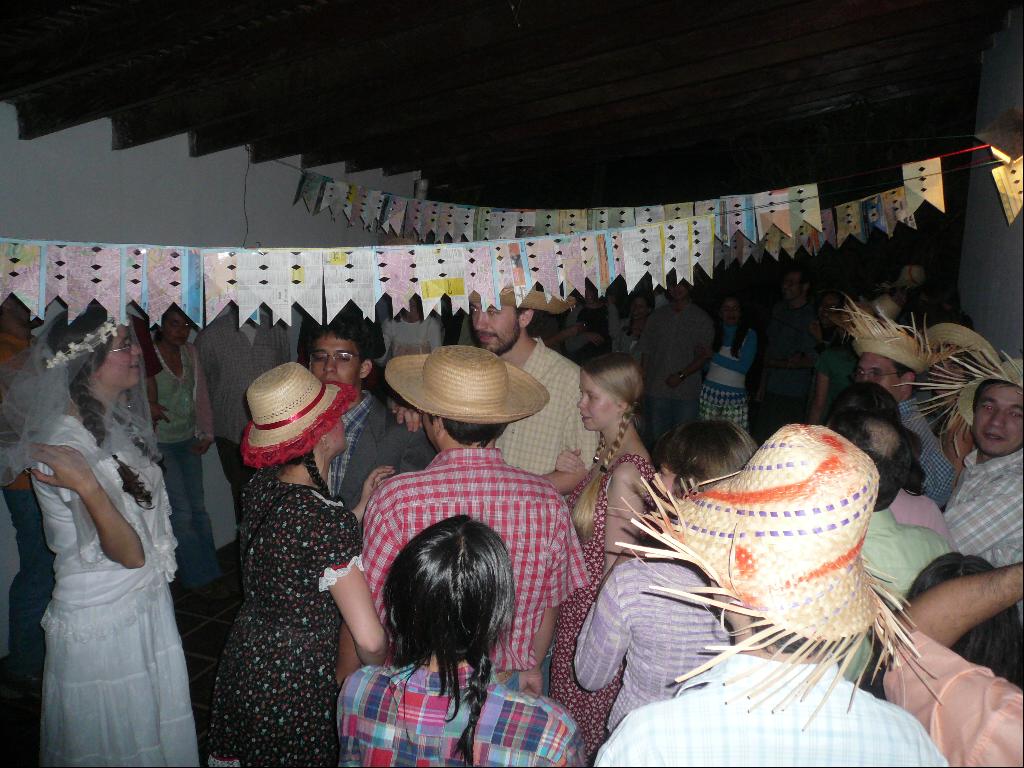
Anxieties over the changing meaning of the festival also reflect a growing "carnivalization" of the tradition. Rather than an emphasis on religion, the festival is presented as a massive gathering for both Brazilians and tourists with large concerts in major cities.
References
References
- Various Authors. (1999). "História da Festa Junina e tradiçõe".
- (2008). "Festas juninas, festas de São João: origens, tradições e história". Publishing Solutions.
- Bholi, Shelly. (June 28, 2017). "Festa junina – the Winter Fest of Brazil".
- Freyre, Gilberto. (1986). "The mansions and the shanties : the making of modern Brazil". University of California Press.
- Bastos, Ângela. (June 24, 2011). "Na maior festa de São João do mundo, público chega a 1,5 milhão de pessoas".
- (August 2007). "Festas juninas nas escolas: lições de preconceitos". Educação & Sociedade.
- Saryne, Bárbara. (2018-06-24). "Para especialista, festa junina não representa bem a cultura caipira".
- Moraes, Antonio Carlos Robert. (January 2003). "O Sertão". Terra Brasilis.
- Estúdio, Prima. (2010-07-01). "O modo de viver caipira".
- Packman, Jeff. (Fall 2014). "The Other Other Festa: June Samba and the Alternative Spaces of Bahia, Brazil's São João Festival and Industries". Black Music Research Journal.
This article was imported from Wikipedia and is available under the Creative Commons Attribution-ShareAlike 4.0 License. Content has been adapted to SurfDoc format. Original contributors can be found on the article history page.
Ask Mako anything about Festa Junina — get instant answers, deeper analysis, and related topics.
Research with MakoFree with your Surf account
Create a free account to save articles, ask Mako questions, and organize your research.
Sign up freeThis content may have been generated or modified by AI. CloudSurf Software LLC is not responsible for the accuracy, completeness, or reliability of AI-generated content. Always verify important information from primary sources.
Report