From Surf Wiki (app.surf) — the open knowledge base
Fermium
Fermium is a synthetic chemical element; it has symbol Fm and atomic number 100. It is an actinide and the heaviest element that can be formed by neutron bombardment of lighter elements, and hence the last element that can be prepared in macroscopic quantities, although pure fermium metal has not been prepared yet. A total of 20 isotopes are known, with 257Fm being the longest-lived with a half-life of 100.5 days.
Fermium was discovered in the debris of the first hydrogen bomb explosion in 1952, and named after Enrico Fermi, one of the pioneers of nuclear physics. Its chemistry is typical for the late actinides, with a preponderance of the +3 oxidation state but also an accessible +2 oxidation state. Owing to the small amounts of produced fermium and all of its isotopes having relatively short half-lives, there are currently no uses for it outside basic scientific research.
Discovery
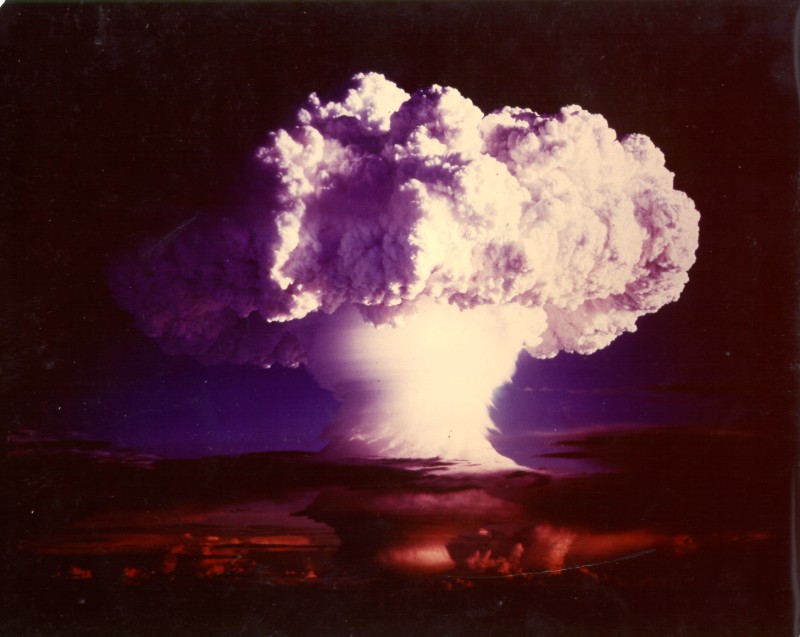
Fermium was first discovered in the fallout from the 'Ivy Mike' nuclear test (1 November 1952), the first successful test of a hydrogen bomb. Initial examination of the debris from the explosion had shown the production of a new isotope of plutonium, 244Pu: this could only have formed by the absorption of six neutrons by a uranium-238 nucleus followed by two β− decays. At the time, the absorption of neutrons by a heavy nucleus was thought to be a rare process, but the identification of 244Pu raised the possibility that still more neutrons could have been absorbed by the uranium nuclei, leading to new elements.
Element 99 (einsteinium) was quickly discovered on filter papers which had been flown through clouds from the explosion (the same sampling technique that had been used to discover 244Pu). It was then identified in December 1952 by Albert Ghiorso and co-workers at the University of California at Berkeley. They discovered the isotope 253Es (half-life ) that was made by the capture of 15 neutrons by uranium-238 nuclei – which then underwent seven successive beta decays:
Some 238U atoms, however, could capture another amount of neutrons (most likely, 16 or 17).
The discovery of fermium () required more material, as the yield was expected to be at least an order of magnitude lower than that of element 99, and so contaminated coral from the Enewetak atoll (where the test had taken place) was shipped to the University of California Radiation Laboratory in Berkeley, California, for processing and analysis. About two months after the test, a new component was isolated emitting high-energy α-particles () with a half-life of about a day. With such a short half-life, it could only arise from the β− decay of an isotope of einsteinium, and so had to be an isotope of the new element 100: it was quickly identified as 255Fm ().
The discovery of the new elements, and the new data on neutron capture, was initially kept secret on the orders of the U.S. military until 1955 due to Cold War tensions.{{cite journal | doi-access = free
The Berkeley team had been worried that another group might discover lighter isotopes of element 100 through ion-bombardment techniques before they could publish their classified research, and this proved to be the case. A group at the Nobel Institute for Physics in Stockholm independently discovered the element, producing an isotope later confirmed to be 250Fm () by bombarding a 238U target with 16O ions, and published their work in May 1954. Nevertheless, the priority of the Berkeley team was generally recognized, and with it the prerogative to name the new element in honour of Enrico Fermi, the developer of the first artificial self-sustained nuclear reactor. Fermi was still alive when the name was proposed, but had died by the time it became official.
Isotopes
Main article: Isotopes of fermium
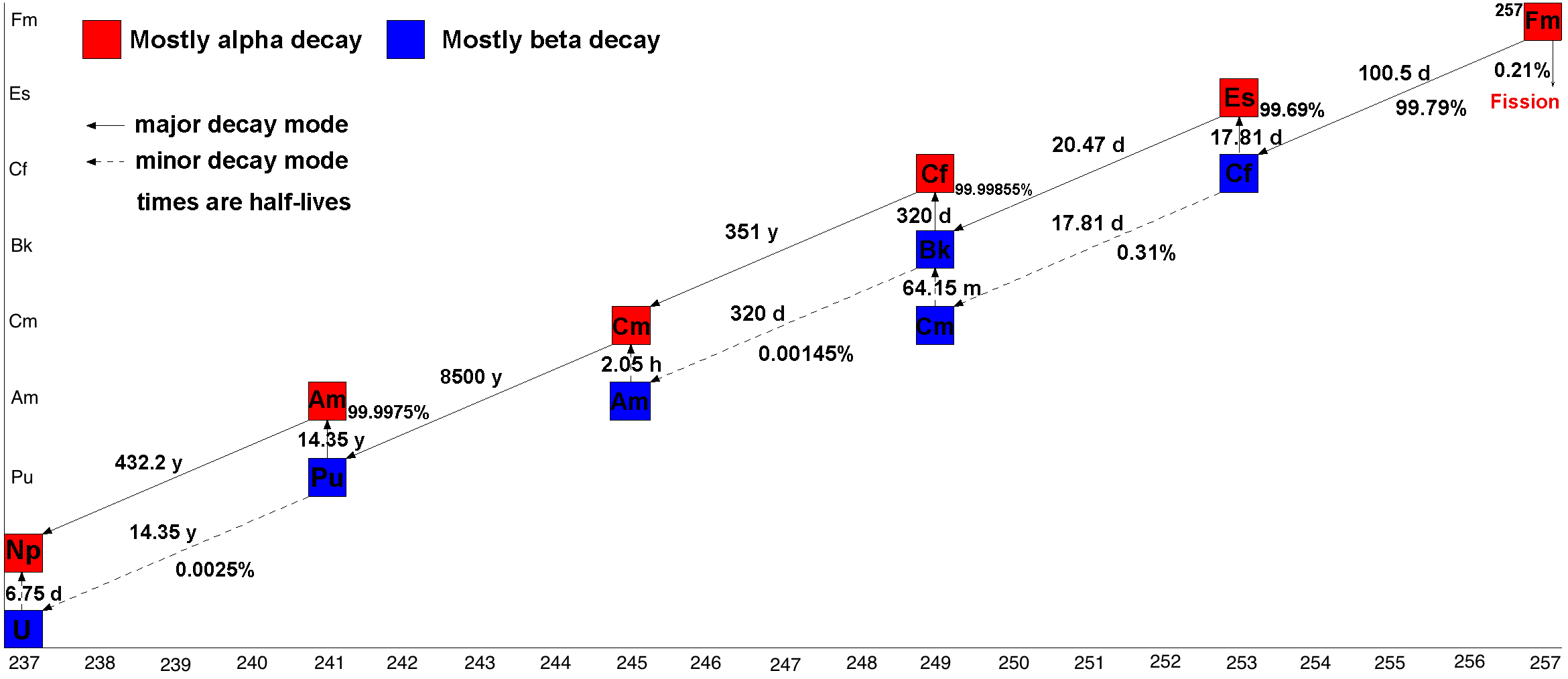
There are 20 known isotopes of fermium, with atomic weights of 241 to 260, of which Fm is the longest-lived with a half-life of 100.5 days. Other isotopes are considerably shorter: Fm has a half-life of 3 days, Fm of 25.4 h, Fm of 20.1 h, while Fm of 5.3 h, Fm of 3.2 h, and Fm of 2.67 hours. All the remaining ones have half-lives ranging from 30 minutes to less than a millisecond.
The neutron capture product of fermium-257, Fm, undergoes spontaneous fission with a half-life of just 370(14) microseconds; Fm and Fm also undergo spontaneous fission (t1/2 = 1.5(3) s and 4 ms respectively). This means that neutron capture does not create nuclides with a mass number greater than 257, unless carried out at extremely high flux, as in a nuclear explosion (or the astrophysical r-process), since no accessible fermium isotopes undergo beta minus decay to the next element, mendelevium. Because of this impediment in forming heavier isotopes, these short-lived isotopes Fm constitute the "fermium gap."
Deliberate attempts at nuclear explosion synthesis, however, also failed to create heavier nuclei, and as a result were deemed not worth continuing,
Occurrence
Production
Fermium is produced by the bombardment of lighter actinides with neutrons in a nuclear reactor. Fermium-257 is the heaviest isotope that is obtained via neutron capture, and can only be produced in picogram quantities. The major source is the 85 MW High Flux Isotope Reactor (HFIR) at the Oak Ridge National Laboratory in Tennessee, USA, which is dedicated to the production of transcurium (Z 96) elements. Lower mass fermium isotopes are available in greater quantities, though these isotopes (254Fm and 255Fm) are comparatively short-lived. In a "typical processing campaign" at Oak Ridge, tens of grams of curium are irradiated to produce decigram quantities of californium, milligram quantities of berkelium and einsteinium, and picogram quantities of fermium. However, nanogram{{cite journal|first1 = M.|last1 = Sewtz|first2 = H.|last2 = Backe|first3 = A.|last3 = Dretzke|first4 = G.|last4 = Kube|first5 = W.|last5 = Lauth|first6 = P.|last6 = Schwamb|first7 = K.|last7 = Eberhardt|first8 = C.|last8 = Grüning|first9 = P.|last10 = Trautmann|first10 = N.|last11 = Kunz|first11 = P.|last12 = Lassen|first12 = J.|last13 = Passler|first13 = G.|last14 = Dong|first14 = C.|last15 = Fritzsche|first15 = S.|last16 = Haire|first16 = R.|last9 = Thörle
After production, the fermium must be separated from other actinides and from lanthanide fission products. This is usually achieved by ion-exchange chromatography, with the standard process using a cation exchanger such as Dowex 50 or TEVA eluted with a solution of ammonium α-hydroxyisobutyrate. Smaller cations form more stable complexes with the α-hydroxyisobutyrate anion, and so are preferentially eluted from the column. A rapid fractional crystallization method has also been described.
Although the most stable isotope of fermium is 257Fm, with a half-life of 100.5 days, most studies are conducted on 255Fm (t1/2 = 20.07(7) hours), since this isotope can be easily isolated as required as the decay product of 255Es (t1/2 = 39.8(12) days).
Synthesis in nuclear explosions
The analysis of the debris at the 10-megaton Ivy Mike nuclear test was a part of long-term project, one of the goals of which was studying the efficiency of production of transuranium elements in high-power nuclear explosions. The motivation for these experiments was as follows: synthesis of such elements from uranium requires multiple neutron capture. The probability of such events increases with the neutron flux, and nuclear explosions are the most powerful neutron sources, providing densities on the order 10 neutrons/cm within a microsecond, i.e. about 10 neutrons/(cm·s). For comparison, the flux of the HFIR reactor is 5 neutrons/(cm·s). A dedicated laboratory was set up right at Enewetak Atoll for preliminary analysis of debris, as some isotopes could have decayed by the time the debris samples reached the U.S. The laboratory was receiving samples for analysis, as soon as possible, from airplanes equipped with paper filters which flew over the atoll after the tests. Whereas it was hoped to discover new chemical elements heavier than fermium, those were not found after a series of megaton explosions conducted between 1954 and 1956 at the atoll.
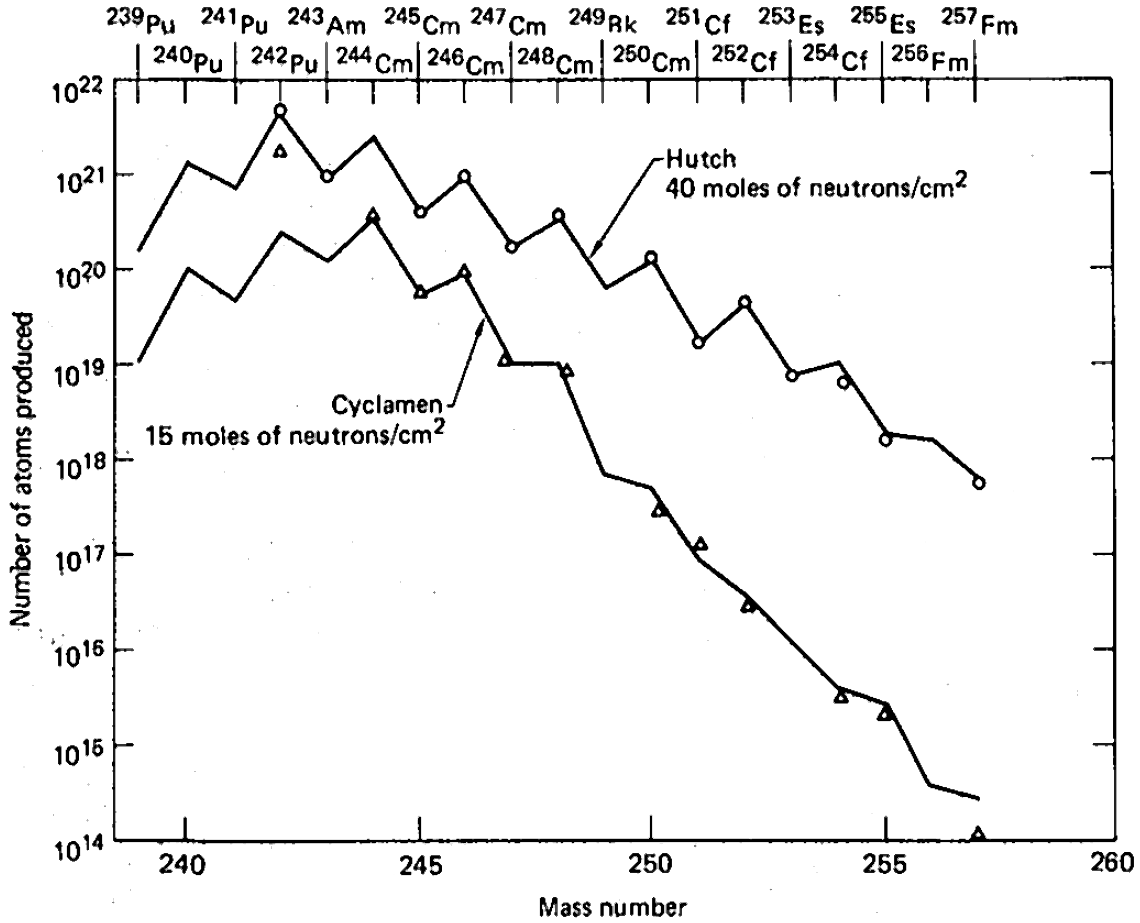
The atmospheric results were supplemented by the underground test data accumulated in the 1960s at the Nevada Test Site, as it was hoped that powerful explosions conducted in confined space might result in improved yields and heavier isotopes. Apart from traditional uranium charges, combinations of uranium with americium and thorium have been tried, as well as a mixed plutonium-neptunium charge. They were less successful in terms of yield (of material), which was attributed to stronger losses of heavy isotopes due to enhanced fission rates in heavy-element charges. Isolation of the products was found to be rather problematic, as the explosions were spreading debris through melting and vaporizing rocks under the great depth of 300–600 meters, and drilling to such depth in order to extract the products was both slow and inefficient in terms of collected volumes.
Among the nine underground tests, which were carried between 1962 and 1969 and codenamed Anacostia (5.2 kilotons, 1962), Kennebec (
Though no new elements (apart from einsteinium and fermium) could be detected in the nuclear test debris, and the total yields of transuranium elements were disappointingly low, these tests did provide significantly higher amounts of rare heavy isotopes than previously available in laboratories. For example, 6 atoms of Fm could be recovered after the Hutch detonation. They were then used in the studies of thermal-neutron induced fission of Fm and in discovery of a new fermium isotope Fm. Also, the rare isotope Cm was synthesized in large quantities, which is very difficult to produce in nuclear reactors from its progenitor Cm; the half-life of Cm (64 minutes) is much too short for months-long reactor irradiations, but is very "long" on the explosion timescale.
Natural occurrence
Because of the short half-life of all known isotopes of fermium, any primordial fermium, that is fermium present on Earth during its formation, has decayed by now. Synthesis of fermium from naturally occurring uranium and thorium in the Earth's crust requires multiple neutron captures, which is extremely unlikely. Therefore, most fermium is produced on Earth in laboratories, high-power nuclear reactors, or in nuclear tests, and is present for only a few months afterward.
The transuranic elements up to fermium should have been present in the natural nuclear fission reactor at Oklo, but any quantities produced then would have long since decayed away.
Chemistry
The chemistry of fermium has only been studied in solution using tracer techniques, and no solid compounds have been prepared. Under normal conditions, fermium exists in solution as the Fm3+ ion, which has a hydration number of 16.9 and an acid dissociation constant of 1.6 (pK = 3.8). Fm forms complexes with a wide variety of organic ligands with hard donor atoms such as oxygen, and these complexes are usually more stable than those of the preceding actinides. It also forms anionic complexes with ligands such as chloride or nitrate and, again, these complexes appear to be more stable than those formed by einsteinium or californium. It is believed that the bonding in the complexes of the later actinides is mostly ionic in character: the Fm ion is expected to be smaller than the preceding An ions because of the higher effective nuclear charge of fermium, and hence fermium would be expected to form shorter and stronger metal–ligand bonds.
Fermium(III) can be fairly easily reduced to fermium(II), for example with samarium(II) chloride, with which fermium(II) coprecipitates. In the precipitate, the compound fermium(II) chloride (FmCl) was produced, though it was not purified or studied in isolation. The electrode potential has been estimated to be similar to that of the ytterbium(III)/(II) couple, or about −1.15 V with respect to the standard hydrogen electrode, a value which agrees with theoretical calculations. The Fm/Fm couple has an electrode potential of −2.37(10) V based on polarographic measurements.
Toxicity
Though few people come in contact with fermium, the International Commission on Radiological Protection has set annual exposure limits for the two most stable isotopes. For fermium-253, the ingestion limit was set at 10 becquerels (1 Bq equals one decay per second), and the inhalation limit at 10 Bq; for fermium-257, at 10 Bq and 4,000 Bq respectively.
References
- "Einsteinium".
- [http://www.nrc-cnrc.gc.ca/eng/education/elements/el/fm.html Fermium – National Research Council Canada] {{webarchive. link. (2010-12-25 . Retrieved 2 December 2007)
- Ghiorso, Albert. (2003). "Einsteinium and Fermium". Chemical and Engineering News.
- (1956). "Transplutonium Elements in Thermonuclear Test Debris". Physical Review.
- (1954). "Transcurium Isotopes Produced in the Neutron Irradiation of Plutonium". Physical Review.
- (1954). "Nuclear Properties of Some Isotopes of Californium, Elements 99 and 100". Physical Review.
- (1954). "Element 100 Produced by Means of Cyclotron-Accelerated Oxygen Ions". Physical Review.
- (2000). "The Transuranium People: The Inside Story". [[World Scientific]].
- Silva, Robert J.. (2006). "The Chemistry of the Actinide and Transactinide Elements". Springer.
- {{Greenwood&Earnshaw1st
- {{NNDC
- (2013). "Future of superheavy element research: Which nuclei could be synthesized within the next few years?". Journal of Physics.
- Becker, Stephen Allan. (January 28, 2016). "Approximating the r-Process on Earth with Thermonuclear Explosions: Lessons Learned and Unanswered Questions".
- (2000). "Ullmann's Encyclopedia of Industrial Chemistry".
- "High Flux Isotope Reactor". Oak Ridge National Laboratory.
- (1997). "Fermium Purification Using Teva Resin Extraction Chromatography". Sep. Sci. Technol..
- (1970). "Engineering with Nuclear Explosives".
- (1956). "A new eluant for the separation of the actinide elements". J. Inorg. Nucl. Chem..
- (1983). "High-speed method for the separation of fermium from actinides and lanthanides". Radiokhimiya.
- Seaborg, p. 39
- Seaborg, p. 40
- [http://www.nv.doe.gov/library/publications/historical/DOENV_209_REV15.pdf United States Nuclear Tests July 1945 through September 1992] {{webarchive. link. (June 15, 2010 , DOE/NV--209-REV 15, December 2000)
- Seaborg, p. 43
- Seaborg, p. 44
- Seaborg, p. 47
- Emsley, John. (2011). "Nature's Building Blocks: An A-Z Guide to the Elements". Oxford University Press.
- (1989). "The enthalpy of sublimation and thermodynamic functions of fermium". The Journal of Chemical Physics.
- (1981). "Electromigration Method in Tracer Studies of Complex Chemistry. II. Hydrated Radii and Hydration Numbers of Trivalent Actinides". Acta Chemica Scandinavica A.
- (1972). Radiochem. Radioanal. Lett.
- (1954). "Chemical Properties of Elements 99 and 100". J. Am. Chem. Soc..
- Malý, Jaromír. (1967). "The amalgamation behaviour of heavy elements 1. Observation of anomalous preference in formation of amalgams of californium, einsteinium, and fermium". Inorg. Nucl. Chem. Lett..
- (1972). "Reduction of fermium to divalent state in chloride aqueous ethanolic solutions". Inorg. Nucl. Chem. Lett..
- (1979). "Non-observance of monovalent Md". J. Inorg. Nucl. Chem..
- (1992). "Dictionary of Inorganic Compounds". Chapman & Hall.
- (1977). "Determination of oxidation potential of the pair Fm{{sup". Inorg. Nucl. Chem. Lett..
- Nugent. L. J.. (1975). MTP Int. Rev. Sci.: Inorg. Chem.
- (1979). "Electrochemical study of mendelevium in aqueous solution: No evidence for monovalent ions". J. Inorg. Nucl. Chem..
- (2000). "Transuranium Elements, in Ullmann's Encyclopedia of Industrial Chemistry". Wiley.
This article was imported from Wikipedia and is available under the Creative Commons Attribution-ShareAlike 4.0 License. Content has been adapted to SurfDoc format. Original contributors can be found on the article history page.
Ask Mako anything about Fermium — get instant answers, deeper analysis, and related topics.
Research with MakoFree with your Surf account
Create a free account to save articles, ask Mako questions, and organize your research.
Sign up freeThis content may have been generated or modified by AI. CloudSurf Software LLC is not responsible for the accuracy, completeness, or reliability of AI-generated content. Always verify important information from primary sources.
Report