From Surf Wiki (app.surf) — the open knowledge base
Ferdinand II, Archduke of Austria
Archduke of Further Austria from 1564 to 1595

Archduke of Further Austria from 1564 to 1595
| Field | Value | ||||
|---|---|---|---|---|---|
| name | Ferdinand II | ||||
| succession | Archduke of Further Austria | ||||
| image | Archduke Ferdinand II of Further Austria.jpg | ||||
| caption | Portrait by Francesco Terzi | ||||
| reign | 25 July 1564 – 24 January 1595 | ||||
| predecessor | Ferdinand I | ||||
| successor | Matthias | ||||
| spouse | {{Plainlist | ||||
| * {{marriage | Philippine Welser | January 1557 | 24 April 1580 | end | d.}} |
| royal house | Habsburg | ||||
| father | Ferdinand I, Holy Roman Emperor | ||||
| mother | Anna of Bohemia and Hungary | ||||
| issue | {{Plainlist | ||||
| issue-link | #Children | ||||
| issue-pipe | more... | ||||
| birth_date | |||||
| birth_place | Linz, Archduchy of Austria, Holy Roman Empire | ||||
| death_date | |||||
| death_place | Innsbruck, County of Tyrol, Holy Roman Empire |
- Andrew, Margrave of Burgau
- Charles, Margrave of Burgau
- Archduchess Eleanor of Austria
- Archduchess Maria of Austria
- Anna, Holy Roman Empress | issue-link = #Children | issue-pipe = more... Ferdinand II, Archduke of Austria (14 June 1529 – 24 January 1595) was ruler of Further Austria and Imperial Count of Tyrol since 1564. The son of Ferdinand I, Holy Roman Emperor, he first married Philippine Welser, and later Anna Caterina Gonzaga. Through his second marriage he was the father of Anna of Tyrol, the future Holy Roman Empress.
Biography
Archduke Ferdinand of Austria was the second son of Ferdinand I, Holy Roman Emperor and Anna of Bohemia and Hungary. He was a younger brother of Emperor Maximilian II.
He grew up in Innsbruck, where his father governed the Austrian hereditary lands on behalf of Ferdinand's uncle Charles V.
Ferdinand was said to be the favorite son of his father. He was described by a visiting dignitary to court as "handsome and friendlier" than his brother Maximilian.
Ferdinand and his siblings were raised very strictly and given a thorough education. Among his teachers were Kaspar Ursinus Velius and Georg Tannstätter. Ferdinand and his brother were educated in languages, and other young noble boys were invited to court to be educated alongside the two archdukes. They were not to speak to them in German, only in Latin, Czech or other foreign languages.
Ferdinand was also instructed in the Catholic religion and their God-given right to rule, and that this was a gift based on the condition that they were to fear and love God.
At the behest of his father, he was put in charge of the administration of Bohemia in 1547. He also led the campaign against the Turks in Hungary in 1556.
In 1557, he was secretly married to Philippine Welser, daughter of a patrician from Augsburg, with whom he had several children. The marriage was only accepted by Emperor Ferdinand I in 1559 under the condition of secrecy. The children were to receive the name "of Austria" but would only be entitled to inherit if the House of Habsburg became totally extinct in the male line, and thus the marriage had many qualities of a morganatic marriage. The sons born of this marriage received the title Margrave of Burgau, an ancient Habsburg possession in Further Austria. The younger of the sons, who survived their father, later received the princely title of Fürst zu Burgau.
After his father's death in 1564, Ferdinand became the ruler of Tyrol and other Further Austrian possessions under his father's will. However, he remained governor of Bohemia in Prague until 1567, according to the wishes of his brother Maximilian II.

In his own lands, Ferdinand made sure that the Catholic Counter-Reformation would prevail. He also was instrumental in promoting the Renaissance in central Europe and was an avid collector of art. He accommodated his world-famous collections in a museum built specifically for that purpose, making Ambras Castle the oldest museum in the world, and as the only Renaissance Kunstkammer of its kind to have been preserved at its original location, the Chamber of Art and Curiosities at Ambras Castle represents an unrivalled cultural monument. The collection was started during Ferdinand's time in Bohemia, and he subsequently moved it to Tyrol. In particular, the Chamber of Art and Curiosities, the gallery of portraits, and the collection of armor were very expensive, leading Ferdinand to incur a high level of debt. Part of the collections remained in Innsbruck, and part ultimately was moved to the Kunsthistorisches Museum in Vienna.
After the death of his wife Philippine in 1580, he married his niece, Anna Caterina Gonzaga, a daughter of William I, Duke of Mantua, in 1582.
Archduke Ferdinand died on 24 January 1595. Since his sons from the first marriage were not entitled to the inheritance, and the second produced only surviving daughters, Tyrol was reunified with the other Habsburg lands. His daughter from the Mantuan marriage to Anna Caterina (later Anna Juliana) became Empress Anna, consort of Mathias, Holy Roman Emperor, who received his Further Austrian inheritance.
Children
.jpg)
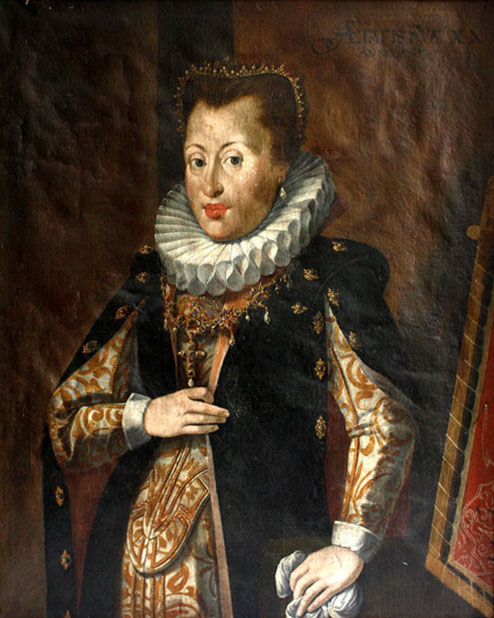
He and his first wife Philippine Welser were parents of four children:
- Margrave Andrew of Burgau (15 June 1558 – 12 November 1600). Became a cardinal in 1576, Margrave of Burgau in 1578, Bishop of Constance in 1589 and Bishop of Brixen in 1591. He had two illegitimate children.
- Charles, Margrave of Burgau (22 November 1560 – 30 October 1618), Margrave of Burgau. He married his first cousin, Sibylle (1557–1627), the youngest daughter of daughter of William, Duke of Jülich-Cleves-Berg (28 July 1516 – 5 January 1592), and Maria, Archduchess of Austria, daughter of Ferdinand I, Holy Roman Emperor. They had no legitimate children. He and his mistress Chiara Elisa di Ferrero had three illegitimate children.
- Philip of Austria (7 August 1562 – 9 January 1563), twin of Maria.
- Maria of Austria (7 August 1562 – 25 January 1563), twin of Philip.
On 14 May 1582, Ferdinand married his niece Anna Caterina Gonzaga. She was a daughter of William I, Duke of Mantua, and Eleonora of Austria, younger sister of Ferdinand. They were parents to three daughters:
- Archduchess Anna Eleonore of Austria (26 June 1583 – 15 January 1584).
- Archduchess Maria of Austria (16 June 1584 – 2 March 1649), a nun.
- Archduchess Anna of Austria (4 October 1585 – 14 December/15 December 1618); married her first cousin Matthias, Holy Roman Emperor.
He had at least two illegitimate children:
With Anna von Obrizon:
- Veronika von Villanders (1551–1589). Married Giovan Francesco di Gonzaga-Novellara, Lord of Campitello.
With Johanna Lydl von Mayenburg:
- Hans Christoph von Hertenberg (c. 1592 – 2 September 1613). Married Ursula Gienger.
Ancestors
Male-line family tree
Notes
References
- Jörg Konrad Hoensch. (1997). "Geschichte Böhmens: von der slavischen Landnahme bis zur Gegenwart". C.H.Beck.
- (30 January 2020). "Handel – Provenienz – Restitution: Tagungsband des Zwölften Heidelberger Kunstrechtstags am 20. und 24. Oktober 2018". Nomos Verlag.
- Taddei, Elena. (2021). "Anna Caterina Gonzaga (1566-1621): Erzherzogin von Österreich, Landesfürstin von Tirol und Klosterstifterin". Tyrolia-Verlag.
- "The Cardinals of the Holy Roman Church – Biographical Dictionary – Consistory of 19 November 1576".
- "Habsburg 4".
- [http://www.literature.at/viewer.alo?objid=11804&page=162&scale=3.33&viewmode=fullscreen Wurzbach: ''Anna Katherina von Mantua'', vol. 31. In: ''Biographisches Lexikon'', Vienna 1860, p. 154.]
- [https://web.archive.org/web/20110716125931/http://stamboom-boden.com/getperson.php?personID=I1083970800&tree=1 Stamboom-boden.com]
- [https://web.archive.org/web/20110716125944/http://stamboom-boden.com/getperson.php?personID=I1083970803&tree=1 Stamboom-boden.com]
- {{cite EB1911
- {{cite ADB. 54. 688. 696. Wladislaw II.. Priebatsch, Felix. ADB:Wladislaw II.
- {{BLKO. (1861)
- Boureau, Alain. (1995). "The Lord's First Night: The Myth of the Droit de Cuissage". The University of Chicago Press.
- (1877). "Revue de l'Agenais". Société académique d'Agen.
This article was imported from Wikipedia and is available under the Creative Commons Attribution-ShareAlike 4.0 License. Content has been adapted to SurfDoc format. Original contributors can be found on the article history page.
Ask Mako anything about Ferdinand II, Archduke of Austria — get instant answers, deeper analysis, and related topics.
Research with MakoFree with your Surf account
Create a free account to save articles, ask Mako questions, and organize your research.
Sign up freeThis content may have been generated or modified by AI. CloudSurf Software LLC is not responsible for the accuracy, completeness, or reliability of AI-generated content. Always verify important information from primary sources.
Report