From Surf Wiki (app.surf) — the open knowledge base
Fat cat
Slang for a wealthy and powerful person
Slang for a wealthy and powerful person
Fat cat is a political term originally describing a rich political donor, also called an angel or big-money man.
The New York Times has described fat cats as symbols of "a deeply corrupt campaign finance system riddled with loopholes", with Americans seeing them as recipients of the "perks of power", but able to "buy access, influence policy and even veto appointments".
It is also commonly used to describe a rich, powerful and greedy person who, due to ownership of large amounts of capital, is able to "live easy" off the work of others. In the United Kingdom, it is also used to refer to executives whose pay is deemed by others to be excessive.
History
The word was first used in the 1920s in the United States to describe rich political donors.
The term's coinage for political purposes has been attributed to Frank Kent, a writer for The Baltimore Sun{{cite web |author-link=David G. Farber
The 1960 campaign for the Democratic nomination to the presidency was marked by competition between fellow Senators Hubert Humphrey and John F. Kennedy. Their first meeting was in the Wisconsin primary, where Kennedy's well-organized and well-funded campaign defeated Humphrey's energetic but poorly funded effort. Humphrey objected to the media, "The Kennedy forces are waging a psychological blitz that I cannot match. I'm not the candidate of the fat cats."{{cite news |archive-url=https://web.archive.org/web/20101008074524/http://www.time.com/time/magazine/article/0,9171,826112,00.html |url-status=dead |archive-date=October 8, 2010
A 1972 book by sociologist G. William Domhoff, titled Fat Cats and Democrats, contrasted the Democratic Party's perceived populism with its funding structure. In Domhoff's view, "Short of a nationwide system of public financing for candidates ... it seems likely that wealthy fat cats will find one way or another to finance the candidates of their choice."{{cite web |author-link=G. William Domhoff
The campaign finance reforms following the Watergate scandal greatly reduced the amount of money that individuals could contribute to a political campaign. In the words of Ben J. Wattenberg, "The fat cats were driven from the temple".
During a 1997 $1,000-per-plate dinner at the Hilton Washington for the Republican Party, which The New York Times dubbed "a lucrative display of the resilience of big-money campaign fund-raising", street protesters calling for further reform dressed in "fat cat" costumes and chanted "Hey, hey, ho, ho! Corporate fat cats have to go!" In the 2008 Democratic race, a group of wealthy backers of Sen. Hillary Clinton wrote to Speaker of the House Nancy Pelosi, warning her they might withdraw financial support for the Democratic Congressional Campaign Committee if Pelosi did not change her position on whether the party's superdelegates "should support the party's pledged delegate leader".{{cite news
Use in culture and imagery
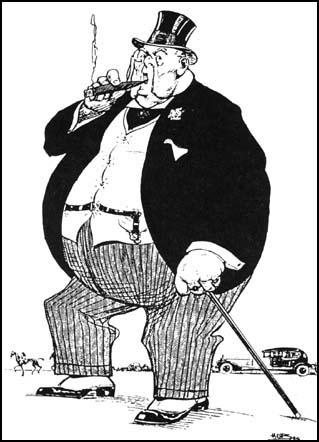
The word has since acquired a meaning of a rich, powerful person of possibly "undeserved" wealth. It is now commonly used in editorial cartoons. In the British printed media, a fat cat is often depicted as a cat-faced, corpulent, middle-aged man clad in a pin striped suit and holding or smoking a thick cigar, representing a venal banker or a high earner executive or "captain of industry".
It is also a term familiar with musicians. James Brown's 1973 song "Down and Out in New York City" includes the lyrics "All the fat cats, in the bad hats". Muse's 2009 song "Uprising" also references the term in its lyrics: "Rise up and take the power back; it's time the fat cats have a heart attack". The punk band NOFX repeatedly uses the term in their song "Perfect Government" on their album Punk in Drublic ("How did the cat get so fat?").
References
References
- (November 29, 1971). "Of Fat Cats and Other Angels".
- Richard L. Berke. (February 17, 2002). "Money Talks; Don't Discount the Fat Cats". [[The New York Times]].
- (October 9, 2003). "Fat cats feeding". The Economist.
- ''Fat Cat'', in Ayto, John (2006). ''Movers and Shakers: A Chronology of Words that Shaped Our Age'', [[Oxford University Press]]
- [http://www.merriam-webster.com/dictionary/fat+cat Merriam Webster Online], ''fat cat''
- Jean Hardisty. (1999). "Mobilizing Resentment: Conservative Resurgence from the John Birch Society to the Promise Keepers". [[Beacon Press]].
- Ben J. Wattenberg. (1984). "The Good News is the Bad News is Wrong". [[Simon & Schuster]].
- Francis X. Clines. (May 14, 1997). "A Dining-for-Dollars Gala Fattens the G.O.P.'s Coffers". [[The New York Times]].
- Lindsay Renick Mayer. (March 27, 2008). "Democratic Donors Send $24 Million Letter to Pelosi". [[OpenSecrets]].
- Bell, Steve. (July 27, 2002). "The crusade against the corporate frod". [[The Guardian]].
- "I'm Still Here!".
- (2003-04-04). "Dr. Fun Cartoon – April 4, 2003". [[Dr. Fun]].


This article was imported from Wikipedia and is available under the Creative Commons Attribution-ShareAlike 4.0 License. Content has been adapted to SurfDoc format. Original contributors can be found on the article history page.
Ask Mako anything about Fat cat — get instant answers, deeper analysis, and related topics.
Research with MakoFree with your Surf account
Create a free account to save articles, ask Mako questions, and organize your research.
Sign up freeThis content may have been generated or modified by AI. CloudSurf Software LLC is not responsible for the accuracy, completeness, or reliability of AI-generated content. Always verify important information from primary sources.
Report