From Surf Wiki (app.surf) — the open knowledge base
Fasciotomy
Surgical cutting of connective tissue (fascia) to restore blood circulation in an area
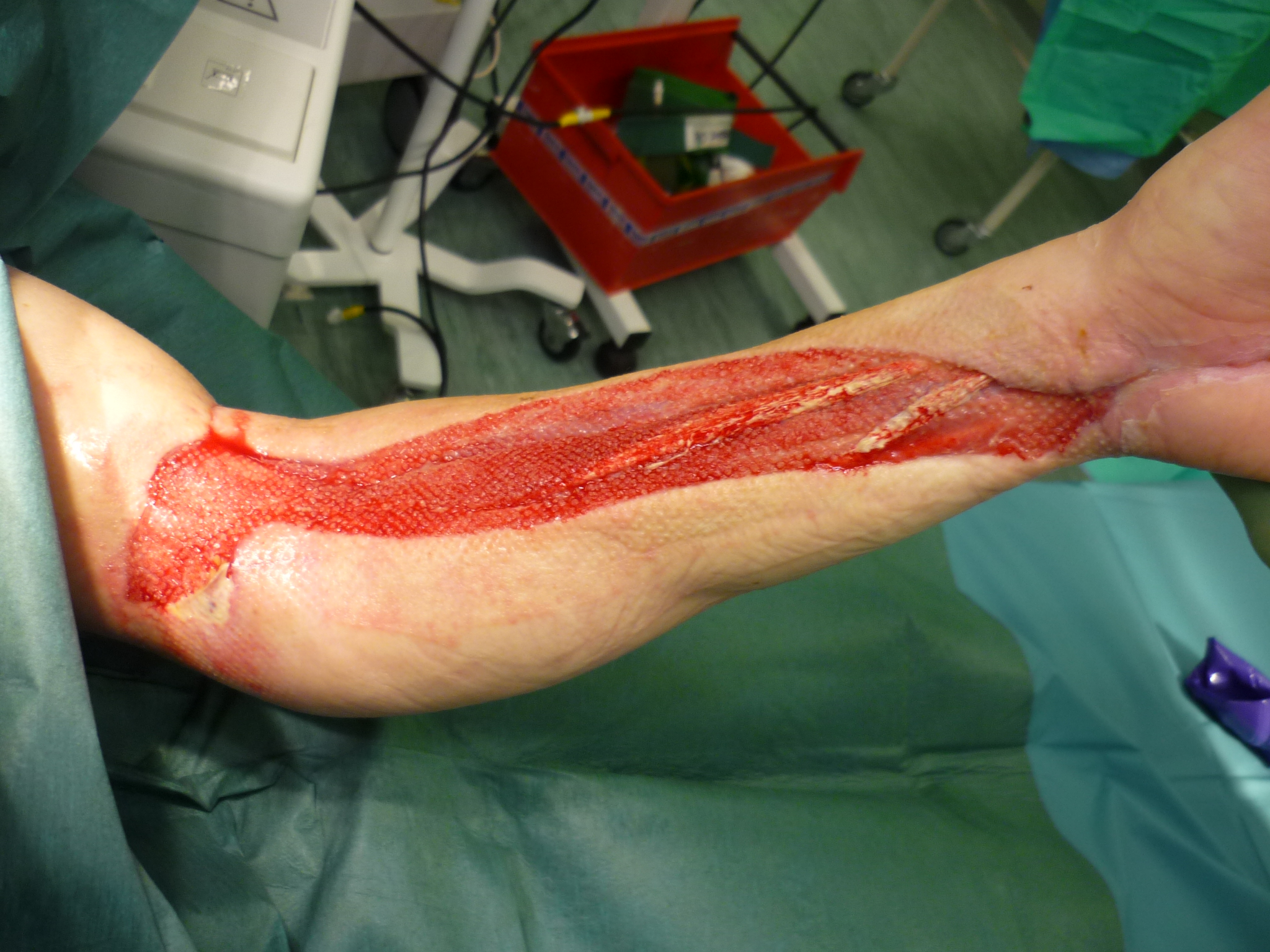
Surgical cutting of connective tissue (fascia) to restore blood circulation in an area
| Field | Value |
|---|---|
| Name | Fasciotomy |
| Image | Fasciotomy leg.jpg |
| Caption | Once the pressure is reduced, the fasciotomy is covered with a skin graft. |
| ICD9unlinked |
Fasciotomy or fasciectomy is a surgical procedure where a fascia is cut to relieve tension or pressure in order to treat the resulting loss of circulation to an area of tissue or muscle. Fasciotomy is a limb-saving procedure when used to treat acute compartment syndrome. It is also sometimes used to treat chronic compartment stress syndrome. The procedure has a very high rate of success, with the most common problem being accidental damage to a nearby nerve.
Indications
Compartment syndrome is one of the conditions where a fasciotomy may be indicated. People who are likely to have injuries needing a fasciotomy include the following:
- Crush injuries
- Athletes who have sustained one or more serious impact injuries
- People with severe burns
- People who are severely overweight
- Snakebite victims, but very rarely
Complications
A delay in performing the procedure can lead to neurovascular complications or lead to the need for amputation of a limb. Complications can also involve the formation of scar tissue after the operation. A thickening of the surgical scars can result in the loss of mobility of the joint involved. This can be addressed through occupational or physical therapy.
Process
.jpg)
Fasciotomy in the limbs is usually performed by a surgeon under general or regional anesthesia. An incision is made in the skin, and a small area of fascia is removed where it will best relieve pressure.
Plantar fasciotomy is an endoscopic procedure. The physician makes two small incisions on either side of the heel. An endoscope is inserted in one incision to guide the physician. A tiny knife is inserted in the other. A portion of the fascia near the heel is removed. The incisions are then closed.
In addition to scar formation, there is a possibility that the surgeon may need to use a skin graft to close the wound. Sometimes when closing the fascia again in another surgical procedure, the muscle is still too large to close it completely. A small bulge is visible but is not harmful. It takes a much longer time to heal and, in some cases, takes several months.
References
References
- (October 2009). "Fasciotomy". Current Problems in Surgery.
- "Compartment syndrome: MedlinePlus Medical Encyclopedia". Nlm.nih.gov.
- (February 3, 2011). "Unified treatment algorithm for the management of crotaline snakebite in the United States: results of an evidence-informed consensus workshop". BMC Emergency Medicine.
This article was imported from Wikipedia and is available under the Creative Commons Attribution-ShareAlike 4.0 License. Content has been adapted to SurfDoc format. Original contributors can be found on the article history page.
Ask Mako anything about Fasciotomy — get instant answers, deeper analysis, and related topics.
Research with MakoFree with your Surf account
Create a free account to save articles, ask Mako questions, and organize your research.
Sign up freeThis content may have been generated or modified by AI. CloudSurf Software LLC is not responsible for the accuracy, completeness, or reliability of AI-generated content. Always verify important information from primary sources.
Report