From Surf Wiki (app.surf) — the open knowledge base
Fars province
Province of Iran

Province of Iran
| Field | Value | ||||||
|---|---|---|---|---|---|---|---|
| name | Fars | ||||||
| native_name | fa | ||||||
| settlement_type | Province | ||||||
| image_skyline | {{multiple image | ||||||
| border | infobox | ||||||
| total_width | 300 | ||||||
| perrow | 1/1/2/2/2 | ||||||
| image1 | Persepolis Panorama 360 Virtual Reality Tachar castle.jpg | ||||||
| alt1 | Persepolis | ||||||
| image2 | Tomb of Cyrus the Great (cropped 4-3).jpg | ||||||
| alt2 | Tomb of Cyrus the Great | ||||||
| image3 | Sa'adi Shrine 04.jpg | ||||||
| alt3 | Sa'adi Shrine | ||||||
| image4 | Shiraz.jpg | ||||||
| alt4 | Hafeziyeh | ||||||
| image5 | Arg of Karim Khan 015.jpg | ||||||
| alt5 | Arg of Karim Khan | ||||||
| image6 | Madreseh Khan.JPG | ||||||
| alt6 | Madreseh Khan | ||||||
| image7 | Bishapur-Iran-ninara01.jpg | ||||||
| alt7 | Bishapur | ||||||
| image8 | Iran - Pars Province - Sadeh - Tang Boragh - panoramio (1).jpg | ||||||
| alt8 | Tang Boragh | ||||||
| image_map | IranFars-SVG.svg | ||||||
| mapsize | 250px | ||||||
| map_caption | Location of Fars Province within Iran | ||||||
| coordinates | |||||||
| coordinates_footnotes | |||||||
| subdivision_type | Country | ||||||
| subdivision_name | Iran | ||||||
| subdivision_type1 | Region | ||||||
| subdivision_name1 | Region 2 | ||||||
| established_title | Parsa | ||||||
| seat_type | Capital | ||||||
| seat | Shiraz | ||||||
| parts_type | Counties | ||||||
| parts_style | para | ||||||
| p1 | 37 | ||||||
| leader_party | Independent | ||||||
| leader_title | Governor-general | ||||||
| leader_name | Hossein-Ali Amiri | ||||||
| unit_pref | Metric | ||||||
| area_total_km2 | 122608 | ||||||
| population_footnotes | |||||||
| population_total | 4851274 | ||||||
| population_as_of | 2016 | ||||||
| population_density_km2 | auto | ||||||
| timezone1 | IRST | ||||||
| utc_offset1 | +03:30 | ||||||
| area_code | 071 | ||||||
| iso_code | IR-07 | ||||||
| blank_name_sec1 | Main language(s) | ||||||
| blank_info_sec1 | {{Plain list | ||||||
| * Luri<ref>{{cite web | url | http://www.ichto.ir:80/Default.aspx?tabid=464 | archive-url=https://web.archive.org/web/20120111112450/http://www.ichto.ir/Default.aspx?tabid=464 | url-status=dead | archive-date=11 January 2012 | title=پرتال سازمان ميراث فرهنگي، صنایع دستی و گردشگري استانها فارس آداب و رسوم | date=11 January 2012}} |
| population_est | 5051000 | ||||||
| pop_est_as_of | 2020 |
- Persian
- Qashqai
- Luri
- Dialects of Fars
|2006|4220721 |2011|4596658 |2016|4851274
Fars Province, (Ostâne Fârs in Romanized Persian), historically known as Pars, Farsistan, and Persis, is one of the 31 provinces of Iran. Its capital is the city of Shiraz.
Fars province has an area of 122,400 km2 and is located in Iran's southwest, in Region 2. It neighbours the provinces of Bushehr to the west, Hormozgan to the south, Kerman and Yazd to the east, Isfahan to the north, and Kohgiluyeh and Boyer-Ahmad to the northwest.
Etymology
The Persian word Fârs (فارس), derived from the earlier form Pârs (پارس), which is in turn derived from peo (𐎱𐎠𐎼𐎿), the native Old Persian name for the region and the source of the Ancient Greek word Persis. The English word Persia also originates from this region, ultimately through the Ancient Greek Persis.
Pars is the historical homeland of the Persian people. It was the homeland of the Achaemenid and Sasanian Persian dynasties of Iran, who reigned on the throne by the time of the ancient Persian Empires. The ruins of the Achaemenid capitals Pasargadae and Persepolis, among others, demonstrate the ancient history of the region. Due to the historical importance of this region, the entire country has historically been also referred to as Persia in the West. Prior to caliphate rule, this region was known as Pars.
History
Persis
Main article: Persis, Pars (Sasanian province)
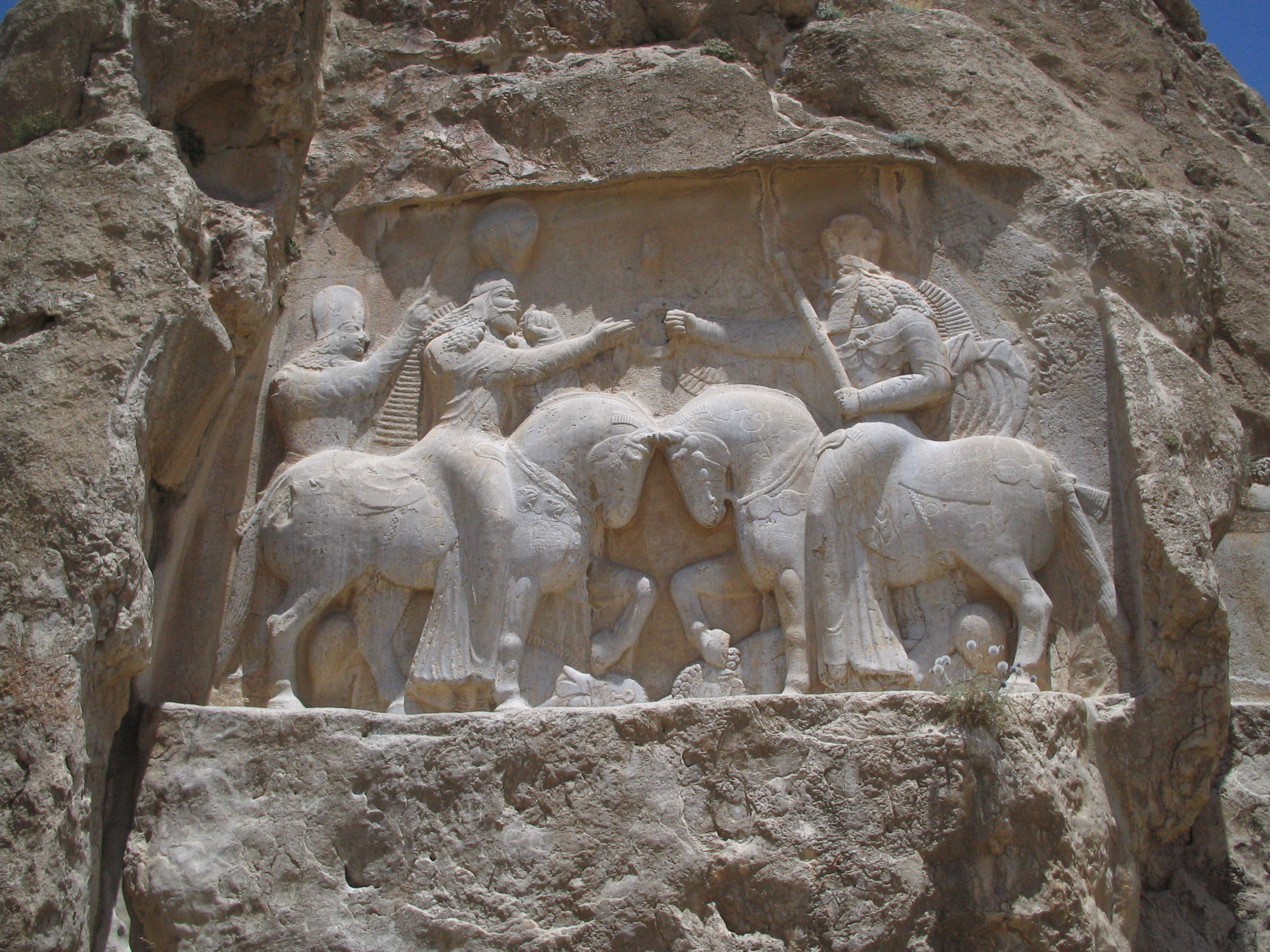
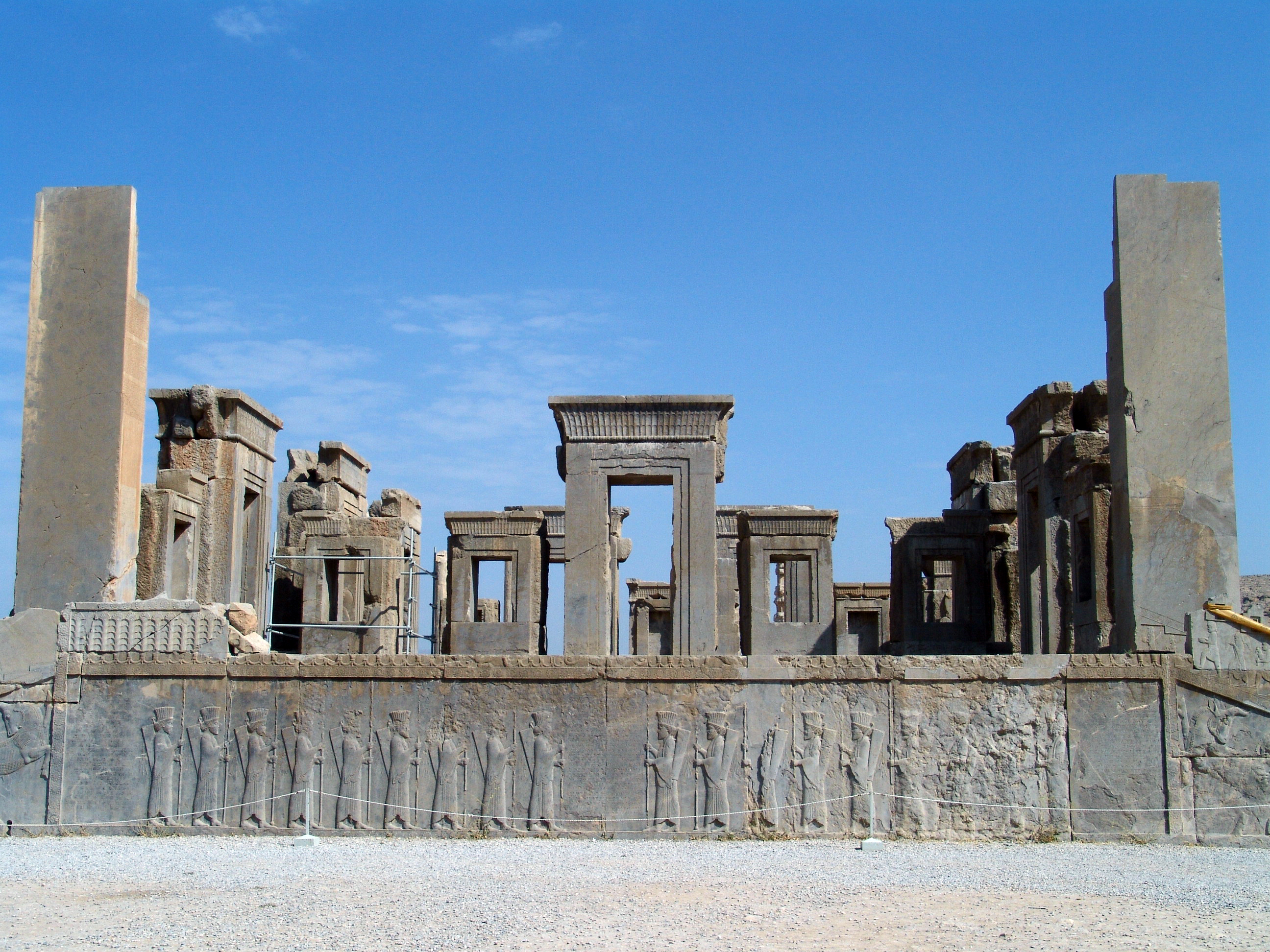
The ancient Persians were present in the region from about the 10th century BC, and became the rulers of the largest empire the world had yet seen under the Achaemenid dynasty which was established in the mid 6th century BC, at its peak stretching from Thrace-Macedonia, Bulgaria-Paeonia and Eastern Europe proper in the west, to the Indus Valley in its far east. The ruins of Persepolis and Pasargadae, two of the four capitals of the Achaemenid Empire, are located in Pars.
The Achaemenid Empire was defeated by Alexander the Great in 333 BC, incorporating most of their vast empire. Shortly after this the Seleucid Empire was established. However, it never extended its power in Pars beyond the main trade routes, and by the reign of Antiochus I or possibly later Persis emerged as an independent state that minted its own coins.
The Seleucid Empire was subsequently defeated by the Parthians in 238 BC, but by 205 BC, the Seleucid king Antiochus III had extended his authority into Persis and it ceased to be an independent state.
Babak was the ruler of a small town called Kheir. Babak's efforts in gaining local power at the time escaped the attention of Artabanus IV, the Parthian Arsacid Emperor of the time. Babak and his eldest son Shapur I managed to expand their power over all of Persis.
The subsequent events are unclear. Following the death of Babak around 220, Ardashir who at the time was the governor of Darabgird, got involved in a power struggle of his own with his elder brother Shapur. The sources tell us that in 222, Shapur was killed when the roof of a building collapsed on him.
At this point, Ardashir moved his capital further to the south of Persis and founded a capital at Ardashir-Khwarrah (formerly Gur, modern day Firouzabad). After establishing his rule over Persis, Ardashir I rapidly extended the territory of his Sassanid Persian Empire, demanding fealty from the local princes of Pars, and gaining control over the neighboring provinces of Kerman, Isfahan, Susiana, and Mesene.
Artabanus marched a second time against Ardashir I in 224. Their armies clashed at Hormizdegan, where Artabanus IV was killed. Ardashir was crowned in 226 at Ctesiphon as the sole ruler of Persia, bringing the 400-year-old Parthian Empire to an end, and starting the virtually equally long rule of the Sassanian Empire, over an even larger territory, once again making Persia a leading power in the known world, only this time along with its arch-rival and successor to Persia's earlier opponents (the Roman Republic and the Roman Empire); the Byzantine Empire.
The Sassanids ruled for 425 years, until the Muslim armies conquered the empire. Afterwards, the Persians started to convert to Islam, this making it much easier for the new Muslim empire to continue the expansion of Islam.
Persis then passed hand to hand through numerous dynasties, leaving behind numerous historical and ancient monuments; each of which has its own values as a world heritage, reflecting the history of the province, Iran, and West Asia. The ruins of Bishapur, Persepolis, and Firouzabad are all reminders of this. The Arab invaders brought about an end to centuries of Zoroastrian political and cultural dominance over the region; supplanted as the faith of the ruling class in the 7th century by Islam, which and over the next 200 years gradually expanded to include a majority of the population.
Demographics
Language and ethnicity
The main ethnic group in the province consists of indigenous Persians (including Larestani people and the Basseri), while Qashqai, Lurs, Arabs, Kurds, Georgians, and Circassians constitute minorities.

Due to the geographical characteristics of Fars and its proximity to the Persian Gulf, Fars has long been a residing area for various peoples and rulers of Iran. However, the tribes of Fars including, Mamasani Lurs, Khamseh and Kohkiluyeh have kept their native and unique cultures and lifestyles which constitute part of the cultural heritage of Iran attracting many tourists. Kurdish tribes include Uriad, Zangana, Chegini, Kordshuli and Kuruni.
Among the hundreds of thousands of Georgians and Circassians that were transplanted to Persia under Shah Abbas I, his predecessors, and successors, a certain amount of them were to guard the main caravan routes; many were settled around Āspās and other villages along the old Isfahan-Shiraz road. By now the vast majority Caucasians that were settled in Pars have lost their cultural, linguistic, and religious identity, having mostly been assimilated into the population.
Population
At the time of the 2006 National Census, the province's population was 4,220,721 people in 1,014,690 households. The following census in 2011 counted 4,596,658 people in 1,250,135 households, of whom 67.6% were registered as urban dwellers (urban/suburbs), 32.1% villagers (small town/rural), and 0.3% nomad tribes. The 2016 census measured the population of the province as 4,851,274 people in 1,443,027 households.
Administrative divisions
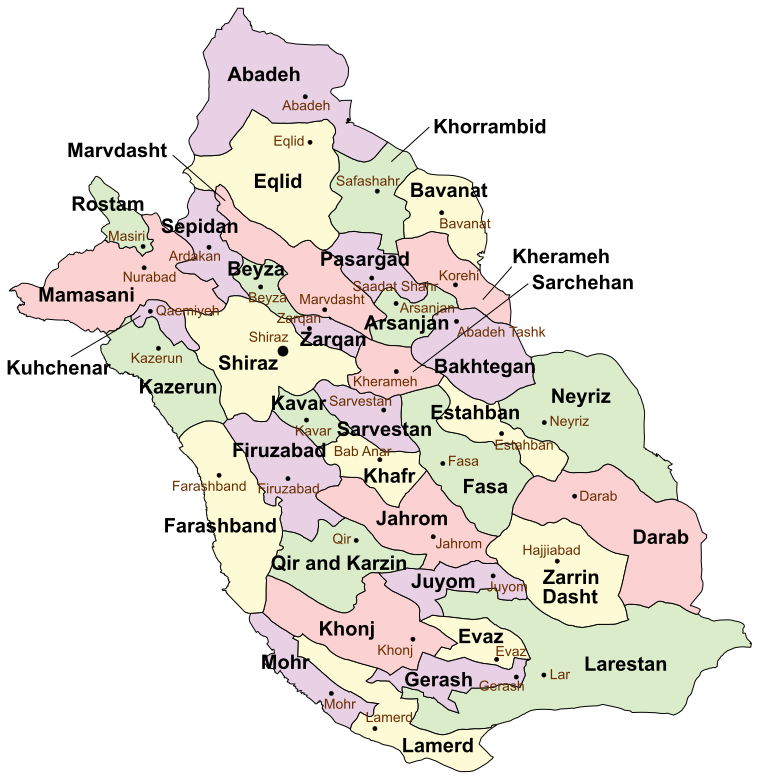
The population history and structural changes of Fars province's administrative divisions over three consecutive censuses are shown in the following table.
| Counties | 2006 | 2011 | 2016 |
|---|---|---|---|
| Abadeh | 87,203 | 98,188 | 100,831 |
| Arsanjan | 40,916 | 41,476 | 42,725 |
| Bakhtegan | — | — | — |
| Bavanat | 44,069 | 48,416 | 50,418 |
| Beyza | — | — | — |
| Darab | 172,938 | 189,345 | 201,489 |
| Eqlid | 99,003 | 93,975 | 93,763 |
| Estahban | 66,391 | 66,172 | 68,850 |
| Evaz | — | — | — |
| Farashband | 38,679 | 42,760 | 45,459 |
| Fasa | 188,189 | 203,129 | 205,187 |
| Firuzabad | 111,973 | 119,721 | 121,417 |
| Gerash | — | 47,055 | 53,907 |
| Jahrom | 197,331 | 209,312 | 228,532 |
| Juyom | — | — | — |
| Kavar | — | 77,836 | 83,883 |
| Kazerun | 258,097 | 254,704 | 266,217 |
| Khafr | — | — | — |
| Kharameh | — | 61,580 | 54,864 |
| Khonj | 37,978 | 41,133 | 41,359 |
| Khorrambid | 44,669 | 50,252 | 50,522 |
| Kuhchenar | — | — | — |
| Lamerd | 76,971 | 83,916 | 91,782 |
| Larestan | 223,235 | 226,879 | 213,920 |
| Mamasani | 162,694 | 116,386 | 117,527 |
| Marvdasht | 294,621 | 307,492 | 323,434 |
| Mohr | 54,094 | 59,727 | 64,827 |
| Neyriz | 105,241 | 113,750 | 113,291 |
| Pasargad | 29,825 | 31,504 | 30,118 |
| Qir and Karzin | 61,432 | 65,045 | 71,203 |
| Rostam | — | 46,851 | 44,386 |
| Sarchehan | — | — | — |
| Sarvestan | — | 40,531 | 38,114 |
| Sepidan | 87,801 | 89,398 | 91,049 |
| Shiraz | 1,676,927 | 1,700,687 | 1,869,001 |
| Zarqan | — | — | — |
| Zarrin Dasht | 60,444 | 69,438 | 73,199 |
| **Total** | **4,220,721 ** | **4,596,658** | **4,851,274** |
Cities



According to the 2016 census, 3,401,675 people (over 70% of the population of Pars province) live in the following cities:
| City | Population |
|---|---|
| Abadeh | 59,116 |
| Abadeh Tashk | 7,379 |
| Ahel | 3,179 |
| Alamarvdasht | 4,068 |
| Ardakan | 14,633 |
| Arsanjan | 17,706 |
| Asir | 3,042 |
| Bab Anar | 7,061 |
| Baba Monir | 1,379 |
| Bahman | 7,568 |
| Baladeh | 5,972 |
| Banaruiyeh | 9,077 |
| Beyram | 7,300 |
| Beyza | 7,252 |
| Darab | 70,232 |
| Darian | 10,037 |
| Dehram | 3,468 |
| Dezhkord | 3,924 |
| Do Borji | 2,907 |
| Dobiran | 13,809 |
| Duzeh | 1,348 |
| Efzar | 2,657 |
| Emad Deh | 4,235 |
| Emam Shahr | 5,803 |
| Eqlid | 44,341 |
| Eshkanan | 9,115 |
| Estahban | 36,410 |
| Evaz | 19,987 |
| Fadami | 4,097 |
| Farashband | 20,320 |
| Fasa | 110,825 |
| Firuzabad | 65,417 |
| Galleh Dar | 13,448 |
| Gerash | 34,469 |
| Hajjiabad | 21,675 |
| Hamashahr | 3,852 |
| Hasanabad | 2,045 |
| Hesami | 3,131 |
| Ij | 6,246 |
| Izadkhast | 5,910 |
| Jahrom | 141,634 |
| Jannat Shahr | 13,598 |
| Juyom | 8,010 |
| Kamfiruz | 3,713 |
| Karzin | 8,841 |
| Kavar | 31,711 |
| Kazerun | 96,683 |
| Khaneh Zenyan | 4,027 |
| Khaniman | 3,020 |
| Khavaran | 4,332 |
| Kherameh | 18,477 |
| Khesht | 9,599 |
| Khonj | 19,217 |
| Khumeh Zar | 6,220 |
| Khur | 7,338 |
| Khuzi | 3,245 |
| Konartakhteh | 6,081 |
| Korehi | 3,954 |
| Kuhenjan | 3,281 |
| Kupon | 3,237 |
| Lamerd | 29,380 |
| Lapui | 8,985 |
| Lar | 62,045 |
| Latifi | 7,300 |
| Madar-e Soleyman | 1,546 |
| Marvdasht | 148,858 |
| Masiri | 9,031 |
| Mazayjan | 3,567 |
| Meshkan | 4,617 |
| Meymand | 10,120 |
| Miyan Deh | 5,912 |
| Mobarakabad | 4,707 |
| Mohr | 7,784 |
| Neyriz | 49,850 |
| Now Bandegan | 2,410 |
| Nowdan | 2,892 |
| Nujin | 3,769 |
| Nurabad | 57,058 |
| Qaderabad | 14,973 |
| Qaemiyeh | 26,918 |
| Qarah Bolagh | 6,772 |
| Qatruyeh | 2,895 |
| Qir | 20,010 |
| Qotbabad | 7,476 |
| Ramjerd | 2,550 |
| Runiz | 5,760 |
| Saadat Shahr | 17,131 |
| Safashahr | 26,933 |
| Sarvestan | 18,187 |
| Sedeh | 6,747 |
| Seyyedan | 8,574 |
| Shahr-e Pir | 8,927 |
| Shahr-e Sadra | 91,863 |
| Sheshdeh | 5,960 |
| **Shiraz** | 1,565,572 |
| Soghad | 12,582 |
| Soltanabad | 1,928 |
| Surian | 9,776 |
| Surmaq | 3,050 |
| Varavi | 4,622 |
| Zahedshahr | 9,719 |
| Zarqan | 32,261 |
Most populous cities
The following sorted table lists the most populous cities in Pars according to the 2016 census results announced by the Statistical Center of Iran.
| Rank | City | County | Population |
|---|---|---|---|
| 1 | **Shiraz** | Shiraz | 1,565,572 |
| 2 | **Marvdasht** | Marvdasht | 148,858 |
| 3 | **Jahrom** | Jahrom | 141,634 |
| 4 | **Fasa** | Fasa | 110,825 |
| 5 | **Kazerun** | Kazerun | 96,683 |
| 6 | **Sadra** | Shiraz | 91,863 |
| 7 | **Darab** | Darab | 70,232 |
| 8 | **Firuzabad** | Firuzabad | 65,417 |
| 9 | **Lar** | Larestan | 62,045 |
| 10 | **Abadeh** | Abadeh | 59,116 |
Climate and wildlife
There are three distinct climatic regions in the Pars province. First, the mountainous area of the north and northwest with moderate cold winters and mild summers. Secondly, the central regions, with relatively rainy mild winters, and hot dry summers. The third region located in the south and southeast has cold winters with hot summers. The average temperature of Shiraz is 16.8 °C, ranging between 4.7 °C and 29.2 °C.
The geographical and climatic variation of the province causes varieties of plants; consequently, variation of wildlife has been formed in the province. Additional to the native animals of the province, many kinds of birds migrate to the province every year. Many kinds of ducks, storks and swallows migrate to this province in an annual parade. The main native animals of the province are gazelle, deer, mountain wild goat, ram, ewe and many kinds of birds. In the past, like in Khuzestan Plain, the Persian lion had occurred here.
The province of Pars includes many protected wildlife zones. The most important protected zones are:
- Toot Siah (Black Berry) Hunt Forbidden Zone, which is located at the end of Boanat region.
- Basiran Hunt Forbidden Zone, which is located 4 kilometers south to Abadeh;
- Bamu National Park, which is located north-east of Shiraz;
- Estahban Forest Park (Parke Jangaly), which is located on the outskirts of Touraj mountain;
- Hermoodlar Protected Zone, which is located east to Larestan. Arjan Meadow 22 km2 and Lake Parishan 40 km2 are designated Wetlands of International Importance under the Ramsar convention.

Economy
Agriculture is of great importance in Pars. The major products include cereal (wheat and barley), citrus fruits, dates, sugar beets and cotton. Pars has major petrochemical facilities, along with an oil refinery, a factory for producing tires, a large electronics industry, and a sugar mill. Tourism is also a large industry in the province. UNESCO has designated an area in the province, called Arzhan (known as Dasht e Arjan) as a biosphere reserve. Shiraz, provincial capital of Pars, is the namesake of Shirazi wine. A large number of wine factories existed in the city.
Transportation
Shiraz Airport is the main international airport of the province and the second in the country. The cities of Jahrom, Lar and Lamerd also have airports linking them with Shiraz and Tehran and nearby Persian Gulf countries such as the UAE and Bahrain. Shiraz is along the main route from Tehran to southern Iran.
Higher education
The Pars province is home to many higher education institutes and universities. The main universities of the province include Shiraz University, Shiraz University of Arts, Shiraz University of Medical Sciences, Shiraz University of Technology, Salman Farsi University of Kazerun, Jahrom University, Jahrom University of Medical Sciences, Fasa University of Medical Sciences, Islamic Azad University of Shiraz, and Islamic Azad University of Jahrom.
Notable people


- Cyrus the Great, founder of the Achaemenian Empire
- Ardashir the Unifier, founder of the Sassanian Empire
- Karim Khan, founder of the Zand dynasty
- Lotf Ali Khan, the last ruler of the Zand dynasty
- Saadi, writer and poet, born and died in Shiraz
- Hafez Shirazi, poet, born and died in Shiraz
- Barbad, the Persian musician of the Sassanid era, born in Jahrom
- Mulla Sadra, Iranian Shia Islamic philosopher and theologian
- Qotb al-Din Kazeruni, born in Kazerun
- Mansur Hallaj, Persian mystic, killed in the 9th century AD
- Salman the Persian, a companion of the Islamic prophet Muhammad and the first Persian who converted to Islam
- Gholamhossein Saber, artist
- Reza Malekzadeh, born in Kazerun
- Christiane Amanpour's father is originally from Sarvestan, Fars.
- Sibawayh, one of the founders of Arabic grammar, died in Shiraz
- Hakim Salman Jahromi, the special doctor of Abbas the Great. He was from Jahrom.
- Ibn Muqaffa, or Ruzbeh Dadwayh, Persian writer and translator from the 8th century AD
- Zahra Kazemi, photographer, born in Shiraz
- Ladan and Laleh Bijani, famous conjoined twins, born in Shiraz
- Khwaju Kermani, buried in Shiraz
- Jamshid Amouzegar
- Seyyed Zia'eddin Tabatabaee, born in Shiraz
- Ibn Khafif, a 9th-century sage, buried in Shiraz
- Sheikh Ruzbehan
- Afshin Ghotbi, football manager of Iranian National Team
- Meulana Shahin Shirazi, Persian Jewish poet and wiseman
- Junayd Shirazi
- Mohsen Kadivar
- Ata'ollah Mohajerani, representative of Shiraz in the Majlis
- Saeed Emami
- Gholam Reza Azhari
- Siyyid Mírzá 'Alí-Muhammad, the Báb
- Mohammad Hashem Pesaran, the most honored Iranian economist
- Firouz Naderi, Iranian-American scientist and the associate director of NASA's Jet Propulsion Laboratory (JPL), responsible for Project Formulation and Strategy. He was born in Shiraz.
- Ebrahim Golestan, filmmaker and literary figure
- Kaveh Golestan, photojournalist and artist
- Habibollah Peyman, Iranian politician
- Mohsen Safaei Farahani, Iranian politician
- Simin Daneshvar, academic, renowned novelist, fiction writer and translator
Notes
References
Bibliography
- {{cite book|author= W. Barthold |others=Translated by Svat Soucek |title=An Historical Geography of Iran|url=https://books.google.com/books?id=Baz_AwAAQBAJ |publisher= Princeton University Press |isbn=978-1-4008-5322-9 |year=1984 |author-link=Vasily Bartold }}
References
- ((OpenStreetMap contributors)). (29 September 2024). "Fars Province".
- (11 January 2012). "پرتال سازمان ميراث فرهنگي، صنایع دستی و گردشگري > استانها > فارس > آداب و رسوم".
- "Luz | ISO 639-3".
- Amar. "توجه: تفاوت در سرجمع به دليل گرد شدن ارقام به رقم هزار مي باشد. (in Persian)".
- "Fārs | Geography, History & Culture of Iran | Britannica".
- (28 May 1860). "The History of the World: Comprising a General History, Both Ancient and Modern, of All the Principal Nations of the Globe, Their Rise, Progress, and Present Condition: Embracing a Brief Account of the Late Russian and Italian Wars, and a Complete History of the United States to the Present Time, Including the War of the Revolution [etc.]". Henry Bill.
- (28 May 2024). "Lectures on ancient history, from the earliest times to the taking of Alexandria by Octavianus, tr. From the Germ. Ed. Of M. Niebuhr, by L. Schmitz, with additions and corrections from his own MS. Notes". Taylor, Walton and Maberly.
- (28 May 2024). "Universal geography, or a description of all the parts of the world".
- Sykes, Percy. (1921). "A History of Persia". Macmillan and Company.
- Habibi, Hassan. (c. 2023). "Approval of the organization and chain of citizenship of the elements and units of the national divisions of Fars province, centered in Shiraz". Ministry of the Interior, Council of Ministers.
- (22 June 2014). "استانهای کشور به ۵ منطقه تقسیم شدند". Hamshahri Online.
- Zangiabadi, A., and M. Akbari. "Assessment and Analysis of Development Indicator in Township of Fars Province." (2011): 113–122.
- Austin, Peter. (1 January 2008). "One Thousand Languages: Living, Endangered, and Lost". University of California Press.
- Xavier de Planhol. (24 January 2012). "FĀRS i. Geography".
- M. A. Dandamaev. (1989). "A Political History of the Achaemenid Empire". BRILL.
- Zargaran, Arman. "The City of Shiraz and Fars Province, the root of medical sciences in the history." (2012): 103–104.
- (2005). "Encyclopedia of the ancient Greek world". Infobase Publishing.
- ''The Cambridge History of Iran'', Vol. 3 (1), p. 299
- ''The Cambridge History of Iran'', Vol. 3 (1), p. 302
- Farrokh, Kaveh. (2007). "Shadows in the Desert: Ancient Persia at War". Osprey Publishing.
- (31 May 2014). "FĀRS vii. Ethnography".
- "Census of the Islamic Republic of Iran, 1385 (2006): Fars Province". The Statistical Center of Iran.
- "Census of the Islamic Republic of Iran, 1390 (2011): Fars Province". The Statistical Center of Iran.
- "Census of the Islamic Republic of Iran, 1395 (2016): Fars Province". The Statistical Center of Iran.
- Jahangiri, Ishaq. (c. 2023). "Letter of approval regarding the changes in the national divisions of Fars province". Ministry of the Interior, Board of Ministers.
- Jahangiri, Ishaq. (c. 2023). "Letter of approval regarding the national divisions of Sepidan County of Fars province". Ministry of the Interior, Council of Ministers.
- Jahangiri, Ishaq. (c. 2023). "Letter of approval regarding the national divisions of Larestan County, Fars province". Ministry of the Interior, Council of Ministers.
- Rahimi, Mohammad Reza. (c. 2021). "Creation of Gerash County in the center of Gerash city in Fars province". Ministry of the Interior, Board of Ministers.
- Mokhbar, Mohammad. (c. 2023). "Letter of approval regarding the national divisions of Larestan County, Fars province". Ministry of the Interior, Council of Ministers.
- Rahimi, Mohammadreza. (22 November 2010). "Four changes in the map of country divisions: Kavar County is formed in Fars province". Ministry of the Interior, Board of Ministers.
- Jahangiri, Ishaq. (c. 2023). "Letter of approval regarding the national divisions of Jahrom County, Fars province". Ministry of the Interior, Council of Ministers.
- Rahimi, Mohammad Reza. (c. 2023). "Letter of approval regarding the national divisions in Fars province". Ministry of the Interior, Cabinet of Ministers.
- Jahangiri, Ishaq. (c. 2023). "Letter of approval regarding the national divisions of Kazerun County of Fars province". Ministry of the Interior, Board of Ministers.
- Davodi, Parviz. (c. 2021). "Letter of approval regarding the reforms of the national divisions in Fars province". Ministry of the Interior, Council of Ministers.
- Jahangiri, Ishaq. (c. 2023). "Letter of approval regarding the national divisions of Bavanat County, Fars province". Ministry of the Interior, Board of Ministers.
- Davodi, Parviz. (c. 2021). "Reforms of the national divisions in Fars province". Ministry of the Interior, Political-Defense Commission of the Council of Ministers.
- Jahangiri, Ishaq. (c. 2022). "Approval letter regarding the national divisions of Zarqan District, Shiraz County, Fars province". Ministry of the Interior, Council of Ministers.
- کشور, پورتال سازمان هواشناسی. "اقلیم استان فارس".
- "Iran fars-shiraz".
- Humphreys, P., Kahrom, E. (1999). [https://books.google.com/books?id=esV0hccod0kC&pg=PA77 Lion and Gazelle: The Mammals and Birds of Iran]. Images Publishing, Avon.
- Firouz, E.. (2005). ["The complete fauna of Iran"]({{Google books). I. B. Tauris.
- "Farmers' participation in agricultural development: The case of Fars province, Iran".
- (2013). "Issues in Discovery, Experimental, and Laboratory Medicine: 2013 Edition". Scholarly Editions.
This article was imported from Wikipedia and is available under the Creative Commons Attribution-ShareAlike 4.0 License. Content has been adapted to SurfDoc format. Original contributors can be found on the article history page.
Ask Mako anything about Fars province — get instant answers, deeper analysis, and related topics.
Research with MakoFree with your Surf account
Create a free account to save articles, ask Mako questions, and organize your research.
Sign up freeThis content may have been generated or modified by AI. CloudSurf Software LLC is not responsible for the accuracy, completeness, or reliability of AI-generated content. Always verify important information from primary sources.
Report