From Surf Wiki (app.surf) — the open knowledge base
Far North (Russia)
Geographical region of Russia located mainly north of the Arctic Circle
Geographical region of Russia located mainly north of the Arctic Circle
]]
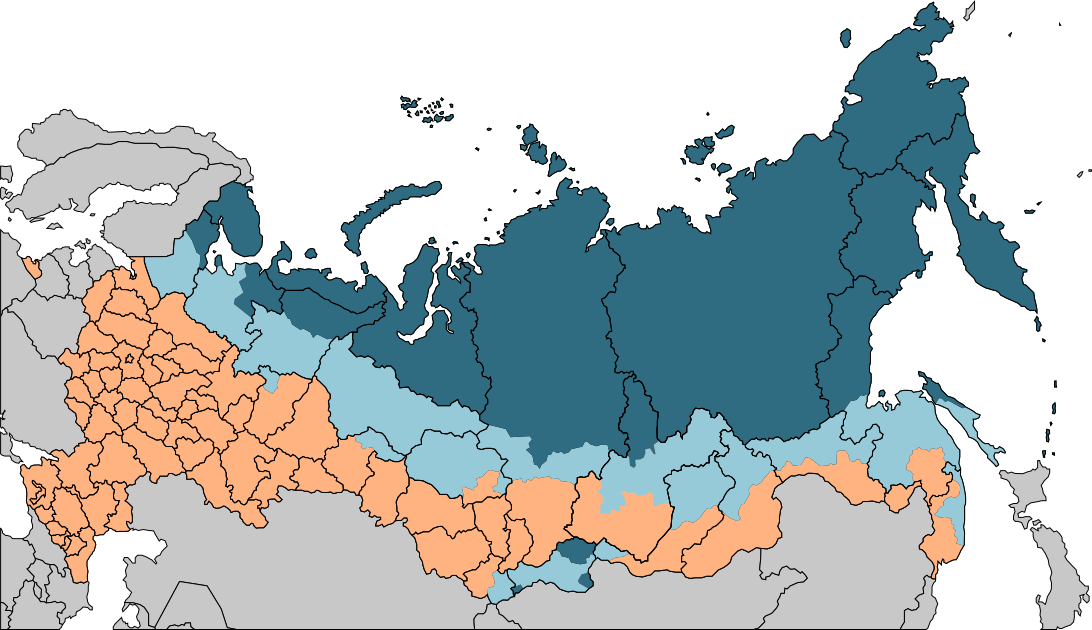
The Extreme North or the Far North is a large part of Russia located mainly north of the Arctic Circle and boasting enormous mineral and natural resources. Its total area is about 5,500,000 km2, comprising about one-third of Russia's total area. Formally, the regions of the Extreme North comprise the whole of Chukotka Autonomous Okrug, Kamchatka Krai, Magadan Oblast, Murmansk Oblast and Sakha, as well as certain parts and cities of Arkhangelsk Oblast, Irkutsk Oblast, Khabarovsk Krai, Komi Republic, Krasnoyarsk Krai, Republic of Karelia, Sakhalin Oblast, Tuva, Tyumen Oblast, as well as all islands of the Arctic Ocean, its seas, the Bering Sea, and the Sea of Okhotsk.
Due to the remoteness and the harsh conditions of the area, since the Soviet times people who work there have traditionally been entitled by the Russian government to higher wages and many other benefits, including earlier retirement age, than workers of other regions. As a result of the climate and environment, the indigenous peoples of the area have developed certain genetic differences that allow them to better cope with the region's environment, as do their cultures.

In 2012, the photoreporter Justin Jin released an award-winning photodocumentary Zone of Absolute Discomfort about gas extraction in Russian Arctic.
Largest cities
- Arkhangelsk (pop. 348,783),
- Yakutsk (pop. 311,760),
- Murmansk (pop. 270,384),
- Severodvinsk (pop. 192,353),
- Norilsk (pop. 176,735),
- Petropavlovsk-Kamchatsky (pop. 164,900),
- Novy Urengoi (pop. 104,107),
- Noyabrsk (pop. 110,620),
- Magadan (pop. 92,782) are the largest cities within the Russian Far North by their population, according to the 2021 Russian census. The larger and more southern Surgut (pop. 396,443) is the largest among cities and territories equated to the Far North.
Legal status
The Far North is known for its extremely harsh climate. People who work there, other than the inmates of labor camps that constituted the Gulag system of the Soviet Union and the inmates of corrective labor colonies in present-day Russia, receive an extra grade of payment, referred to as the "Northern Bonus" (severnye nadbavki ). Additional benefits include extra vacation, extra disability benefits, extra retirement benefits (a lower retirement age), and housing benefits, in compensation for the difficult working conditions. Such compensation began under the Soviet Union and has been maintained by the Russian Federation.
In January 2007, the State Duma Committee for Issues of the North and Far East approved a proposed law defining regions within the Far North that would determine the extent of compensation for workers. The regions were established based on general climate, with harsher regions garnering greater compensation relative to milder regions. In this legal definition, some areas, such as some mountainous areas of Tuva, do not match the intuitive geographical definition of "Extreme North"; in fact they are among the southernmost in Russia.
Notes
References
References
- Laverov, Nicolay. (2009). "Area Studies (Regional Sustainable Development Review): Russia - Volume I". EOLSS Publications.
- https://объясняем.рф/articles/questions/social-protection/drugie_mery_podderzhki/pochemu_rabotat_na_kraynem_severe_vygodno/ {{Bare URL inline. (August 2024)
- "pochemu_rabotat_na_kraynem_severe_vygodno".
- "Портал государственных услуг Российской Федерации (Why is it profitable to work in the Far North?)".
- (2010). "Historical Dictionary of the Russian Federation". Scarecrow Press.
- Yenikeev, Alexander. "Poles Apart".
- [[Justin Jin]], [https://www.theguardian.com/artanddesign/2022/feb/28/wild-north-pioneers-on-energy-politics-coldest-battle-front-a-photo-essay-gazprom-arctic-siberia The workers searching for gas in the icy Russian Arctic – a photo essay], ''[[The Guardian]]'', February 28, 2022
- (19 February 1993). "Law of the Russian Federation, About the State Guarantees and Compensations for the Persons Working and Living in the Region of the Far North and Districts Equated to them".
- "Ямал - Крайний Север России".
This article was imported from Wikipedia and is available under the Creative Commons Attribution-ShareAlike 4.0 License. Content has been adapted to SurfDoc format. Original contributors can be found on the article history page.
Ask Mako anything about Far North (Russia) — get instant answers, deeper analysis, and related topics.
Research with MakoFree with your Surf account
Create a free account to save articles, ask Mako questions, and organize your research.
Sign up freeThis content may have been generated or modified by AI. CloudSurf Software LLC is not responsible for the accuracy, completeness, or reliability of AI-generated content. Always verify important information from primary sources.
Report