From Surf Wiki (app.surf) — the open knowledge base
FANCM
Mammalian protein found in Homo sapiens

Mammalian protein found in Homo sapiens
Fanconi anemia, complementation group M, also known as FANCM is a human gene. It is an emerging target in cancer therapy, in particular cancers with specific genetic deficiencies.
Function
The protein encoded by this gene, FANCM displays DNA binding against fork structures and an ATPase activity associated with DNA branch migration. It is believed that FANCM in conjunction with other Fanconi anemia- proteins repair DNA at stalled replication forks, and stalled transcription structures called R-loops.
The structure of the C-terminus of FANCM (amino acids 1799-2048), bound to a partner protein FAAP24, reveals how the protein complex recognises branched DNA. A structure of amino acids 675-790 of FANCM reveal how the protein binds duplex DNA through a remodeling of the MHF1:MHF2 histone-like protein complex.
Disease association
Bi-allelic mutations in the FANCM gene were originally associated with Fanconi anemia, although several individuals with FANCM deficiency do not appear to have the disorder. Mono-allelic FANCM mutations are associated with breast cancer risk and especially with risk of developing ER-negative and TNBC disease subtypes. A founder mutation in the Scandinavian population is also associated with a higher than average frequency of triple negative breast cancer in heterozygous carriers. FANCM carriers also have elevated levels of Ovarian cancer and other solid tumours
FANCM as a therapeutic target in ALT cancer
Expression and activity of FANCM, is essential for the viability of cancers using Alternative Lengthening of Telomeres (ALT-associated cancers). Several other synthetic lethal interactions have been observed for FANCM that may widen the targetability of the protein in therapeutic use.
There are several potential ways in which FANCM activity could be targeted as an anti-cancer agent. In the context of ALT, one of the best targets may be a peptide domain of FANCM called MM2. Ectopic MM2 peptide (that acts as a dominant decoy) was sufficient to inhibit colony formation of ALT-associated cancer cells, but not telomerase-positive cancer cells. This peptide works as a dominant interfering binder to RMI1:RMI2, and sequesters another DNA repair complex called the Bloom Syndrome complex away from FANCM. As with FANCM depletion, this induces death through a "hyper-ALT" phenotype. An in vitro high-throughput screen for small molecule inhibitors of MM2-RMI1:2 interaction lead to the discovery of PIP-199. This experimental drug also showed some discriminatory activity in killing of ALT-cells, compared to telomerase-positive cells.
Meiosis
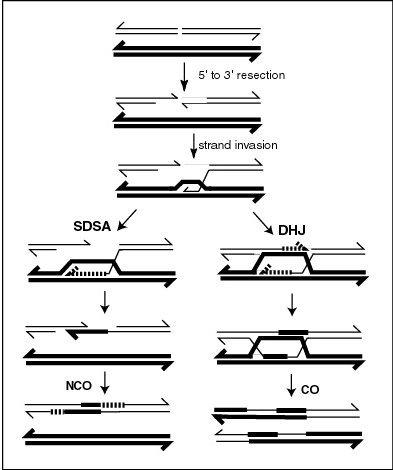
Recombination during meiosis is often initiated by a DNA double-strand break (DSB). During recombination, sections of DNA at the 5' ends of the break are cut away in a process called resection. In the strand invasion step that follows, an overhanging 3' end of the broken DNA molecule then "invades" the DNA of a homologous chromosome that is not broken forming a displacement loop (D-loop). After strand invasion, the further sequence of events may follow either of two main pathways leading to a crossover (CO) or a non-crossover (NCO) recombinant (see Genetic recombination and Homologous recombination). The pathway leading to a NCO is referred to as synthesis dependent strand annealing (SDSA).
FANCM acts as a meiotic anti-crossover factor in mammals, limiting the number of crossovers during meiotic recombination. Deletion of the Fancm gene in mice leads to an increase in genome-wide crossover frequencies and perturbed gametogenesis, consistent with reproductive defects observed in humans with biallelic FANCM mutations.
In the plant Arabidopsis thaliana FANCM helicase antagonizes the formation of CO recombinants during meiosis, thus favoring NCO recombinants. The FANCM helicase is required for genome stability in humans and yeast, and is a major factor limiting meiotic CO formation in A. thaliana. A pathway involving another helicase, RECQ4A/B, also acts independently of FANCM to reduce CO recombination. These two pathways likely act by unwinding different joint molecule substrates (e.g. nascent versus extended D-loops; see Figure).
Only about 4% of DSBs in A. thaliana are repaired by CO recombination; the remaining 96% are likely repaired mainly by NCO recombination. Sequela-Arnaud et al. suggested that CO numbers are restricted because of the long-term costs of CO recombination, that is, the breaking up of favorable genetic combinations of alleles built up by past natural selection.
In the fission yeast Schizosaccharomyces pombe, FANCM helicase also directs NCO recombination during meiosis.
References
References
- (August 2000). "Prediction of the coding sequences of unidentified human genes. XVIII. The complete sequences of 100 new cDNA clones from brain which code for large proteins in vitro". DNA Research.
- (September 2005). "A human ortholog of archaeal DNA repair protein Hef is defective in Fanconi anemia complementation group M". Nature Genetics.
- (2017-11-02). "Breaking the end: Target the replication stress response at the ALT telomeres for cancer therapy". Molecular & Cellular Oncology.
- (September 2013). "Architecture and DNA recognition elements of the Fanconi anemia FANCM-FAAP24 complex". Structure.
- (January 2008). "The Fanconi anemia protein FANCM can promote branch migration of Holliday junctions and replication forks". Molecular Cell.
- (December 2009). "FANCM connects the genome instability disorders Bloom's Syndrome and Fanconi Anemia". Molecular Cell.
- (2014). "The Fanconi anemia DNA repair pathway: structural and functional insights into a complex disorder". Annual Review of Biophysics.
- (May 2003). "A multiprotein nuclear complex connects Fanconi anemia and Bloom syndrome". Molecular and Cellular Biology.
- (April 2018). "Biallelic truncating FANCM mutations cause early-onset cancer but not Fanconi anemia". Genetics in Medicine.
- (April 2018). "Individuals with FANCM biallelic mutations do not develop Fanconi anemia, but show risk for breast cancer, chemotherapy toxicity and may display chromosome fragility". Genetics in Medicine.
- (September 2015). "FANCM c.5791C>T nonsense mutation (rs144567652) induces exon skipping, affects DNA repair activity and is a familial breast cancer risk factor". Human Molecular Genetics.
- (September 2017). "Association Between Loss-of-Function Mutations Within the FANCM Gene and Early-Onset Familial Breast Cancer". JAMA Oncology.
- (November 2019). "The FANCM:p.Arg658* truncating variant is associated with risk of triple-negative breast cancer". npj Breast Cancer.
- (October 2014). "Exome sequencing identifies FANCM as a susceptibility gene for triple-negative breast cancer". Proceedings of the National Academy of Sciences of the United States of America.
- (August 2017). "FANCM as a likely high grade serous ovarian cancer susceptibility gene". Oncotarget.
- (July 2017). "FANCM, BRCA1, and BLM cooperatively resolve the replication stress at the ALT telomeres". Proceedings of the National Academy of Sciences of the United States of America.
- (May 2019). "The FANCM-BLM-TOP3A-RMI complex suppresses alternative lengthening of telomeres (ALT)". Nature Communications.
- (May 2019). "FANCM limits ALT activity by restricting telomeric replication stress induced by deregulated BLM and R-loops". Nature Communications.
- (July 2016). "A High-Throughput Screening Strategy to Identify Protein-Protein Interaction Inhibitors That Block the Fanconi Anemia DNA Repair Pathway". Journal of Biomolecular Screening.
- Tsui, Vanessa. (2023). "Fancm has dual roles in the limiting of meiotic crossovers and germ cell maintenance in mammals". Cell Genomics.
- (April 2015). "Multiple mechanisms limit meiotic crossovers: TOP3α and two BLM homologs antagonize crossovers in parallel to FANCM". Proceedings of the National Academy of Sciences of the United States of America.
- (June 2012). "FANCM limits meiotic crossovers". Science.
- (June 2012). "The fission yeast FANCM ortholog directs non-crossover recombination during meiosis". Science.
This article was imported from Wikipedia and is available under the Creative Commons Attribution-ShareAlike 4.0 License. Content has been adapted to SurfDoc format. Original contributors can be found on the article history page.
Ask Mako anything about FANCM — get instant answers, deeper analysis, and related topics.
Research with MakoFree with your Surf account
Create a free account to save articles, ask Mako questions, and organize your research.
Sign up freeThis content may have been generated or modified by AI. CloudSurf Software LLC is not responsible for the accuracy, completeness, or reliability of AI-generated content. Always verify important information from primary sources.
Report