From Surf Wiki (app.surf) — the open knowledge base
External ray

An external ray is a curve that runs from infinity toward a Julia or Mandelbrot set. Although this curve is only rarely a half-line (ray) it is called a ray because it is an image of a ray.
External rays are used in complex analysis, particularly in complex dynamics and geometric function theory.
History
External rays were introduced in Douady and Hubbard's study of the Mandelbrot set.
Types
Criteria for classification:
- Plane: parameter or dynamic
- Map
- Bifurcation of dynamic rays
- Stretching
- Landing
Plane
External rays of (connected) Julia sets on dynamical plane are often called dynamic rays.
External rays of the Mandelbrot set (and similar one-dimensional connectedness loci) on parameter plane are called parameter rays.
Bifurcation
Dynamic rays can be:
- Bifurcated, branched, broken
- Smooth, unbranched, unbroken
When the filled Julia set is connected, there are no branching external rays. When the Julia set is not connected then some external rays branch.
Stretching
Stretching rays were introduced by Branner and Hubbard: "The notion of stretching rays is a generalization of that of external rays for the Mandelbrot set to higher degree polynomials."
Landing
Every rational parameter ray of the Mandelbrot set lands at a single parameter.
Maps
Polynomials
Dynamical plane = z-plane
External rays are associated to a compact, full, connected subset K, of the complex plane as :
- the images of radial rays under the Riemann map of the complement of K,
- the gradient lines of the Green's function of K,
- field lines of Douady-Hubbard potential
- an integral curve of the gradient vector field of the Green's function on neighborhood of infinity
External rays together with equipotential lines of Douady-Hubbard potential ( level sets) form a new polar coordinate system for exterior ( complement ) of K,.
In other words the external rays define vertical foliation which is orthogonal to horizontal foliation defined by the level sets of potential.
Uniformization
Let \Psi_c, be the conformal isomorphism from the complement (exterior) of the closed unit disk \overline{\mathbb{D}} to the complement of the filled Julia set \ K_c .
:\Psi_c: \hat{\Complex} \setminus \overline{\mathbb{D}} \to \hat{\Complex} \setminus K_c
where \hat{\Complex} denotes the extended complex plane. Let \Phi_c = \Psi_c^{-1}, denote the Boettcher map. \Phi_c, is a uniformizing map of the basin of attraction of infinity, because it conjugates f_c on the complement of the filled Julia set K_c to f_0(z)=z^2 on the complement of the unit disk:
:\begin{align} \Phi_c: \hat{\Complex} \setminus K_c &\to \hat{\Complex} \setminus \overline{\mathbb{D}}\ z & \mapsto \lim_{n\to \infty} (f_c^n(z))^{2^{-n}} \end{align}
and
: \Phi_c \circ f_c \circ \Phi_c^{-1} = f_0
A value w = \Phi_c(z) is called the Boettcher coordinate for a point z \in \hat{\Complex}\setminus K_c.
Formal definition of dynamic ray
\mathbb{\hat{C}}\setminus \overline{\mathbb{D}} = { w\setin\mathbb{\hat{C}}:abs(w)1} If \Psi_c, is unique conformal isomorphism whose leading Laurent coefficient at infinity is real and positive
The external ray of angle \theta, noted as \mathcal{R}^K _{\theta} is:
- the image under \Psi_c, of straight lines \mathcal{R}_{\theta} = {\left(r\cdot e^{2\pi i \theta}\right) : \ r 1 }
:\mathcal{R}^K {\theta} = \Psi_c(\mathcal{R}{\theta})
- set of points of exterior of filled-in Julia set with the same external angle \theta
:\mathcal{R}^K _{\theta} = { z\in \hat{\Complex} \setminus K_c : \arg(\Phi_c(z)) = \theta }
Properties
The external ray for a periodic angle \theta, satisfies:
:f(\mathcal{R}^K _{\theta}) = \mathcal{R}^K _{2 \theta}
and its landing point \gamma_f(\theta) satisfies:
:f(\gamma_f(\theta)) = \gamma_f(2\theta)
Parameter plane = c-plane
"Parameter rays are simply the curves that run perpendicular to the equipotential curves of the M-set."
Uniformization
Let \Psi_M, be the mapping from the complement (exterior) of the closed unit disk \overline{\mathbb{D}} to the complement of the Mandelbrot set \ M .
:\Psi_M:\mathbb{\hat{C}}\setminus \overline{\mathbb{D}}\to\mathbb{\hat{C}}\setminus M
and Boettcher map (function) \Phi_M,, which is uniformizing map of complement of Mandelbrot set, because it conjugates complement of the Mandelbrot set \ M and the complement (exterior) of the closed unit disk
:\Phi_M: \mathbb{\hat{C}}\setminus M \to \mathbb{\hat{C}}\setminus \overline{\mathbb{D}}
it can be normalized so that :
\frac{\Phi_M(c)}{c} \to 1 \ as\ c \to \infty ,
where : :\mathbb{\hat{C}} denotes the extended complex plane
Jungreis function \Psi_M, is the inverse of uniformizing map :
:\Psi_M = \Phi_{M}^{-1} ,
In the case of complex quadratic polynomial one can compute this map using Laurent series about infinity
:c = \Psi_M (w) = w + \sum_{m=0}^{\infty} b_m w^{-m} = w -\frac{1}{2} + \frac{1}{8w} - \frac{1}{4w^2} + \frac{15}{128w^3} + ...,
where
:c \in \mathbb{\hat{C}}\setminus M
:w \in \mathbb{\hat{C}}\setminus \overline{\mathbb{D}}
Formal definition of parameter ray
\mathbb{\hat{C}}\setminus \overline{\mathbb{D}} = { w\setin\mathbb{\hat{C}}:abs(w)1} If \Psi_c, is unique conformal isomorphism whose leading Laurent coefficient at infinity is real and positive
The external ray of angle \theta, is:
- the image under \Psi_c, of straight lines \mathcal{R}_{\theta} = {\left(r*e^{2\pi i \theta}\right) : \ r 1 }
:\mathcal{R}^M {\theta} = \Psi_M(\mathcal{R}{\theta})
- set of points of exterior of Mandelbrot set with the same external angle \theta
:\mathcal{R}^M _{\theta} = { c\in \mathbb{\hat{C}}\setminus M : \arg(\Phi_M(c)) = \theta }
Definition of the Boettcher map
Douady and Hubbard define:
\Phi_M(c) \ \overset{\underset{\mathrm{def}}{}}{=} \ \Phi_c(z=c),
so external angle of point c, of parameter plane is equal to external angle of point z=c, of dynamical plane
External angle
2015-03-04 exray binary.gif|collecting bits outwards Binary decomposition.png|Binary decomposition of unrolled circle plane Binary decomposition of dynamic plane for f0(z) = z^2.png|binary decomposition of dynamic plane for f(z) = z^2
Angle θ is named external angle ( argument ).
Principal value of external angles are measured in turns modulo 1
:1 turn = 360 degrees = 2 × radians
Compare different types of angles :
- external ( point of set's exterior )
- internal ( point of component's interior )
- plain ( argument of complex number )
| external angle | internal angle | plain angle | parameter plane | dynamic plane |
|---|---|---|---|---|
| \arg(\Phi_M(c)) \, | \arg(\rho_n(c)) \, | \arg(c) \, | ||
| \arg(\Phi_c(z)) \, | \arg(z) \, |
Computation of external argument
- argument of Böttcher coordinate as an external argument
- \arg_M(c) = \arg(\Phi_M(c))
- \arg_c(z) = \arg(\Phi_c(z))
- kneading sequence as a binary expansion of external argument
Transcendental maps
For transcendental maps ( for example exponential ) infinity is not a fixed point but an essential singularity and there is no Boettcher isomorphism.
Here dynamic ray is defined as a curve :
- connecting a point in an escaping set and infinity
- lying in an escaping set
Images
Dynamic rays
JuliaRay 1 3.png|Julia set for f_c(z) = z^2 -1 with 2 external ray landing on repelling fixed point alpha JuliaRay3.png|Julia set and 3 external rays landing on fixed point \alpha_c, Dynamic internal and external rays .svg|Dynamic external rays landing on repelling period 3 cycle and 3 internal rays landing on fixed point \alpha_c, Julia-p9.png|Julia set with external rays landing on period 3 orbit Parabolic rays landing on fixed point.ogv|Rays landing on parabolic fixed point for periods 2-40
Dynamical plane with branched periodic external ray 0 for map f(z) = z*z + 0.35.png| Branched dynamic ray
Parameter rays
Mandelbrot set for complex quadratic polynomial with parameter rays of root points
File:Mandelbrot set for complex quadratic polynomial with parameter rays of root points.jpg|External rays for angles of the form : n / ( 21 - 1) (0/1; 1/1) landing on the point c= 1/4, which is cusp of main cardioid ( period 1 component) Image:Man2period.jpg|External rays for angles of the form : n / ( 22 - 1) (1/3, 2/3) landing on the point c= - 3/4, which is root point of period 2 component Image:Man3period.jpg|External rays for angles of the form : n / ( 23 - 1) (1/7,2/7) (3/7,4/7) landing on the point c= -1.75 = -7/4 (5/7,6/7) landing on the root points of period 3 components. Image:Man4period.jpg|External rays for angles of form : n / ( 24 - 1) (1/15,2/15) (3/15, 4/15) (6/15, 9/15) landing on the root point c= -5/4 (7/15, 8/15) (11/15,12/15) (13/15, 14/15) landing on the root points of period 4 components. Image:Man5period.jpg| External rays for angles of form : n / ( 25 - 1) landing on the root points of period 5 components Image:Mandel ie 1 3.jpg|internal ray of main cardioid of angle 1/3: starts from center of main cardioid c=0, ends in the root point of period 3 component, which is the landing point of parameter (external) rays of angles 1/7 and 2/7 Image:Iray.png|Internal ray for angle 1/3 of main cardioid made by conformal map from unit circle
File:Smiley mini Mandelbrot set with external rays.png| Mini Mandelbrot set with period 134 and 2 external rays File:Part of parameter plane with external 5 rays landing on the Mandelbrot set.png File:One arm spiral - part of Mandelbrot set.png File:Mini Mandelbrot set period=68 with external rays.png File:Wakes near the period 3 island in the Mandelbrot set.png|Wakes near the period 3 island File:Wakes along the main antenna in the Mandelbrot set.png|Wakes along the main antenna
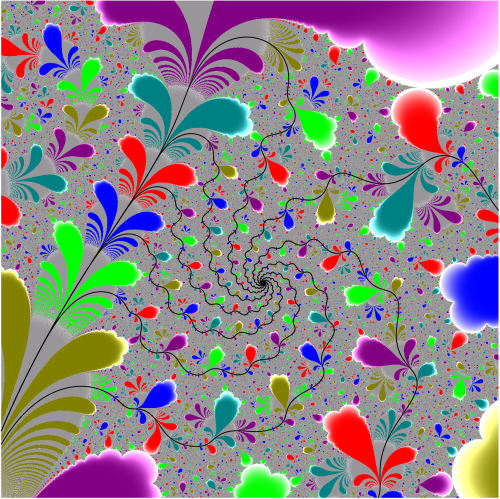
Parameter space of the complex exponential family f(z)=exp(z)+c. Eight parameter rays landing at this parameter are drawn in black.
Programs that can draw external rays
- Mandel - program by Wolf Jung written in C++ using Qt with source code available under the GNU General Public License
- Java applets by Evgeny Demidov ( code of mndlbrot::turn function by Wolf Jung has been ported to Java ) with free source code
- ezfract by Michael Sargent, uses the code by Wolf Jung
- OTIS by Tomoki KAWAHIRA - Java applet without source code
- Spider XView program by Yuval Fisher
- YABMP by Prof. Eugene Zaustinsky for MS-DOS without source code
- DH_Drawer by Arnaud Chéritat written for Windows 95 without source code
- Linas Vepstas C programs for Linux console with source code
- Program Julia by Curtis T. McMullen written in C and Linux commands for C shell console with source code
- mjwinq program by Matjaz Erat written in delphi/windows without source code ( For the external rays it uses the methods from quad.c in julia.tar by Curtis T McMullen)
- RatioField by Gert Buschmann, for windows with Pascal source code for Dev-Pascal 1.9.2 (with Free Pascal compiler )
- Mandelbrot program by Milan Va, written in Delphi with source code
- Power MANDELZOOM by Robert Munafo
- ruff by Claude Heiland-Allen
References
- Lennart Carleson and Theodore W. Gamelin, Complex Dynamics, Springer 1993
- Adrien Douady and John H. Hubbard, Etude dynamique des polynômes complexes, Prépublications mathémathiques d'Orsay 2/4 (1984 / 1985)
- John W. Milnor, Periodic Orbits, External Rays and the Mandelbrot Set: An Expository Account; Géométrie complexe et systèmes dynamiques (Orsay, 1995), Astérisque No. 261 (2000), 277–333. (First appeared as a Stony Brook IMS Preprint in 1999, available as arXiV:math.DS/9905169.)
- John Milnor, Dynamics in One Complex Variable, Third Edition, Princeton University Press, 2006,
- Wolf Jung : Homeomorphisms on Edges of the Mandelbrot Set. Ph.D. thesis of 2002
References
- J. Kiwi : Rational rays and critical portraits of complex polynomials. Ph. D. Thesis SUNY at Stony Brook (1997); [http://www.math.sunysb.edu/cgi-bin/preprint.pl?ims97-15 IMS Preprint #1997/15.] {{Webarchive. link. (2004-11-05)
- (2016). "Non-landing parameter rays of the multicorns". Inventiones Mathematicae.
- (1992). "Bifurcations of dynamic rays in complex polynomials of degree two". Ergodic Theory and Dynamical Systems.
- (2020). "Periodic points and smooth rays". Conformal Geometry and Dynamics of the American Mathematical Society.
- [https://orbit.dtu.dk/en/publications/holomorphic-dynamics-on-accumulation-of-stretching-rays Holomorphic Dynamics: On Accumulation of Stretching Rays by Pia B.N. Willumsen, see page 12]
- [https://pi.math.cornell.edu/~hubbard/IterationCubics1.pdf The iteration of cubic polynomials Part I : The global topology of parameter by BODIL BRANNER and JOHN H. HUBBARD]
- [https://www.youtube.com/watch?v=DyJDt4EyiBA&list=PL53AB2CAE70F31F2A&index=29 Stretching rays for cubic polynomials by Pascale Roesch]
- (2004). "Landing property of stretching rays for real cubic polynomials". Conformal Geometry and Dynamics.
- [https://web.archive.org/web/20160526222635/http://www.math.cornell.edu/~hubbard/OrsayFrench.pdf A. Douady, J. Hubbard: Etude dynamique des polynˆomes complexes. Publications math´ematiques d’Orsay 84-02 (1984) (premi
ere partie) and 85-04 (1985) (deuxieme partie).] - (1997). "Rational parameter rays of the Mandelbrot set".
- [https://www.youtube.com/watch?v=N3ah6iTupIg&t=2652s Video : The beauty and complexity of the Mandelbrot set by John Hubbard ( see part 3 )]
- [http://qcpages.qc.cuny.edu/~yjiang/HomePageYJ/Download/2004MandLocConn.pdf Yunping Jing : Local connectivity of the Mandelbrot set at certain infinitely renormalizable points ] Complex Dynamics and Related Topics, New Studies in Advanced Mathematics, 2004, The International Press, 236-264
- [http://www.math.northwestern.edu/~demarco/basins.pdf POLYNOMIAL BASINS OF INFINITY LAURA DEMARCO AND KEVIN M. PILGRIM]
- [http://www.mndynamics.com/indexp.html How to draw external rays by Wolf Jung]
- {{usurped
- [http://linas.org/art-gallery/escape/phase/phase.html Douady Hubbard Parameter Rays by Linas Vepstas]
- [http://gdz.sub.uni-goettingen.de/dms/load/img/?PID=GDZPPN001185500 John H. Ewing, Glenn Schober, The area of the Mandelbrot Set]
- [http://projecteuclid.org/euclid.dmj/1077304731 Irwin Jungreis: The uniformization of the complement of the Mandelbrot set. Duke Math. J. Volume 52, Number 4 (1985), 935-938.]
- [https://www.math.cornell.edu/~hubbard/OrsayEnglish.pdf Adrien Douady, John Hubbard, Etudes dynamique des polynomes complexes I & II, Publ. Math. Orsay. (1984-85) (The Orsay notes)]
- (1993). "Computing the Laurent Series of the Map Ψ: C − D → C − M". Advances in Applied Mathematics.
- [http://mathworld.wolfram.com/MandelbrotSet.html Weisstein, Eric W. "Mandelbrot Set." From MathWorld--A Wolfram Web Resource]
- [http://www.math.titech.ac.jp/~kawahira/programs/mandel-exray.pdf An algorithm to draw external rays of the Mandelbrot set by Tomoki Kawahira ]
- http://www.mrob.com/pub/muency/externalangle.html External angle at Mu-ENCY (the Encyclopedia of the Mandelbrot Set) by Robert Munafo
- [http://www.mndynamics.com/indexp.html Computation of the external argument by Wolf Jung]
- A. DOUADY, Algorithms for computing angles in the Mandelbrot set (Chaotic Dynamics and Fractals, ed. Barnsley and Demko, Acad. Press, 1986, pp. 155-168).
- [https://www.math.cornell.edu/~hubbard/OrsayEnglish.pdf Adrien Douady, John H. Hubbard: Exploring the Mandelbrot set. The Orsay Notes. page 58 ]
- [http://www.dhushara.com/DarkHeart/DarkHeart.htm Exploding the Dark Heart of Chaos by Chris King from Mathematics Department of University of Auckland]
- [http://pcwww.liv.ac.uk/~helenam/Poster.pdf Topological Dynamics of Entire Functions by Helena Mihaljevic-Brandt]
- [http://pcwww.liv.ac.uk/~helenam/slides_manchester.pdf Dynamic rays of entire functions and their landing behaviour by Helena Mihaljevic-Brandt]
This article was imported from Wikipedia and is available under the Creative Commons Attribution-ShareAlike 4.0 License. Content has been adapted to SurfDoc format. Original contributors can be found on the article history page.
Ask Mako anything about External ray — get instant answers, deeper analysis, and related topics.
Research with MakoFree with your Surf account
Create a free account to save articles, ask Mako questions, and organize your research.
Sign up freeThis content may have been generated or modified by AI. CloudSurf Software LLC is not responsible for the accuracy, completeness, or reliability of AI-generated content. Always verify important information from primary sources.
Report