From Surf Wiki (app.surf) — the open knowledge base
Expo 58
World's fair held in Brussels, Belgium
World's fair held in Brussels, Belgium
| Field | Value |
|---|---|
| class | Universal |
| category | 1 |
| image | Haarlemse bloemenmeisjes brengen bezoek aan de Expo, Bestanddeelnr 909-5043.jpg |
| caption | View of the exhibition's main avenue and gondola lift towards the Atomium |
| year | 1958 |
| name | Expo 58 |
| area | 2 km2 |
| visitors | 41,454,412 |
| cnt | 44 |
| country | Belgium |
| city | Brussels |
| venue | Heysel/Heizel Plateau |
| coord | |
| cand | |
| award | November 1953 |
| open | |
| close | |
| prevexpo | Exposition internationale du bicentenaire de Port-au-Prince |
| prevcity | Port-au-Prince |
| nextexpo | Century 21 Exposition |
| nextcity | Seattle |
| suppl | Specialized Expositions |
| prevsuppl | Interbau |
| prevsupcity | Berlin |
| nextsuppl | Expo 61 |
| nextsupcity | Turin |
| nextunho | Floriade 1960 |
| nextunhocity | Rotterdam |
Expo 58, also known as the 1958 Brussels World's Fair (; ), was a world's fair held on the Heysel/Heizel Plateau in Brussels, Belgium, from 17 April to 19 October 1958. It was the first major world's fair registered under the Bureau International des Expositions (BIE) after World War II and the fifth in Brussels overall.
Expo 58 left a deep impression on Belgium. It was also the pretext for major upheavals and works in Brussels, whose boulevards were transformed into urban motorways. The Atomium, built for the occasion, has become one of the city's must-see landmarks.
Background
Expo 58 was the eleventh world's fair hosted by Belgium, and the fifth in Brussels, following the fairs in 1888, 1897, 1910 and 1935. In 1953, Belgium won the bid for the next world's fair, winning out over other European capitals such as Paris and London.
Nearly 15,000 workers spent three years building the 2 km2 site on the Heysel/Heizel Plateau, 7 km north-west of central Brussels. Many of the buildings were re-used from the 1935 World's Fair, which had been held on the same site.
The theme of Expo 58 was "Bilan du monde, pour un monde plus humain" (in English: "Evaluation of the world for a more humane world"), a motto inspired by faith in technical and scientific progress, as well as post-war debates over the ethical use of atomic power.
The exhibition attracted some 41.5 million visitors, making Expo 58 the second largest world's fair after the 1900 Exposition Universelle et Internationale de Paris, which had attracted 48 million visitors. Since Expo 58, Belgium has not organised any more world's fairs.
Exhibition
Overview
More than forty nations took part in Expo 58, with more than forty-five national pavilions, not including those of the Belgian Congo and Belgium itself.
The site is best known for the Atomium, a giant model of a unit cell of an iron crystal (each sphere representing an atom). During the 1958 European exposition, the molecular model hosted an observation of more than forty-one million visitors while refining an astonishment for atomism by distant global communities. The atomistic model was opened with a call for world peace and social and economic progress, issued by King Baudouin. The Atomium was originally foreseen to last only the six months of the exhibition; but it was never taken down, its outer coating was renewed on the 50th anniversary of the exhibition, and it stands nowadays as just as much an emblem of Brussels as the Eiffel Tower is of Paris.
Notable exhibitions include the Philips Pavilion, where Poème électronique, commissioned specifically for the location, was played back from 425 loudspeakers, placed at specific points as designed by Iannis Xenakis, and Le Corbusier.
File:Expo 1958 Orientierungs-Plan.jpg|Map of Expo 58 in the Heysel/Heizel district of Brussels File:Expo58 building Philips.jpg|The Philips Pavilion was built to house a multimedia spectacle. File:Expo58 ontvangsthal.jpg|The Centenary Palace served as the exhibition's entrance hall. File:Expo58 Belgie kaart B.jpg|A pedestrian bridge over a model of the Belgian landscape
Belgian Congo Section
The Belgian Congo section was located in 7.7 ha in close proximity to the Atomium model. The Belgian Congo, today known as the Democratic Republic of the Congo, was at that time a Belgian colonial holding. Expo 58 organizers also included participants from the UN trust territories of Ruanda-Urundi (today, Rwanda and Burundi) in the Belgian Congo section, without differentiation. This section was divided into seven pavilions: the Belgian Congo and Ruanda-Urundi Palace, agriculture; Catholic missions; insurance, banks, trade; mines and metallurgy; energy, construction, and transport; a village indigène (indigenous village). The Belgian Congo section was, above all, intended to display the "civilizing" work of Belgian colonialism.
Human zoo
The Congolese recognized the village indigène as a human zoo. The Ministry of Colonies built the Congolese exhibit, intending to demonstrate their claim to have "civilized" the "primitive Africans." Native Congolese art was rejected for display, as the Ministry claimed it was "insufficiently Congolese." Instead, nearly all of the art on display was created by Europeans in a purposefully primitive and imitative style, and the entrance of the exhibit featured a bust of King Leopold II, under whose colonial rule millions of Congolese died.
The 598 Congolese chosen to be exhibited by the Ministry were educated urbanites referred to by Belgians as évolués, meaning literally "evolved," but were made to dress in "primitive" clothing, and an armed guard blocked them from communicating with white Belgians who came to observe them. There were 273 men, 128 women and 197 children, a total of 183 families. The exotic nature of the exhibit was lauded by visitors and international press, with the Belgian socialist newspaper Le Peuple praising the portrayal of Africans, saying it was "in complete agreement with historical truth." However, in mid-July, the Congolese protested the condescending treatment they were receiving from spectators and demanded to be sent home, abruptly ending the exhibit and eliciting some sympathy from European newspapers.
National pavilions
Austria
The Austrian pavilion was designed by Austrian architect Karl Schwanzer in modernist style. It was later transferred to Vienna to host the museum of the 20th century. In 2011 it was reopened under the new name 21er Haus. It included a model Austrian Kindergarten, which doubled as a day care facility for the employees, the Vienna Philharmonic playing behind glass, and a model nuclear fusion reactor that fired every 5 minutes.
Czechoslovakia
The exposition "One Day in Czechoslovakia" was designed by Jindřich Santar who cooperated with artists Jiří Trnka, Antonín Kybal, Stanislav Libenský and Jan Kotík. Architects of the simple, but modern and graceful construction were František Cubr, Josef Hrubý and Zdeněk Pokorný. The team's artistic freedom, so rare in the hard-line communist regime of the 1950s, was ensured by the government committee for exhibitions chairman František Kahuda. He supported the famous Laterna Magika show, as well as Josef Svoboda's technically unique Polyekran. The Czechoslovak pavilion was visited by 6 million people and was officially awarded the best pavilion of the Expo 58.
Federal Republic of Germany

The West German pavilion was designed by the architects Egon Eiermann and Sep Ruf. The world press called it the most polished and sophisticated pavilion of the exhibition.
Hungary
Hungary was represented by a large modular modernist pavilion designed by the architect Lajos Gádoros. The scenario for the exhibition was compiled by the writer Iván Boldizsár. It hosted a mix of early-1900s paintings by Tivadar Csontváry Kosztka, József Egry and Gyula Derkovitz, and modern ones such as the Life in Budapest fresco painted on aluminium panels by Túry Mária and Kádár György. In the entrance hall hung József Somogyi and Kerényi Jenő's dynamic statue group Dancers, which won a Grand Prix, and was later bought by the city of Namur. Margit Kovács' sculpture The Spinner was also on display.
The exhibition took place during very turbulent times for Hungary. The decision to participate was made in 1955, under the Stalinist party leader Mátyás Rákosi, shortly after he got rid of his reformist prime minister Imre Nagy. By the time the exhibition closed in 1958, the party leader was exiled, and the prime minister was tried and executed.
Liechtenstein
The Liechtenstein pavilion featured a bronze bust of Franz Joseph II at the entrance, a collection of weapons, stamps, and important historical documents from the Principality, paintings from the Prince's personal collection, and exhibits showcasing Liechtenstein's industry, landscape, and religious history. Also featured in the building was an interior garden with a circular walkway enabling visitors to browse the entire pavilion.
Mexico
The Mexican pavilion was designed by the architect Pedro Ramírez Vázquez. It was awarded the exposition's star of gold.
City of Paris

The city of Paris had its own pavilion, separate from the French exhibit.
United Kingdom
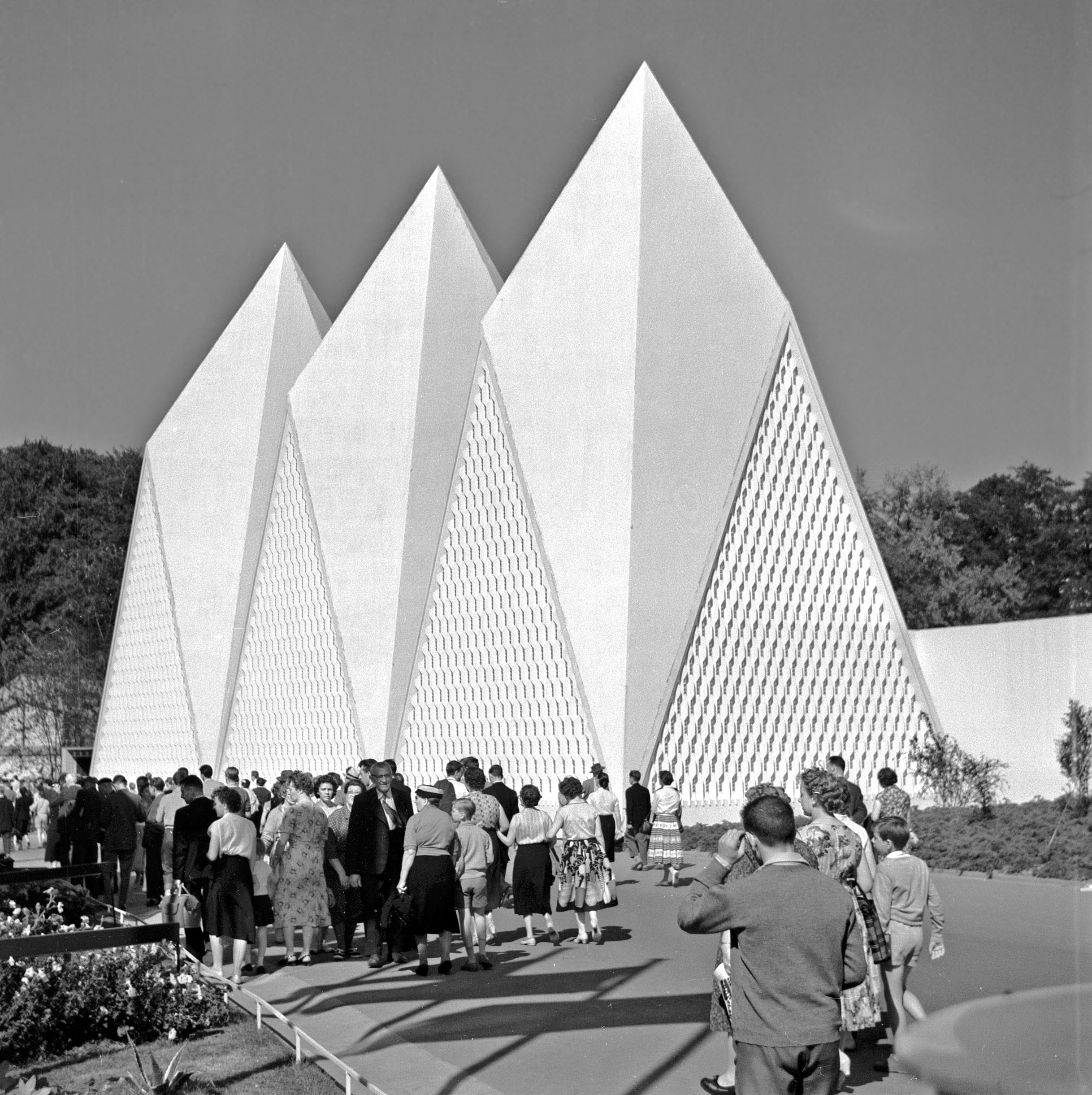
The UK pavilion was produced by the designer James Gardner, architect Howard Lobb and engineer Felix Samuely. The on-site British architect was Michael Blower, Brussels born and bilingual.
Thailand

The Thai pavilion was designed by Sampatisiri, reflecting the national architectural style, with the aim of promoting Thai culture as a branding strategy that was adopted in many world's fairs. The pavilion was built in teak wood and its shapes and decors resembled the pavilion of Siam at the Turin 1911 International Exxposition of Industries and Work, built by the Italian architects Mario Tamagno and Annibale Rigotti.
USSR
The Soviet pavilion was a large impressive building which was folded up and taken back to Russia when Expo 58 ended. There was a bookstore selling science and technology books in English and other languages published by the Moscow Press.
The exhibit featured a celestial mechanics display of the experimental Sputnik 1 and Sputnik 2 prototypes placed into orbit during the International Geophysical Year. The robotic spacecraft was low earth orbital satellite which debuted as the Sputnik 1 on 4 October 1957 for an international spectators observation from the surface of the earth. The spacecraft completed the geocentric orbit upon depleting the silver zinc battery capacity for an atmospheric entry of the earth's atmosphere on 4 January 1958.
The exposition highlighted a model of the Soviet Union's watercraft vessel Lenin the first nuclear-powered icebreaker, and Soviet automobiles: GAZ-21 Volga, GAZ-13 Chaika, ZIL-111, Moskvitch 407 and 423, trucks GAZ-53 and MAZ-525.
File:Expo58 building URSS.jpg|USSR pavilion File:1958 USSR Expo Pavillon.jpg|Interior of USSR pavilion
United States
The US pavilion was quite spacious and included a fashion show with models walking down a large spiral staircase, an electronic computer that demonstrated a knowledge of history, and a colour television studio behind glass. It also served as the concert venue for performance by the Seventh Army Symphony Orchestra under the direction of Edward Lee Alley. It was designed by architect Edward Durell Stone. It would also play host to the University of California Marching Band which had financed its own way to the fair under the direction of James Berdahl. The United States pavilion consisted of 4 buildings, one of which hosted America the Beautiful, a 360° movie attraction in Circarama made by Walt Disney Productions. The film would subsequently travel to the American National Exhibition in Moscow in 1959, and would find its first American audiences at Disneyland in Anaheim in 1960.
File:Expo58 building USA.jpg|US pavilion File:Expo58 building USA inside.jpg|Interior of US pavilion
Yugoslavia

The government of Yugoslavia was among the first to accept the Expo 58 invitation in November 1954. The exhibition was seen as an opportunity to showcase the country, its delineation from the Soviet Union, independent socioeconomic system and international profile, as well as the impact of these policies on the cultural and artistic life. The content was curated by the architect Branislav Kojić and the writer and art-critic Oto Bihalji-Merin.
The modernist pavilion was designed by the architect Vjenceslav Richter, who originally proposed to suspend the whole structure from a giant cable-stayed mast. When that proved too complicated, Richter devised a tension column consisting of six steel arches supported by a pre-stressed cable, which stood in front of the pavilion as a visual marker and symbolised Yugoslavia's six constituent republics.
It housed four galleries:
- Economy – focused on non-ferrous metals and hydroelectric potential of the country with some industrial design items such as Rex chairs;
- State and Social Organisation – concentrated on the country's history, WW2 resistance, self-management and co-operatives in agriculture;
- Contemporary Art – naïve and modernist paintings and sculptures including works by Vojin Bakić (The Bull), Krsto Hegedušić, Miodrag Protić, Gabrijel Stupica and others;
- Tourism – including large photographs of the country's natural beauty spots and a collection of 55 dolls dressed in traditional costumes.
The pavilion was praised for its elegance and simplicity and Richter was awarded as Knight of the Order of the Belgian Crown. After the end of Expo 58, it was sold and reconstructed as a school, , in the Belgian municipality of Wevelgem, where it still stands.
Other pavilions
File:Expo58 Brasil.jpg|Brazilian pavilion File:Expo58 building Canada.jpg|Canadian pavilion File:Expo58 Dutch building inside.jpg|Dutch pavilion File:Expo58 building Japan inside.jpg|Japanese pavilion File:Expo58 radio luxembourg.jpg|Luxembourgish pavilion File:Expo58 building Moracco.tif|Moroccan pavilion File:Expo1958 Pavilion of Arab States.tiff|Arab States pavilion File:Világkiállítás (EXPO 58), Kongó, Ruanda és Burundi (ekkor Ruanda-Urundi) pavilonja. Fortepan 77990.jpg|Ruanda-Urundi pavilion File:The Turkish Pavilion for Expo 58 Brussels (14667541454).jpg|Turkish pavilion File:VaticanBuilding.tif|Vatican pavilion
Transport
- As many visitors were expected, SABENA temporarily increased capacity by renting a couple of Lockheed Constellations.
- For the same reason, and well in time, it was decided to add a new terminal to the Melsbroek national airport; it was to be at the west side of the airport, on the grounds of the municipality of Zaventem, which has since given its name to the airport. A very modern addition was the railway station in the airport, offering direct train service to the city centre, though not to the expo itself.
- Several tram lines were built to serve the site, those to Brussels remain in service. One line (81) was temporarily deviated to go all the way through Brussels with endpoints at both ends of the Expo.
Mozart's ''Requiem'' incident

The autograph of Mozart's Requiem was placed on display. At some point, someone was able to gain access to the manuscript, tearing off the bottom right-hand corner of the second to last page (folio 99r/45r), containing the words "Quam olim d: C:". the perpetrator has not been identified and the fragment has not been recovered.
International film poll
The event offered the occasion for the organization by thousands of critics and filmmakers from all over the world, of the first universal film poll in history. The poll received nominations from 117 critics from 26 nations. Броненосец Потёмкин (Battleship Potemkin) received 100 votes with The Gold Rush second with 95.
| Rank | Film | Director | Year |
|---|---|---|---|
| 1 | *Броненосец Потёмкин (Battleship Potemkin)* | Sergei Eisenstein | [1925](1925-in-film) |
| 2 | *The Gold Rush* | Charles Chaplin | [1925](1925-in-film) |
| 3 | *Ladri di biciclette (Bicycle Thieves)* | Vittorio De Sica | [1948](1948-in-film) |
| 4 | *La Passion de Jeanne d'Arc (The Passion of Joan of Arc)* | Carl Theodor Dreyer | [1928](1928-in-film) |
| 5 | *La Grande Illusion (Grand Illusion)* | Jean Renoir | [1937](1937-in-film) |
| 6 | *Greed* | Erich von Stroheim | [1924](1924-in-film) |
| 7 | *Intolerance: Love's Struggle Through the Ages* | D. W. Griffith | [1916](1916-in-film) |
| 8 | *Мать (Mother)* | Vsevolod Pudovkin | [1926](1926-in-film) |
| 9 | *Citizen Kane* | Orson Welles | [1941](1941-in-film) |
| 10 | *Земля (Earth)* | Alexander Dovzhenko | [1930](1930-in-film) |
| 11 | *Der letzte Mann (The Last Laugh)* | F. W. Murnau | [1924](1924-in-film) |
| 12 | *Das Cabinet des Dr. Caligari (The Cabinet of Dr. Caligari)* | Robert Wiene | [1920](1920-in-film) |
A jury of young filmmakers (Robert Aldrich, Satyajit Ray, Alexandre Astruc, Michael Cacoyannis, Juan Bardem, Francesco Maselli and Alexander Mackendrick) were due to select a winner from the nominees but voted not to. Instead they indicated the following as still holding value to young filmmakers: Battleship Potemkin; Grand Illusion; Mother; The Passion of Joan of Arc; The Gold Rush and Bicycle Thieves.
Commemoration
- The logo for Expo 58 was designed by Lucien De Roeck, and posters based on it were produced by De Roeck and by Leo Marfurt
- The 50th anniversary of Expo 58 was selected as the main motif of a high-value collectors' coin: the Belgian €100 50th Anniversary of the International Expo in Belgium commemorative coin, minted in 2008. In the obverse, the logo of the event is depicted together with the number 50, representing its 50th anniversary.
File:Expo '58.jpg|Pocket sized guide to Expo 58 File:Willy Bosschem138.jpg|Publicity poster File:BEL 1958 MiNr1091 pm B002.jpg|Commemorative Belgian postage stamp File:Brussels Exhibition 3c 1958 issue U.S. stamp.jpg|Commemorative US postage stamp File:1958 CPA 2140.jpg|Commemorative Soviet postage stamp
Footnotes
References
Bibliography
References
- (16 April 2008 }}{{dead link). "When the world was in Brussels". Flanders Today.
- (1958). "Video: Brussels World's Fair, 1958/03/17 (1958)". [[Universal Newsreel]].
- Stanard, Matthew. (April 2005). "'Bilan du monde pour un monde plus déshumanisé': The 1958 Brussels World's Fair and Belgian Perceptions of the Congo". European History Quarterly.
- Every 25 years starting in 1855, Belgium had staged large national events to celebrate its national independence following the [[Belgian Revolution]] of 1830. However, the [[Federal Government of Belgium. Belgian Government]] under [[Prime Minister of Belgium. Prime Minister]] [[Achille Van Acker]] decided to forego celebrations in 1955 to have additional funding for the 1958 Expo.''Expo 58'', The Royal Belgian Film Archive, Revised Edition, 2008, p. 78 (booklet accompanying DVD edition of footage from the exhibition)
- Mattie, Erik. (1998). ["Weltausstellungen"]({{google books). Belser.
- (15 August 1957). "Atoms over Brussels". Oklahoma Historical Society.
- Drew, Joe. (16 January 2010). "Recreating the Philips Pavilion".
- Stanard, Matthew G.. (2012). "Selling the Congo: A History of European Pro-Empire Propaganda and the Making of Belgian Imperialism". University of Nebraska Press.
- Boffey, Daniel. (2018-04-16). "Belgium comes to terms with 'human zoos' of its colonial past". The Guardian.
- Petrequin, Samuel. (2020-06-30). "Belgium takes down statue, king expresses regret for colonial violence".
- Stanard, Matthew. (2005-04-01). "‘Bilan du monde pour un monde plus déshumanisé’: The 1958 Brussels World’s Fair and Belgian Perceptions of the Congo". European History Quarterly.
- "The human zoo of Tervuren (1897)".
- MF DNES, Expo 2010, Mimořádná příloha o světové výstavě v Šanghaji, 3 May 2010.
- (2012). "Modern Architecture Through Case Studies 1945 to 1990". Routledge.
- Péteri, György. “Transsystemic Fantasies: Counterrevolutionary Hungary at Brussels Expo ’58.” Journal of Contemporary History, vol. 47, no. 1, 2012, pp. 137–60. ISSN = 00220094, URL = http://www.jstor.org/stable/23248985
- . (1958). "Official Guide to the Brussels World Exposition 1958". *Desclée & Co.*.
- See chapter by Jonathan Woodham – Caught between Many Worlds: the British Site at Expo '58'(see bibliography)
- "Expo Brussels 1958 {{!}} Thailand {{!}} Foreign Section Pavilions".
- "The Evolution of Thai Pavilions at World Expos: Reflecting the Image of Thailand Through Time".
- INTARABOONSOM, Nussara. (2023-11-24). "Nation Brand Strategies: National Identity, Architecture and Cultural Heritage Value A case study of the Thai Pavilion at the World Expos". Silpakorn University.
- (2022-03-16). "การออกแบบอาคารศาลาไทย สำหรับงานมหกรรมโลก เวิลด์เอ็กซ์โป 2020 ณ เมืองดูไบ สหรัฐอาหรับเอมิเรตส์". Journal of Architectural/Planning Research and Studies.
- "Turin 1911: The World's Fair in Italy".
- Siegelbaum, Lewis. (January 2012). "Sputnik Goes to Brussels: The Exhibition of a Soviet Technological Wonder". Sage Publications, Ltd..
- ru, p.7
- "Choronology".
- (1954). "Pan Pipes of Sigma Alpha Iota". Annual American Music.
- "The Pride of California: A Cal Band Centennial Celebration".
- Arke, Laurenzo. (8 June 2016). "Expo 58: A Brief History of Belgium's World Fair Showcase".
- "America the Beautiful – 1958 Brussels World's Fair".
- Iwerks, Don. (2019). "Walt Disney's ultimate inventor : the genius of Ub Iwerks". [[Disney Editions]].
- (January 2012). "An Avant-Garde Architecture for an Avant-Garde Socialism: Yugoslavia at EXPO '58". [[Sage Publishing.
- [http://www2.onb.ac.at/siteseeing/requiem/galerie3.htm Facsimile of the manuscript's last page, showing the missing corner] {{webarchive. link. (13 January 2012 from [[Austrian National Library]])
- Władysław Jewsiewicki: "Kronika kinematografii światowej 1895–1964", Warsaw 1967, no ISBN, page 129 (in Polish)
- (24 September 1958). "Inside Pictures". [[Variety (magazine).
- (22 October 1958). "Brussels Jury ('The Young in Heart') Can't Choose All-Time Greatest Film". Variety.
This article was imported from Wikipedia and is available under the Creative Commons Attribution-ShareAlike 4.0 License. Content has been adapted to SurfDoc format. Original contributors can be found on the article history page.
Ask Mako anything about Expo 58 — get instant answers, deeper analysis, and related topics.
Research with MakoFree with your Surf account
Create a free account to save articles, ask Mako questions, and organize your research.
Sign up freeThis content may have been generated or modified by AI. CloudSurf Software LLC is not responsible for the accuracy, completeness, or reliability of AI-generated content. Always verify important information from primary sources.
Report