From Surf Wiki (app.surf) — the open knowledge base
Eurovision Song Contest 1990
International song competition
International song competition
| Field | Value |
|---|---|
| name | Eurovision Song Contest |
| year | 1990 |
| logo | ESC 1990 logo.png |
| final | |
| presenters | Oliver Mlakar |
| Helga Vlahović | |
| musdirector | Seadeta Midžić |
| director | Nenad Puhovski |
| scrutineer | Frank Naef |
| exproducer | Goran Radman |
| organiser | European Broadcasting Union (EBU) |
| host | Jugoslavenska radiotelevizija (JRT) |
| Radiotelevizija Zagreb (RTV Zagreb) | |
| venue | Vatroslav Lisinski Concert Hall |
| Zagreb, Yugoslavia | |
| entries | 22 |
| vote | Each country awarded 12, 10, 8-1 point(s) to their 10 favourite songs |
| winner | |
| "Insieme: 1992" | |
| Map NoSemis | Y |
Helga Vlahović Radiotelevizija Zagreb (RTV Zagreb) Zagreb, Yugoslavia "Insieme: 1992"
The Eurovision Song Contest 1990 was the 35th edition of the Eurovision Song Contest, held on 5 May 1990 at the Vatroslav Lisinski Concert Hall in Zagreb, Yugoslavia, and presented by Oliver Mlakar and Helga Vlahović. It was organised by the European Broadcasting Union (EBU) and host broadcaster Radiotelevizija Zagreb (RTV Zagreb) on behalf of Jugoslavenska radiotelevizija (JRT), who staged the event after winning the for with the song "Rock Me" by the group Riva. It was the first contest to be held in the Balkans and the only to be held in a socialist state.
Broadcasters from twenty-two countries participated in the contest, with the same countries that had participated in 1989 returning. The 1990 contest was the first to implement an age limit on the competing performers, following criticism of the participation of two child performers in the previous year's event; all artists were now required to reach the age of sixteen within the year of the contest.
The winner was for the second time in its history, with the song "Insieme: 1992", written and performed by Toto Cutugno. and shared second place, with and rounding out the top five countries. France and Spain both placed within the top 5 for the first time in several years, while Iceland recorded its best ever result up to that point.
Location
The 1990 contest took place in Zagreb, Yugoslavia, following the country's victory at the with the song "Rock Me", performed by the group Riva. It was the first time that Yugoslavia had hosted the contest, and marked the first time the contest had been held in the Balkans and the first edition to be held in a socialist state. The chosen venue was the Vatroslav Lisinski Concert Hall (), named after the 19th-century Croatian composer Vatroslav Lisinski and whose main hall has an audience capacity of over 1,800. Constructed between 1963 and 1971, the venue underwent significant renovation ahead of hosting the Eurovision Song Contest. "Eurovision night club" was organised in the Ritz night club.
Participants
The same twenty-two countries which had participated in 1989 returned for the 1990 contest; this marked the first time since that no changes to the composition of the competing countries were made compared to the previous event.
Among the competing artists in this year's event was Ketil Stokkan, who had also represented . Additionally, Kari Kuivalainen, who had represented , returned as a backing vocalist for the Finnish group , and the Slovene group supported Italy's Toto Cutugno as backing vocalists, having previously represented .
Many of the competing songs made reference to the changing political and social landscape across the European continent following revolutions in Central and Eastern European countries in 1989 and spoke of the future of the European continent. The and entries referenced the increasing freedoms experienced by citizens in countries formerly under repressive regimes, the and entries harked back to the fall of the Berlin Wall six months prior and the opening of frontiers along the Iron Curtain between east and west Europe, while the made reference to the planned signing of the Maastricht Treaty in 1992 which would form the European Union and lead to greater European integration. Other social and political messages were also present among the competing entries, including a message for racial harmony from , an ode to the environment from the , and 's Philippe Lafontaine presenting a love song for his Macedonian wife.
| Country | Broadcaster | Artist | Song | Language | Songwriter(s) | Conductor |
|---|---|---|---|---|---|---|
| ORF | Simone | "Keine Mauern mehr" | German | Richard Oesterreicher | ||
| RTBF | Philippe Lafontaine | "Macédomienne" | French | Philippe Lafontaine | Rony Brack | |
| CyBC | "Milas poli" (Μιλάς πολύ) | Greek | Stanko Selak | |||
| DR | "Hallo Hallo" | Danish | ||||
| YLE | "Fri?" | Swedish | Olli Ahvenlahti | |||
| Antenne 2 | Joëlle Ursull | "White and Black Blues" | French | Régis Dupré | ||
| BR | Chris Kempers and Daniel Kovac | "Frei zu leben" | German | Rainer Pietsch | ||
| ERT | "Horis skopo" (Χωρίς σκοπό) | Greek | ||||
| RÚV | Stjórnin | "Eitt lag enn" | Icelandic | Jon Kjell Seljeseth | ||
| RTÉ | Liam Reilly | "Somewhere in Europe" | English | Liam Reilly | Noel Kelehan | |
| IBA | Rita | "Shara Barkhovot" (שרה ברחובות) | Hebrew | Rami Levin | ||
| RAI | Toto Cutugno | "Insieme: 1992" | Italian | Toto Cutugno | Gianni Madonini | |
| CLT | "Quand je te rêve" | French | Thierry Durbet | |||
| NOS | Maywood | "Ik wil alles met je delen" | Dutch | Harry van Hoof | ||
| NRK | Ketil Stokkan | "Brandenburger Tor" | Norwegian | Ketil Stokkan | ||
| RTP | Nucha | "Há sempre alguém" | Portuguese | |||
| TVE | Azúcar Moreno | "Bandido" | Spanish | |||
| SVT | Edin-Ådahl | "Som en vind" | Swedish | Curt-Eric Holmquist | ||
| SRG SSR | "Musik klingt in die Welt hinaus" | German | Cornelia Lackner | Bela Balint | ||
| TRT | Kayahan | "Gözlerinin Hapsindeyim" | Turkish | Kayahan Açar | Ümit Eroğlu | |
| BBC | Emma | "Give a Little Love Back to the World" | English | Paul Curtis | Alyn Ainsworth | |
| JRT | Tajči | "Hajde da ludujemo" (Хајде да лудујемо) | Serbo-Croatian |
Production
The Eurovision Song Contest 1990 was produced by the Yugoslav public broadcaster Radiotelevizija Zagreb (RTV Zagreb) on behalf of Jugoslavenska radiotelevizija (JRT). Goran Radman served as executive producer, Nenad Puhovski served as director, Zvjezdana Kvočić served as designer, Seadeta Midžić served as musical director, and Igor Kuljerić served as conductor leading an assembled orchestra, with assistance from . A separate musical director could be appointed by each participating delegation to lead the orchestra during its country's performance, with the host conductors also available to conduct for those which did not appoint their own conductor. On behalf of the contest organisers, the European Broadcasting Union (EBU), the event was overseen by Frank Naef as scrutineer. Over 400 journalists covered the event. The overall costs to organise the contest was about 6 million Yugoslav dinars.
Following the confirmation of the twenty-two competing countries, the draw to determine the running order of the contest was held on 10 November 1989.
Rehearsals for the participating artists began on 30 April 1990. Two technical rehearsals were conducted for each participating delegation in the week approaching the contest, with countries rehearsing in the order in which they would perform. The first rehearsals, comprising 15 minutes for stage set-up and 35 minutes for performances, were held on 30 April and 1 May. Following these rehearsals each delegation was provided an opportunity to watch back recordings of its entrant's performances and engage in a press conference. Each country's second rehearsals were held on 2 and 3 May and lasted 35 minutes total, followed by another viewing session and press conference. Three dress rehearsals were held with all artists, two held in the afternoon and evening of 4 May and one final rehearsal in the afternoon of 5 May. An audience was present during the two dress rehearsals held on 4 May; the final dress rehearsal on 5 May was also recorded for use as a production standby for use should broadcast of the live event became impossible.
During the week of rehearsals, problems arose regarding the choice of presenters for the event. Oliver Mlakar and Helga Vlahović had been selected to host the contest, officially announced publicly in March 1990, however a second couple, Rene Medvešek and , had also been chosen as a reserve hosting pair. No agreement on which duo would host the contest had been settled going into the rehearsal week however, and screen tests of the voting sequence with the contest's executive supervisor Frank Naef were scheduled to determine which of the pairings would get the job. The ages of Mlakar and Vlahović, respectively 54 and 45 years old at the time, had also resulted in criticism from press outlets ahead of the contest. Subsequently, Mlakar and Vlahović walked away during rehearsals on the Wednesday before the event and announced their resignations as show hosts, leading to a hastily arranged press conference to announce Medvešek and Marković as their replacements. Meetings held behind closed doors over the following 24 hours however led to Mlakar and Vlahović returning to the contest as the show's presenters.
For the first time in its history the contest featured an official mascot, "Eurocat", an animated anthropomorphic cat created by the Croatian illustrator Joško Marušić. Eurocat featured within the video postcards which served as an introduction to each country's entry, as well as providing an opportunity for transition between entries and allow stage crew to make changes on stage. The postcards for the 1990 contest centered around the theme of tourism, in conjunction with 1990 being the European Year of Tourism; each participating delegation commissioned its own postcard to highlight their country as a tourist destination, with Eurocat introducing these clips while highlighting cultural stereotypes associated with the competing countries.
With the advent of music videos during the 1980s, the television production of the contest also adapted to new aesthetics as it entered the 1990s; in contrast to previous editions, the 1990 contest saw an increased use of dynamic camera direction, with footage captured from cameras moving to and around the stage during the performances and showing angles that could not be seen by spectators in the auditorium. This change in the visual aesthetics was part of a transition which made elaborately staged performances possible, bearing similarities to music videos and which went on to develop throughout the 1990s and into editions of the contest held during the twenty-first century.
Format
Each participating broadcaster submitted one song, which was required to be no longer than three minutes in duration and performed in the language, or one of the languages, of the country which it represented. A maximum of six performers were allowed on stage during each country's performance. Each entry could utilise all or part of the live orchestra and could use instrumental-only backing tracks, however any backing tracks used could only include the sound of instruments featured on stage being mimed by the performers. The 1990 contest was the first to implement restrictions on the age of the performers, following criticism of the young age of the and entrants in the previous year's contest, 12-year-old and 11-year-old Nathalie Pâque respectively. For the 1990 event performers were required to be at least 16 years old in the year they competed in the event; although the United Kingdom had selected 15-year-old Emma as its representative, as she turned 16 later in the year she was still eligible to compete. The introduction of this rule, which remains in effect but which now specifies that the contestant must be 16 years old on the day of the contest final, means that Sandra Kim, who won the contest for at the age of 13, will hold the record of the youngest ever Eurovision winner in perpetuity, barring any further changes to the rule.
The results of the 1990 contest were determined through the same scoring system as had first been introduced in : each country awarded twelve points to its favourite entry, followed by ten points to its second favourite, and then awarded points in decreasing value from eight to one for the remaining songs which featured in the country's top ten, with countries unable to vote for their own entry. The points awarded by each country were determined by an assembled jury of sixteen individuals, who were all required to be members of the public with no connection to the music industry, split evenly between men and women and by age. Each jury member voted in secret and awarded between one and ten votes to each participating song, excluding that from their own country and with no abstentions permitted. The votes of each member were collected following the country's performance and then tallied by the non-voting jury chairperson to determine the points to be awarded. In any cases where two or more songs in the top ten received the same number of votes, a show of hands by all jury members was used to determine the final placing.
Contest overview
The contest took place on 5 May 1990 at 21:00 (CEST) with a duration of 2 hours and 47 minutes and was presented by Oliver Mlakar and Helga Vlahović.
The contest was opened with a pre-recorded film entitled Zagreb: City of Music, which showcased various locations in Zagreb and featured performances of various musical styles and genres. Another pre-recorded film featured during the interval between the competing entries and the voting sequence; entitled Yugoslav Changes, which highlighted the various cultures, landscapes, cuisines and industries within Yugoslavia. The trophy awarded to the winners was presented at the end of the broadcast by the contest's executive producer Goran Radman.
The contest's first entry suffered from a technical incident. The conductor of the Spanish entry was unable to hear the backing track, as the sound engineers had failed to raise the volume of the tape, and could not cue the orchestra to commence on time. When the volume was eventually raised the track was already partway through the song, meaning the orchestra and performers were out of sync with the tape, resulting in the two Salazar sisters of Azúcar Moreno leaving the stage as the backing tape continued to play. The tape was ultimately reset and the performance restarted with no further issues.
The winner was represented by the song "Insieme: 1992", written and performed by Toto Cutugno. It was Italy's second win in the contest, following its first victory in . At 46 years old Cutugno became the oldest Eurovision winner at that point. achieved its first top 5 placing since , placing equal second with , while 's fourth place finish was the country's best ever result to that point. also achieved its best finish since , placing fifth. The 1990 contest marks the last time that the future "Big Five" countries all placed within the top 10: alongside Italy's first place, France's equal second place and Spain's fifth place finish, the placed sixth and placed ninth.
| R/O | Country | Artist | Song | Points | Place | 1 | 2 | 3 | 4 | 5 | 6 | 7 | 8 | 9 | 10 | 11 | 12 | 13 | 14 | 15 | 16 | 17 | 18 | 19 | 20 | 21 | 22 |
|---|---|---|---|---|---|---|---|---|---|---|---|---|---|---|---|---|---|---|---|---|---|---|---|---|---|---|---|
| Azúcar Moreno | "Bandido" | 96 | 5 | ||||||||||||||||||||||||
| "Horis skopo" | 11 | 19 | |||||||||||||||||||||||||
| "Macédomienne" | 46 | 12 | |||||||||||||||||||||||||
| Kayahan | "Gözlerinin Hapsindeyim" | 21 | 17 | ||||||||||||||||||||||||
| Maywood | "Ik wil alles met je delen" | 25 | 15 | ||||||||||||||||||||||||
| "Quand je te rêve" | 38 | 13 | |||||||||||||||||||||||||
| Emma | "Give a Little Love Back to the World" | 87 | 6 | ||||||||||||||||||||||||
| Stjórnin | "Eitt lag enn" | 124 | 4 | ||||||||||||||||||||||||
| "Brandenburger Tor" | 8 | 21 | |||||||||||||||||||||||||
| Rita | "Shara Barkhovot" | 16 | 18 | ||||||||||||||||||||||||
| "Hallo Hallo" | 64 | 8 | |||||||||||||||||||||||||
| "Musik klingt in die Welt hinaus" | 51 | 11 | |||||||||||||||||||||||||
| and Daniel Kovac | "Frei zu leben" | 60 | 9 | ||||||||||||||||||||||||
| "White and Black Blues" | 132 | 2 | |||||||||||||||||||||||||
| Tajči | "Hajde da ludujemo" | 81 | 7 | ||||||||||||||||||||||||
| Nucha | "Há sempre alguém" | 9 | 20 | ||||||||||||||||||||||||
| "Somewhere in Europe" | 132 | 2 | |||||||||||||||||||||||||
| Edin-Ådahl | "Som en vind" | 24 | 16 | ||||||||||||||||||||||||
| "Insieme: 1992" | 149 | 1 | |||||||||||||||||||||||||
| Simone | "Keine Mauern mehr" | 58 | 10 | ||||||||||||||||||||||||
| Anastasiou | "Milas poli" | 36 | 14 | ||||||||||||||||||||||||
| Beat | "Fri?" | 8 | 21 |
Spokespersons
Each participating broadcaster appointed a spokesperson, connected to the contest venue via telephone lines and responsible for announcing, in English or French, the votes for its respective country. Known spokespersons at the 1990 contest are listed below.
- CyprusAnna Partelidou
- FinlandSolveig Herlin
- IrelandEileen Dunne
- NetherlandsJoop van Os
- Sweden
- United KingdomColin Berry
Detailed voting results
Jury voting was used to determine the points awarded by all countries. The announcement of the results from each country was conducted in the order in which they performed, with the spokespersons announcing their country's points in English or French in ascending order. The detailed breakdown of the points awarded by each country is listed in the tables below.
| nb=1 | Total score}} | nb=1 | Spain}} | nb=1 | Greece}} | nb=1 | Belgium}} | nb=1 | Turkey}} | nb=1 | Netherlands}} | nb=1 | Luxembourg}} | nb=1 | United Kingdom}} | nb=1 | Iceland}} | nb=1 | Norway}} | nb=1 | Israel}} | nb=1 | Denmark}} | nb=1 | Switzerland}} | nb=1 | Germany}} | nb=1 | France}} | nb=1 | Yugoslavia}} | nb=1 | Portugal}} | nb=1 | Ireland}} | nb=1 | Sweden}} | nb=1 | Italy}} | nb=1 | Austria}} | nb=1 | Cyprus}} | nb=1 | Finland}} | va=middle | Contestants}} | Spain | Greece | Belgium | Turkey | Netherlands | Luxembourg | United Kingdom | Iceland | Norway | Israel | Denmark | Switzerland | Germany | France | Yugoslavia | Portugal | Ireland | Sweden | Italy | Austria | Cyprus | Finland |
|---|---|---|---|---|---|---|---|---|---|---|---|---|---|---|---|---|---|---|---|---|---|---|---|---|---|---|---|---|---|---|---|---|---|---|---|---|---|---|---|---|---|---|---|---|---|---|---|---|---|---|---|---|---|---|---|---|---|---|---|---|---|---|---|---|---|---|---|---|---|
| 96 | 8 | 1 | 10 | 2 | 1 | 4 | 5 | 6 | **12** | 5 | 3 | 5 | 8 | 8 | 8 | 10 | |||||||||||||||||||||||||||||||||||||||||||||||||||||
| 11 | 5 | 6 | |||||||||||||||||||||||||||||||||||||||||||||||||||||||||||||||||||
| 46 | 7 | 4 | 1 | 4 | 8 | 8 | 2 | 1 | 7 | 4 | |||||||||||||||||||||||||||||||||||||||||||||||||||||||||||
| 21 | 3 | 2 | 4 | 5 | 7 | ||||||||||||||||||||||||||||||||||||||||||||||||||||||||||||||||
| 25 | 1 | 3 | 1 | 4 | 2 | 3 | 6 | 1 | 2 | 2 | |||||||||||||||||||||||||||||||||||||||||||||||||||||||||||
| 38 | 4 | 3 | 3 | **12** | 2 | 3 | 1 | 5 | 5 | ||||||||||||||||||||||||||||||||||||||||||||||||||||||||||||
| 87 | 7 | 5 | **12** | 3 | 10 | 3 | 10 | 1 | 10 | 10 | 6 | 6 | 1 | 3 | |||||||||||||||||||||||||||||||||||||||||||||||||||||||
| 124 | 4 | 3 | 10 | 1 | 8 | **12** | 10 | 8 | 10 | 7 | 4 | **12** | 7 | 8 | 3 | 10 | 7 | ||||||||||||||||||||||||||||||||||||||||||||||||||||
| 8 | 4 | 1 | 3 | ||||||||||||||||||||||||||||||||||||||||||||||||||||||||||||||||||
| 16 | 4 | 2 | 4 | 1 | 5 | ||||||||||||||||||||||||||||||||||||||||||||||||||||||||||||||||
| 64 | 6 | 3 | 2 | 7 | 7 | 7 | 1 | 7 | 4 | 3 | 7 | 6 | 4 | ||||||||||||||||||||||||||||||||||||||||||||||||||||||||
| 51 | 1 | **12** | 6 | 2 | **12** | 1 | 5 | 8 | 1 | 3 | |||||||||||||||||||||||||||||||||||||||||||||||||||||||||||
| 60 | 8 | 6 | **12** | 7 | 1 | 4 | 10 | 4 | 5 | 3 | |||||||||||||||||||||||||||||||||||||||||||||||||||||||||||
| 132 | 5 | 4 | 4 | **12** | **12** | **12** | 6 | 5 | **12** | 10 | **12** | 4 | 8 | 5 | 2 | 7 | **12** | ||||||||||||||||||||||||||||||||||||||||||||||||||||
| 81 | 3 | **12** | 5 | 10 | 3 | **12** | 7 | 2 | 5 | 1 | 10 | 10 | 1 | ||||||||||||||||||||||||||||||||||||||||||||||||||||||||
| 9 | 7 | 2 | |||||||||||||||||||||||||||||||||||||||||||||||||||||||||||||||||||
| 132 | 10 | 7 | 7 | 5 | 10 | 6 | 10 | 8 | 8 | 8 | 5 | 7 | 7 | 6 | **12** | **12** | 4 | ||||||||||||||||||||||||||||||||||||||||||||||||||||
| 24 | 2 | 2 | 6 | 6 | 6 | 2 | |||||||||||||||||||||||||||||||||||||||||||||||||||||||||||||||
| 149 | **12** | 10 | 8 | 8 | 8 | 10 | 3 | 1 | 6 | 8 | 6 | 4 | 6 | 10 | **12** | 10 | 7 | **12** | 8 | ||||||||||||||||||||||||||||||||||||||||||||||||||
| 58 | 2 | 7 | 1 | 5 | 8 | 6 | 3 | 8 | 2 | 2 | **12** | 2 | |||||||||||||||||||||||||||||||||||||||||||||||||||||||||
| 36 | 6 | 5 | 2 | 5 | 2 | 6 | 4 | 6 | |||||||||||||||||||||||||||||||||||||||||||||||||||||||||||||
| 8 | 5 | 3 |
12 points
The below table summarises how the maximum 12 points were awarded from one country to another. The winning country is shown in bold. France received the maximum score of 12 points from six of the voting countries, with Italy receiving three sets of 12 points, Iceland, Ireland, Switzerland and Yugoslavia receiving two sets of maximum scores each, and Austria, Germany, Luxembourg, Spain and the United Kingdom each receiving one maximum score.
| N. | Contestant | Nation(s) giving 12 points | 6 | 3 | 2 | 1 |
|---|---|---|---|---|---|---|
| , , , , , | ||||||
| **** | , , | |||||
| , | ||||||
| , | ||||||
| , | ||||||
| , |
Broadcasts
Each participating broadcaster was required to relay the contest via its networks. Non-participating member broadcasters were also able to relay the contest as "passive participants". Broadcasters were able to send commentators to provide coverage of the contest in their own native language and to relay information about the artists and songs to their television viewers. These commentators were typically sent to the venue to report on the event, and were able to provide commentary from small booths constructed at the back of the venue.
The contest was reportedly broadcast in 37 countries, with a number of non-participating broadcasting countries name-checked by Helga Vlahović during the event, specifically Australia, Bulgaria, Canada, China, Czechoslovakia, Hungary, Japan, Poland, Romania, South Korea, and the Soviet Union. The contest was also reportedly intended to be broadcast in Tunisia as well as other countries in Africa and South America. Reports at the time indicated that the estimated global audience could be as high as 600 million viewers, with Vlahović also mentioning that the contest could be seen by as many as one billion people.
Known details on the broadcasts in each country, including the specific broadcasting stations and commentators are shown in the tables below.
| Country | Broadcaster | Channel(s) | Commentator(s) | Austria | Belgium | Cyprus | Denmark | Finland | France | Germany | Greece | Iceland | Ireland | Israel | Italy | Luxembourg | Netherlands | Norway | Portugal | Spain | Sweden | Switzerland | Turkey | United Kingdom | Yugoslavia |
|---|---|---|---|---|---|---|---|---|---|---|---|---|---|---|---|---|---|---|---|---|---|---|---|---|---|
| ORF | FS1 | Barbara Stöckl | |||||||||||||||||||||||
| RTBF | RTBF1 | Claude Delacroix | |||||||||||||||||||||||
| BRT | TV2 | Luc Appermont | |||||||||||||||||||||||
| BRT 2 | |||||||||||||||||||||||||
| CyBC | RIK | Neofytos Taliotis | |||||||||||||||||||||||
| A Programma | |||||||||||||||||||||||||
| DR | DR TV | Jørgen de Mylius | |||||||||||||||||||||||
| DR P3 | and Kurt Helge Andersen | ||||||||||||||||||||||||
| YLE | TV1 | Erkki Pohjanheimo and Ossi Runne | |||||||||||||||||||||||
| Antenne 2 | Richard Adaridi | ||||||||||||||||||||||||
| ARD | Erstes Deutsches Fernsehen | Fritz Egner | |||||||||||||||||||||||
| SSVC | SSVC Television | ||||||||||||||||||||||||
| ERT | ET1 | ||||||||||||||||||||||||
| RÚV | Sjónvarpið, Rás 1 | Arthúr Björgvin Bollason | |||||||||||||||||||||||
| RTÉ | RTÉ 1 | Jimmy Greeley and Clíona Ní Bhuachalla | |||||||||||||||||||||||
| RTÉ Radio 1 | Larry Gogan | ||||||||||||||||||||||||
| IBA | Israeli Television, | ||||||||||||||||||||||||
| RAI | Rai Due | ||||||||||||||||||||||||
| CLT | RTL Télévision | ||||||||||||||||||||||||
| NOS | Nederland 3 | Willem van Beusekom | |||||||||||||||||||||||
| NRK | NRK Fjernsynet, NRK P2 | Leif Erik Forberg | |||||||||||||||||||||||
| RTP | RTP Canal 1 | ||||||||||||||||||||||||
| TVE | TVE 2 | Luis Cobos | |||||||||||||||||||||||
| SVT | TV2 | ||||||||||||||||||||||||
| SR P3 | |||||||||||||||||||||||||
| SRG SSR | |||||||||||||||||||||||||
| TRT | TV1 | ||||||||||||||||||||||||
| BBC | BBC1 | Terry Wogan | |||||||||||||||||||||||
| BBC Radio 2 | Ken Bruce | ||||||||||||||||||||||||
| JRT | TV Beograd 1, Radio Beograd 1 | ||||||||||||||||||||||||
| TV Novi Sad | |||||||||||||||||||||||||
| TV Ljubljana 1, Val 202 | |||||||||||||||||||||||||
| TV Prishtina | |||||||||||||||||||||||||
| TV Zagreb 1, Radio Zagreb 1 |
| Country | Broadcaster | Channel(s) | Commentator(s) | Australia | Czechoslovakia | Faroe Islands | Greenland | Hungary | Poland | South Korea | Soviet Union |
|---|---|---|---|---|---|---|---|---|---|---|---|
| SBS | SBS TV | ||||||||||
| ČST | |||||||||||
| SvF | |||||||||||
| KNR | KNR | ||||||||||
| MTV | MTV2 | ||||||||||
| TP | TP1 | ||||||||||
| KBS | KBS1 | ||||||||||
| CT USSR | Programme One | ||||||||||
| ETV |
References
- "Lisinski – Congress Offer". [[Vatroslav Lisinski Concert Hall]].
- (21 March 1990). "Novo ruho 'Lisinskog'". [[Slobodna Dalmacija]].
- (13 February 2018). "Lisinski Concert Hall". [[Time Out (magazine).
- (5 May 1990). "Радио Телевизија Београд". [[Borba (newspaper).
- (21 November 2020). "#EurovisionAgain 1990: Eurovision unites Europe". European Broadcasting Union (EBU).
- (5 May 1990). "Euroviisut raikuvat tänään Zagrebissa". [[Helsingin Sanomat]].
- (14 May 2019). "Kako so Slovenci leta 1990 zmagali na Evroviziji". [[Siol]].
- "Zagreb 1990 – Participants". European Broadcasting Union (EBU).
- "Alle deutschen ESC-Acts und ihre Titel". [[ARD (broadcaster).
- (20 July 1989). "'Pjesma Eurovizije' u Zagrebu". [[Slobodna Dalmacija]].
- "The Organisers behind the Eurovision Song Contest". European Broadcasting Union (EBU).
- (10 February 2017). "Former Eurovision scrutineer Frank Naef shares his backstage recollections". European Broadcasting Union (EBU).
- (5–6 May 1990). "Шоу може да почне!". [[Borba (newspaper).
- L. Vasic. (20 July 1989). "Из 'Лисинског' у свет". [[Politika]].
- (10 November 1989). "Eurosong '90". [[Slobodna Dalmacija]].
- Z. Kršlak. (28 April 1990). "Спремни за врхунски медијски догађај". [[Politika]].
- (31 March 1990). "'Eurosong '90' – Odabran voditeljski par – Helga i Oliver". [[Slobodna Dalmacija]].
- (31 March 1990). "Skandal na 'Eurosongu' – Otkaz Helge i Olivera". [[Slobodna Dalmacija]].
- (31 March 1990). "Posljednja vijest s 'Eurosonga' – Helga i Oliver - ipak voditelji!". [[Slobodna Dalmacija]].
- (3 May 1990). "Silvije Hum – Trema ne, uzbuđenje da!". [[Slobodna Dalmacija]].
- (22 May 2015). "All Kinds of Everything: a history of Eurovision Postcards". ESC Insight.
- (1 May 2022). "Eurovision 2022: The theme of this year's Eurovision postcards". ESC Plus.
- (18 May 2019). "How it works". European Broadcasting Union (EBU).
- "Jerusalem 1999". European Broadcasting Union (EBU).
- (31 October 2018). "The Rules of the Contest". European Broadcasting Union (EBU).
- (18 April 2020). "#EurovisionAgain travels back to Dublin 1997". European Broadcasting Union (EBU).
- (14 September 2011). "Winners of the 1980s - What happened to them?". European Broadcasting Union (EBU).
- (31 March 2017). "In a Nutshell". European Broadcasting Union (EBU).
- "Zagreb 1990". European Broadcasting Union (EBU).
- (5 May 1990). "Eurovision Song Contest '90 Zagreb/YU". {{lang.
- "Zagreb 1990 – Toto Cutugno". European Broadcasting Union (EBU).
- "Italy – Participation history". European Broadcasting Union (EBU).
- (23 August 2023). "Eurovision winner Toto Cutugno dies aged 80". [[Metro (British newspaper).
- (5 October 2023). "Remembering 3 Times Italy Won Big at Eurovision". Italy Magazine.
- "France – Participation history". European Broadcasting Union (EBU).
- "Zagreb 1990 – Scoreboard". European Broadcasting Union (EBU).
- (24 May 2021). "Lugano to Liverpool: Broadcasting Eurovision". [[National Science and Media Museum]].
- (5 May 1990). "Τα μέλη της Κριτικής Επιτροπής Κύπρου". Mesimvrini.
- (8 June 2021). "RTE Eileen Dunne's marriage to soap star Macdara O'Fatharta, their wedding day and grown up son Cormac". RSVP Live.
- de Cocq, René. (5 May 1990). "Een miljard tv-kijkers voor het Eurovisie songfestival". [[Leydse Courant.
- "Zagreb 1990 – Detailed voting results". European Broadcasting Union (EBU).
- "Eurovision Song Contest 1990 – Scoreboard". European Broadcasting Union (EBU).
- (15 May 2011). "Commentator's guide to the commentators". European Broadcasting Union (EBU).
- (14 May 2017). "Commentators: The national hosts of Eurovision". European Broadcasting Union (EBU).
- (7 May 1990). "'Insieme' donne la victoire à l'Italie". [[La Liberté (Switzerland).
- Yurtsever, Ali H.. (5 May 1990). "Eurovision' da büyük heyecan". [[Milliyet]].
- Kršlak, Z.. (15 February 1990). "Spektakl za ceo svet". Politika novine i magazini d.o.o..
- (4 May 1990). "
So 5.5. ". Slovenski vestnik. - (1 June 2022). "Barbara Stöckl: Die einfühlsame ORF-Talkerin". [[NEWS (Austrian magazine).
- (4 May 1990). "Zaterdag 5 mei". {{ill.
- (5 May 1990). "RTV-Programma's Zaterdag". [[Leydse Courant.
- (5 May 1990). "Τηλεόραση". {{lang.
- (2 May 1990). "'Μιλάς πολύ' καλή επιτυχία!". Mesimvrini.
- (5 May 1990). "Ραδιόφωνο". {{lang.
- "Alle tiders programoversigter – Lørdag den 5. maj 1990". [[DR (broadcaster).
- (5 May 1990). "Televisio & Radio". [[Helsingin Sanomat]].
- Kajava, Juuka. (7 May 1990). "Hyvin kävi euroviisuissa". Helsingin Sanomat.
- (5 May 1990). "Sonnabend, 5. Mai 1990". [[Der Nordschleswiger.
- (5 May 1990). "Radio en televisie zaterdag". [[Limburgs Dagblad]].
- (5 May 1990). "Το πρόγραμμα της τηλεόρασης". Imerisia.
- (5 May 1990). "Laugurdagur 5. maí". [[DV (newspaper).
- (30 April – 6 May 1990). "Laugardagur 5. maí". [[Ríkisútvarpið]] (RÚV).
- (5 May 1990). "Saturday's Television". [[The Irish Times.
- (5 May 1990). "Radio". [[The Irish Times.
- (4 May 1990). "שבת 5.5.90 – טלוויזיה {{!}} רדיו". [[Maariv (newspaper).
- (29 April – 5 May 1990). "Sabato 5 maggio".
- (28 March 2014). "Peppi Franzelin ci racconta gli ESC 1990 e 1992. E la Cinquetti...". Eurofestival News.
- (2 May 1990). "Samstag, 5. Mai {{!}} Samedi, 5 mai".
- (5 May 1990). "TV zaterdag". [[De Telegraaf.
- (5 May 1990). "TV lørdag". [[Moss Dagblad]].
- (5 May 1990). "P2 – Kjøreplan lørdag 5. mai 1990". [[NRK]].
- (4 May 1990). "Cartaz / Televisão". [[Diário de Lisboa]].
- (5 May 1990). "Programación de televisión". {{ill.
- (5 May 1990). "TV-programmen". [[Svenska Dagbladet]].
- (5 May 1990). "Radioprogrammen". Svenska Dagbladet.
- (5 May 1990). "Programmübersicht – Samstag". [[Neue Zürcher Zeitung]].
- (26 April 1990). "Samedi 4 mai". [[TV8 (magazine).
- (5 May 1990). "Programmi TV". Popolo e Libertà.
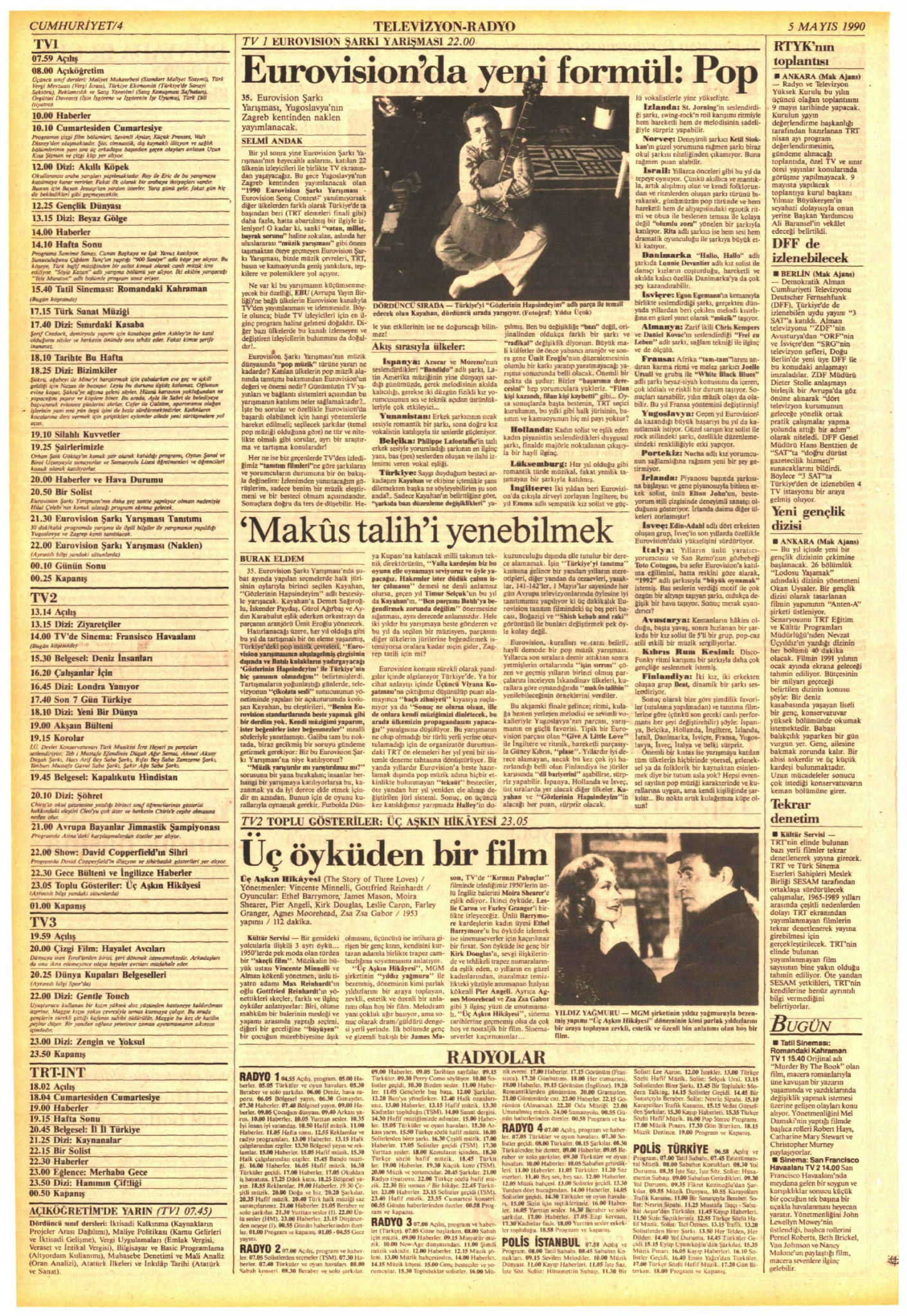
- (5 May 1990). "Televizyon-Radyo". [[Cumhuriyet]].
- (8 May 1990). "Tele görüş – Garip anlayış". [[Milliyet]].
- (5 May 1990). "Eurovision Song Contest 90 – BBC One".
- (5 May 1990). "Eurovision Song Contest – BBC Radio 2".
- (5 May 1990). "Телевизија". [[Politika]].
- (5 May 1990). "Радио • Телевизија • Видео". [[Politika]].
- (5 May 1990). "Televizió". [[Magyar Szó]].
- (5 May 1990). "Spored za soboto". [[Delo (newspaper).
- (5 May 1990). "rtv". [[Slobodna Dalmacija]].
- (6 May 1990). "Television today". [[The Canberra Times]].
- (21 May 1990). "
pondělí 28.5. ". {{ill. - (4 May 1990). "Радио Телевизија Београд". [[Borba (newspaper).
- (4 May 1990). "Sjónvarp". [[Oyggjatíðindi]].
- (12 May 1990). "TV KNR". [[Atuagagdliutit/Grønlandsposten.
- (5 May 1990). "A televízió és a rádió műsora". [[Magyar Nemzet]].
- (19–20 May 1990). "TV {{!}} 19-20.05.". [[Dziennik Bałtycki]].
- (23 June 1990). "유러비전노래競演 실황". [[The Dong-A Ilbo]].
- (28 April 1990). "Программа телевидения на неделю". [[Sovetskaya Sibir]].
- (28 April 1990). "Телевидение". [[Pravda]].
- (30 April – 6 May 1990). "L. 5. V".
This article was imported from Wikipedia and is available under the Creative Commons Attribution-ShareAlike 4.0 License. Content has been adapted to SurfDoc format. Original contributors can be found on the article history page.
Ask Mako anything about Eurovision Song Contest 1990 — get instant answers, deeper analysis, and related topics.
Research with MakoFree with your Surf account
Create a free account to save articles, ask Mako questions, and organize your research.
Sign up freeThis content may have been generated or modified by AI. CloudSurf Software LLC is not responsible for the accuracy, completeness, or reliability of AI-generated content. Always verify important information from primary sources.
Report