From Surf Wiki (app.surf) — the open knowledge base
Eurovision Song Contest 1974
International song competition
International song competition
| Field | Value |
|---|---|
| name | Eurovision Song Contest |
| year | 1974 |
| logo | ESC 1974 logo.png |
| final | |
| venue | Brighton Dome |
| Brighton, United Kingdom | |
| presenter | Katie Boyle |
| musdirector | Ronnie Hazlehurst |
| director | Michael Hurll |
| scrutineer | Clifford Brown |
| exproducer | Bill Cotton |
| organiser | European Broadcasting Union (EBU) |
| host | British Broadcasting Corporation (BBC) |
| entries | 17 |
| debut | |
| nonreturn | |
| vote | Ten-member juries in each country; each member gave one vote to their favourite song |
| winner | |
| "Waterloo" | |
| Map NoSemis | Y |
Brighton, United Kingdom "Waterloo"
The Eurovision Song Contest 1974 was the 19th edition of the Eurovision Song Contest, held on 6 April 1974 at the Brighton Dome in Brighton, United Kingdom, and presented by Katie Boyle. It was organised by the European Broadcasting Union (EBU) and host broadcaster the British Broadcasting Corporation (BBC), who staged the event after Compagnie Luxembourgeoise de Télédiffusion (CLT), which had won the for , declined hosting responsibilities as it had staged the competition in 1973. The BBC took over as host after Televisión Española (TVE), which had finished second for , declined the offer when approached, with the EBU ultimately choosing the BBC over bids from the Israel Broadcasting Authority (IBA) and the BBC's commercial rival ITV. This was the fourth time that the BBC had staged the contest after another broadcaster declinedfollowing the , and contestsand the fifth time overall including .
Entries representing eighteen countries were submitted for the contest, with making its first appearance. However, ultimately did not participate as the contest coincided with the death of French president Georges Pompidou, and with a national day of mourning scheduled for the date of the contest the French broadcaster, Office de Radiodiffusion Télévision Française (ORTF), deemed participating in the event to be inappropriate. The voting system used between and 1973 was scrapped, and was replaced by the system last used in , with ten people in each country awarding one vote to their favourite song.
The winner was , with the song "Waterloo", composed by Benny Andersson and Björn Ulvaeus, written by Stig Anderson and performed by ABBA. and the finishing second and third respectively, followed by a three-way tie for fourth place between Luxembourg, and the United Kingdom. It was Sweden's first contest win. After previous success within European markets with "Ring Ring", with which ABBA had attempted to represent , "Waterloo" gave the group their first global hit, and their Eurovision win was a launching point for ABBA to become one of the world's best-selling music artists. Olivia Newton-John, who represented the United Kingdom at this event, would also go on to achieve worldwide success in the years following the contest.
Location
The 1974 contest was held in Brighton, United Kingdom. It was the fifth time that the United Kingdom had hosted the contest, having previously done so in , , , and . The selected venue was the Dome, completed in 1805 and originally built for the Prince Regent as stables and a riding school for his personal use. Sold by Queen Victoria in 1850, the stables were converted into a concert hall and assembly rooms in 1867, and the riding school into a market for corn merchants in 1868. The concert hall could normally seat up to 2,102 people, but for the contest some seating was removed for the commentator booths and technical equipment, leaving space for an audience of just over 1,000 people.
Among the other venues considered to stage the event by the BBC were the Royal Opera House and Royal Albert Hall in London, the latter of which had previously staged the 1968 contest. Both venues proved to be unavailable however, with the broadcaster then looking outside of the capital for potential venues. The Dome was then ultimately selected, and this choice was announced publicly by the BBC and EBU in July 1973.
Host selection
The was won by , represented by Compagnie Luxembourgeoise de Télédiffusion (CLT), with the song "Tu te reconnaîtras" performed by Anne-Marie David, which according to Eurovision tradition made CLT the presumptive host of the 1974 contest. The broadcaster had staged the event on three previous occasions, in , , and 1973, each time in Luxembourg City. As CLT had hosted the event the previous year, it declined the opportunity to stage the event for a second consecutive year due to the financial strain such an undertaking would entail. , which had come second in 1973, was also considered as a potential host for the event, however Televisión Española (TVE) also turned down the opportunity to stage the 1974 contest; TVE had previously hosted the event in .
The European Broadcasting Union (EBU) originally asked the British Broadcasting Corporation (BBC), as the participating broadcaster which came third the previous year, not to make an offer at this initial stage in order to determine if other participating broadcasters were willing to stage the event. Of the four previous events held by the BBC three of these had been staged in place of the previous year's winning broadcaster, specifically the 1960, 1963, and 1972 events. Two offers were subsequently made, from the Israel Broadcasting Authority (IBA) and from the BBC's commercial rival ITV. Concerns were raised about the prospect of hosting the event in Israel; they had just joined the contest in 1973 and it was felt some countries would not be prepared to accept an Israeli-held contest. Israel was also some distance geographically from the core of Western European nations which participated in the event at this time, and IBA still lagged behind many European broadcasters from a technological perspective. A successful ITV bid would have effectively barred the BBC from participating, as only one entry from a given country can participate in the event, resulting in the BBC submitting a counter-offer which the EBU accepted on 7 June 1973.
Participants
.jpg)
Broadcasters from a total of eighteen countries submitted entries to compete in this edition of the contest, comprising all seventeen countries which had participated in 1973, and , which was making its first appearance in the contest. Turkish broadcaster, the Turkish Radio and Television Corporation (TRT), had also expressed an interest in competing but it had been too late in submitting its request to the EBU and was subsequently informed that, as the scoreboard with space for eighteen countries had already been constructed, its planned entry would not have been possible. Ultimately, however, only seventeen participating entries were performed at the contest, as French broadcaster, Office de Radiodiffusion Télévision Française (ORTF), made the decision to withdraw from the event due to the death of French president Georges Pompidou on 2 April. With the state memorial service and a national day of mourning scheduled to be held on the same day as the contest, it was deemed by ORTF that competing in and broadcasting the contest would be inappropriate. France would have been represented by the song "La Vie à vingt-cinq ans", written by Christine Fontaine and to have been performed by Dani, with Jean-Claude Petit scheduled to conduct the orchestra during the performance.
Among the participating artists were a number of acts which had competed in the Eurovision Song Contest in previous years: 's Gigliola Cinquetti had previously won the contest for with the song "Non ho l'età"; Romuald, representing , had previously represented both and ; and 's Bendik Singers, supporting Anne-Karine Strøm at this event, had represented , with Strøm having also been a member of the group in that contest.
| Country | Broadcaster | Artist | Song | Language | Songwriter(s) | Conductor |
|---|---|---|---|---|---|---|
| RTB | Jacques Hustin | "Fleur de liberté" | French | Pierre Chiffre | ||
| YLE | Carita | "Keep Me Warm" | English | Ossi Runne | ||
| HR | Cindy and Bert | "Die Sommermelodie" | German | Werner Scharfenberger | ||
| EIRT | Marinella | "Krassi, thalassa ke t' agori mu" | ||||
| (Κρασί, θάλασσα και τ' αγόρι μου) | Greek | Giorgos Katsaros | ||||
| RTÉ | Tina Reynolds | "Cross Your Heart" | English | Paul Lyttle | Colman Pearce | |
| IBA | Poogy | "Natati La Khaiai" (נתתי לה חיי) | Hebrew | Yonatan Rechter | ||
| RAI | Gigliola Cinquetti | "Sì" | Italian | |||
| CLT | Ireen Sheer | "Bye Bye I Love You" | French | Charles Blackwell | ||
| TMC | Romuald | "Celui qui reste et celui qui s'en va" | French | Raymond Donnez | ||
| NOS | Mouth and MacNeal | "I See a Star" | English | Harry van Hoof | ||
| NRK | Anne-Karine and the Bendik Singers | "The First Day of Love" | English | Frode Thingnæs | ||
| RTP | Paulo de Carvalho | "E depois do adeus" | Portuguese | José Calvário | ||
| TVE | Peret | "Canta y sé feliz" | Spanish | Pedro Pubill Calaf | Rafael Ibarbia | |
| SR | ABBA | "Waterloo" | English | Sven-Olof Walldoff | ||
| SRG SSR | Piera Martell | "Mein Ruf nach dir" | German | Pepe Ederer | Pepe Ederer | |
| BBC | Olivia Newton-John | "Long Live Love" | English | Nick Ingman | ||
| JRT | Korni Grupa | "Generacija '42" (Генерација '42) | Serbo-Croatian | Kornelije Kovač |
Production and format
The Eurovision Song Contest 1974 was produced by the BBC. Bill Cotton served as executive producer, Michael Hurll served as producer and director, John Burrowes served as designer, and Ronnie Hazlehurst served as musical director, leading the BBC Concert Orchestra. A separate musical director could be appointed by each participating delegation to lead the orchestra during its country's performance, with the host musical director also available to conduct for those which did not appoint their own conductor. On behalf of the EBU, the event was overseen by Clifford Brown as scrutineer.
Each participating broadcaster submitted one song, which was required to be no longer than three minutes in duration. As with the previous year's event, artists were able to perform in any language, and not necessarily that of the country they represented. A maximum of six performers were allowed on stage during each country's performance. Each entry could utilise all or part of the live orchestra and could use instrumental-only backing tracks, however any backing tracks used could only include the sound of instruments featured on stage being mimed by the performers.
Rehearsals in the contest venue began on Tuesday 2 April, involving technical rehearsals with the production team, the orchestra, and tests of the voting system and scoreboard. This was followed by rehearsals with the competing acts over subsequent days. The first rehearsals for all countries were held over two days on 3 and 4 April, with each participating act having a 50-minute slot on stage to perform through their entry with the orchestra without stage costumes. A second round of rehearsals, this time in costume, was held for all acts on 5 April, with each country given 20 minutes on stage, followed that evening by a complete run-through of the whole show, including dummy voting. Further technical rehearsals were held on the morning of 6 April, and a second full dress rehearsal was held that afternoon; this rehearsal was also recorded for use as a back-up in case technical failure meant the contest could not go ahead as planned.
Security in Brighton was tight in the lead-up to, and during, the contest, due to the threat of actions by Irish republican militants. There was an increased police presence, and tanks could be seen in the streets of Brighton during the week of the contest. The contest presenter Katie Boyle also recalled being ferried in bulletproof coaches between the hotel and the contest venue, each time taking a different route.
Voting procedure
Due in part to the closeness of the voting in the previous year's contest, a new voting system was planned to be introduced for this event, which incorporated elements from the two previous voting systems used in the contest: each participating broadcaster would assemble a jury comprising ten members, which would be based in their own country, with each member awarding between one and five votes for each song, with no abstentions allowed and without the option to vote for their own country's entry. This would have resulted in each country potentially awarding a maximum of 50 votes and a minimum of 10 votes to any other country's song; with eighteen planned participating countries, this would have meant that the highest possible score any country could have received was 850, and the lowest possible score was 170. In case of a tie between two or more countries for first place, these acts would have performed again and each country not involved in the tie would have had one vote each to determine the winner. A lottery element to the voting, in order to add greater suspense, was also devised: the order of the voting would have been determined on stage during the voting segment, with cards being drawn at random to decide the order in which countries would vote.
During rehearsals however, it quickly became apparent to the organisers that they had misjudged how long it would take to conduct this new voting system, as well as mounting concerns that any issues with totalling the scores live could exacerbate the problems. Although a computerised system to calculate each country's total had been investigated, this was rejected for cost reasons. Ultimately the contest's executive producer Bill Cotton took the unilateral decision to abandon the proposed voting system and, given the jury structure of ten people had already been established and jury members had most likely already been recruited by the broadcasters, determined that the only alternative was to revert to the scoring system last used in : each of the ten jury members had one vote to award to their favourite song. The lottery aspect of the voting system was, however, retained, although due to timing and sound quality reasons this draw was held before the contest by the EBU's scrutineer Clifford Brown.
Contest overview
The contest was held on 6 April 1974, beginning at 21:30 (BST) and lasting 1 hour and 49 minutes. The contest was presented by the British television presenter and actress Katie Boyle, who had previously presented the contest in 1960, 1963 and 1968. Having hosted the contest four times, Boyle holds the record for most contest appearances as a presenter . Following the confirmation of the eighteen planned participating countries, the draw to determine the running order (R/O) of the contest was held on 5 December 1973; prior to its withdrawal, France was scheduled to perform in fourteenth position, between the entries from and .
The interval act was a pre-recorded video montage featuring the Wombles, a novelty pop band based on the children's characters of the same name, in various locations across Brighton. The medallions awarded to the winning songwriters were presented by the Director-General of the BBC and the President of the EBU, Charles Curran.
The winner was represented by the song "Waterloo", composed by Benny Andersson and Björn Ulvaeus, written by Stig Anderson and performed by ABBA. It was Sweden's first contest win.
| R/O | Country | Artist | Song | Votes | Place | 1 | 2 | 3 | 4 | 5 | 6 | 7 | 8 | 9 | 10 | 11 | 12 | 13 | 14 | 15 | 16 | 17 |
|---|---|---|---|---|---|---|---|---|---|---|---|---|---|---|---|---|---|---|---|---|---|---|
| Carita | "Keep Me Warm" | 4 | 13 | |||||||||||||||||||
| "Long Live Love" | 14 | 4 | ||||||||||||||||||||
| Peret | "Canta y sé feliz" | 10 | 9 | |||||||||||||||||||
| Anne-Karine and the Bendik Singers | "The First Day of Love" | 3 | 14 | |||||||||||||||||||
| Marinella | "Krassi, thalassa ke t' agori mou" | 7 | 11 | |||||||||||||||||||
| Poogy | "Natati La Khaiai" | 11 | 7 | |||||||||||||||||||
| Korni Grupa | "Generacija '42" | 6 | 12 | |||||||||||||||||||
| ABBA | "Waterloo" | 24 | 1 | |||||||||||||||||||
| "Bye Bye I Love You" | 14 | 4 | ||||||||||||||||||||
| Romuald | "Celui qui reste et celui qui s'en va" | 14 | 4 | |||||||||||||||||||
| "Fleur de liberté" | 10 | 9 | ||||||||||||||||||||
| Mouth and MacNeal | "I See a Star" | 15 | 3 | |||||||||||||||||||
| "Cross Your Heart" | 11 | 7 | ||||||||||||||||||||
| Cindy and Bert | "Die Sommermelodie" | 3 | 14 | |||||||||||||||||||
| "Mein Ruf nach dir" | 3 | 14 | ||||||||||||||||||||
| "E depois do adeus" | 3 | 14 | ||||||||||||||||||||
| "Sì" | 18 | 2 |
Spokespersons
Each participating broadcaster appointed a spokesperson, connected to the contest venue via telephone lines and responsible for announcing, in English or French, the votes for its respective country. Known spokespersons at the 1974 contest are listed below.
- Finland
- IrelandBrendan Balfe
- MonacoSophie Hecquet
- SwedenSven Lindahl
- United KingdomColin Ward-Lewis
- YugoslaviaHelga Vlahović
Detailed voting results
Jury voting was used to determine the votes awarded by all countries. The announcement of the results from each country was conducted in a predetermined order chosen at random, with the spokespersons announcing their country's votes in English or French in performance order. The detailed breakdown of the votes awarded by each country is listed in the tables below, with voting countries listed in the order in which they presented their votes.
| nb=1 | Total score}} | nb=1 | Finland}} | nb=1 | Luxembourg}} | nb=1 | Israel}} | nb=1 | Norway}} | nb=1 | United Kingdom}} | nb=1 | Yugoslavia}} | nb=1 | Greece}} | nb=1 | Ireland}} | nb=1 | Germany}} | nb=1 | Portugal}} | nb=1 | Netherlands}} | nb=1 | Sweden}} | nb=1 | Spain}} | nb=1 | Monaco}} | nb=1 | Switzerland}} | nb=1 | Belgium}} | nb=1 | Italy}} | va=middle | Contestants}} | Finland | United Kingdom | Spain | Norway | Greece | Israel | Yugoslavia | Sweden | Luxembourg | Monaco | Belgium | Netherlands | Ireland | Germany | Switzerland | Portugal | Italy |
|---|---|---|---|---|---|---|---|---|---|---|---|---|---|---|---|---|---|---|---|---|---|---|---|---|---|---|---|---|---|---|---|---|---|---|---|---|---|---|---|---|---|---|---|---|---|---|---|---|---|---|---|---|---|---|
| 4 | 2 | 1 | 1 | |||||||||||||||||||||||||||||||||||||||||||||||||||
| 14 | 1 | 4 | 1 | 1 | 2 | 1 | 1 | 3 | ||||||||||||||||||||||||||||||||||||||||||||||
| 10 | 1 | 2 | 1 | 2 | 1 | 3 | ||||||||||||||||||||||||||||||||||||||||||||||||
| 3 | 1 | 1 | 1 | |||||||||||||||||||||||||||||||||||||||||||||||||||
| 7 | 1 | 4 | 2 | |||||||||||||||||||||||||||||||||||||||||||||||||||
| 11 | 2 | 1 | 2 | 2 | 1 | 3 | ||||||||||||||||||||||||||||||||||||||||||||||||
| 6 | 1 | 1 | 1 | 1 | 2 | |||||||||||||||||||||||||||||||||||||||||||||||||
| 24 | 5 | 1 | 2 | 2 | 1 | 1 | 2 | 1 | 3 | 1 | 5 | |||||||||||||||||||||||||||||||||||||||||||
| 14 | 2 | 2 | 1 | 3 | 1 | 1 | 1 | 1 | 2 | |||||||||||||||||||||||||||||||||||||||||||||
| 14 | 2 | 1 | 1 | 1 | 2 | 1 | 1 | 2 | 1 | 2 | ||||||||||||||||||||||||||||||||||||||||||||
| 10 | 3 | 2 | 5 | |||||||||||||||||||||||||||||||||||||||||||||||||||
| 15 | 1 | 1 | 1 | 3 | 2 | 1 | 1 | 1 | 3 | 1 | ||||||||||||||||||||||||||||||||||||||||||||
| 11 | 2 | 1 | 2 | 1 | 2 | 2 | 1 | |||||||||||||||||||||||||||||||||||||||||||||||
| 3 | 1 | 1 | 1 | |||||||||||||||||||||||||||||||||||||||||||||||||||
| 3 | 1 | 1 | 1 | |||||||||||||||||||||||||||||||||||||||||||||||||||
| 3 | 1 | 2 | ||||||||||||||||||||||||||||||||||||||||||||||||||||
| 18 | 2 | 1 | 1 | 5 | 1 | 1 | 2 | 4 | 1 |
Broadcasts
Broadcasters competing in the event were required to relay the contest via its networks; non-participating EBU member broadcasters were also able to relay the contest. Broadcasters were able to send commentators to provide coverage of the contest in their own native language and to relay information about the artists and songs to their television viewers.
In addition to the participating nations, which, with the exception of Italy, all broadcast the contest live on television, the contest was also reportedly aired, live or deferred, by broadcasters in Algeria, Austria, Bulgaria, Cyprus, Czechoslovakia, France, Hungary, Japan, Jordan, Iceland, Morocco, Poland, South Korea, the Soviet Union and Tunisia. In addition to television coverage, participating broadcasters in Belgium, Finland, Germany, Ireland, Norway, Spain, Sweden, Switzerland and the United Kingdom were also reported to have relayed the contest via radio. Although the script for the contest's opening remarks by Katie Boyle and the press suggested that around 500 million viewers were expected to watch and listen to the contest, the EBU later put the actual estimated figure for the total audience at 231 million.
Known details on the broadcasts in each country, including the specific broadcasting stations and commentators are shown in the tables below.
| Country | Broadcaster | Channel(s) | Commentator(s) | Belgium | Finland | Germany | Greece | Ireland | Israel | Italy | Luxembourg | Netherlands | Norway | Portugal | Spain | Sweden | Switzerland | United Kingdom | Yugoslavia | |||
|---|---|---|---|---|---|---|---|---|---|---|---|---|---|---|---|---|---|---|---|---|---|---|
| RTB | RTB | Paule Herreman | ||||||||||||||||||||
| RTB 1 | ||||||||||||||||||||||
| BRT | BRT, BRT 1 | |||||||||||||||||||||
| YLE | TV1, {{ill | Yleisohjelma | fi | Yleisohjelma (Suomen Yleisradio)}} | ||||||||||||||||||
| Ruotsinkielinen ohjelma | ||||||||||||||||||||||
| ARD | Deutsches Fernsehen | |||||||||||||||||||||
| EIRT | EIRT | |||||||||||||||||||||
| RTÉ | RTÉ | Mike Murphy | ||||||||||||||||||||
| RTÉ Radio | ||||||||||||||||||||||
| IBA | Israeli Television | |||||||||||||||||||||
| RAI | Secondo Programma TV, Secondo Programma | Rosanna Vaudetti | ||||||||||||||||||||
| CLT | RTL Télé-Luxembourg | |||||||||||||||||||||
| NOS | Nederland 2 | Willem Duys | ||||||||||||||||||||
| NRK | NRK Fjernsynet | John Andreassen | ||||||||||||||||||||
| NRK | ||||||||||||||||||||||
| RTP | I Programa | Artur Agostinho | ||||||||||||||||||||
| ENR | Emissora Nacional Programa 1 | |||||||||||||||||||||
| TVE | TVE 1 | José Luis Uribarri | ||||||||||||||||||||
| RNE | Radio Nacional | Carlos Tena | ||||||||||||||||||||
| Cadena SER | ||||||||||||||||||||||
| SR | TV1 | |||||||||||||||||||||
| SR P3 | ||||||||||||||||||||||
| SRG SSR | TV DRS | |||||||||||||||||||||
| TSR | ||||||||||||||||||||||
| TSI | ||||||||||||||||||||||
| DRS 1 | ||||||||||||||||||||||
| RSR 1 | Robert Burnier | |||||||||||||||||||||
| Radio Monte Ceneri | ||||||||||||||||||||||
| BBC | BBC1 | David Vine | ||||||||||||||||||||
| BBC Radio 2 | Terry Wogan | |||||||||||||||||||||
| BFBS | BFBS Radio | Richard Astbury | ||||||||||||||||||||
| JRT | TV Beograd 1 | |||||||||||||||||||||
| TV Koper-Capodistria | ||||||||||||||||||||||
| TV Ljubljana 1 | ||||||||||||||||||||||
| TV Zagreb 1 |
| Country | Broadcaster | Channel(s) | Commentator(s) | Austria | France | Hungary | Iceland | Japan | Malta | Netherlands Antilles | Poland | South Korea | Romania | Turkey |
|---|---|---|---|---|---|---|---|---|---|---|---|---|---|---|
| ORF | FS2 | Ernst Grissemann | ||||||||||||
| ORTF | Première Chaîne | Pierre Tchernia | ||||||||||||
| MTV | MTV1 | |||||||||||||
| RÚV | Sjónvarpið | |||||||||||||
| Fuji Television | Shizue Abe and Ben Okano | |||||||||||||
| MBA | National Network | Victor Aquilina | ||||||||||||
| Voz di Aruba | ||||||||||||||
| TP | TP1 | |||||||||||||
| PR | PR1 | |||||||||||||
| KBS | KBS | |||||||||||||
| TVR | Programul 1 | |||||||||||||
| TRT | TRT Televizyon, Radyo 2 |
Legacy
The 1974 contest has retrospectively gained notability for a number of aspects, particularly due to the success of some of the competing acts, as well as political developments within Europe that have indirect links to this edition of the event. Two competing artists at this year's event, in particular, went on to sustained worldwide success after the contest: Sweden's ABBA and the United Kingdom's Olivia Newton-John.
The individual members of ABBA had made previous attempts to reach Eurovision, participating in Sweden's national selection, Melodifestivalen, several times, both as a group and individually. Anni-Frid Lyngstad participated in Melodifestivalen 1969, placing fourth with the song "Härlig är vår jord", while Benny Andersson competed in the same edition as a songwriter, placing second with the song "Hej clown" performed by Jan Malmsjö. Andersson and Björn Ulvaeus subsequently competed as a songwriting partnership in 1972, penning the Lena Andersson song "Säg det med en sång", which placed third. Following the formation of ABBA, the group (performing under the name "Björn & Benny, Agnetha & Anni-Frid") competed in Melodifestivalen 1973 with the song "Ring Ring", which ultimately placed third. While "Ring Ring" was popular within European markets, wider success for the group, particularly in English-speaking markets, proved elusive, and the group saw Eurovision as a launchpad for exposure among these markets, resulting in a further attempt to get to the contest in 1974. Although "Waterloo" had been written with Eurovision in mind, the group also considered submitting the song "Hasta Mañana" to Swedish broadcaster Sveriges Radio (SR), as the latter song was felt to be more in-line with the songs that had done well in Eurovision in previous years. Ultimately, however, "Waterloo" was chosen, given it was more likely to be unlike other entries submitted, and therefore would stand out more; "Hasta Mañana" was also mainly sung only by Agnetha Fältskog, whereas with "Waterloo" all four members of the group could give their vocals to the song.
Following the group's win, "Waterloo" went on to top the charts in multiple European countries, including the UK singles chart, as well as reaching the top ten in the Billboard Hot 100. Long-term success for the group, however, did not materialise until the release of "SOS" in 1975, which allowed the group to shrug off a perception of being "one-hit wonders" and led to a string of hits through the rest of the 1970s and early 1980s, which catapulted the foursome to become one of the best-selling music groups of all time. ABBA's international success within the global music scene, starting from their Eurovision win, additionally led to a large growth in the accessibility of Swedish pop music worldwide, with Sweden often considered a superpower in the realm of music export and claims made by the 2000s of being the third-largest exporter of music globally, behind only the United States and the United Kingdom.
Olivia Newton-John was in the early stages of her career when she was approached by the BBC to represent the United Kingdom at Eurovision; she had achieved previous success in the charts in both the UK and US, particularly with country pop songs, and had been a frequent guest on the It's Cliff Richard show, fronted by two-time Eurovision entrant for the United Kingdom Cliff Richard. Newton-John had performed six songs at that year's A Song for Europe contest, with "Long Live Love" being chosen by the viewing public through postcard voting; although it was considered a favourite to win the contest, she later told the press after placing fourth that she felt the wrong song had been chosen and that she would have preferred to have performed a ballad. Newton-John subsequently achieved considerable success in the United States and global recognition after starring in the musical films Grease (1978) and Xanadu (1980).
Following the contest, the Portuguese entry, "E depois do adeus" by Paulo de Carvalho, played a large part in the launching of the Carnation Revolution, which ultimately led to the overthrow of the authoritarian Estado Novo regime, setting Portugal along a path towards the reestablishment of democracy and ending the country's war with its African colonies. The radio broadcast of the song on the evening of 24 April 1974 was used as a signal to alert rebelling officers in the Portuguese army to begin the coup, which kicked off overnight following the playing of another song, "Grândola, vila morena" by José Afonso, in the early hours of 25 April.
The Italian broadcaster, Radiotelevisione italiana (RAI), did not air the contest for two months due to the content of its own entry. The contest coincided with the campaigning period for a referendum on abolishing divorce within the country, which was held a month after the contest, and there were fears that the , "Sì" ("Yes") by Gigliola Cinquetti, could have been seen as an attempt to sway the result of the vote. The contest was, however, available to watch in parts of northern Italy where transmissions of Swiss and Yugoslav Italian-language television were accessible. The contest was eventually broadcast on RAI on 6 June 1974, a month after the referendum.
"Waterloo" was subsequently nominated in 2005 to compete in Congratulations: 50 Years of the Eurovision Song Contest, a special broadcast to determine the contest's most popular entry of its first 50 years as part of the contest's anniversary celebrations. One of 14 entries chosen to compete, "Waterloo" was ultimately declared the winner of the competition over two rounds of jury and public voting.
References
- "United Kingdom – Participation history". European Broadcasting Union (EBU).
- "Brighton 1974". European Broadcasting Union (EBU).
- "Heritage Stories – Architecture". [[Brighton Dome]].
- "Luxembourg 1973". European Broadcasting Union (EBU).
- "Luxembourg – Participation history". European Broadcasting Union (EBU).
- "Spain – Participation history". European Broadcasting Union (EBU).
- (14 May 2016). "7 times the Eurovision Song Contest was not hosted by the winning country". EuroVisionary.
- "Israel – Participation history". European Broadcasting Union (EBU).
- (4 May 2022). "Sì! Gigliola Cinquetti returns to the Eurovision Grand Final". European Broadcasting Union (EBU).
- (21 March 2014). "Recalling the Copenhagen contest of 50 years ago". European Broadcasting Union (EBU).
- Sanabria-Rangel, Álvaro. (10 April 2021). "Eurovision 1976: Norway's Anne-Karine Strøm in focus". EuroVisionary.
- "Brighton 1974 – Participants". European Broadcasting Union (EBU).
- "Alle deutschen ESC-Acts und ihre Titel". [[ARD (broadcaster).
- "The Organisers behind the Eurovision Song Contest". European Broadcasting Union (EBU).
- (18 May 2019). "How it works". European Broadcasting Union (EBU).
- (31 October 2018). "The Rules of the Contest". European Broadcasting Union (EBU).
- "Dublin 1971". European Broadcasting Union (EBU).
- (6 April 2024). "Abba won Eurovision Song Contest in Brighton 50 years ago today". [[The Argus (Brighton).
- Zwart, Josianne. (21 March 2018). "Katie Boyle, iconic Eurovision Song Contest host, dies at 91". European Broadcasting Union (EBU).
- Barker, Dennis. (20 March 2018). "Katie Boyle obituary". [[The Guardian]].
- (6 April 1974). "Eurovision Song Contest 1974". [[BBC.
- (6 April 2011). "37 years ago today - ABBA take the title with Waterloo". European Broadcasting Union (EBU).
- "Brighton 1974 – ABBA". European Broadcasting Union (EBU).
- (5 September 2016). "Milestone Moments: 1974 - The arrival of ABBA". European Broadcasting Union (EBU).
- "Sweden – Participation history". European Broadcasting Union (EBU).
- "Brighton 1974 – Scoreboard". European Broadcasting Union (EBU).
- (24 May 2021). "Lugano to Liverpool: Broadcasting Eurovision". [[National Science and Media Museum]].
- (6 April 1974). "Tonight's television". [[The Herald (Ireland).
- (31 March 1975). "Facets of Eurovision's Song Contest '75". [[Times of Malta]].
- (27 February 2012). "Helga Vlahović: 1990 presenter has died". European Broadcasting Union (EBU).
- "Brighton 1974 – Detailed voting results". European Broadcasting Union (EBU).
- "Eurovision Song Contest 1974 – Scoreboard". European Broadcasting Union (EBU).
- West, Roy. (6 April 1974). "TV preview". [[Liverpool Daily Post]].
- (6 April 1974). "TV–programma's van zaterdag 6 april 1974". [[De Standaard]].
- (5 April 1974). "Radio- und TV-programm". [[Grenz-Echo]] and {{ill.
- (6 April 1974). "Radio". [[De Standaard]].
- (6 April 1974). "Lauwe kompetitiespeer op songfestival: Een vedette wordt geboren in koninklijke paardestal". [[De Standaard]].
- (6 April 1974). "Carita ensimmäisenä Eurovisiokilpailussa". [[Helsingin Sanomat]].
- (6 April 1974). "Radio ja TV". [[Helsingin Sanomat]].
- (6 April 1974). "Fernsehen heute". {{ill.
- (6 April 1974). "Τηλεόρασις". [[Makedonia (newspaper).
- (6 April 1974). "Today's TV and radio programmes". [[Irish Independent]].
- (5 April 1974). "טלוויזיה כללית". [[Al HaMishmar]].
- (2–8 June 1974). "TV {{!}} 6 giugno {{!}} giovedi".
- (2–8 June 1974). "radio – giovedi 6 giugno".
- (5 April 1974). "Télé-programmes – samedi 6 avril". [[Luxemburger Wort]].
- (6 April 1974). "Televisie {{!}} Radio". [[De Volkskrant]].
- Van Dijk, Ale. (6 April 1974). "Eurovisie songfestival volgend jaar bij ons". [[Het Vrije Volk]].
- (6 April 1974). "Radio • TV". [[Haugesunds Avis]].
- (6 April 1974). "Televisão {{!}} Rádio". [[Diário de Lisboa]].
- Castrim, Mário. (7 April 1974). "Um Waterloo onde faltou Cambronne". [[Diário de Lisboa]].
- (6 April 1974). "1a Cadena – Sábado".
- HerGar, Paula. (28 March 2018). "Todos los comentaristas de la historia de España en Eurovisión (y una única mujer en solitario)". [[Los 40]].
- (6 April 1974). "Programas de Radio y Televisión". [[La Vanguardia]].
- (5 April 1974). "Eurovision en directo por Radio Nacional de España". {{ill.
- (6 April 1974). "La radio, hoy". {{ill.
- (6 April 1974). "Programa de las emisoras castellonenses". {{ill.
- (6 April 1974). "TVE Programas". {{ill.
- (6 April 1974). "Programas de Radio". {{ill.
- (6 April 1974). "tv". {{ill.
- (6 April 1974). "Programa de radio para hoy". [[ABC (newspaper).
- (6 April 1974). "Radio y Television". {{ill.
- (6 April 1974). "tv programmen". [[Svenska Dagbladet]].
- (6 April 1974). "radioprogrammen". [[Svenska Dagbladet]].
- (7 April 1974). "Fernsehen – Samstag". [[Der Bund]].
- (4 April 1974). "TV – samedi 6 avril".
- (6 April 1974). "Radio Televisione". {{ill.
- (9 April 1974). "Radio". [[Der Bund]].
- (4 April 1974). "Radio – samedi 6 avril".
- (6 April 1974). "Eurovision Song Contest 1974 – BBC1".
- (6 April 1974). "as Radio 2 – BBC Radio 1".
- (6 April 1974). "Radio". [[Birmingham Post.
- (6 April 1974). "Your full guide to this weekend's television and radio programmes". [[Lancashire Telegraph]].
- (6 April 1974). "all your TV". [[The Journal (Newcastle upon Tyne newspaper).
- (6 April 1974). "TV & radio". [[The Northern Echo]].
- (6 April 1974). "Radio programmes". [[Nottingham Post.
- (6 April 1974). "Television and radio". [[Grimsby Telegraph.
- (7 April 1973). "Saturday radio". [[Daily Mirror]].
- (6 April 1974). "Your weekend TV and radio guide". [[Reading Post.
- (6 April 1974). "Weekend TV guide". [[The Sentinel (Staffordshire).
- (6 April 1974). "Eurovision Song Contest 1974 – BBC Radio 2".
- (6 April 1974). "Телевизија". [[Borba (newspaper).
- (6 April 1974). "Radio televizija". [[Primorski dnevnik]].
- (6 April 1974). "Program {{!}} Televizija danes". [[Delo (newspaper).
- (5 April 1974). "Tjedni televizijski program {{!}} TV Zagreb od 6. travnja do 12. travnja". Glas Podravine.
- (28 March 1974). "TV Avstrija". Naš tednik.
- Halbhuber, Axel. (22 May 2015). "Ein virtueller Disput der ESC-Kommentatoren". [[Kurier]].
- (9 April 1974). "19ème Concours Eurovision de la chanson 1974". {{lang.
- (9 April 1974). "Téléprevision {{!}} mardi 9 avril". {{ill.
- (20 May 1974). "Szombat – május 25".
- (17 May 1974). "'ABBA' með lagið "Waterloo" leggja Evrópu að fótum sér". [[Vísir]].
- (18 May 1974). "From the Music Capitals of the World".
- (8 April 1974). "Euro Song Contest – Sweden's runaway victory". [[Times of Malta]].
- (4 May 1974). "Boutique Carnaby ta presenta – Diadomingo 5 Mei pa 5.00 di atardi Eurovisie Festival – Atravez di PJA-10 Voz di Aruba". [[Amigoe.
- (11–12 January 1975). "Telewizja {{!}} sobota: 11. I.". [[Trybuna Śląska.
- (4–5 May 1974). "Radio {{!}} niedziela — 5. V.". [[Trybuna Śląska.
- (19 June 1974). "「유럽 放送가요제」". [[Kyunghyang Shinmun]].
- (20 April 1974). "Televiziune". Flacăra roșie.
- (6 April 1974). "TV". [[Cumhuriyet]].
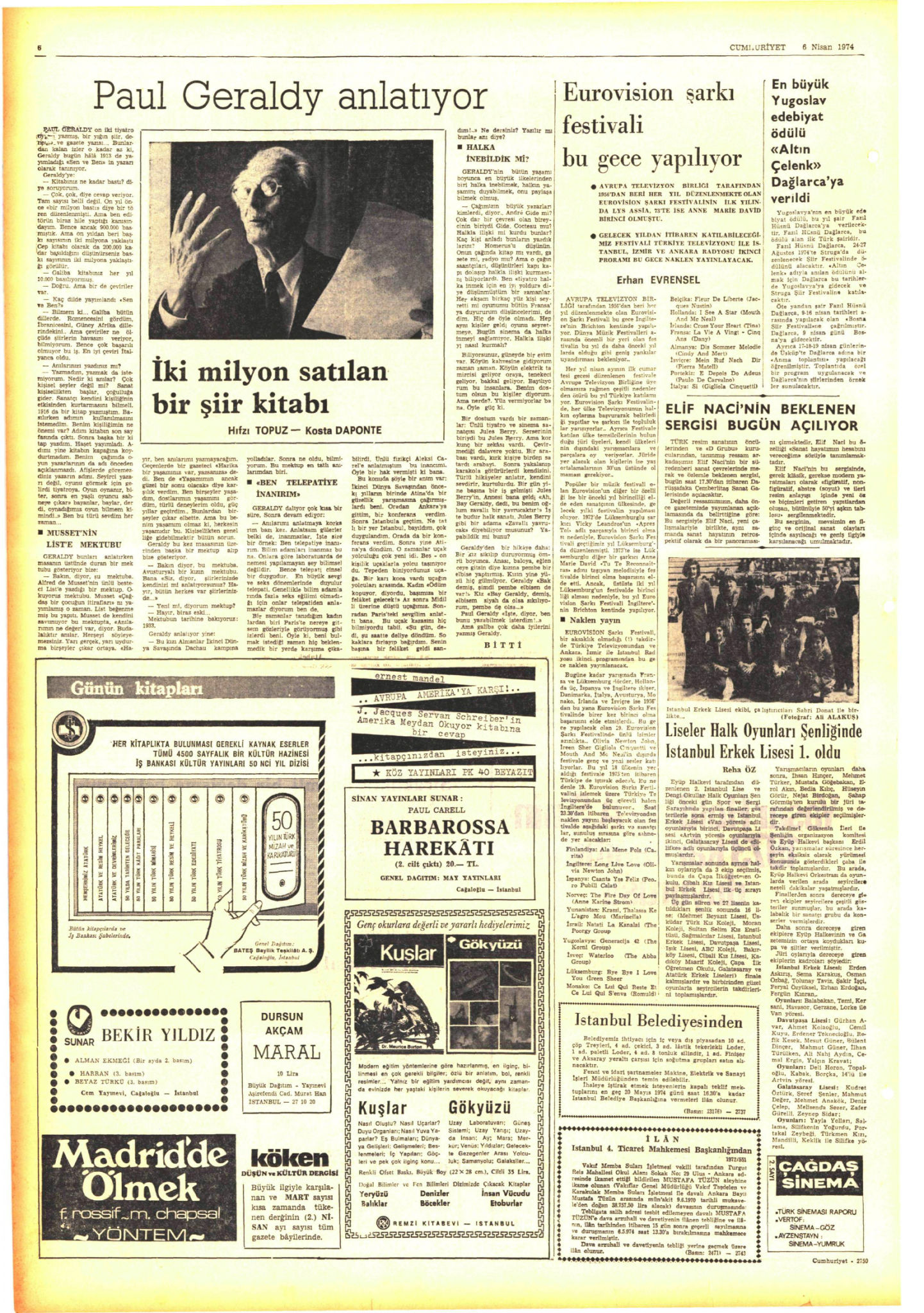
- Everensel, Erhan. (6 April 1974). "Eurovision şarkı festivali bu gece yapılıyor". [[Cumhuriyet]].
- (19 October 2023). "Ring Ringing in the year: ABBA's other 50th Eurovision anniversary". European Broadcasting Union (EBU).
- (5 April 2024). "How Abba's douze-points energy at Eurovision started a pop revolution". [[The Independent]].
- (5 April 2024). "'Waterloo' at 50: Revisiting ABBA's charge to Eurovision victory in 1974". European Broadcasting Union (EBU).
- (5 April 2024). "Abba, cabaret and smug marionettes: the 1974 Eurovision song contest reviewed!". [[The Guardian]].
- (3 November 2012). "The Official Top 20 biggest selling groups of all time revealed!". [[Official Charts Company]].
- (22 February 2024). "Abba and engineering: How Swedish music took over the world". [[Daily Maverick]].
- (9 August 2022). "Olivia Newton-John's career highlights: Grease, Eurovision and so much more". Cambridgeshire Live.
- (8 August 2022). "Olivia Newton-John: a life and career in pictures". [[The Guardian]].
- (13 May 2023). "Did this pop banger just trigger an armed coup? The wild revolutionary politics of Eurovision". [[The Guardian]].
- (25 April 2021). "Paulo de Carvalho conta a história da canção que era 'essencialmente uma canção de amor'". [[Lisbon.
- (25 April 2014). "Canção do Dia – "E Depois do Adeus" – Paulo de Carvalho". Altamont.
- Baldo, Enersto. (6 April 1974). "Stasera l'Eurofestival. Lo vedremo tra un mese". [[La Stampa]].
- (7 April 1974). "Il "Sì" della Cinquetti alla televisione svizzera". [[La Stampa]].
- (26 May 1974). "Il "sì" non più proibito". [[La Stampa]].
- (16 June 2005). "'Congratulations' – 14 songs to compete". European Broadcasting Union.
- (24 October 2005). "Abba's 'Waterloo' is voted best song of 50 Eurovision years". [[The Independent]].
- "Results from the voting (Round 1 and 2)". European Broadcasting Union.
This article was imported from Wikipedia and is available under the Creative Commons Attribution-ShareAlike 4.0 License. Content has been adapted to SurfDoc format. Original contributors can be found on the article history page.
Ask Mako anything about Eurovision Song Contest 1974 — get instant answers, deeper analysis, and related topics.
Research with MakoFree with your Surf account
Create a free account to save articles, ask Mako questions, and organize your research.
Sign up freeThis content may have been generated or modified by AI. CloudSurf Software LLC is not responsible for the accuracy, completeness, or reliability of AI-generated content. Always verify important information from primary sources.
Report