From Surf Wiki (app.surf) — the open knowledge base
Eurovision Song Contest
Annual international song competition
.png)
Annual international song competition
| Field | Value | |
|---|---|---|
| name | Eurovision Song Contest | |
| image | Eurovision Song Contest 2025.svgclass=skin-invert | |
| image_size | 270 | |
| image_alt | The current Eurovision Song Contest logo, in use since 2026 | |
| caption | Logo debuting in 2026 | |
| genre | Music competition | |
| creator | European Broadcasting Union | |
| based_on | Sanremo Music Festival | |
| presenter | Various presenters | |
| country | Various participating countries | |
| language | Various; primarily English and French | |
| num_episodes | {{Plainlist | |
| location | Various host cities | |
| runtime | {{Plainlist | |
| company | European Broadcasting Union | |
| Various national broadcasters | ||
| first_aired | ||
| last_aired | present | |
| related | {{Plainlist | |
| italic_title | no |
- 69 contests
- 107 live shows
- ~2 hours (semi-finals)
- ~4 hours (finals) Various national broadcasters
- Junior Eurovision Song Contest
- Eurovision Young Musicians
- Eurovision Young Dancers
- Eurovision Dance Contest
- Eurovision Choir
- American Song Contest
The Eurovision Song Contest (), often known simply as Eurovision, is an international song competition organised annually by the European Broadcasting Union (EBU) among its members since 1956. Each participating broadcaster submits an original song representing its country to be performed and broadcast live to all of them via the Eurovision and Euroradio networks, and then casts votes for the other countries' songs to determine a winner.
The contest was inspired by and based on the Italian Sanremo Music Festival, held in the Italian Riviera since 1951. Eurovision has been held annually since 1956 (except for 2020 due to the COVID-19 pandemic), making it the longest-running international music competition on television and one of the world's longest-running television programmes. Active members of the EBU and invited associate members are eligible to compete; broadcasters from 52 countries have participated at least once. Each participating broadcaster sends an original song of three minutes duration or less to be performed live by a singer, or group of up to six people, aged 16 or older of its choice. Each country awards 1–8, 10, and 12 points to their ten favourite songs, based on the views of an assembled group of music professionals and their viewing public, with the song receiving the most points declared the winner. Other performances feature alongside the competition, including specially-commissioned opening and interval acts and guest performances by musicians and other personalities, with past acts including Cirque du Soleil, Madonna, Justin Timberlake, Mika, Rita Ora, and the first performance of Riverdance. Originally consisting of a single evening event, the contest has expanded as broadcasters from new countries joined (including countries outside of Europe, such as , , and ), leading to the introduction of relegation procedures in the 1990s, before the creation of semi-finals in the 2000s. has competed more times than any other country, having participated in all edition, while and both hold the record for the most victories, with seven wins each in total.
Traditionally held in the country that won the preceding year's event, the contest provides an opportunity to promote the host country and city as a tourist destination. Thousands of spectators attend each year, along with journalists who cover all aspects of the contest, including rehearsals in venue, press conferences with the competing acts, in addition to other related events and performances in the host city. Alongside the generic Eurovision logo, a unique theme is typically developed for each event. The contest has aired in countries across all continents; it has been available online via the official Eurovision website since 2001. Eurovision ranks among the world's most watched non-sporting events every year, with hundreds of millions of viewers globally. Performing at the contest has often provided artists with a local career boost and in some cases long-lasting international success. Several of the best-selling music artists in the world have competed in past editions, including ABBA, Céline Dion, Julio Iglesias, Cliff Richard, and Olivia Newton-John; some of the world's best-selling singles have received their first international performance on the Eurovision stage.
While having gained popularity with the viewing public in both participating and non-participating countries, the contest has also been the subject of criticism for its artistic quality, as well as a perceived political aspect to the event. Concerns have been raised regarding political friendships and rivalries between countries potentially having an impact on the results. Controversial moments have included participating broadcasters withdrawing at a late stage, censorship of broadcast segments by broadcasters, disqualification of contestants, as well as political events impacting participation. The contest has also been criticised for an over-abundance of elaborate stage shows at the cost of artistic merit. Eurovision has gained popularity for its camp appeal, its musical span of ethnic and international styles, as well as emergence as part of LGBTQ culture, resulting in a large, active fanbase and an influence on popular culture. The popularity of the contest has led to the creation of several similar events, either organised by the EBU or created by external organisations; several special events have been organised by the EBU to celebrate select anniversaries or as a replacement due to cancellation.
Origins and history
The European Broadcasting Union (EBU) was formed in 1950 among 23 broadcasting organisations. The word "Eurovision" was first used by British journalist George Campey in the Evening Standard in 1951, when he referred to a British Broadcasting Corporation (BBC) programme being relayed by Dutch television. Following several events broadcast internationally via their Eurovision transmission network in the early 1950s, including the coronation of Elizabeth II in 1953, an EBU committee, headed by Marcel Bezençon, was formed in January 1955 to investigate new initiatives for cooperation between broadcasters, which approved for further study a European song competition from an idea initially proposed by Radiotelevisione italiana (RAI) manager Sergio Pugliese. The EBU's general assembly agreed to the organising of the song contest in October 1955, under the initial title of the European Grand Prix, and accepted a proposal by the Swiss Broadcasting Corporation (SRG SSR) to host the event in Lugano in the spring of 1956. The Italian Sanremo Music Festival, held since 1951, was used as a basis for the initial planning of the contest, with several amendments and additions given its international nature. The Eurovision Song Contest was developed as a way of putting transnational live television to the test, promoting television, as well as encouraging the production of original songs.
Broadcasters from seven countries participated in the , with each country represented by two songs; the only time in which multiple entries per country were permitted. The winning song was "Refrain", representing the host country Switzerland and performed by Lys Assia. Voting during the first contest was held behind closed doors, with only the winner being announced on stage; the use of a scoreboard and public announcement of the voting, inspired by the BBC's Festival of British Popular Songs, began in . The tradition of the winning broadcaster hosting the following year's contest, which has since become a standard feature of the event, began in . Technological developments have transformed the contest: colour broadcasts began in ; satellite broadcasts in ; and streaming in . Broadcasts in widescreen began in and in high-definition in , with ultra-high-definition tested for the first time in .
By the 1960s, between 16 and 18 countries were regularly competing each year. Countries from outside the traditional boundaries of Europe began entering the contest, and countries in Western Asia and North Africa started competing in the 1970s and 1980s. Apart from (a member of the non-aligned movement and not seen as part of the Eastern Bloc at the time) no socialist or communist country ever participated. Only after the end of the Cold War did other countries from Central and Eastern Europe participate for the first time – some of those countries having gained or regained their independence in the course of the breakup of Yugoslavia, Czechoslovakia, and the Soviet Union. As a consequence, more broadcasters were now applying than could feasibly participate in a one-night-event of reasonable length. Numerous solutions to this problem were tried out over the years. The included a contest called Kvalifikacija za Millstreet which was a pre-qualifying round for seven of these new countries, and from , relegation systems were introduced to manage the number of competing entries, with the poorest performing countries barred from entering the following year's contest. From 2004, the contest expanded to become a multi-programme event, with a semi-final at the allowing all interested countries to compete each year; a second semi-final was added to each edition from .
There have been 69 contests making Eurovision the longest-running annual international televised music competition as determined by Guinness World Records. The contest has been listed as one of the longest-running television programmes in the world and among the world's most watched non-sporting events. Broadcasters from a total of 52 countries have taken part in at least one edition, with a record 43 countries participating in a single contest, first in and subsequently in and .
Eurovision had been held every year until 2020, when was cancelled in response to the COVID-19 pandemic. No competitive event was able to take place due to uncertainty caused by the spread of the virus in Europe and the various restrictions imposed by the governments of the participating countries. In its place a special broadcast, Eurovision: Europe Shine a Light, was produced by the organisers, which honoured the songs and artists that would have competed in 2020 in a non-competitive format.
Naming
The contest has been known by different names in various languages. The first contest was officially named the Gran premio Eurovisione della canzone europea in Italian, the Grand Prix Eurovision de la chanson européenne in French, and the Grand Prix of the Eurovision Song Competition in English, Similar variations, such as Eurovision Schlagerfestival in Swedish or Eurovisie Songfestival in Dutch, were unofficially used in some editions. The names Eurovision Song Contest and Concours Eurovision de la Chanson in French became a de facto standard in subsequent decades. The contest was briefly rebranded as Eurosong in English for the , but this was reverted the following year. The names were not standardised until 2004, when the contest was rebranded. The official brand guidelines specify that translations of the name may be used depending on national tradition and brand recognition in the competing countries, but that the official name Eurovision Song Contest is always preferred.
On only four occasions has the name used for the official logo of the contest not been in English or French: the Italian names Gran Premio Eurovisione della Canzone and Concorso Eurovisione della Canzone were used when Italy hosted the and contests respectively; and the Dutch name Eurovisiesongfestival was used when the Netherlands hosted in and .
Format
Original songs representing participating countries are performed in a live television programme broadcast via the Eurovision and Euroradio networks simultaneously to all countries. A "country" as a participant is represented by one television broadcaster from that country, a member of the EBU, and is typically that country's national public broadcasting organisation. The programme is staged by one of the participant broadcasters and is transmitted from an auditorium in the selected host city. Since 2008, each contest is typically formed of three live television shows held over one week: two semi-finals are held on the Tuesday and Thursday, followed by a final on the Saturday. All participating countries compete in one of the two semi-finals, except for the host country of that year's contest and the "Big Five"—the countries whose broadcasters are the contest's biggest financial contributors: , , , , and the . The remaining countries are split between the two semi-finals, and the 10 highest-scoring entries in each qualify to produce 26 entries competing in the final. Since the introduction of the semi-final round in 2004, and are the only countries outside of the "Big Five" to have qualified for the final of every contest they have competed in.
Each participating broadcaster has sole discretion over the process it may employ to select its entry for the contest. Typical methods in which participants are selected include a televised national final using a jury and/or public vote; an internal selection by a committee appointed by the broadcaster; and a mixed format where some decisions are made internally and the public are engaged in others. Among the most successful televised selection shows is Melodifestivalen in Sweden, first established in 1959 and now one of the most watched television shows in the country each year.
Each show typically begins with an opening act consisting of music and/or dance performances by invited artists, which contributes to a unique theme and identity created for that year's event; since 2013, the opening of the contest's final has included a "Flag Parade", with competing artists entering the stage behind their country's flag in a similar manner to the procession of competing athletes at the Olympic Games opening ceremony. Viewers are welcomed by one or more presenters who provide key updates during the show, conduct interviews with competing acts from the green room, and guide the voting procedure in English and French. Competing acts perform sequentially, and after all songs have been performed, viewers are invited to vote for their favourite performances—except for the performance of their own country—via telephone, SMS, and the official Eurovision app. The public vote comprises 50% of the final result alongside the views of a jury of music industry professionals from each country. An interval act is invariably featured during this voting period, which on several occasions has included a well-known personality from the host country or an internationally recognised figure. The results of the voting are subsequently announced; in the semi-finals, the 10 highest-ranked countries are announced in a random order, with the full results undisclosed until after the final. In the final, the presenters call upon a representative spokesperson for each country in turn who announces their jury's points, while the results of the public vote are subsequently announced by the presenters. In recent years, it has been tradition that the first country to announce its jury points is the previous host, whereas the last country is the current host. The qualifying acts in the semi-finals, and the winning delegation in the final are invited back on stage; in the final, a trophy is awarded to the winning performers and songwriters by the previous year's winner, followed by a reprise of the winning song. The full results of the competition, including detailed results of the jury and public vote, are released online shortly after the final, and the participating broadcaster of the winning entry is traditionally given the honour of organising the following year's event.
Participation


Active members (as opposed to associate members) of the European Broadcasting Union (EBU) are eligible to participate; active members are those who are located in states that fall within the European Broadcasting Area (EBA), or are member states of the Council of Europe. Active members include media organisations whose broadcasts are often made available to at least 98% of households in their own country which are equipped to receive such transmissions. Associate member broadcasters may be eligible to compete, dependent on approval by the contest's reference group.
The EBA is defined by the International Telecommunication Union as encompassing the geographical area between the boundary of ITU Region 1 in the west, the meridian 40° East of Greenwich in the east, and parallel 30° North in the south. Armenia, Azerbaijan, Georgia, and the parts of Iraq, Jordan, Syria, Turkey, and Ukraine lying outside these limits are also included in the EBA.
Eligibility to participate in the contest is therefore not limited to broadcasters from countries in Europe, as several states geographically outside the boundaries of the continent or which span more than one continent are included in the EBA. Broadcasters from countries in these groups have taken part in past editions, including countries in Western Asia such as Israel and Cyprus, countries which span Europe and Asia like Russia and Turkey, and North African countries such as Morocco.
became the first country without an active EBU member broadcaster to compete, following an invitation by the contest's reference group to associate member Special Broadcasting Service (SBS) ahead of the contest's in 2015. Initially announced as a "one-off" for the anniversary edition, SBS was invited back the following year and has subsequently participated every year since. Australia is also the only country from outside the EBA to ever participate.
EBU members wishing to participate must fulfil conditions as laid down in the rules of the contest, a separate copy of which is drafted annually. A maximum of 44 countries can take part in any one contest. Broadcasters must have paid the EBU a participation fee in advance of the deadline specified in the rules for the year in which they wish to participate; this fee is different for each country based on its size and viewership.
Broadcasters from fifty-two countries have participated at least once. These countries are listed here alongside the year in which they made their debut:
| Year | Country making its debut entry |
|---|
|
| Year | Country making its debut entry |
|---|
|
| Year | Country making its debut entry |
|---|
|}
Hosting

The winning broadcaster traditionally hosts the following year's event, with some exceptions since . Hosting the contest can be seen as a unique opportunity for promoting the host country as a tourist destination and can provide benefits to the local economy and tourism sectors of the host city. However, there is a perception reflected in popular culture that some broadcasters wish to avoid the costly burden of hostingsometimes resulting in them sending deliberately subpar entries with no chance of winning. Preparations for each year's contest typically begin at the conclusion of the previous year's contest, with the head of delegation of the winning country receiving a welcome package of information related to hosting the contest at the winner's press conference. Eurovision is a non-profit event, and financing is typically achieved through a fee from each participating broadcaster, contributions from the host broadcaster and the host city, and commercial revenues from sponsorships, ticket sales, televoting, and merchandise.
The host broadcaster will subsequently select a host city, typically a national or regional capital city, which must meet certain criteria set out in the contest's rules. The host venue must be able to accommodate at least 10,000 spectators, a press centre for 1,500 journalists, should be within easy reach of an international airport and with hotel accommodation available for at least 2,000 delegates, journalists, and spectators. A variety of different venues have been used, from small theatres and television studios to large arenas and stadiums. The largest host venue is Parken Stadium in Copenhagen, which was attended by almost 38,000 spectators in . With a population of 1,500 at the time of the , Millstreet, Ireland, remains the smallest hosting settlement, although its Green Glens Arena is capable of hosting up to 8,000 spectators.
Unlike the Olympic Games or FIFA World Cup, whose host venues are announced several years in advance, there is usually no purpose-built infrastructure whose construction is justified with the needs of hosting the Eurovision Song Contest. However, the , hosted in Baku, Azerbaijan, was held at Baku Crystal Hall, a venue that had not existed when Azerbaijan won the previous year. Every other edition has been held in pre-existing venues, but renovations or modifications have sometimes been undertaken in the year prior which are justified with the needs of the contest.
Eurovision logo and theme
Until 2004, each edition of the contest used its own logo and visual identity as determined by the respective host broadcaster. To create a consistent visual identity, the EBU introduced a generic logo ahead of the . This is typically accompanied by a unique theme artwork designed for each individual contest by the host broadcaster, with the flag of the host country placed prominently in the centre of the Eurovision heart. The original logo was designed by the London-based agency JM International, and received revamps in 2014 by the Amsterdam-based Cityzen Agency for the contest's , and in 2025 by the Sheffield-based studio Pals for the .
An individual theme is utilised by contest producers when constructing the visual identity of each edition of the contest, including the stage design, the opening and interval acts, and the "postcards". The short video postcards are interspersed between the entries and were first introduced in , initially as an attempt to "bulk up" the contest after a number of countries decided not to compete, but has since become a regular part of the show and usually highlight the host country and introduce the competing acts. A unique slogan for each edition, first introduced in , was also an integral part of each contest's visual identity, which was replaced by a permanent slogan from onwards. The permanent slogan, "United by Music", had previously served as the slogan for the before being retained for all future editions as part of the contest's global brand strategy.
Preparations

Preparations in the host venue typically begin approximately six weeks before the final, to accommodate building works and technical rehearsals before the arrival of the competing artists. Delegations will typically arrive in the host city two to three weeks before the live show, and each participating broadcaster appoints a head of delegation, responsible for coordinating the movements of their delegation and being their representative to the EBU. Members of each country's delegation include performers, composers, lyricists, a Head of Press, and—in the years where a live orchestra was present—a conductor. Present if desired is a commentator, who provides commentary of the event for their radio and/or television feed in their own language in dedicated booths situated around the back of the arena behind the audience.
Each delegation conducts two individual rehearsals behind closed doors, the first for 30 minutes and the second for 20 minutes. Individual rehearsals for the semi-finalists commence the week before the live shows, with countries typically rehearsing in the order in which they will perform during the contest; rehearsals for the host country and the "Big Five" automatic finalists are held towards the end of the week. Following rehearsals, delegations meet with the show's production team to review footage of the rehearsal and raise any special requirements or changes. "Meet and greet" sessions with accredited fans and press are held during these rehearsal weeks. Each live show is preceded by three dress rehearsals, where the whole show is run in the same way as it will be presented on TV. The second dress rehearsal, alternatively called the "jury show" or "evening preview show" and held the night before the broadcast, is used as a recorded back-up in case of technological failure, and performances during this show are used by the professional jury in each country to determine their votes. Until 2025, the delegations from the qualifying countries in each semi-final attended a qualifiers' press conference after their respective semi-final. The winning delegation attends a winners' press conference following the final.
A welcome reception is typically held at a venue in the host city on the Sunday preceding the live shows, which includes a red carpet ceremony for all the participating countries and is usually broadcast online. Accredited delegates, press and fans have access to an official nightclub, the "EuroClub", and some delegations will hold their own parties. The "Eurovision Village" is an official fan zone open to the public free of charge, with live performances by the contest's artists and screenings of the live shows on big screens.
Rules
The contest is organised annually by the European Broadcasting Union (EBU), together with the host broadcaster in co-production with all the participating broadcasters. The event is monitored by an executive supervisor appointed by the EBU, and by the reference group which represents all participating broadcasters, who are each represented by a head of delegation. The most recent executive supervisor was Martin Österdahl, who took over the role from Jon Ola Sand in May 2020 and served until June 2025, after which Martin Green took over on an interim basis. A detailed set of rules is written by the EBU for each contest and approved by the reference group. These rules have changed over time, and typically outline, among other points, the eligibility of the competing songs, the format of the contest, and the voting system to be used to determine the winner and how the results will be presented.
Song eligibility and languages
All competing songs must have a duration of three minutes or less. This rule applies only to the version performed during the live shows. In order to be considered eligible, competing songs in a given year's contest must not have been released commercially before the first day of September of the previous year. All competing entries must include vocals and lyrics of some kind; a cappella songs and purely instrumental pieces are not allowed. Competing entries may be performed in any language, be that natural or constructed, and participating broadcasters are free to decide the language in which their entry may be performed.
Rules specifying in which language a song may be performed have changed over time. No restrictions were originally enacted when the contest was first founded; however, following criticism over the being performed in English, a new rule was introduced for the restricting songs to be performed only in an official language of the country it represented. This rule was first abolished in , and subsequently reinstated for most countries in , with only and permitted freedom of language as their selection processes for that year's contest had already commenced. The language rule was once again abolished ahead of the .
There is no restriction on the national origin, country of residence or age of the songwriter(s). Furthermore, unlike performers who may only represent one country in any given year, songwriters are free to enter multiple songs in a single year sung by different acts. For example, the entries of and in 1980 were either written or co-written by Ralph Siegel, who was involved in some form in the writing of dozens of entries throughout his 40-year long career, both advancing to the final and failing to make it past the national selection, including "Ein bißchen Frieden", the winning entry for .
Artist eligibility and performances
,_Bestanddeelnr_909-4001_(cropped).jpg)
The rules for the first contest specified that only solo performers were permitted to enter; this criterion was changed the following year to permit duos to compete, and groups were subsequently permitted for the first time in . Currently the number of people permitted on stage during competing performances is limited to a maximum of six, and no live animals are allowed. Since , all contestants must be aged 16 or over on the day of the live show in which they perform. Sandra Kim, the winner for at the age of 13, shall remain the contest's youngest winner while this rule remains in place. There is no limit on the nationality or country of birth of the competing artists, and participating broadcasters are free to select an artist from any country; several winning artists have subsequently held a different nationality or were born in a different country to that which they represented. No performer may compete for more than one country in a given year. There is no restriction regarding performers who have participated in past events competing again – whether for the same country or a different one. It is even possible for a winning performer to try and defend their title in the next edition, as happened when Lys Assia competed for after winning in 1956, or when Lena competed for after winning . However, in the history of the contest only two individuals have won more than once as a performerJohnny Logan for and , and Loreen for and .
From 1956 to 1998, a live orchestra formed an integral part of the contest, providing accompaniment to all the acts performing. Pre-recorded backing tracks were first allowed for competing acts in 1973, but any pre-recorded instruments were required to be seen being "performed" on stage. In 1997, all instrumental music was allowed to be pre-recorded, although the host country was still required to provide an orchestra. In 1999, the rules were changed again, making the orchestra an optional requirement; the host broadcaster of , the Israel Broadcasting Authority (IBA), subsequently decided not to provide an orchestra, resulting in all acts using backing tracks for the first time.
The main vocals of competing songs must be performed live during the contest. Previously live backing vocals were also required; since these may optionally be pre-recordedthis change has been implemented in an effort to introduce flexibility following the cancellation of the 2020 edition and to facilitate modernisation.
Running order
Since , the order in which the competing countries perform has been determined by the contest's producers, and submitted to the executive supervisor and reference group for approval before public announcement. This was changed from a random draw used in previous years in order to provide a better experience for television viewers and ensure all entries stand out by avoiding instances where songs of a similar style or tempo are performed in sequence.
Since the creation of a second semi-final in 2008, a semi-final allocation draw is held each year. Countries are placed into pots based on their geographical location and voting history in recent contests, and are assigned to compete in one of the two semi-finals through a random draw. Countries are then randomly assigned to compete in either the first or second half of their respective semi-final, and once all competing songs have been selected the producers then determine the running order for the semi-finals. The automatic qualifiers are assigned at random to a semi-final for the purposes of voting rights.
Semi-final qualifiers make a draw at random during the qualifiers' press conference to determine whether they will perform during the first, second half, or a producer-determined position in the final, while the automatic finalists randomly draw their competing half or producer-determined position in the run-up to the final, except for the host country, whose exact performance position is determined in a separate draw. The running order for the final is then decided following the second semi-final by the producers. The running orders are decided with the competing songs' musical qualities, stage performance, prop, and lighting set-up, and other production considerations taken into account.
Voting
The results of the contest are determined by a positional voting system, with its upcoming version set to be implemented in 2026. Each country awards two sets of 1–8, 10, and 12 points to the ten favourite songs as voted for by its general public and assembled jury, with the most preferred song receiving 12 points. The points from the viewing public are based on the votes cast via telephone, SMS, or the official Eurovision app, while the points from the jury are awarded by a panel comprising seven music professionals. A Rest of the World vote was introduced in 2023, allowing viewers in non-participating countries to vote via an online platform, with these votes aggregated and awarded as one set of points from an "extra country" for the overall public vote. This system is a modification of that used since 1975, when the "12 points" system was first introduced but with one set of points per country. National juries and the public in each country are not allowed to vote for their own country, a rule first introduced in 1957.
Historically, each country's points were determined by a jury, consisting at various times of members of the public, music professionals, or both in combination. With advances in telecommunication technology, televoting was first introduced to the contest in on a trial basis, with broadcasters in five countries allowing the viewing public to determine their votes for the first time. From , televoting was extended to almost all competing countries, and subsequently became mandatory from . A jury was reintroduced for the final in , with each country's points comprising both the votes of the jury and public in an equal split; this mix of jury and public voting was expanded into the semi-finals from 2010, and was used until 2023, when full public voting was reintroduced to determine the results of the semi-finals. The mix of jury and public voting continues to be used in the final, and is set to return to the semi-finals from 2026.
Should two or more countries finish with the same number of points, a tie-break procedure is employed to determine the final placings. a combined national televoting and jury result is calculated for each country, and the country which has obtained more points from the public voting following this calculation is deemed to have placed higher.
Presentation of the votes

Since 1957, each country's votes have been announced during a special voting segment as part of the contest's broadcast, with a selected spokesperson assigned to announce the results of their country's vote. This spokesperson is typically well known in their country; previous spokespersons have included former Eurovision artists and presenters. Historically, the announcements were made through telephone lines from the countries of origin, with satellite links employed for the first time in , allowing the spokespersons to be seen visually by the audience and TV spectators.
Scoring is done by both a national jury and a national televote. Each country's jury votes are consecutively added to the totals scoreboard as they are called upon by the contest presenter(s). The scoreboard was historically placed at the side of the stage and updated manually as each country gave their votes; in a computer graphics scoreboard was introduced. The jury points from 1–8 and 10 are displayed on screen and added automatically to the scoreboard, then the country's spokesperson announces which country will receive the 12 points. Once jury points from all countries have been announced, the presenter(s) announce the total public points received for each finalist, with the votes for each country being consolidated and announced as a single value. Since , the public points have been revealed in ascending order based on the jury vote, with the country that received the fewest points from the jury being the first to receive their public points. A full breakdown of the results across all shows is published on the official Eurovision website after the final, including each country's televoting ranking and the votes of its jury and individual jury members. Each country's individual televoting points in the final are typically displayed on-screen by that country's broadcaster following the announcement of the winner.
Broadcasting
Participating broadcasters are required to air live the semi-final in which they compete, or in the case of the automatic finalists the semi-final in which they are required to vote, and the final, in its entirety; this includes all competing songs, the voting recap containing short clips of the performances, the voting procedure or semi-final qualification reveal, and the reprise of the winning song in the final. Since 1999, broadcasters who wished to do so were given the opportunity to provide advertising during short, non-essential hiatuses in the show's schedule. In exceptional circumstances, such as due to developing emergency situations, participating broadcasters may delay or postpone broadcast of the event. Should a broadcaster fail to air a show as expected in any other scenario they may be subject to sanctions by the EBU. Many broadcasters that are unable to compete have aired the contest in their markets.
As broadcasters join and leave the Eurovision feed transmitted by the EBU, the EBU/Eurovision network logo ident (not to be confused with the logo of the song contest itself) is displayed. The accompanying theme tune is the Prelude (Marche en rondeau) to Marc-Antoine Charpentier's "Te Deum". Originally, the same logo was used for both the Eurovision network and the EBU, but they now have two different logos; the latest Eurovision network logo was introduced in 2026, and when the ident is transmitted at the start and end of programmes it is this Eurovision network logo that appears.
The EBU now holds the recordings of all but two editions of the contest in its archives, following a project initiated in 2011 to collate footage and related materials of all editions ahead of the event's 60th edition in 2015. The only footage available of the 1956 contest is a Kinescope recording of Lys Assia's reprise of her winning song. No full recording of the is known to exist, with conflicting reports of the fate of any copies that may have survived. Audio recordings of both contests do, however, exist, and some short pieces of footage from both events have survived. Until 2004, the host broadcaster owned the copyright of the contest that they produced, with the EBU owning the copyright of all subsequent editions.
Expansion of the contest
From the original seven countries which entered the first contest in 1956, the number of competing countries has steadily grown over time. 18 countries participated in the contest's tenth edition in 1965, and by 1990, 22 countries were regularly competing each year.
Besides slight modifications to the voting system and other contest rules, no fundamental changes to the contest's format were introduced until the events in Europe in the late 1980s and early 1990s led to the breakup of Yugoslavia, with the subsequent admission into the EBU of the broadcasters of the countries that emerged from the breakup, and to the merger in 1993 of the EBU with its Eastern European counterpart, the International Radio and Television Organisation (OIRT), which further expanded the number of broadcasters by including those from countries of the former Eastern Bloc. These events impacted the contest as they expanded the number of broadcasters eligible to participate with those from new countries.
Pre-selections and relegation
Broadcasters from 29 countries registered to take part in the 1993 contest, a figure the EBU considered unable to fit reasonably into a single television show. A pre-selection method was subsequently introduced for the first time in order to reduce the number of competing entries, with the seven new countries from Central and Eastern Europe participating in Kvalifikacija za Millstreet, held in Ljubljana, Slovenia, one month before the event. Following a vote amongst the seven competing countries, , and were chosen to head to the contest in Millstreet, Ireland, whilst , , and were forced to wait another year before being allowed to compete for the first time. A new relegation system was introduced for entry into the 1994 contest, with the lowest-placed countries being forced to sit out the following year's event to be replaced by countries which had not competed in the previous contest. The bottom seven countries in 1993 were required to miss the following year's contest, and were replaced by the four unsuccessful countries in Kvalifikacija za Millstreet and new entries from , , and .
This system was used again in 1994 for qualification for the , but a new system was introduced for the , when an audio-only qualification round was held in the months before the contest in Oslo, Norway; this system was primarily introduced in an attempt to appease Germany, one of Eurovision's biggest markets and financial contributors, which would have otherwise been relegated under the previous system. 29 countries competed for 22 places in the main contest alongside the automatically qualified Norwegian hosts. However, Germany would ultimately still miss out, and joined Hungary, Romania, Russia, , , and as one of the seven countries to be absent from the Oslo contest. this is the only contest Germany has not participated in. For the , a similar relegation system to that used between 1993 and 1995 was introduced, with each country's average scores in the preceding five contests being used as a measure to determine which countries would be relegated. This was subsequently changed again in 2001, back to the same system used between 1993 and 1995 where only the results from that year's contest would count towards relegation.
The "Big Four" and "Big Five"
In 1999, an exemption from relegation was introduced for France, Germany, Spain, and the United Kingdom, giving them an automatic right to compete in the 2000 contest and in all subsequent editions. This group, as the highest-paying EBU members which significantly fund the contest each year, subsequently became known as the "Big Four" countries. This group was expanded in 2011 when Italy began competing again, becoming the "Big Five". The "Big Four" were originally brought in to ensure that the financial contributions of the contest's biggest financial backers would not be missed, as the production of the 1996 contest was significantly compromised by the absence of Germany. Since the introduction of the semi-finals in 2004, the "Big Five" countries have now automatically qualified for the final alongside the host country, and have not been required to compete in the semi-finals. Spain opted not to participate for the first time in 2026 as part of a larger boycott against Israel's participation in the context of the Gaza war, thereby reducing the numbers of "Big" countries for the year back to four.
There remains debate on whether this status prejudices the countries' results, based on reported antipathy over their automatic qualification and the potential disadvantage of having spent less time on stage through not competing in the semi-finals; however, this status appears to be more complex given that the results of the "Big Five" countries can vary widely. This status has caused consternation from other competing countries, and was cited, among other aspects, as a reason why had ceased participating after . In response to the criticism on less stage time from these countries, since , the entries from the "Big Five" countries, along with the host country, have been performed live in one of the two semi-finals outside of the competition for qualification, a change which was announced as giving these countries "a fairer playing field" in the final.
Introduction of semi-finals
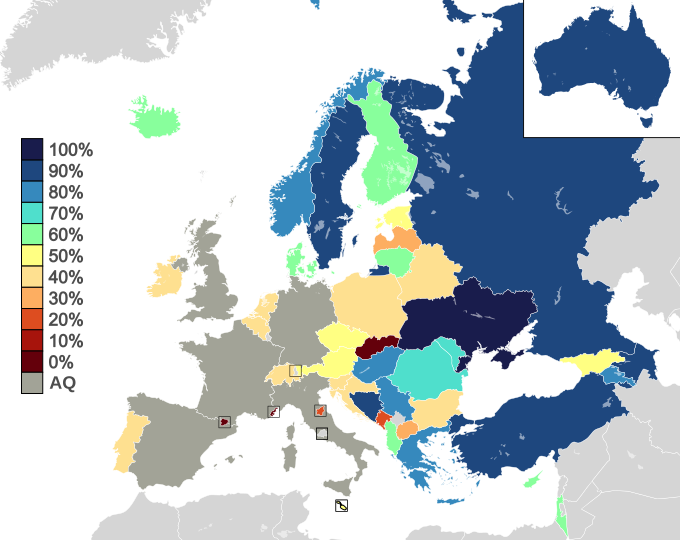
An influx of new broadcasters applying for the resulted in the introduction of a semi-final from 2004, with the contest becoming a two-day event. The top 10 countries in each year's final would qualify automatically to the following year's final, alongside the "Big Four", meaning all other countries would compete in the semi-final to compete for 10 qualification spots. The saw a record 36 countries competing, with new entries from , , , and and the return of previously relegated countries. The format of this semi-final remained similar to the final proper, taking place a few days before the final; following the performances and the voting window, the names of the 10 countries with the highest number of points, which would therefore qualify for the final, were announced at the end of the show, revealed in a random order by the contest's presenters.
The single semi-final continued to be held between 2005 and 2007; however, with 42 countries competing in the , that year's semi-final had 28 entries competing for 10 spots in the final. Following criticism over the mainly Central and Eastern European qualifiers at the 2007 event and the poor performance of entries from Western European countries, a second semi-final was subsequently introduced for the , with all countries now competing in one of the two semi-finals, with only the host country and the "Big Four", and subsequently the "Big Five" from 2011, qualifying automatically. 10 qualification spots would be available in each of the semi-finals, and a new system to split the competing countries between the two semi-finals was introduced based on their geographic location and previous voting patterns, in an attempt to reduce the impact of bloc voting and to make the outcome less predictable.
Entries and participants
A number of performers have competed in the contest after having already achieved considerable success. These include winning artists Lulu, Toto Cutugno, and Katrina and the Waves, and other acts that competed such as Nana Mouskouri, Cliff Richard, Baccara, Umberto Tozzi, Plastic Bertrand, t.A.T.u., Las Ketchup, Patricia Kaas, Engelbert Humperdinck, Bonnie Tyler, Gabry Ponte, Flo Rida, and Melody. Many well-known composers and lyricists have penned entries of varying success over the years, including Serge Gainsbourg, Goran Bregović, Diane Warren, Andrew Lloyd Webber, Pete Waterman, and Tony Iommi, as well as producers Timbaland and Guy-Manuel de Homem-Christo.
Past participants have contributed to other fields in addition to their music careers. The Netherlands' Annie M.G. Schmidt, lyricist of the first entry performed at Eurovision, has gained a worldwide reputation for her stories and earned the Hans Christian Andersen Award for children's literature. French "yé-yé girls" Françoise Hardy and contest winner France Gall are household names of 1960s pop culture, with Hardy also being a pioneer of street style fashion trends and an inspiration for the global youthquake movement. Figures who carved a career in politics and gained international acclaim for humanitarian achievements include contest winner Dana as a two-time Irish presidential candidate and Member of the European Parliament (MEP); Nana Mouskouri as Greek MEP and a UNICEF international goodwill ambassador; contest winner Ruslana as member of Verkhovna Rada, Ukraine's parliament and a figure of the Orange Revolution and Euromaidan protests, who gained global honours for leadership and courage; and North Macedonia's Esma Redžepova as member of political parties and a two-time Nobel Peace Prize nominee.
Competing songs have occasionally gone on to become successes for their original performers and other artists, and some of the best-selling singles globally received their first international performances at Eurovision. "Save Your Kisses for Me", the winning song for the performed by Brotherhood of Man, went on to sell over six million singles, more than any other winning song. "Nel blu, dipinto di blu", also known as "Volare", third-placed song for performed by Domenico Modugno, is the only Eurovision entry to win a Grammy Award. It was the first Grammy winner for both Record of the Year and Song of the Year and it has since been recorded by various artists, topped the Billboard Hot 100 in the United States and achieved combined sales of over 22 million copies worldwide. "Eres tú", runner-up for performed by Mocedades, became the first Spanish-language song to reach the top 10 of the Billboard Hot 100, and the Grammy-nominated "Ooh Aah... Just a Little Bit", which came eighth for the performed by Gina G, sold 790,000 records and achieved success across Europe and the US, reaching number 1 on the UK Singles Chart and peaking at number 12 on the Billboard Hot 100.
The turn of the century has also seen numerous competing songs becoming successes. "Euphoria", Loreen's winning song for , achieved Europe-wide success, reaching number one in several countries and by 2014 had become the most downloaded Eurovision song to date. The video for "Occidentali's Karma" by Francesco Gabbani, which placed sixth for , became the first Eurovision song to reach more than 200 million views on YouTube, while "Soldi" by Mahmood, the runner-up for , was the most-streamed Eurovision song on Spotify until it was overtaken by that year's winner for the , "Arcade" by Duncan Laurence, following viral success on TikTok in late 2020 and early 2021; "Arcade" later became the first Eurovision song since "Ooh Aah... Just a Little Bit" and the first Eurovision winning song since "Save Your Kisses for Me" to chart on the Billboard Hot 100, eventually peaking at number 30. The saw the next major breakthrough success from Eurovision, with Måneskin, that year's winners for with "Zitti e buoni", attracting worldwide attention across their repertoire immediately following their victory.
Johnny Logan was the first artist to have won multiple contests as a performer, winning for with "What's Another Year", written by Shay Healy, and with the self-penned "Hold Me Now". Logan was also the winning songwriter for with "Why Me?" performed by Linda Martin, and has therefore achieved three contest victories as either a performer or writer. Four further songwriters have each written two contest-winning songs: Willy van Hemert, Yves Dessca, Rolf Løvland, and Brendan Graham. Following their introduction in , Alexander Rybak became the first artist to win multiple Eurovision semi-finals, finishing in first at the second semi-finals for and ; he remains the only entrant to have done so to date.
Winners
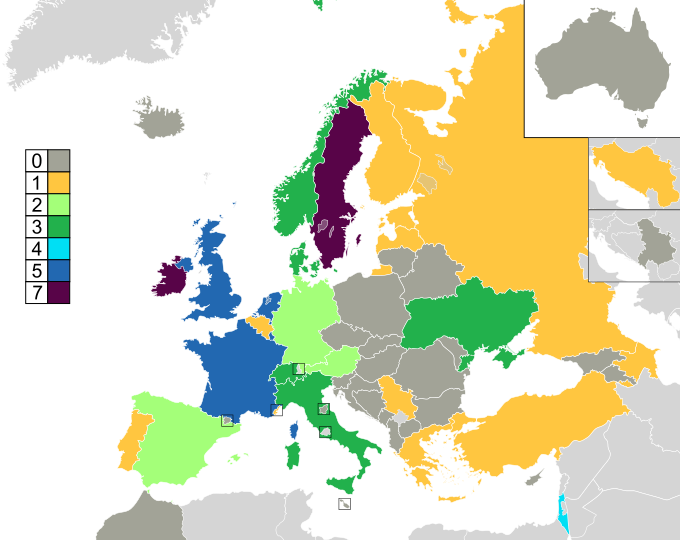
72 songs from 27 countries have won the Eurovision Song Contest and have recorded the most wins with seven each, followed by , , the , and the with five each. Of the 52 countries to have taken part, 24 have yet to win. Only one contest has featured multiple winners in a single year: in , four entries finished the contest with an equal number of points and were all declared winners, as allowed by the rules at the time. A majority of winning songs have been performed in English, particularly since the rule requiring native-language songs was abolished in 1999: since then, only seven winning songs have been performed either fully or partially in a language other than English.
Only one country has won the contest on its first appearance: won in 2007 with as an independent country; since had won the inaugural contest in 1956 with in that contest. Other countries have had relatively short waits before winning their first contest, with winning on in 2004 and winning with in 2002. Conversely, some countries have had considerable gaps between their debut entry and their first win: recorded its first win , 31 years after its first appearance, while ended a 45-year losing streak . holds the record for the most contest entries prior to its first win , coming 53 years after it first competed. Other countries have also had large gaps between their winning entries: Switzerland went 32 years between winning in 1956 and , and a further 36 years between then and winning ; had a 37-year gap between its wins and ; the Netherlands had a 44-year gap between its wins and ; and achieved its second win , 48 years after its first win .
The United Kingdom holds the record for runner-up placements, having finished second sixteen times. has finished last on a record twelve occasions, including scoring nul points four times; it shares the record for receiving this score with Austria. Countries have recorded back-to-back wins on four occasions: in and ; Luxembourg in and ; Israel in and ; and Ireland in , , and , becoming the first and only country to date to win three times in a row. Additionally, Ireland later won , giving it a record four wins in the span of five years.
The winning artist(s), songwriter(s), and broadcaster, receive a medal or a trophy, which since 2008 has followed a standard design: a handmade trophy of sandblasted glass with painted details in the shape of a 1950s-style microphone, designed by Kjell Engman of the Swedish-based glassworks Kosta Boda. The award is typically presented by the previous year's winner; others who have handed out the award in the past include representatives from the host broadcaster or the EBU, and politicians; in 2007, the fictional character Joulupukki (the original Santa Claus in Finland) presented the award to the winner Marija Šerifović.
Interval acts and guest appearances
Alongside the song contest and appearances from local and international personalities, performances from non-competing artists and musicians have been included since the first edition, and have become a staple of the live show. These performances have varied widely, previously featuring music, art, dance, and circus performances, and past participants are regularly invited to perform, with the reigning champion traditionally returning each year to perform the previous year's winning song.
The contest's opening performance and the main interval act, held following the competing song and before the announcement of the voting results, has become a memorable part of the contest and has included both internationally known artists and local stars. Contest organisers have previously used these performances as a way to explore their country's culture and history, such as in "4,000 Years of Greek Song" at the held in Greece; other performances have been more comedic in nature, featuring parody and humour, as was the case with "Love Love Peace Peace" in , a humorous ode to the history and spectacle of the contest itself. Riverdance, which later became one of the most successful dance productions in the world, first began as the interval performance at the 1994 contest in Ireland; the seven-minute performance of traditional Irish music and dance was later expanded into a full stage show that has been seen by over 25 million people worldwide and provided a launchpad for its lead dancers Michael Flatley and Jean Butler.
Among other artists who have performed in a non-competitive manner are Danish Europop group Aqua in , Finnish cello metal band Apocalyptica in 2007, Russian pop duo t.A.T.u. in , and American entertainers Justin Timberlake and Madonna in and respectively. Other notable artists, including Charlie Rivel (), Cirque du Soleil (), Alexandrov Ensemble (), Vienna Boys' Choir ( and ), and Fire of Anatolia (), also performed on the Eurovision stage, and there have been guest appearances from well-known faces from outside the world of music, including actors, athletes, and serving astronauts and cosmonauts. Guest performances have been used as a channel in response to global events happening concurrently with the contest. The in Israel closed with all competing acts performing a rendition of winning song "Hallelujah" as a tribute to the victims of the Kosovo War, a dance performance entitled "The Grey People" in 2016's first semi-final was devoted to the 2015 European migrant crisis, the featured known anti-war songs "Fragile", "People Have the Power", and "Give Peace a Chance" in response to the Russian invasion of Ukraine that year, and an interval act in 's first semi-final alluded to the refugee crisis caused by the aforementioned invasion.
Criticism and controversy
The contest has been the subject of considerable criticism regarding both its musical content and what has been reported to be a political element to the event, and several controversial moments have been witnessed over the course of its history. British historian Tony Judt wrote in 2006 that the contest in the 1970s and 1980s became "the most widely celebrated object of ridicule" on public television, because it "was so stunningly banal in conception and execution as to defy parody." Judt dismissed the artists who entered the contest as "a stream of inept performers" who would in most cases return to "the obscurity from whence they briefly emerged."
Musical style and presentation
Criticism has been levied against the musical quality of competing entries, with a perception that certain music styles seen as being presented more often than others in an attempt to appeal to as many potential voters as possible among the international audience. By the 2000s, power ballads, folk rhythms, and bubblegum pop have been considered staples of the contest, leading to allegations that the event has become formulaic. Other traits in competing entries which have regularly been mocked by media and viewers include an abundance of key changes and lyrics about love and/or peace, as well as the pronunciation of English by non-native users of the language. Given Eurovision is principally a television show, over the years competing performances have attempted to attract the viewers' attention through means other than music, and elaborate lighting displays, pyrotechnics, and extravagant on-stage theatrics and costumes having become a common sight; criticism of these tactics have been levied as being a method of distracting the viewer from the weak musical quality of some of the competing entries.
While many of these traits are ridiculed in the media and elsewhere, for others these traits are celebrated and considered an integral part of what makes the contest appealing. Although many of the competing acts each year will fall into some of the categories above, the contest has seen a diverse range of musical styles in its history, including rock, heavy metal, jazz, country, electronic, R&B, hip-hop, and avant-garde.
Political controversies
Main article: Controversies of the Eurovision Song Contest}}As artists and songs ultimately represent a country, the contest has seen several controversial moments where political tensions between competing countries as a result of [[frozen conflict]]s, and in some cases open warfare, are reflected in the performances and voting.{{Cite news
The conflict between and has affected the contest on numerous occasions. Conflicts between the two countries at Eurovision escalated quickly since both countries began competing in the late 2000s, resulting in fines and disciplinary action for both countries' broadcasters over political stunts, and a forced change of title for one competing song due to allegations of political subtext. Interactions between and in the contest had originally been positive, but as political relations soured between the two countries so, too, have relations at Eurovision become more complex. Complaints were levied against the winning song for , "1944", whose lyrics referenced the deportation of the Crimean Tatars, but which the claimed had a greater political meaning in light of Russia's annexation of Crimea. As prepared to host the , 's selected representative, Yuliya Samoylova, was barred from entering the country due to having previously entered Crimea illegally according to Ukrainian law. Channel One Russia eventually pulled out of the contest after offers for Samoylova to perform remotely were refused by the broadcaster, resulting in the EBU reprimanding the Public Broadcasting Company of Ukraine (UA:PBC). In the wake of the Russian invasion of Ukraine and subsequent protests from other participating countries, was barred from competing in the , which went on to win.
The planned entry from , "We Don't Wanna Put In", caused controversy as the lyrics appeared to criticise Vladimir Putin, in a move seen as opposition to the then-Russian prime minister in the aftermath of the Russo-Georgian War. After requests by the EBU for changes to the lyrics were refused, the Georgian Public Broadcaster (GPB) subsequently withdrew from the event. The planned entry from , "Ya nauchu tebya (I'll Teach You)", also caused controversy in the wake of demonstrations against disputed election results, resulting in the Belarusian Television and Radio Company (BTRC) being disqualified when the aforementioned song and another potential song were deemed to breach the contest's rules on neutrality and politicisation.
Israeli participation
.jpg)
Israel's participation has been criticised by those who oppose current government policies in the state as well as on the Israeli–Palestinian conflict, with calls raised by various political groups for a boycott ahead of the in Tel Aviv, including proponents of the Boycott, Divestment and Sanctions movement in response to the country's policies towards Palestinians in the West Bank and Gaza, as well as groups who take issue with perceived pinkwashing in Israel. Others campaigned against a boycott, asserting that any cultural boycott would be antithetical to advancing peace in the region.
Following the outbreak of the Gaza war in October 2023, the Israeli–Palestinian conflict once again impacted the contest, with renewed calls for Israel's exclusion ahead of the . "Hurricane", Israel's entry for that year's contest, was accepted by the EBU, although it was required to undergo rewrites as the EBU objected to the political nature of the original lyrics, which made reference to the 7 October attacks. Israel's second-place finish and win in the public vote in was contested by several participating countries, with Israel having conducted a large advertising campaign to encourage voting for its entry. Both editions saw protests against Israel's participation. After Israel was permitted to compete in , , , the , , and announced they would boycott, and 2024 winner Nemo and 1994 winner Charlie McGettigan returned their trophies in protest of the decision. Some media outlets described the situation as "the biggest crisis in the contest's history".
Political and geographical voting
Southwest Northwest North Central Southeast East
The contest has been described as containing political elements in its voting process, a perception that countries will give votes more frequently and in higher quantities to other countries based on political relationships, rather than the musical merits of the songs themselves. Numerous studies and academic papers have been written on this subject, which have corroborated that certain countries form "clusters" or "cliques" by frequently voting in the same way; one study concludes that voting blocs can play a crucial role in deciding the winner of the contest, with evidence that on at least two occasions bloc voting was a pivotal factor in the vote for the winning song. Other views on these "blocs" argue that certain countries will allocate high points to others based on similar musical tastes, shared cultural links and a high degree of similarity and mutual intelligibility between languages, and are therefore more likely to appreciate and vote for the competing songs from these countries based on these factors, rather than political relationships specifically. Analysis on other voting patterns have revealed examples which indicate voting preferences among countries based on shared religion, as well as "patriotic voting", particularly since the introduction of televoting in , where foreign nationals vote for their country of origin.
Voting patterns in the contest have been reported by news publishers, including The Economist, The Times, and BBC News. Criticism of the voting system was at its highest in the mid-2000s, resulting in a number of calls for countries to boycott the contest over reported voting biases, particularly following the where Eastern European countries occupied the top 15 places in the final and dominated the qualifying spaces. The poor performance of the entries from more traditional Eurovision countries had subsequently been discussed in European national parliaments. In response to this criticism, the EBU introduced a second semi-final in 2008, with countries split based on geographic proximity and voting history, and juries of music professionals were reintroduced in 2009, in an effort to reduce the impacts of bloc voting.
LGBTQ visibility
Main article: LGBTQ visibility in the Eurovision Song Contest
Eurovision has had a long-held fan base in the LGBTQ community, and contest organisers have actively worked to include these fans in the event since the 1990s. Paul Oscar became the contest's first openly gay artist to compete when he represented . Dana International, representing , was the contest's first trans performer, and became the first LGBTQ artist to win the contest. In , Nikkie de Jager became the first trans person to host the contest.
Several open members of the LGBTQ community have since gone on to compete and win: Conchita Wurst, the drag persona of openly gay Thomas Neuwirth, won for . Marija Šerifović, who won for , subsequently came out publicly as a lesbian in 2013. Openly bisexual performer Duncan Laurence was the winner for the ; and rock band Måneskin, which won for , features openly lesbian Victoria De Angelis as its bassist, who at the time of the contest also identified as bisexual. Nemo, who represented , was the first non-binary winner.
Past competing songs and performances have included references and allusions to same-sex relationships; "Nous les amoureux", the winning song for , contained references to the difficulties faced by a homosexual relationship; Krista Siegfrids' performance of "Marry Me" for included a same-sex kiss with one of her female backing dancers; and Ryan O'Shaughnessy's performance of "Together" for featured two male dancers portraying a same-sex relationship. Drag performers, such as Verka Serduchka for , DQ for , Sestre for , have appeared, including Wurst winning in 2014.
Various political ideologies across Europe have clashed in the Eurovision setting, particularly on LGBTQ rights. Dana International's selection for the 1998 contest was marked by objections and death threats from orthodox religious sections of Israeli society, and at the contest her accommodation was reportedly in the only hotel in Birmingham with bulletproof windows. Türkiye Radyo ve Televizyon Kurumu (TRT) from , once a regular participant in the contest and a one-time winner, first pulled out of the contest in 2013, citing dissatisfaction in the voting rules; more recently when asked about returning to the contest it has cited LGBTQ performances as another reason for its continued boycott, refusing to broadcast the 2013 event over Finland's same sex kiss. LGBTQ visibility in the contest has been cited as a deciding factor for the non-participation of Médiaszolgáltatás-támogató és Vagyonkezelő Alap (MTVA) from since 2020, although no official reason was given. The rise of anti-LGBTQ rhetoric in Europe led to a marked increase in booing from contest audiences in protest, particularly since the introduction of a "gay propaganda" law in Russia in 2013. Conchita Wurst's win was met with criticism on the Russian political stage, with several conservative politicians voicing displeasure in the result. Clashes on LGBTQ visibility in the contest have occurred in countries which do not compete, such as in China, where broadcasting rights were terminated during the 2018 contest due to censorship of "abnormal sexual relationships and behaviours" that went against Chinese broadcasting guidelines.
Cultural influence

The Eurovision Song Contest has amassed a global following and sees annual audience figures of between 100 and 200 million in the 21st century, though figures as high as 700 million for the 1980s were reported by some sources. The contest has become a cultural influence worldwide since its first years. It is regularly described as having kitsch appeal, and is included as a topic of parody in television sketches and in stage performances at the Edinburgh Fringe and Melbourne Comedy festivals amongst others. Several films have been created which celebrate the contest, including 1972 Spanish musical En un mundo nuevo, Eytan Fox's 2013 Israeli comedy Cupcakes, and Netflix's 2020 musical comedy, Eurovision Song Contest: The Story of Fire Saga, produced with backing from the EBU and starring Will Ferrell and Rachel McAdams.
Eurovision has a large online following and multiple independent websites, news blogs and fan clubs are dedicated to the event. One of the oldest and largest Eurovision fan clubs is the Organisation Générale des Amateurs de l'Eurovision (OGAE), founded in 1984 in Finland and grew into a network of over 40 national branches worldwide. National branches regularly host events to promote and celebrate Eurovision, and several participating broadcasters work closely with these branches when preparing their entries.
In the run-up to each year's contest, smaller events are regularly hosted in several countries between the conclusion of the national selection shows in March and the contest proper in May, known as the "pre-parties". These events typically feature the artists which will go on to compete at that year's contest, and consist of performances at a venue and meet-and-greets with fans and the press. Eurovision in Concert, held annually in Amsterdam, was one of the first of these events to be created, holding its first edition in 2008. Other events held regularly include the London Eurovision Party in London and PrePartyES in Madrid. Several community events have been held virtually, particularly since the outbreak of the COVID-19 pandemic in Europe in 2020, among these EurovisionAgain, an initiative where fans watched and discussed past contests in sync on YouTube and other social media platforms. Launched during the first COVID-19 lockdowns, the event subsequently became a top trend on Twitter across Europe and facilitated over in donations for UK-based LGBTQ charities.
Special events and related competitions
.jpg)
Several anniversary events, and related contests under the "Eurovision Live Events" brand, have been organised by the EBU with its member broadcasters. In addition, participating broadcasters have occasionally commissioned special Eurovision programmes for their home audiences, and a number of other imitator contests have been developed outside of the EBU framework, on both a national and international level.
The EBU has held several events to mark selected anniversaries in the contest's history: Songs of Europe, held in 1981 to celebrate its twenty-fifth anniversary, had live performances and video recordings of all Eurovision Song Contest winners up to 1981; Congratulations: 50 Years of the Eurovision Song Contest was organised in 2005 to celebrate the event's fiftieth anniversary, and featured a contest to determine the most popular song from among 14 selected entries from the contest's first 50 years; the event's sixtieth anniversary was marked in 2015 by Eurovision Song Contest's Greatest Hits, a concert of performances by past Eurovision artists and video montages of performances and footage from previous contests; and a concert tour will be held across several countries in June 2026 to mark the contest's seventieth anniversary. Following the cancellation of the , the EBU organised a special non-competitive broadcast, Eurovision: Europe Shine a Light, which provided a showcase for the songs that would have taken part in the competition.
Other contests organised by the EBU include Eurovision Young Musicians, a classical music competition for European musicians between the ages of 12 and 21; Eurovision Young Dancers, a dance competition for non-professional performers between the ages of 16 and 21; Eurovision Choir, a choral competition for non-professional European choirs produced in partnership with the Interkultur Foundation and modelled after the World Choir Games; and the Junior Eurovision Song Contest, a similar song contest for singers aged between 9 and 14 representing their countries. The Eurovision Dance Contest was an event featuring pairs of dancers performing ballroom and Latin dancing, which took place for two editions, in 2007 and 2008.
Similar international music competitions have been organised externally to the EBU. The Sopot International Song Festival has been held annually since 1961; between 1977 and 1980, under the patronage of the International Radio and Television Organisation (OIRT), an Eastern European broadcasting union similar to the EBU, it was rebranded as the Intervision Song Contest. An Ibero-American contest, the OTI Festival, was held by the Organización de Televisión Iberoamericana (OTI) between 1972 and 2000 among hispanophone and lusophone broadcasters in Europe and the Americas; and a contest for countries and autonomous regions with Turkic links, the Turkvision Song Contest, has been organised since 2013. Similarly, an adaptation of the contest for artists in the United States, the American Song Contest, was held in 2022 and featured songs representing U.S. states and territories. Further adaptations of the contest were also announced for Canada and Latin America in 2022, though development on the former had been halted by 2023. An adaptation for Asia entered development in 2016.
Notes
References
Sources
References
- Jaquin, Patrick. (1 December 2004). "Eurovision's Golden Jubilee". [[European Broadcasting Union]].
- Campey, George. (5 November 1951). "And now– Eurovision". [[Evening Standard]].
- "Eurovision: About us – who we are". [[Eurovision (network).
- Sommerlad, Joe. (18 May 2019). "Eurovision 2019: What exactly is the point of the annual song contest and how did it begin?".
- Österdahl, Martin. (2023). "The Eurovision Song Contest: an academic phenomenon". Routledge, Taylor & Francis Group.
- (27 May 2019). "The Origins of Eurovision".
- Vuletic, Dean. (2023). "The Eurovision Song Contest: an academic phenomenon". Routledge, Taylor & Francis Group.
- "Règlement du Grand Prix Eurovision 1956 de la Chanson Européenne (version définitive)". [[European Broadcasting Union]] (EBU).
- (31 March 2017). "Eurovision Song Contest: In a Nutshell". Eurovision Song Contest.
- (12 January 2017). "Eurovision Song Contest: Facts & Figures". Eurovision Song Contest.
- "Eurovision Song Contest: Winners". Eurovision Song Contest.
- "Eurovision Song Contest: London 1968". Eurovision Song Contest.
- Laven, Philip. (July 2002). "Webcasting and the Eurovision Song Contest". [[European Broadcasting Union]].
- Polishchuk, Tetiana. (17 May 2005). "Eurovision to Be Broadcast in Widescreen, With New Hosts". [[The Day (Kyiv).
- Cafarelli, Donato. (23 April 2022). "Eurovision Song Contest 2022: la Rai trasmetterà l'evento per la prima volta in 4K".
- "Eurovision Song Contest: History by events". Eurovision Song Contest.
- "Eurovision Song Contest 1993". Eurovision Song Contest.
- Lynch, Kevin. (23 May 2015). "Eurovision recognised by Guinness World Records as the longest-running annual TV music competition (international)". [[Guinness World Records]].
- Escudero, Victor M.. (23 May 2015). "Eurovision Song Contest awarded Guinness world record". Eurovision Song Contest.
- (26 June 2015). "Culture & Entertainment {{!}} Eurovision". [[Brand EU]].
- (3 June 2015). "Press Release: 60th Eurovision Song Contest Seen by Nearly 200 Million Viewers". [[European Broadcasting Union]].
- Ritman, Alex. (3 June 2015). "Eurovision Song Contest Draws Almost 200 Million Viewers".
- (6 April 2020). "Official EBU statement & FAQ on Eurovision 2020 cancellation". Eurovision Song Contest.
- (9 April 2020). "Eurovision: Europe Shine A Light". Eurovision Song Contest.
- (17 May 2020). "Eurovision still shines despite cancelled final". [[The Guardian]].
- (18 May 1956). "Thursday 24 May – Television". [[Radio Times]].
- Marlowe, Chris. (1996-05-11). "Norway Shapes a New-style Eurovision".
- (2002). "Palmarès du Concours Eurovision de la Chanson". [[European Broadcasting Union]].
- "Rules of the 2004 Eurovision Song Contest". European Broadcasting Union.
- (15 January 2017). "How it works – Eurovision Song Contest". Eurovision Song Contest.
- LaFleur, Louise. (30 August 2019). "Rotterdam to host Eurovision 2020!". Eurovision Song Contest.
- (21 March 2017). "Eurovision Song Contest: National Selections". Eurovision Song Contest.
- Rosney, Daniel. (7 March 2020). "Sweden's Melfest: Why a national Eurovision show won global fans".
- (16 May 2020). "Looking back: the Grand Final". European Broadcasting Union.
- (16 August 2019). "The Most Iconic Opening & Interval Acts of the Eurovision Song Contest". Eurovision Song Contest.
- (31 March 2017). "Presenters – Eurovision Song Contest". Eurovision Song Contest.
- Jordan, Paul. (1 March 2017). "Behind the scenes with the hosts of the 2017 Eurovision Song Contest". European Broadcasting Union.
- (3 May 2017). "Eurovision Song Contest: Voting". Eurovision Song Contest.
- Tarbuck, Sean. (12 May 2023). "Jury voting order revealed for Eurovision 2023".
- (14 January 2017). "Eurovision Song Contest: Trophy". Eurovision Song Contest.
- (27 April 2018). "EBU – Admission". [[European Broadcasting Union]].
- (June 2013). "Regulation on Detailed Membership Criteria under Article 3.6 of the EBU Statutes". [[European Broadcasting Union]].
- "Which countries can take part?". Eurovision Song Contest.
- (2012). "ITU-R Radio Regulations 2012–15". [[International Telecommunication Union]], available from the Spectrum Management Authority of Jamaica.
- (2004). "ITU-R Radio Regulations – Articles edition of 2004 (valid in 2004–07)". [[International Telecommunication Union]].
- (10 February 2015). "Australia to compete in the 2015 Eurovision Song Contest". Eurovision Song Contest.
- (10 February 2015). "Eurovision Song Contest invites Australia to join 'world's biggest party'".
- (17 November 2015). "Australia to return to the Eurovision Song Contest!". Eurovision Song Contest.
- (12 February 2019). "Australia secures spot in Eurovision for the next five years". Eurovision Song Contest.
- (5 December 2023). "Eurovision 2024: 37 broadcasters head to Malmö". Eurovision Song Contest.
- (12 January 2017). "Eurovision Song Contest: Rules". [[European Broadcasting Union]].
- (12 January 2017). "FAQ – Eurovision Song Contest". Eurovision Song Contest.
- "Historical Milestones". [[European Broadcasting Union]].
- Boyle, Stephen. (13 May 2016). "The cost of winning the Eurovision Song Contest". [[Royal Bank of Scotland]].
- O'Sullivan, Domhnall. (2024-07-19). "Swiss direct democracy is Eurovision's latest challenge".
- (14 May 2017). "Winner's Press Conference with Portugal's Salvador Sobral". Eurovision Song Contest.
- (19 May 2019). "Winner's Press Conference with the Netherlands' Duncan Laurence". Eurovision Song Contest.
- (30 July 2007). "What does it take to become a Eurovision host city?". Eurovision Song Contest.
- "Millstreet Town: Green Glens Arena".
- (2014-08-13). "From Eurovision to the European Games – the Baku Crystal Hall".
- Ghazi, Saarah. (2024-05-08). "Eurovision: Does the winner take it all?".
- (12 January 2017). "Eurovision Song Contest: Brand". Eurovision Song Contest.
- (12 January 2017). "Eurovision Song Contest: Logos and Artwork". Eurovision Song Contest.
- (31 July 2014). "Eurovision Song Contest logo evolves". Eurovision Song Contest.
- (2025-08-18). "Eurovision Song Contest gets brand refresh to celebrate 70 years of world's largest live music event".
- Bamford, Abbey. (2025-09-03). "Eurovision unveils new global identity for 70th anniversary designed by a one-woman agency in Sheffield".
- Groot, Evert. (28 October 2018). "Tel Aviv 2019: Dare to Dream". Eurovision Song Contest.
- LaFleur, Louise. (25 October 2019). "The making of 'Open Up'". Eurovision Song Contest.
- (9 December 2019). "2020 postcard concept revealed as Dutch people can join in on the fun". Eurovision Song Contest.
- Gleave, Amy. (2023-05-02). "Eurovision branding over the years".
- (29 April 2020). "Happy 50th Anniversary, Eurovision 1970!". Eurovision Song Contest.
- (2023-11-14). "'United By Music' chosen as permanent Eurovision slogan". Eurovision Song Contest.
- "Anforderungsprofil an die Austragungsstätte des Eurovision Song Contest 2015". [[ORF (broadcaster).
- "Rules of the 2005 Eurovision Song Contest". Eurovision Song Contest.
- (14 January 2017). "Eurovision Song Contest: Heads of Delegation". Eurovision Song Contest.
- (15 May 2011). "Commentator's guide to the commentators". Eurovision Song Contest.
- Escudero, Victor M.. (14 May 2017). "Commentators: The national hosts of Eurovision". Eurovision Song Contest.
- Granger, Anthony. (10 May 2023). "Eurovision 2023: EBU & BBC Discuss Voting, Rehearsals & Qualifiers Announcement".
- "Eurovision Song Contest 2008: Rehearsal schedule". Eurovision Song Contest.
- (27 April 2018). "Your ultimate guide to the Eurovision 2018 event weeks". Eurovision Song Contest.
- (21 March 2017). "Eurovision Song Contest: Event weeks". Eurovision Song Contest.
- (2019-03-27). "Tickets for Eurovision 2024 in Malmö". Eurovision Song Contest.
- (17 May 2013). "Time now for the all important Jury Final". Eurovision Song Contest.
- Robertson, Ben. (2025-05-11). "The Impact Of Possibly The Smallest Eurovision Media Centre This Century".
- (25 May 2010). "Welcome Reception: Pink champagne for the stars". Eurovision Song Contest.
- (12 May 2019). "Tel Aviv prepares for glamorous Orange Carpet". Eurovision Song Contest.
- (21 April 2017). "Eurovision Song Contest: EuroClub". Eurovision Song Contest.
- (14 May 2011). "'Big Five' meet to take a trip down the Rhine". Eurovision Song Contest.
- (23 April 2018). "Eurovision Song Contest: Eurovision Village". Eurovision Song Contest.
- (12 January 2017). "Eurovision Song Contest: Organisers". Eurovision Song Contest.
- (20 January 2020). "Martin Österdahl announced as new Eurovision Song Contest Executive Supervisor". [[European Broadcasting Union]].
- (2025-06-27). "Martin Österdahl to step down as Executive Supervisor of the Eurovision Song Contest this summer". EBU.
- Muldoon, Padraig. (30 March 2018). "Italy: Ermal Meta & Fabrizio Moro release three-minute Eurovision 2018 version of 'Non mi avete fatto niente'".
- (7 March 2013). "Eurovision: Rules, facts and controversies". [[The Scotsman]].
- "Eurovision Song Contest: Naples 1965". Eurovision Song Contest.
- "Eurovision Song Contest: Luxembourg 1966". Eurovision Song Contest.
- "Eurovision Song Contest: Luxembourg 1973". Eurovision Song Contest.
- "Eurovision Song Contest: London 1977". Eurovision Song Contest.
- Roberts, Dale. (2019-10-20). "Best Eurovision songwriters of the decade".
- (2015-06-09). "He holds the record: Meet Ralph Siegel!".
- "Eurovision Song Contest: Dublin 1971". Eurovision Song Contest.
- "Eurovision Song Contest: Lausanne 1989". Eurovision Song Contest.
- "Eurovision Song Contest: Bergen 1986". Eurovision Song Contest.
- "Frankfurt 1957 – Participants". [[European Broadcasting Union]] (EBU).
- (2011-05-13). "Lena looks back".
- (2023-05-13). "Eurovision: Sweden's Loreen wins again, but UK's Mae Muller is second from last". BBC News.
- (18 June 2020). "Changes announced to ensure Eurovision comes 'back for good'". Eurovision Song Contest.
- (7 November 2012). "Running order Malmö 2013 to be determined by producers". Eurovision Song Contest.
- (24 January 2008). "All you need to know for Monday's draw!". Eurovision Song Contest.
- (29 January 2018). "Which countries will perform in which Semi-Final at Eurovision 2018?". Eurovision Song Contest.
- (28 March 2013). "Eurovision 2013: Semi-Final running order revealed". Eurovision Song Contest.
- Groot, Evert. (6 May 2018). "Portugal and 'Big Five' rehearse for the second time". Eurovision Song Contest.
- (2024-04-16). "Malmö 2024: Producers to get more "choice" in deciding Grand Final running order". EBU.
- (12 May 2017). "How is the Running Order being decided?". Eurovision Song Contest.
- (2025-11-21). "EBU announces changes to Eurovision Song Contest voting rules to strengthen trust and transparency". European Broadcasting Union.
- (22 November 2022). "Voting changes announced for Eurovision Song Contest 2023". Eurovision Song Contest.
- (22 November 2022). "Voting changes (2023) FAQ". Eurovision Song Contest.
- (25 May 2023). "Eurovision 2023: Votes from 144 countries".
- Jordan, Paul. (18 February 2016). "Biggest change to Eurovision Song Contest voting since 1975". Eurovision Song Contest.
- (18 February 2016). "Eurovision Song Contest overhauls voting rules".
- "Eurovision Song Contest: Frankfurt 1957". Eurovision Song Contest.
- "Rules of the 2004 Eurovision Song Contest". [[European Broadcasting Union]].
- (22 November 2022). "Eurovision scraps jury voting in semi-finals". [[BBC News]].
- (14 September 2008). "Televoting/jury mix in 2009 Final voting". Eurovision Song Contest.
- (11 October 2009). "Juries also get 50% stake in Semi-Final result". Eurovision Song Contest.
- "Public rules of the 60th Eurovision Song Contest". European Broadcasting Union.
- Roxburgh, Gordon. (14 May 2016). "The 42 spokespersons for the 2016 Grand Final". Eurovision Song Contest.
- "Eurovision Song Contest: Dublin 1988". Eurovision Song Contest.
- (12 September 2016). "Milestone Moments: 1988 – When Celine was crowned Queen". Eurovision Song Contest.
- "Public Rules of the 60th Eurovision Song Contest". Eurovision Song Contest.
- (12 January 2017). "Eurovision Song Contest: Broadcasting Rights". Eurovision Song Contest.
- (21 December 2009). "The end of a decade: Stockholm 2000". Eurovision Song Contest.
- (22 May 2012). "Albania to broadcast tonight's Semi-Final deferred". Eurovision Song Contest.
- Royston, Benny. (15 May 2009). "Spain to face sanctions over late broadcast".
- Escartín, Javier. (15 May 2009). "Los problemas de Soraya en Eurovisión".
- (16 April 2020). "Here's where to watch Eurovision: Europe Shine A Light". Eurovision Song Contest.
- "The Eurovision Song Contest".
- (19 July 2019). "Netflix Picks Up U.S. VOD Rights To Eurovision Song Contest 2019 & 2020".
- Granger, Anthony. (2026-01-01). "European Broadcasting Union Rolls Out New Ident".
- "Eurovision Song Contest: Lugano 1956". Eurovision Song Contest.
- Grønbech, Jens. (2 May 2014). "BT afslører: Her er DRs største grandprix-brøler". [[B.T. (tabloid).
- Dohrman, Jan. (20 March 2019). "Billeder: I denne uge er det 55 år siden, Danmark holdt sit første Eurovision i Tivoli". [[DR (broadcaster).
- "Eurovision Song Contest: Copenhagen 1964". Eurovision Song Contest.
- "Eurovision Song Contest: Zagreb 1990". Eurovision Song Contest.
- (2004). "50 Years of Eurovision". [[European Broadcasting Union]].
- "Eurovision Song Contest: Millstreet 1993". Eurovision Song Contest.
- "Eurovision Song Contest: Dublin 1994". Eurovision Song Contest.
- "Eurovision Song Contest: Oslo 1996". Eurovision Song Contest.
- "Eurovision Song Contest: Dublin 1997". Eurovision Song Contest.
- "Eurovision Song Contest: Copenhagen 2001". Eurovision Song Contest.
- "Eurovision Song Contest: Jerusalem 1999". Eurovision Song Contest.
- "Rules of the 44th Eurovision Song Contest, 1999".
- (31 December 2010). "43 nations on 2011 participants list!". Eurovision Song Contest.
- (25 December 2009). "The end of a decade: Istanbul 2004". Eurovision Song Contest.
- (2026-01-06). "The Semi-Final Draw for Vienna 2026: All you need to know". EBU.
- Martínez, Héctor Llanos. (2025-12-05). "España abandona Eurovisión: cómo la guerra de Netanyahu terminó con 65 años de idilio musical".
- Rowe, Callum. (2023-09-26). "Swedish commentator urging Martin Österdahl to change Big Five rule".
- (19 May 2019). "Eurovision 2019: Five lessons learned".
- (20 May 2019). "Eurovision: Is Brexit to blame for the UK's latest flop?".
- Adessi, Antonio. (2 June 2021). "Eurovision 2022: cambiamenti in vista per Germania, Spagna e Regno Unito".
- (4 August 2018). "Turkey to return Eurovision 'if no more bearded divas'".
- (11 March 2024). "Major changes for Malmö: Big Five & Sweden perform LIVE in Semi-Finals and you can vote for longer". Eurovision Song Contest.
- Bakker, Sietse. (29 January 2003). "EBU confirms new Eurovision Song Contest format".
- (18 January 2012). "Countdown to Baku – Helsinki 2007". Eurovision Song Contest.
- "Eurovision Song Contest: Two Semi-Finals in 2008". [[European Broadcasting Union]].
- (11 January 2008). "Two Semi-Finals Eurovision Song Contest in 2008". Eurovision Song Contest.
- (14 January 2017). "Eurovision Song Contest: Semi-Final Allocation Draw". Eurovision Song Contest.
- (24 January 2008). "All you need to know for Monday's draw!". Eurovision Song Contest.
- Harrison, Andrew. (21 October 2014). "Why are Abba so popular?".
- Murrells, Joseph. (1978). "The Book of Golden Discs". Barrie & Jenkins.
- Southern, Kieran. (21 May 2019). "Celine Dion and James Corden recreate famous Titanic scene for Carpool Karaoke". [[Irish Independent]].
- (11 October 2008). "Iglesias praises Eurovision as a learning moment". Eurovision Song Contest.
- (2 November 2016). "Julio Iglesias pulls out of NZ tour". [[Stuff (website).
- (5 September 2016). "Milestone Moments: 1974 – The arrival of ABBA". Eurovision Song Contest.
- (25 July 2019). "Olivia Newton-John displays movie memorabilia in Newbridge". [[Raidió Teilifís Éireann]].
- "Eurovision Song Contest: United Kingdom".
- (3 November 2018). "Lulu at 70: singer celebrates landmark birthday". [[Belfast Telegraph]].
- Bensalhia, John. (5 October 2018). "Music Maestros: Top 10 Best Selling Italian Music Artists and Acts".
- Puglisi, Federica. (8 July 2020). "Happy birthday Toto Cutugno, the most loved Italian singer abroad".
- Kelly, Emma. (7 September 2020). "Katrina And The Waves reckon Eurovision winner Love Shine A Light 'didn't get a look in' in the UK". [[Metro (British newspaper).
- Keeb, Brigitte. (21 April 1962). "Wendland Nearing One Million Mark".
- Papadatos, Markos. (8 July 2018). "'Forever Young' with Nana Mouskouri, the biggest-selling female artist of all time!".
- (6 May 2008). "Cliff Richard's 'Congratulations' beaten in Eurovision fix?". [[NME]].
- Escudero, Victor M.. (19 November 2017). "Luxembourg: Small in size, big in Eurovision". Eurovision Song Contest.
- Eames, Tom. (16 November 2020). "How Scotland's football team has given Baccara's 'Yes Sir I Can Boogie' a sudden chart comeback". [[Smooth Radio (2014).
- Dondoni, Luca. (20 June 2019). "Tozzi: "Ti amo" ha 40 anni, merita una festa". [[La Stampa]].
- (August 2017). "Italy's Music Charts: Then and Now".
- Idato, Michael. (19 May 2015). "Eurovision's honour roll: from Domenico Modugno to ABBA and Celine Dion". [[The Sydney Morning Herald]].
- Paton Walsh, Nick. (30 May 2003). "Vote switch 'stole Tatu's Eurovision win'". [[The Guardian]].
- (21 July 2019). "Las Ketchup: 'We didn't choose to do Eurovision — we had to do it'". [[Wiwibloggs]].
- (30 January 2009). "Patricia Kaas représentera la France à l'Eurovision". [[Le Parisien]].
- Osborn, Michael. (12 May 2009). "Battle of the Eurovision ballads". [[BBC News]].
- (1 March 2012). "Engelbert Humperdinck is United Kingdom entrant!". Eurovision Song Contest.
- (7 March 2013). "Bonnie Tyler to represent United Kingdom". Eurovision Song Contest.
- Lanham, Tom. (2 March 2021). "'Total Eclipse' singer Bonnie Tyler survived Eurovision". [[San Francisco Examiner]].
- (2025-04-23). "From 'Tutta L'Italia' to San Marino: It's Gabry Ponte's party".
- (18 May 2021). "Flo Rida will join Senhit for San Marino".
- (2 February 2025). "Melody wins 'Benidorm Fest' and will sing for Spain in Basel".
- Jordan, Paul. (7 January 2018). "France Gall, Luxembourg's Eurovision 1965 winner, dies at 70". Eurovision Song Contest.
- Kennedy, Maev. (7 January 2018). "France Gall: French singer who inspired My Way dies age 70". [[The Guardian]].
- (20 January 2010). "Bregović to compose Serbian entry; picks from three artists". Eurovision Song Contest.
- (15 May 2009). "Diane Warren: Legendary songwriter". Eurovision Song Contest.
- (18 October 2008). "Andrew Lloyd Webber to compose the UK entry". Eurovision Song Contest.
- Kelly, Emma. (14 May 2020). "Andrew Lloyd Webber was almost replaced by a body double at Eurovision because he was so nervous". [[Metro (British newspaper).
- (29 January 2010). "Pete Waterman to write UK entry for Eurovision". [[BBC]].
- (31 May 2010). "Pete Waterman's Eurovision entry finishes last". [[Coventry Telegraph]].
- (6 March 2013). "Sabbath star Tony Iommi writes Eurovision entry". [[BBC]].
- (9 March 2008). "Dima Bilan again conquers Russian hearts". eurovision.tv.
- (9 March 2008). "Sébastien Tellier to represent France". eurovision.tv.
- Lynch-Brown, Carol. (22 December 2010). "A profile of Annie M. G. Schmidt, 1988 Hans Christian Andersen medalist". Early Child Development and Care.
- Wilson, Eric. (11 June 2014). "Now You Know: Françoise Hardy Was the Original Street Style Star".
- Borrelli-Persson, Laird. (14 March 2017). "Sarah Jessica Parker Narrates the History of 1960s Fashion in Vogue".
- Mackenzie-Smith, Stevie. "A Tribute to France Gall, the Iconic Yé-Yé Star".
- (20 September 2011). "Dana Rosemary Scallon seeking presidency backing".
- (29 October 2011). "Irish presidential election: Michael D Higgins elected".
- "Nana Mouskouri Goodwill Ambassador". [[UNICEF]].
- (13 October 1934). "European Parliament – Nana MOUSKOURI". [[European Union]].
- Ahuja, Masuma. (5 March 2014). "Why did Michelle Obama give a Ukrainian pop star the Women of Courage award?". [[The Washington Post]].
- Davies, Russell. (15 February 2008). "Ruslana: sings<!—sic—> major recording deal with Warner Records". ESCToday.
- [http://www.kyivpost.com/guide/about-kyiv/musicians-liven-up-euromaidan-stage-332611.html Musicians liven up EuroMaidan stage], ''[[Kyiv Post]]'' (29 November 2013) {{webarchive. link. (29 November 2013)
- Cartwright, Garth. (14 December 2016). "Esma Redžepova obituary". [[The Guardian]].
- O'Connor, John Kennedy. (2007). "The Eurovision Song Contest: The Official History". [[Carlton Publishing Group.
- Pierluigi, Panza. (17 February 1996). "Piramidi rotanti luci da record e 007 in azione".
- (15 September 2017). "Hispanic Heritage Month: The 50 Greatest Latin Songs of All Time".
- Roberts, David. (2006). "[[British Hit Singles & Albums]]". Guinness World Records Limited.
- Anderson, Sarah. (21 May 2012). "50 best-selling tracks of the '90s".
- "Gina G Chart History (Hot 100)".
- (5 June 2012). "Loreen's "Euphoria" Enjoys Biggest Chart Success From Eurovision Winner In Years". [[Warner Music Group]].
- Kreisler, Lauren. (9 May 2014). "The Most Downloaded Eurovision Songs of All Time Revealed!". [[Official Charts Company]].
- (16 September 2018). "Occidentali's Karma hits 200 million views on Youtube!". escxtra.com.
- (16 October 2019). "Italy: Mahmood's "Soldi" is now the most-streamed Eurovision song on Spotify". Wiwibloggs.
- (29 January 2021). "'Arcade' passes 'Soldi' as the most-streamed Eurovision entry on Spotify".
- (13 April 2021). "Duncan Laurence's 'Arcade' Is First Eurovision Song Contest Winner to Hit Hot 100 in 45 Years".
- (10 June 2021). "Duncan Laurence Has 'No Idea' How His Breakthrough Single 'Arcade' Keeps Going Viral".
- Lee Adams, William. (31 August 2021). "Eurovision winners Måneskin and Duncan Laurence crack Top 30 on Billboard charts".
- (3 August 2021). "Chartbreaker: Inside Måneskin's Unlikely, TikTok-Assisted Journey to Rock Stardom".
- Shaw, Lucas. "Maneskin Is Italy's First Rock Band to Rule the Charts". [[Bloomberg News]].
- Trendell, Andrew. (21 October 2021). "Måneskin live in London: embrace the Eurovision winners' rock'n'roll circus". [[NME]].
- "Eurovision Song Contest: Malmö 1992". Eurovision Song Contest.
- "Alexander Rybak – Norway – Moscow 2009". Eurovision Song Contest.
- "Alexander Rybak – Norway – Lisbon 2018". Eurovision Song Contest.
- "Eurovision Song Contest: Madrid 1969". Eurovision Song Contest.
- (30 December 2009). "The end of a decade: Helsinki 2007". Eurovision Song Contest.
- (27 December 2011). "Countdown to Baku – Athens 2006". Eurovision Song Contest.
- (15 May 2017). "Salvador Sobral given a hero's welcome in Portugal". Eurovision Song Contest.
- (15 May 2014). "Welcome home, Conchita!". Eurovision Song Contest.
- "Eurovision Song Contest: United Kingdom". Eurovision Song Contest.
- "Eurovision Song Contest: Norway". Eurovision Song Contest.
- "Eurovision Song Contest: Ireland". Eurovision Song Contest.
- "Eurovision Song Contest". [[Kosta Boda]].
- (18 March 2015). "Star percussionist revealed as Eurovision interval act". Eurovision Song Contest.
- Siim, Jarmo. (29 April 2015). "Conchita Wurst & a magical bridge to open the Eurovision Final". Eurovision Song Contest.
- Polychronakis, Ioannis. (2019). "Made in Greece: Studies in Popular Music". [[Routledge]].
- Jordan, Paul. (17 June 2016). "Stockholm Revisited Part Three: Writing the Script". Eurovision Song Contest.
- "Riverdance: The Journey".
- (29 January 2015). "Amazing facts about the Irish dance phenomenon 'Riverdance'".
- Collins, Simon. (7 October 2018). "Aqua ride the highs and lows ahead of 2019 Australian tour". [[The West Australian]].
- (22 December 2009). "The end of a decade: Copenhagen 2001". Eurovision Song Contest.
- (13 April 2007). "Apocalyptica to Accordion at Eurovision Shows". Yle.
- (26 December 2016). "Russian army choir – Eurovision 2009 interval act – loses 64 members in plane crash tragedy". Eurovision Song Contest.
- Jordan, Paul. (9 May 2016). "Justin Timberlake makes world premiere live performance in the Eurovision Song Contest!". Eurovision Song Contest.
- Picheta, Rob. (19 May 2018). "Eurovision: Madonna mixes politics with a classic hit during performance". CNN.
- Belam, Martin. (19 May 2019). "Madonna was excruciating: what we learned from Eurovision 2019".
- (15 May 2009). "Cirque du Soleil!". [[European Broadcasting Union]].
- (15 May 2009). "Cirque du Soleil: opener for the final!". Eurovision Song Contest.
- (27 December 2009). "The end of a decade: Kyiv 2005". Eurovision Song Contest.
- (24 December 2009). "The end of a decade: Riga 2003". Eurovision Song Contest.
- (24 May 2008). "Russian singer wins 2008 Eurovision Song Contest". [[CTV News]].
- Fry, Naomi. (21 May 2019). "Eurovision's Sanitized Vision of Israel".
- "Jerusalem 1999". Eurovision Song Contest.
- (1 July 2016). "Stockholm Revisited Part Five: Interval Acts". Eurovision Song Contest.
- Åberg, Erik. (11 May 2016). "Mellanakten hyllas av Eurovision-tittarna".
- (11 May 2016). "The Grey People (Interval act Semi – Final 1 of the 2016 Eurovision Song Contest)". Eurovision Song Contest.
- Farren, Neil. (11 May 2022). "Live From Turin: Semi-Final Two Jury Show".
- (14 May 2022). "Eurovision 2022: All about the Grand Final".
- Marshall, Alex. (2023-05-12). "How Liverpool Put on a Song Contest for Ukraine". [[The New York Times]].
- Butterworth, Benjamin. (2023-05-12). "'Ukrainian officials have been planning Eurovision with us from bunkers'".
- Robinson, Frances. (3 May 2017). "13 times Eurovision got super political".
- Judt, Tony. (2006). "[[Postwar: A History of Europe Since 1945]]". Penguin.
- (16 May 2019). "How to win the Eurovision Song Contest". [[The Economist]].
- Carniel, Jess. (10 May 2018). "The Six Types of Eurovision Contestant".
- (11 May 2018). "What makes the perfect Eurovision song?".
- Picheta, Rob. (29 June 2020). "Want to win Eurovision? Write a nice, slow song about love". [[CNN]].
- Picheta, Rob. (18 May 2019). "Eurovision: What is it and what time is it on?". [[CNN]].
- Allatson, Paul. (2007). "'Antes cursi que sencilla': Eurovision Song Contests and the Kitsch-Drive to Euro-Unity". Culture, Theory and Critique.
- Campbell, Chuck. (5 July 2020). "'Eurovision' soundtrack kicks up the camp".
- Pattillo, Alice. (14 May 2019). "The 10 Most Metal Moments in Eurovision".
- Escudero, Victor M.. (11 August 2017). "Eurovision and all that jazz!". Eurovision Song Contest.
- Osborn, Michael. (16 May 2006). "Rapping for glory at Eurovision".
- Holden, Steve. (4 June 2021). "Måneskin: The Eurovision winners storming the UK charts".
- Macdonald, Kyle. (17 May 2022). "Serbia's viral Eurovision song featured Allegri's Miserere, and you might have missed it...".
- Robinson, Frances. (3 May 2017). "13 times Eurovision got super political". [[Politico]].
- "Can Eurovision Succeed Where Diplomacy Has Failed?".
- Lomsadze, Giorgi. (17 March 2015). "Armenia Dodges Eurovision Controversy". Eurasianet.
- Halpin, Chris. (11 May 2016). "EBU sanctions Armenian broadcaster over Nagorno-Karabakh flag incident".
- Savage, Mark. (22 February 2016). "Eurovision: Ukraine's entry aimed at Russia".
- Withnall, Adam. (15 May 2016). "Russian officials threaten to boycott next Eurovision after victory for 'political' Ukraine entry".
- (22 March 2017). "Eurovision 2017: Ukraine bars Russian singer Samoilova from contest".
- (13 April 2017). "EBU: 'Russia no longer able to take part in Eurovision 2017'". [[European Broadcasting Union]] (EBU).
- "Eurovision threatens to ban Ukraine over Russian singer row". [[The Guardian]].
- (25 February 2022). "EBU statement regarding the participation of Russia in the Eurovision Song Contest 2022". EBU.
- (25 February 2022). "Eurovision: Russia banned from competing at 2022 Song Contest". [[BBC News]].
- (14 May 2022). "Ukraine wins 2022 Eurovision song contest as UK finishes second in Turin".
- (10 March 2009). "Eurovision axes 'anti-Putin' song".
- (26 March 2021). "EBU statement on Belarusian participation". EBU.
- Agadellis, Stratos. (11 March 2021). "Belarus: EBU releases statement on the country's entry for Eurovision 2021".
- Hamerman, Josh. (2007-05-08). "Debunking a Eurovision myth". Ynet.
- "Eurovision Song Contest: Paris 1978". Eurovision Song Contest.
- Roxburgh, Gordon. (2014). "Songs for Europe: The United Kingdom at the Eurovision Song Contest". Telos Publishing.
- "Eurovision Song Contest: The Hague 1980". Eurovision Song Contest.
- Farrell, Stephen. (10 May 2019). "Israel counters Eurovision boycott campaign with Google ads".
- (4 March 2019). "L'Eurovision comme occasion de pinkwashing pour Israël – la communauté LGBT+ devrait le boycotter". Agence Médias Palestine.
- Sherwin, Adam. (30 April 2019). "Eurovision 2019: Stephen Fry & Sharon Osbourne lead celebrities rejecting boycott of Israel Song Contest".
- Snapes, Laura. (30 April 2019). "Celebrities denounce proposed boycott of Eurovision in Israel".
- (8 February 2024). "Israel chooses Eurovision 2024 entrant amid calls for a boycott". [[BBC News]].
- "FAQ: Israel at the Eurovision Song Contest 2024 – Eurovision Song Contest". Eurovision Song Contest.
- (9 April 2024). "EBU Statement on abuse and harassment of ESC 2024 Artists". Eurovision Song Contest.
- (11 March 2024). "Israel reveals Eurovision song after weeks of wrangling". [[BBC News]].
- (3 March 2024). "Israel: KAN Confirms Changes to Previously Rejected Eurovision Songs". Eurovoix.
- Bryant, Miranda. (2024-04-07). "'We are not the arena to solve a Middle East conflict': Sweden braced for a politically charged Eurovision". The Observer.
- (2025-05-20). "Israeli government agency paid for adverts targeting Eurovision Song Contest public vote". Eurovision News Spotlight.
- "Ads Transparancy Centre".
- (2025-05-18). "Israel's Yuval Raphael performs to mixed response at Eurovision 2025 final".
- Heylen, Kathleen. (2025-05-19). "Moet televoting bij Songfestival herbekeken worden? "Te makkelijk om resultaten op grote schaal te beïnvloeden" {{!}} VRT NWS: nieuws". [[VRT (broadcaster).
- Martínez, Héctor Llanos. (2025-05-18). "¿Cómo se reparten los puntos del público en Eurovisión? ¿Por qué Israel domina el televoto". [[El País]].
- (2025-05-19). "Les résultats de l'Eurovision suscitent une vive polémique: "Il est évident qu'Israël a tenté de manipuler le télévote"". [[La Libre Belgique]].
- (2025-05-15). "Chaotic build-up to Eurovision as thousands protest".
- (2025-05-15). "Israel qualifies for Eurovision final after protests disrupt rehearsal".
- (5 December 2025). "Eurovision: Which countries are boycotting the song contest and can it survive?".
- Hrólfsson, Ragnar Jón. (2025-12-10). "Ísland tekur ekki þátt í Eurovision 2026 - RÚV.is". RÚV.
- (2025-12-11). "Eurovision winner to return trophy over Israel's participation".
- Martínez, Héctor Llanos. (2025-12-05). "España abandona Eurovisión: cómo la guerra de Netanyahu terminó con 65 años de idilio musical".
- (5 December 2025). "Eurovision: Which countries are boycotting the song contest and can it survive?".
- (5 December 2025). "What to know about the Eurovision Song Contest as Israel's participation sparks walkouts".
- (8 December 2025). "Može li Evrovizija da prevaziđe najveću krizu u istoriji". Standard.co.me.
- (16 September 2025). "Najveća kriza Eurosonga: Evo zašto države masovno odustaju od natjecanja". Bljesak.info.
- Raatgever, Stefan. (2025-12-04). "Inschattingsfouten bij AvroTros leidden tot grootste Songfestivalcrisis ooit".
- (2025-12-04). "Eurovision in turmoil as countries stage boycott over Israel's place in contest".
- (16 May 2004). "Eurovision votes 'farce' attack".
- (14 May 2007). "Malta slates Eurovision's voting". [[BBC News]].
- (1 February 2006). "How does Europe Make Its Mind Up? Connections, cliques, and compatibility between countries in the Eurovision Song Contest". Physica A: Statistical Mechanics and Its Applications.
- Gatherer, Derek. (31 March 2006). "Comparison of Eurovision Song Contest Simulation with Actual Results Reveals Shifting Patterns of Collusive Voting Alliances". Journal of Artificial Societies and Social Simulation.
- (October 2006). "The Eurovision Song Contest: Is Voting Political or Cultural?".
- (2006). "Geography, culture, and religion: Explaining the bias in Eurovision song contest voting". Applied Mathematics Memoranda.
- (17 May 2016). "Is there a Eurovision migrant effect?".
- Alexander, Ruth. (19 May 2008). "The maths of Eurovision voting".
- Davies, Matilda. (13 May 2022). "Data holds the key to Eurovision success or failure".
- (12 May 2018). "Neighbourly voting in the Eurovision Song Contest". [[The Economist]].
- (11 May 2018). "Partisanship at Eurovision is becoming more blatant". [[The Economist]].
- (15 May 2007). "MP demands Eurovision vote change".
- (12 August 2008). "Terry Wogan 'very doubtful' about presenting Eurovision again".
- (5 December 2008). "Norton is Eurovision's new Wogan".
- (9 January 2008). "Revamp for Eurovision Song Contest". Eurovision Song Contest.
- (22 May 2015). "How Eurovision became a gay-friendly contest". [[France 24]].
- "Eurovision Song Contest: Birmingham 1998". Eurovision Song Contest.
- Roessink, Paulien. (17 May 2021). "'Eurovision' gets first transgender host in YouTube star Nikkie de Jager". SBS Your Language.
- Bromwich, Kathryn. (6 July 2014). "Conchita Wurst: 'Most artists are sensitive and insecure people. I am too'".
- (28 November 2013). "I Am A Lesbian! – Marija Serifovic Opens Up in Her Film 'Confession'". InSerbia News.
- Moore, Matt. (18 May 2019). "Dutch Eurovision contestant Duncan Laurence comes out as bisexual".
- Boni, Federico. (12 February 2021). "Sanremo 2021, i Maneskin a nudo tra bisessualità e "libertà sessuale" – la gallery social". Gay.it.
- (2024-05-11). "Nemo offre à la Suisse un triomphe à l'Eurovision avec son titre 'The Code'".
- (16 May 2019). "'Nous les amoureux' de Jean-Claude Pascal, une chanson qui annonce la révolution du mouvement gay...".
- (18 May 2013). "Eurovision 2013 final underway amid lesbian kiss controversy". [[Deutsche Welle]].
- Reynolds, Daniel. (9 May 2018). "Ireland's Gay Dance on Eurovision Shows World That 'Love Is Love'". [[The Advocate (LGBT magazine).
- Jordan, Paul. (24 October 2016). "Life's a drag! Eurovision queens past and present". [[European Broadcasting Union]].
- (5 March 2002). "Transvestite Sisters stir Eurovision storm". [[BBC News]].
- Banks, Martin. (6 March 2002). "Transvestite Eurosong win sparks Slovenia accession doubts". [[Politico]].
- (10 May 1998). "Transsexual singer stirs up passions".
- Marshall, Alex. (18 March 2020). "Eurovision Song Contest Is Canceled Over Coronavirus Concerns".
- Morgan, Joe. (16 May 2013). "Turkey cancels Eurovision Song Contest over lesbian kiss". [[Gay Star News]].
- (27 November 2019). "Hungary pulls out of Eurovision amid rise in anti-LGBTQ+ rhetoric".
- Kozlov, Vladimir. (29 November 2019). "Hungary Exits 2020 Eurovision Over Contest's LGBT-Friendly Policies: Report".
- Nelson, Fraser. (11 May 2014). "Eurovision 2014: the booing of Russia was a disgrace".
- Davies, Caroline. (11 May 2014). "Conchita Wurst pledges to promote tolerance after jubilant welcome home".
- Royston, Benny. (10 May 2018). "China banned from broadcasting Eurovision after cutting same-sex dance and tattooed singer". [[Metro (British newspaper).
- Bakker, Sietse. (10 May 2018). "EBU terminates this year's partnership with Mango TV". Eurovision Song Contest.
- (2010-07-08). "Eurovision 2010 ratings follow trend of 2007, 2008". European Broadcasting Union.
- "Finland wins Eurovision contest". [[Al Jazeera Media Network.
- (2016-05-24). "Eurovision Song Contest attracts 204 million viewers!". EBU.
- "Eurovision Song Contest – International Music Program". [[Museum of Broadcast Communications]].
- (2010-02-28). "Ascolti TV Eurovision Song Contest".
- Majendie, Paul. (11 August 2007). "Fringe show celebrates Eurovision kitsch".
- "comedyfestival.com.au".
- (9 July 2022). "Karina, protagonista de "En un mundo nuevo"".
- (26 March 2015). "'Cupcakes': Film Review". [[The Hollywood Reporter]].
- (24 June 2020). "Eurovision Song Contest: The Story of Fire Saga – out now!". Eurovision Song Contest.
- Scott, Sheena. (26 June 2020). "'Eurovision Song Contest' Movie on Netflix Celebrates A Very European Show".
- Gross, Jenny. (2024-05-03). "Eurovision Fans Are Hungry for News. These Superfans Are Here to Help.". [[The New York Times]].
- "Eurovision Song Contest: Fans". Eurovision Song Contest.
- "About Eurovision in Concert".
- Groot, Evert. (7 April 2019). "This was Eurovision in Concert 2019 in Amsterdam". Eurovision Song Contest.
- (12 May 2019). "Eurovision Tel Aviv 2019: Why the song contest is bigger than ever".
- (18 April 2018). "Over 20 acts to appear at Madrid's ESPreParty this weekend". Eurovision Song Contest.
- Rosney, Daniel. (25 April 2020). "Eurovision Again: Why fans of the song contest get together every Saturday".
- (27 June 2020). "Eurovision Again wordt maandelijks initiatief".
- (27 June 2020). "How Eurovision Again came to your screens". Eurovision Song Contest.
- "Eurovision Live Events". Eurovision Song Contest.
- Dahlander, Gustav. (3 April 2020). "Klart för Eurovision-vecka i SVT". [[Sveriges Television]].
- (1 May 2020). "May means Eurovision on the BBC". BBC.
- (25 September 1981). "Songs of Europe – BBC Two "Radio Times" listing". [[BBC Genome Project]].
- "Congratulations Show – Eurovision History". Eurovision Song Contest.
- Adam, Karla. (24 October 2005). "Abba's 'Waterloo' is voted best song of 50 Eurovision years".
- (5 February 2005). "Official: London to host Eurovision's 60th Anniversary Event". Eurovision Song Contest.
- "Eurovision's Greatest Hits – line-up". BBC.
- (2026-01-15). "Eurovision Song Contest announces live tour to celebrate 70th birthday".
- (9 April 2020). "Eurovision: Europe Shine A Light". Eurovision Song Contest.
- (17 May 2020). "Eurovision still shines despite cancelled final". [[The Guardian]].
- (15 May 2018). "Live Event: Eurovision Young Musicians". [[European Broadcasting Union]].
- (22 June 2017). "Live Event: Eurovision Young Dancers". [[European Broadcasting Union]].
- (3 June 2020). "Eurovision Choir". [[European Broadcasting Union]].
- "Eurovision Events: Junior Eurovision Song Contest". Eurovision Song Contest.
- "Eurovision Dance Contest". BBC.
- Morton, Elise. (5 May 2019). "Intervision, the Communist Counterpart to Eurovision That Didn't Quite Work". Culture Trip.
- Rosenberg, Steve. (14 May 2012). "The Cold War rival to Eurovision". [[BBC News]].
- Escudero, Victor M.. (28 January 2018). "Celebration! The best of Spain in Eurovision". [[European Broadcasting Union]].
- (22 January 2020). "El Festival de la OTI, el olvidado Eurovisión de las Américas". [[El Español]].
- (21 September 2013). "After snubbing the Eurovision Song Contest, Turkey officially launches 'Turkvision'". [[Hürriyet Daily News]].
- (7 August 2020). "The Eurovision Song Contest travels to America!". [[European Broadcasting Union]].
- (14 May 2021). "'American Song Contest' on screens in 2022". [[European Broadcasting Union]].
- White, Peter. (14 May 2021). "'American Song Contest', U.S. Version Of Eurovision, Tunes Up For NBC".
- Granger, Anthony. (10 May 2023). "Partners Looking at Options For American Song Contest".
- (25 April 2022). "'Eurovision Canada' will join the family in 2023". [[European Broadcasting Union]].
- (12 July 2022). "Eurovision Song Contest to launch in Latin America". [[European Broadcasting Union]].
- (12 July 2022). "La UER y RTVE se reunirán para explorar vías de colaboración en un proyecto de música en Latinoamérica". [[RTVE]].
- Granger, Anthony. (10 May 2023). "Eurovision Canada Has Taken a Step Back".
- Granger, Anthony. (21 March 2016). "Asia: SBS to create Eurovision Song Contest in Asia".
- (2025-06-24). "Eurovision Song Contest Brand Impact Report 2025". EBU.
This article was imported from Wikipedia and is available under the Creative Commons Attribution-ShareAlike 4.0 License. Content has been adapted to SurfDoc format. Original contributors can be found on the article history page.
Ask Mako anything about Eurovision Song Contest — get instant answers, deeper analysis, and related topics.
Research with MakoFree with your Surf account
Create a free account to save articles, ask Mako questions, and organize your research.
Sign up freeThis content may have been generated or modified by AI. CloudSurf Software LLC is not responsible for the accuracy, completeness, or reliability of AI-generated content. Always verify important information from primary sources.
Report