From Surf Wiki (app.surf) — the open knowledge base
EuroBasket 2011
International basketball event

International basketball event
| Field | Value |
|---|---|
| tourney_name | EuroBasket 2011 |
| other_titles | 2011 m. Europos krepšinio čempionatas |
| ** | |
| image | EuroBasket 2011 logo.jpg |
| size | 160 |
| country | Lithuania |
| dates | 31 August – 18 September |
| num_teams | 24 |
| venues | 6 |
| cities | 6 |
| champion | Spain |
| count | 2 |
| second | France |
| second-flagvar | 1974 |
| third | Russia |
| fourth | Macedonia |
| games | 90 |
| mvp | ESP Juan Carlos Navarro |
| top_scorer | FRA Tony Parker |
| (22.1 points per game) | |
| prevseason | 2009 |
| nextseason | 2013 |
** | second-flagvar = 1974 (22.1 points per game) EuroBasket 2011 was the 37th men's European Basketball Championship, held by FIBA Europe. The competition was hosted by Lithuania. This was the second time EuroBasket had been held in Lithuania, the country having also hosted the 1939 championship. FIBA Europe asserted that Lithuania managed to organize the best European championship in its history. The top two teams are guaranteed spots at the 2012 Summer Olympics.
EuroBasket 2011 was the largest sporting event in the history of the Baltic states, both in terms of the number of national teams (24), games (90), and that of spectators (158,000 tickets sold, with most tickets valid for three separate games.)
Spain won the title for the second consecutive tournament, after defeating France, by a score of 98–85 in the final. Spain's Juan Carlos Navarro was the tournament's MVP.
Venues and attendances
The group matches were played in four arenas, namely Alytus Arena, Šiauliai Arena, Cido Arena in Panevėžys and an arena in Klaipėda. The second stage matches were played at the Siemens Arena in the capital Vilnius and the playoffs at the new Žalgiris Arena in Kaunas.
All tickets were sold for matches in which Lithuania played in a matter of several hours after the start of sale. Other tickets were also sold out in advance for all venues except for Alytus (75% of available tickets sold in total). However the Organizing Committee's policy of selling tickets as a 3-game package meant that in some cases the sold-out arenas were not full as some fans would choose to go to only some of the games their ticket entitled them to. This policy was altered in Panevėžys where there were separate tickets for the games Lithuania played.
20,000 foreign visitors went to Lithuania for the championship. 135,000 local fans visited the arenas. 120,000 people (both local and foreign) watched EuroBasket 2011 matches in special fan zones that were constructed beside every arena with a large screen and outdoor seating available.
Among the foreign teams the Georgian, Slovenian, Russian and Latvian national teams had the most fans traveling from their home countries. Georgians had certain city squares decorated in their flags in both Klaipėda and Vilnius.
Several famous people and heads of states went to championship. This included the president of Georgia Mikheil Saakashvili, Foreign Minister of Russia Sergey Lavrov and prince of Spain Felipe.
| Location | Picture | City | Arena | Capacity | Status | Round | ||||
|---|---|---|---|---|---|---|---|---|---|---|
| {{Location map+ | Lithuania | border = | caption = | float = center | width = 150 | Lithuania | lat=54.897222 | long=23.886111 | position = top | label=Kaunas}} |
| {{Location map+ | Lithuania | border = | caption = | float = center | width = 150 | Lithuania | lat=54.677778 | long=25.291667 | position = top | label=Vilnius}} |
| {{Location map+ | Lithuania | border = | caption = | float = center | width = 150 | Lithuania | lat=55.922222 | long=23.316667 | position = top | label=Šiauliai}} |
| {{Location map+ | Lithuania | border = | caption = | float = center | width = 150 | Lithuania | lat=55.725 | long=24.363889 | position = top | label=Panevėžys}} |
| {{Location map+ | Lithuania | border = | caption = | float = center | width = 150 | Lithuania | lat=54.388889 | long=24.047222 | position = top | label=Alytus}} |
| {{Location map+ | Lithuania | border = | caption = | float = center | width = 150 | Lithuania | lat=55.711111 | long=21.130556 | position = top | label=Klaipėda}} |
File:Lithuania XXXVII EUROPEAN MEN’S BASKETBALL CHAMPIONSHIP postage stamp Michel 1055.jpg|Postage stamp issued to commemorate the EuroBasket 2011 File:Slovenian Team bus in Vilnius Eurobasket 2011.jpg|Slovenian national team bus in Vilnius File:Akropolis ball fro eurobasket 2011 in Vilnius.jpg|Huge ball for EuroBasket 2011 in Vilnius File:Basket net in Vilnius.jpg|Baskets and balls in Vilnius center File:LT-2011-1litas-Basketball-b.png|One Litas coin for EuroBasket 2011
Teams
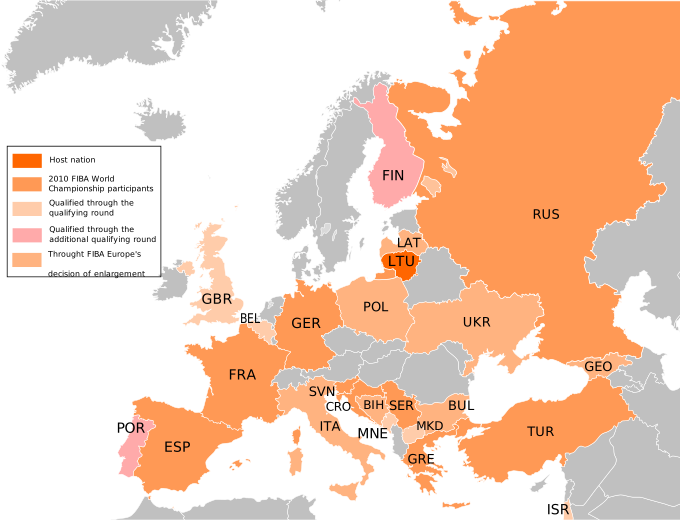
It was first decided that 16 teams would participate in EuroBasket 2011, however FIBA Europe decided on 5 September 2010, in a meeting in Istanbul, that there would be 24 teams in the tournament, after the Qualifying Round was concluded.
Lithuania automatically received a place as the hosts, nine other countries that competed in the 2010 FIBA World Championship also received a place, 12 Countries were determined through qualifying matches played in August 2010 (five had initially qualified, and seven were added after the decision to expand the tournament to 24 teams), and two more qualifiers were decided in an additional qualifying tournament that took place in August 2011. All but one of the 15 countries that participated in the Qualifying Round qualified for the final tournament.
Qualification
Main article: EuroBasket 2011 qualification
Qualified teams
| Competition | Date | Vacancies | Qualified |
|---|---|---|---|
| Host nation | – | 1 | |
| Participant of [2010 FIBA World Championship](2010-fiba-world-championship) | 28 August – 12 September 2010 | 9 | |
| Qualified through Qualifying Round | 2 August 2010 – 29 August 2010 | 5 | |
| Qualified through FIBA Europe decision | 5 September 2010 | 7 | |
| Qualified through Additional Qualifying Round | 9 August 2011 – 24 August 2011 | 2 | |
Squads
Main article: EuroBasket 2011 squads
Each team consisted of 12 players. Only 1 among the 12 could be a naturalised foreign player, who could not have been in the national team of another nation. Some of the teams had players that traced their ancestry to the teams they represent and were allowed to play for that team, such as Germany (US-born Chris Kaman) and Israel (US-born David Blu, who as Jewish was entitled to Israeli citizenship from birth). Other teams naturalised players participating in their country's league system, among them Spain (Congolese-born Serge Ibaka), Croatia (US-born Dontaye Draper), Bulgaria (US-born E. J. Rowland), Belgium (US-born Marcus Faison), and Poland (US-born Thomas Kelati, who qualified for Polish citizenship through marriage to a Pole). Montenegro and Macedonia each naturalised US-born players who had never played in their league system, but had played in neighbouring Serbia, respectively Omar Cook and Bo McCalebb. Other naturalised players moved to their current countries in their youth, with a notable example being Great Britain's Luol Deng, who fled the Sudanese Civil War with his family as a child.
Lithuania, Serbia, Portugal (Cape Verde was a Portuguese colony) and Finland are notable exceptions, with all of their players having been born in Lithuania, Portugal, Serbia and Finland respectively. Another exception was Latvia playing without foreign players. Turkey had Enes Kanter, who was born to Turkish parents in Switzerland as well as Emir Preldzic, who was born in Zenica, Bosnia and Herzegovina and had already played on the national team of Slovenia in the Olympic Qualifying Tournament in 2008 and Slovenian youth national teams.
Some of the Eastern European national teams, such as Bosnia and Herzegovina, were composed mainly or entirely from players playing abroad. This was primarily true for countries that have good basketball players but no powerful clubs or leagues to match that.
On the other hand, for countries with strong leagues, such as Italy, the National teams were primarily composed of players playing in the local league. The same was true for countries weak in basketball (i.e. with both weak national team and local league) as their players are unable to get into strong foreign leagues. Portugal could be an example here.
Many NBA players represented their national teams, with the Spanish team having 6 NBA stars, the French team having 5, the Turkish team having 4, and so on. It was one of the strongest European basketball competition ever organized as a lot of European stars helped their nations.
Notable players and coaches
-
Spain:
- ESP Pau Gasol
- ESP Marc Gasol
- ESP Rudy Fernández
- ESP Ricky Rubio
- ESP Juan Carlos Navarro
- ESP José Calderón
- CGOESP Serge Ibaka
- ITA Sergio Scariolo (coach)
-
France:
- FRA Tony Parker
- FRA Joakim Noah
- FRA Nicolas Batum
- FRA Boris Diaw
- FRA Mickaël Gelabale
- FRA Nando de Colo
-
Russia:
- RUS Andrei Kirilenko
- RUS Victor Khryapa
- RUS Timofey Mozgov
- RUS Andrey Vorontsevich
- RUS Vitaly Fridzon
- RUS Alexey Shved
- RUS Sergei Monia
- USAISR David Blatt (coach)
-
Macedonia:
- MKD Bo McCalebb
- MKD Vlado Ilievski
- MKD Pero Antić
-
Finland
- FIN Hanno Möttölä
- FIN Petteri Koponen
- FIN Sasu Salin
- FIN Henrik Dettmann (coach)
-
Lithuania:
- LTU Šarūnas Jasikevičius
- LTU Jonas Valančiūnas
- LTU Darius Songaila
- LTU Rimantas Kaukėnas
- LTU Kšyštof Lavrinovič
-
Greece:
- GRE Ioannis Bourousis
- GRE Nikos Zisis
- GRE Nick Calathes
- GRE Kostas Papanikolaou
- GRE Kosta Koufos
-
Slovenia:
- SLO Jaka Lakovič
- SLO Goran Dragić
- SLO Erazem Lorbek
- SLO Mirza Begić
- SRB Božidar Maljković (coach)
-
Serbia:
- SRB Miloš Teodosić
- SRB Nemanja Bjelica
- SRB Nenad Krstić
- SRB Duško Savanović
- SRB Dušan Ivković (coach)
-
Germany:
- GER Dirk Nowitzki
- GER Chris Kaman
-
Turkey:
- TUR Ersan İlyasova
- TUR Ömer Aşık
- TUR Enes Kanter
- TUR Hedo Türkoğlu
-
Georgia:
- GEO Zaza Pachulia
- GEO Giorgi Shermadini
- GEO Tornike Shengelia
-
Croatia:
- CRO Ante Tomić
- CRO Marko Popović
- CRO Bojan Bogdanović
- USACRO Dontaye Draper
-
Great Britain:
- GBR Luol Deng
- GBR Joel Freeland
-
Israeli:
- ISR Omri Casspi
-
Poland:
- USAPOL Thomas Kelati
- KOSPOL Dardan Berisha
-
Bosnia and Herzegovina
- BIH Mirza Teletović
-
Italy:
- ITA Andrea Bargnani
- ITA Marco Belinelli
- ITA Danilo Gallinari
- ITA Simone Pianigiani (coach)
-
Montenegro:
- USAMNE Omar Cook
- MNE Nikola Peković
- MNE Nikola Vučević
-
Latvia:
- LAT Dāvis Bertāns
- LAT Dairis Bertāns
-
Belgium:
- BEL Tomas Van Den Spiegel
- DRCBEL D. J. Mbenga
-
Portugal:
- POR Mário Palma (coach)
Group draw and championship system
The draw ceremony held on 30 January 2011 in the Lithuanian National Drama Theatre, Vilnius, divided the qualified teams into four groups of six, groups A, B, C, and D. The hosts of the evening were Jurgita Jurkutė and Vytautas Rumšas. The balls were drawn by retired basketball players European champions and Olympic medalists Stasys Stonkus, Modestas Paulauskas, Dino Meneghin, Sergejus Jovaiša, Alexander Anatolyevich Volkov and Arvydas Sabonis. A special concert followed the draw where a song was dedicated for each of the participating nations.
It was decided that Group A games would take place in Panevėžys, Group B in Šiauliai, Group C in Alytus and Group D in Klaipėda.
| **Line 1** | **Line 2** | **Line 3** | **Line 4** | **Line 5** | **Line 6** |
|---|
In the first stage every team had to play against every other team of their group (round robin). This meant five matches per team.
From every group the 3 best teams advanced to the second stage and the 3 worst teams were eliminated. In the second stage 2 new groups were formed. The 3 best teams from groups A and B were united to form group E whereas the 3 best teams from groups C and D were united to form group F.
In these two new groups of the second stage only matches by teams that had not yet played each other had to be played. As for the matches that had already happened in the first stage their results would also count in the second stage. Therefore, every team played 3 matches and there were 12 teams in the second stage.
Out of the second stage the 4 best teams from each of the two groups advanced to the quarterfinals (8 teams in total) whereas the 2 worst teams were eliminated from championship (4 teams in total).
Logo, official song and mascot of the championship
.jpg)
A public contest was introduced to create the logo for the competition. 49 designs were presented initially to the organizers and the best three were sent to FIBA Europe, which selected the winning design. The author of it was designer Kęstutis Koira. The EuroBasket 2011 logo was unveiled on 24 January 2009 in Cido Arena, Panevėžys, during the final game of the Lithuanian Basketball Federation Cup. It displays the Columns of Gediminas overlaid on a backboard.
Lithuania is the first host country of EuroBasket to have an official EuroBasket song. The song "Celebrate basketball", written by Marijonas Mikutavičius and performed by Mia, Mantas Jankavičius and Marijonas Mikutavičius, was chosen by a televoting in Lithuania. There are two versions of the song – in Lithuanian and English. Later, another version was added – "Nebetyli sirgaliai" (lit. The Fans are no Longer Quiet).
The mascot of the championship was Amberis. Its head was in the form and color of a piece of amber. The name "Amberis" is a portmanteau of the English word amber and the Lithuanian nominative case masculine gender ending "is". The real word for amber in Lithuanian is Gintaras. There was an Amberis in every arena and quite frequently there were more than a single Amberis at a time interacting with each other as well as spectators. On the screens in the arenas a "legend" was shown where a piece of amber was given by a coach to a young basketball player to bring him luck and this piece turned into Amberis.
Special events

Basketball enjoys extraordinary popularity in Lithuania. As such, many events were organized to mark the championship, including:
- In summer 2011 a dribble marathon around the whole of Lithuania was organized. Groups of people would dribble from one town to the next one, where they would give the balls to another set of people who would then dribble to the next town and so on. Every town of Lithuania was visited with TV documenting the events every day. Among the people who took part in the event were the president of Lithuania, several ministers, mayors, sportsmen, opera and ballet stars and so on. In the end the 13 balls were given to the Lithuanian National Basketball team on 29 August 2011.
- On 29 August 2011, Lithuania set a new record for simultaneous dribbling, previously held by Poland. 60,000 Lithuanians from Vilnius, Kaunas, Panevėžys, Klaipėda, Šiauliai and Alytus dribbled Molten balls simultaneously, beating Poland's record of 30,000 people.
- The Vilnius TV Tower observation deck was turned into a large basketball basket. It was made of lights that shone in the dark. The "basket" was 160 meters tall, higher than any other building in Lithuania.
- Composer Vidmantas Bartulis and poet Gintaras Patackas wrote an oratorio for basketball called "That Space-like Feeling of Basketball" ("Tas kosminis krepšinio jausmas"). This oratorio, praising basketball and Kauno Žalgiris team, was performed during the opening of Kaunas Arena on 16 August 2011.
Additionally, from Spring 2011, many of the TV and newspaper advertisements became basketball-oriented. Each of the cities where EuroBasket 2011 would take place received many minor details marking the championship: for example, the trash bins in Panevėžys were repainted to look like basketballs, an abandoned building in Vilnius had its windows covered by flags of the participant nations while balls were drawn on the pavement in some places.
Many ordinary Lithuanians decorated their cars with small Lithuanian flags flying above side windows (like during every other basketball championship). Flags covering the opposite side of the car mirrors are also popular. Some foreign fans who visited Lithuania during the championship adopted this practice as well.
A major Lithuanian news company adopted the practice of predicting each Lithuania national basketball team match in the EuroBasket. Lazdeika the Crab served as the oracle. The crab selected one of the two coconut shells to hide in when light was shone on it. Each of the two coconut shells has a country's flag – Lithuania's flag and opponent flag. At the beginning the crab's guesses would prove to be correct yet in the end they went wrong. Some people believe that the predictions were fixed - that is, the crab would be filmed many times and only when its "prediction" would match that of bookmakers would the "prediction" be aired on TV.
FIBA broadcasting rights
At least some matches were broadcast in 150 countries and territories all over the world.
| Country | Broadcaster |
|---|---|
| Albania | SuperSport Albania |
| Argentina | DirecTV |
| Belgium | Be TV |
| TELENET | |
| Bosnia and Herzegovina | BHRT |
| Brazil | SporTV |
| ESPN Brasil | |
| Band Sports | |
| TV Esporte Interativo | |
| Bulgaria | BNT |
| Croatia | HRT |
| Czech Republic | Czech Television |
| Sport 1 | |
| Cyprus | Lumiere TV |
| Denmark | Viasat Sport |
| Great Britain | ESPN |
| BBC Red Button | |
| Estonia | Viasat Sport |
| Finland | Viasat Sport |
| Nelonen Pro | |
| France | Sport+ |
| Macedonia | Sitel |
| Sitel 3 | |
| Georgia | 1TV |
| Germany | Sport1 |
| Greece | ERT |
| Hungary | Sport 1 |
| Israel | IBA |
| Charlton |

| Country | Broadcaster |
|---|---|
| Italy | RAI |
| Latvia | TV6 |
| Lithuania | TV3 |
| Viasat Sport | |
| Japan | J Sports |
| Montenegro | RTCG |
| Norway | Viasat Sport |
| Philippines | Basketball TV/AKTV |
| Poland | TVP |
| Portugal | Sport TV |
| Qatar | Al Jazeera Sports |
| Russia | NTV Plus |
| Russia 2 | |
| Romania | Sport 1 |
| Serbia | RTS 1 |
| Slovakia | Sport 1 |
| Slovenia | RTVSLO |
| Šport TV | |
| South Africa | SuperSport |
| Spain | La Sexta |
| Marca TV | |
| Sweden | TV10 |
| Taiwan | Videoland |
| Turkey | NTV Spor |
| Ukraine | [2+2](2-2-tv-channel) |
| USA | ESPN3 |
Financial details
According to the Lithuanian Basketball Association the championship expenses were 32 million Litas and the income was 34.8 million Litas, which means the profit of the event was 2.8 million Litas.
Out of the 32 million Litas expenses some 9.8 million were funded by the Lithuanian state institutions whereas the remaining 22.2 million were amassed from sponsors or other sources. It is assumed that the state earned 11.9 million Litas due to VAT taxes paid by 20 000 foreign visitors therefore earning a 2.1 million Litas profit.
Out of the 34.8 million litas income 24.7 million Litas were amassed by selling tickets (TV rights and certain other rights are owned by FIBA rather than the local basketball association and therefore are not included in the revenues).
During the championship there were 3,984 people responsible for safety and 1,500 volunteers responsible for various duties such as helping spectators or giving the balls for play. The 1,500 volunteers were chosen out of 6,000 persons who wanted to volunteer.
1,300 journalists worked in the championships, out of them 200 were TV and radio commentators. 1,300 media accreditation licenses were issued.
Preliminary round
Teams played each other once. The top three placed teams move on to the next round. In the event of a tie on points, direct matches between (points and goal average, i.e. points for/points against) were taken into account, if still tied, goal average in all matches was used as tiebreaker and not points difference.
All times are local (UTC+3)
Group A
Venue: Cido Arena, Panevėžys Main article: EuroBasket 2011 Group A
| **** | **69–98** | **** |
|---|
Group B
Venue: Šiauliai Arena, Šiauliai Main article: EuroBasket 2011 Group B
| **** | ** 96–97 (OT) ** | **** |
|---|
Group C
Venue: Alytus Arena, Alytus Main article: EuroBasket 2011 Group C
| **** | ** 75–63 ** | **** |
|---|
Group D
Venue: Klaipėda Arena, Klaipėda Main article: EuroBasket 2011 Group D
| **** | ** 74–61 ** | **** |
|---|
Second round
Group E
Main article: EuroBasket 2011 Group E
The group composed of the three best ranked teams from Groups A and B. Teams coming from the same initial group didn't play again vs. each other, but "carried" the results of the matches played between them for the first round.
Four teams with the best records advanced to the quarter-finals.
| **** | ** 84–75 ** | **** | Siemens Arena, Vilnius |
|---|
Group F
Main article: EuroBasket 2011 Group F
The group composed of the three best ranked teams from groups C and D. Teams coming from the same initial group didn't play again vs. each other, but "carried" the results of the matches played between them for the first round.
The four teams with the best records advanced to the quarter-finals.
| **** | ** 63–61 ** | **** | Siemens Arena, Vilnius |
|---|
Knockout stage
Main article: EuroBasket 2011 knockout stage


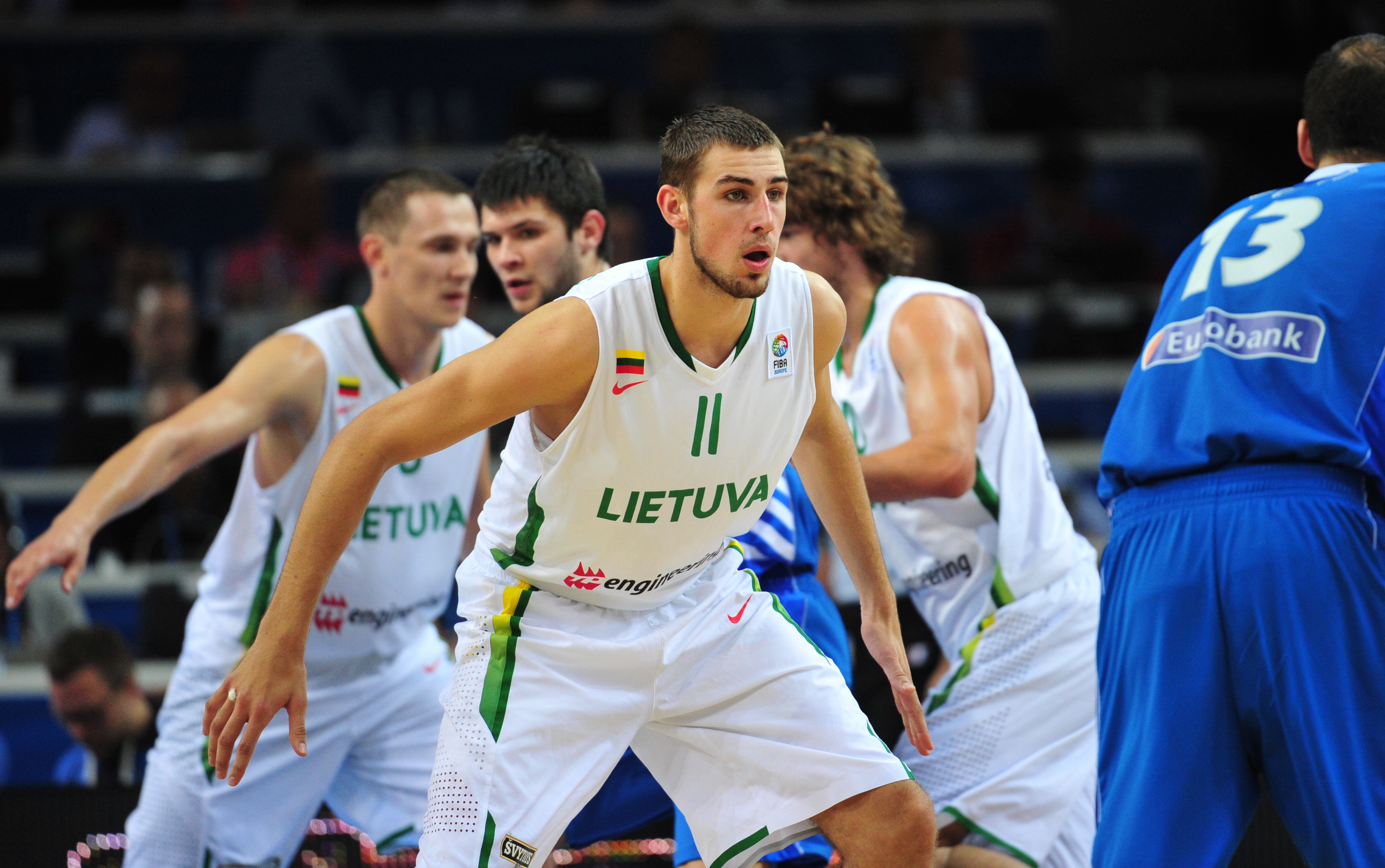
: All matches were played in: Žalgiris Arena, Kaunas
| 14 September||86||64 | 14 September||67||65 | 15 September||64||56 | 15 September||77||67 | 16 September||92||80 | 16 September||79||71 | 18 September||98||85 | 18 September||68||72
; 5th place bracket
| 15 September||77||80 | 16 September||87||77 | 17 September||73||69 | 17 September||72||68
Quarterfinals
Classification 5–8
Semifinals
Seventh place game
Fifth place game
Third place game
Final
Main article: EuroBasket 2011 Final
Final standings
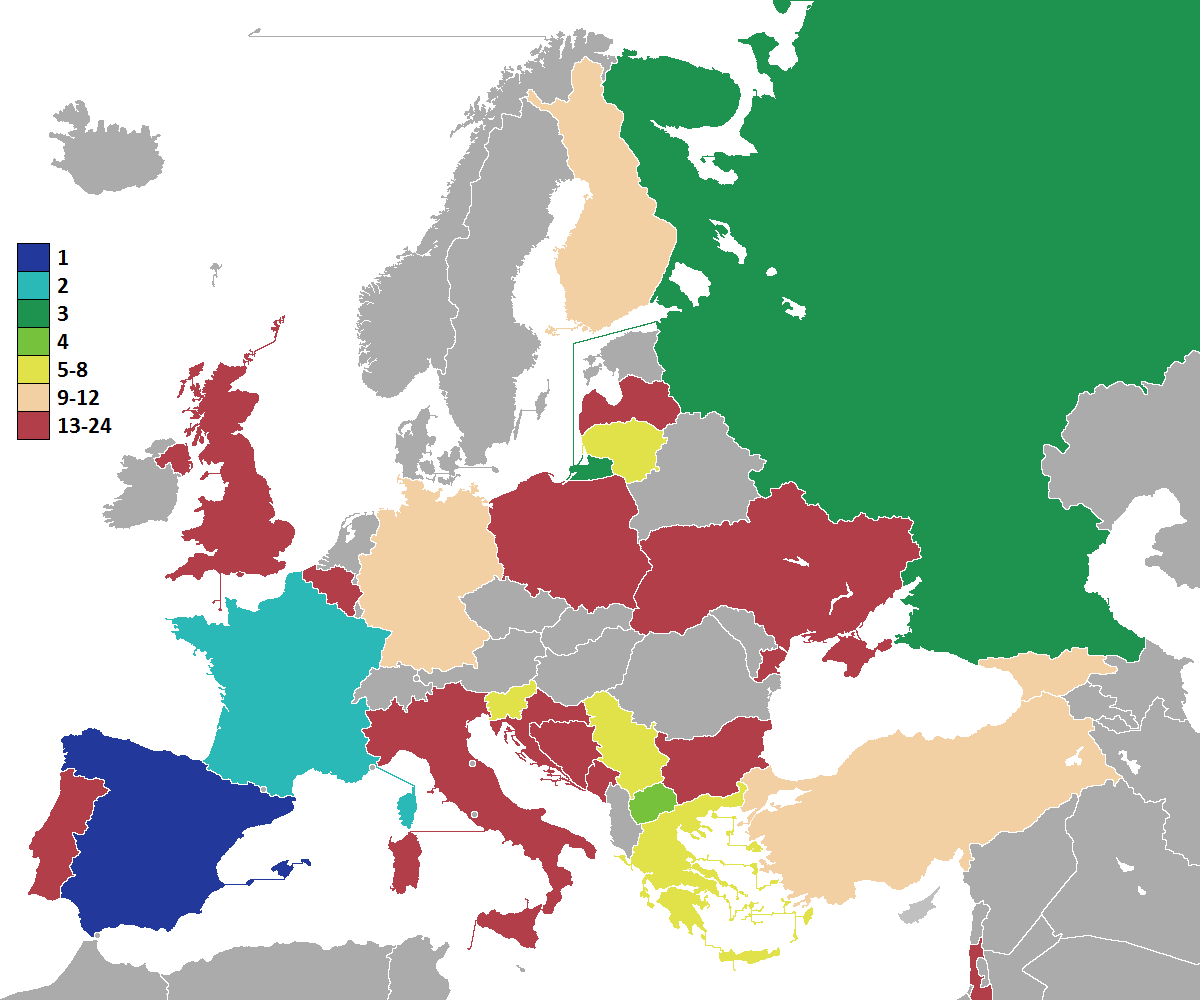
The results of the championship included some surprises. Finland and Georgia, the latter supported by some 1,500 fans who had traveled to Lithuania, managed to reach the second stage despite being allowed to take part in the championship only after FIBA Europe decision. In fact Finland had the possibility of advancing to the quarterfinals until the very last game against Slovenia.
Croatia on the other hand was a powerful team that failed to reach even the second stage. Turkey with 5 NBA players failed to reach the quarterfinals.
The biggest surprise was probably Macedonia, a country that had had no major basketball victories prior to this championship. Having lost only two games in the first and second stages and these two by just a single point each (one of them after overtime) Macedonia easily advanced to the quarterfinals. In the quarterfinals the Macedonians defeated the hosts Lithuanians, and went to the semifinals.
A match between Georgia and Russia in Klaipėda was regarded to have political significance due to these countries having recently fought a war (the South Ossetia War). There were more than 1,000 Georgians and under 1,000 Russians in the arena during the game and large police forces were amassed to prevent possible riots. Despite the tight battle the Russians defeated the Georgians and prevented any surprise result. No riots happened.
These are the final standings. Two countries, Spain and France, qualified for the 2012 Summer Olympics basketball tournament outright. Four more qualified for the 2012 Olympic Qualifying Tournament, with Russia and Lithuania obtaining qualification through the tournament. In addition, Great Britain qualified as host.
| Qualified for the [2012 FIBA World Olympic Qualifying Tournament](2012-fiba-world-olympic-qualifying-tournament-for-men). |
|---|
| Rank | Team | Record |
|---|---|---|
| 10–1 | ||
| 9–2 | ||
| 10–1 | ||
| 4 | 7–4 | |
| 5 | 8–3 | |
| 6 | 7–4 | |
| 7 | 6–5 | |
| 8 | 5–6 | |
| 9-10 | 4–4 | |
| 3–5 | ||
| 11-12 | 3–5 | |
| 2–6 | ||
| 13-16 | 2–3 | |
| 2–3 | ||
| 2–3 | ||
| 2–3 | ||
| 17-20 | 2–3 | |
| 2–3 | ||
| 2–3 | ||
| 1–4 | ||
| 21-24 | 1–4 | |
| 0–5 | ||
| 0–5 | ||
| 0–5 |
Statistical leaders
Individual Tournament Highs
Points
| Rank | Name | G | Pts | PPG |
|---|---|---|---|---|
| **1** | FRA **Tony Parker** | 10 | 221 | 22.1 |
| **2** | MKD Bo McCalebb | 11 | 235 | 21.4 |
| **3** | ESP Pau Gasol | 10 | 201 | 20.1 |
| **4** | GER Dirk Nowitzki | 8 | 156 | 19.5 |
| **5** | ESP Juan Carlos Navarro | 11 | 206 | 18.7 |
| **6** | SRB Nenad Krstić | 10 | 155 | 15.5 |
| **7** | GER Chris Kaman | 8 | 124 | 15.5 |
| **8** | RUS Andrei Kirilenko | 10 | 146 | 14.6 |
| **9** | FRA Nicolas Batum | 10 | 142 | 14.2 |
| **10** | ESP Marc Gasol | 10 | 135 | 13.5 |
Rebounds
| Rank | Name | G | Rbs | RPG |
|---|---|---|---|---|
| **1** | GER **Chris Kaman** | 8 | 80 | 10.0 |
| **2** | MKD Pero Antić | 10 | 88 | 8.8 |
| **3** | TUR Ömer Aşık | 8 | 68 | 8.5 |
| **4** | ESP Pau Gasol | 9 | 73 | 8.1 |
| **5** | FRA Joakim Noah | 9 | 72 | 8.0 |
| GEO Viktor Sanikidze | 8 | 64 | 8.0 | |
| **7** | ESP Marc Gasol | 10 | 74 | 7.4 |
| **8** | GER Dirk Nowitzki | 8 | 53 | 6.6 |
| **9** | TUR Ersan İlyasova | 8 | 52 | 6.5 |
| **10** | SVN Mirza Begić | 11 | 71 | 6.5 |
Assists
| Rank | Name | G | Ast | APG | ||
|---|---|---|---|---|---|---|
| **1** | SRB **Miloš Teodosić** | 11 | 63 | 5.7 | ||
| **2** | RUS Victor Khryapa | 10 | 51 | 5.1 | ||
| **3** | LTU Šarūnas Jasikevičius | 11 | 51 | 4.6 | ||
| **4** | FIN Teemu Rannikko | 8 | 36 | 4.5 | ||
| **5** | FRA Tony Parker | 9 | 39 | 4.3 | ||
| **6** | GER Heiko Schaffartzik | 8 | 31 | 3.9 | ||
| **7** | LTU Mantas Kalnietis | 11 | 42 | 3.8 | ||
| GRE Nick Calathes | 11 | 42 | 3.8 | |||
| **9** | MKD Bo McCalebb | 11 | title=McCalebb statistics in 2011 | url= http://basketball.eurobasket.com/player/Bo_McCalebb/Fenerbahce_Ulker_Istanbul/39781?Cntry=&PlayerID=39781&stats=2011 | access-date=4 September 2013}} | 3.7 |
| **10** | GEO Giorgi Tsintsadze | 6 | 20 | 3.3 |
Steals
| Rank | Name | G | Stl | SPG |
|---|---|---|---|---|
| **1** | RUS **Andrei Kirilenko** | 10 | 29 | 2.9 |
| **2** | FRA Nicolas Batum | 10 | 21 | 2.1 |
| **3** | MKD Bo McCalebb | 11 | 23 | 2.1 |
| **4** | FIN Tuukka Kotti | 8 | 15 | 1.9 |
| **5** | MKD Vojdan Stojanovski | 10 | 18 | 1.8 |
| **6** | FRA Tony Parker | 9 | 15 | 1.7 |
| **7** | SVN Goran Dragić | 11 | 18 | 1.6 |
| GRE Nick Calathes | 11 | 18 | 1.6 | |
| **9** | ESP Rudy Fernández | 10 | 16 | 1.6 |
| **10** | GEO Manuchar Markoishvili | 8 | 12 | 1.5 |
Blocks
| Rank | Name | G | Blk | BPG |
|---|---|---|---|---|
| **1** | SVN **Mirza Begić** | 11 | 21 | 1.9 |
| **2** | GER Chris Kaman | 8 | 14 | 1.8 |
| **3** | ESP Pau Gasol | 10 | 17 | 1.7 |
| **4** | RUS Timofey Mozgov | 10 | 15 | 1.5 |
| TUR Ömer Aşık | 8 | 12 | 1.5 | |
| **6** | ESP Serge Ibaka | 11 | 13 | 1.2 |
| **7** | LTU Jonas Valančiūnas | 10 | 11 | 1.1 |
| **8** | GRE Kosta Koufos | 11 | 12 | 1.1 |
| **9** | MKD Predrag Samardžiski | 11 | 10 | 0.9 |
| **10** | MKD Todor Gečevski | 6 | 5 | 0.8 |
Minutes
| Rank | Name | G | Min | MPG |
|---|---|---|---|---|
| **1** | MKD **Vlado Ilievski** | 10 | 375 | 37.5 |
| **2** | FRA Tony Parker | 9 | 311 | 34.6 |
| **3** | MKD Pero Antić | 10 | 344 | 34.4 |
| **4** | MKD Bo McCalebb | 11 | 376 | 34.2 |
| **5** | GEO Manuchar Markoishvili | 8 | 260 | 32.5 |
| **6** | GEO Viktor Sanikidze | 8 | 257 | 32.1 |
| **7** | FRA Nicolas Batum | 10 | 314 | 31.4 |
| **8** | FIN Petteri Koponen | 8 | 250 | 31.3 |
| **9** | GER Heiko Schaffartzik | 8 | 241 | 30.1 |
| **10** | GER Dirk Nowitzki | 8 | 239 | 29.9 |
Individual Game Highs
| Department | Name | Total | Opponent |
|---|---|---|---|
| Points | ITA Andrea Bargnani | 36 | |
| Rebounds | MKD Pero Antić | 19 | |
| Assists | CRO Dontaye Draper | 12 | |
| Steals | FRA Nicolas Batum | ||
| FRA Tony Parker | 6 | ||
| Blocks | ESP Serge Ibaka | 5 | |
| 2-point field goal percentage | GBR Joel Freeland | 100% (11/11) | |
| 3-point field goal percentage | MKD Vojdan Stojanovski | 100% (5/5) | |
| Free throw percentage | FRA Tony Parker | ||
| POR Miguel Minhava | 100% (12/12) | ||
| Turnovers | SRB Miloš Teodosić | 9 |
Team Tournament Highs
Offensive PPG
| Pos. | Name | PPG |
|---|---|---|
| **1** | **** | **85.2** |
| **2** | 82.3 | |
| **3** | 81.1 | |
| **4** | 80.2 | |
| **5** | 79.8 | |
| **6** | 79.2 | |
| **7** | 79.1 | |
| **8** | 77.0 | |
| **9** | 76.0 | |
| **9** | 76.0 |
Defensive PPG
| Pos. | Name | PPG |
|---|---|---|
| **1** | **** | **63.3** |
| **2** | 65.2 | |
| **3** | 65.4 | |
| **4** | 65.7 | |
| **5** | 67.8 | |
| **6** | 68.7 | |
| **7** | 69.3 | |
| **8** | 71.0 | |
| **9** | 71.4 | |
| **10** | 73.1 | |
| **10** | 73.1 |
Rebounds
| Pos. | Name | RPG |
|---|---|---|
| **1** | **** | **39** |
| **2** | 38.7 | |
| **3** | 37.6 | |
| **4** | 37.1 | |
| **5** | 36.4 | |
| **6** | 35.4 | |
| **7** | 34.7 | |
| **8** | 34.5 | |
| **9** | 34.5 | |
| **10** | 34.2 |
Assists
| Pos. | Name | APG |
|---|---|---|
| **1** | **** | **19.2** |
| **2** | 19.0 | |
| **3** | 17.7 | |
| **4** | 17.4 | |
| **5** | 17.3 | |
| **6** | 15.4 | |
| **7** | 14.8 | |
| **8** | 14.6 | |
| **9** | 14.6 | |
| **10** | 13.8 |
Steals
| Pos. | Name | SPG |
|---|---|---|
| **1** | **** | **8.6** |
| **2** | 8.4 | |
| **3** | 7.6 | |
| **4** | 7.6 | |
| **5** | 7.5 | |
| **6** | 7.5 | |
| **7** | 7.2 | |
| **8** | 7.1 | |
| **9** | 7.0 | |
| **10** | 6.4 |
Blocks
| Pos. | Name | BPG |
|---|---|---|
| **1** | **** | **3.7** |
| **2** | 3.4 | |
| **3** | 3.3 | |
| **4** | 3.1 | |
| **5** | 3.0 | |
| **6** | 2.6 | |
| **7** | 2.6 | |
| **8** | 2.4 | |
| **9** | 2.2 | |
| **10** | 2.2 |
2-point field goal percentage
| Pos. | Name | % |
|---|---|---|
| **1** | **** | **58.3** |
| **2** | 56.3 | |
| **3** | 55.4 | |
| **4** | 54.7 | |
| **5** | 54.6 | |
| **6** | 52.9 | |
| **7** | 52.8 | |
| **8** | 52.0 | |
| **9** | 51.6 | |
| **10** | 51.5 |
3-point field goal percentage
| Pos. | Name | % |
|---|---|---|
| **1** | **** | **41.1** |
| **2** | 39.2 | |
| **3** | 39.1 | |
| **4** | 36.6 | |
| **5** | 36.3 | |
| **6** | 36.1 | |
| **7** | 35.7 | |
| **8** | 35.6 | |
| **9** | 35.6 | |
| **10** | 35.5 |
Free throw percentage
| Pos. | Name | % |
|---|---|---|
| **1** | **** | **84.6** |
| **2** | 81.3 | |
| **3** | 80.1 | |
| **4** | 79.7 | |
| **5** | 79.5 | |
| **6** | 79.4 | |
| **7** | 78.9 | |
| **8** | 78.4 | |
| **9** | 77.7 | |
| **10** | 75.8 |
Team Game highs
| Department | Name | Total | Opponent |
|---|---|---|---|
| Points | 100 | ||
| Rebounds | 50 | ||
| Assists | 26 | ||
| Steals | |||
| 14 | |||
| Blocks | 10 | ||
| 2-point field goal percentage | 78.4% (29/37) | ||
| 3-point field goal percentage | 63.3% (7/11) | ||
| Free throw percentage | 100% (16/16) | ||
| Turnovers | |||
| 23 | |||
All-Tournament Team

The following players were named to the All-Tournament Team:
PG – France Tony Parker
SG – Macedonia Bo McCalebb
SF – Spain Juan Carlos Navarro (MVP)
PF – Russia Andrei Kirilenko
C – Spain Pau Gasol
References
References
- "Another masterpiece for MVP "La Bomba"". Eurobasket2011.com.
- ""FIBA Europe": lietuviai Europos čempionatą suorganizavo geriausiai per visą istoriją". 15min.lt.
- "Naujienos - Europos krepĹĄinio Ä?empionatas: kiek uĹždirbome?". Vtv.lt.
- Nilsen, Paul. (18 September 2011). "Spain Retains European Crown". [[FIBA]].
- "Eurobasket 2011 will be played with 24 teams". Fibaeurope.com.
- "Seven More Teams Get Direct EuroBasket Berth". Fibaeurope.com.
- (2011-01-29). "Official EuroBasket 2011 anthem (Lithuanian version)".
- (2011-06-17). "Official song of EuroBasket 2011 Celebrate Basketball HD (with lyrics) - YouTube".
- Keisels, Guntis. (19 August 2011). "Latvijas valstsvienības spēlēs Eiropas čempionāta finālturnīrā translēs TV6".
- (17 August 2011). "FIBA Europe Regulations". FIBA.
- (11 January 2011). "Official Basketball Rules". FIBA.
- (16 April 1985). "EuroBasket 2011". EuroBasket 2011.
- "McCalebb statistics in 2011".
- "News". EuroBasket 2011.
This article was imported from Wikipedia and is available under the Creative Commons Attribution-ShareAlike 4.0 License. Content has been adapted to SurfDoc format. Original contributors can be found on the article history page.
Ask Mako anything about EuroBasket 2011 — get instant answers, deeper analysis, and related topics.
Research with MakoFree with your Surf account
Create a free account to save articles, ask Mako questions, and organize your research.
Sign up freeThis content may have been generated or modified by AI. CloudSurf Software LLC is not responsible for the accuracy, completeness, or reliability of AI-generated content. Always verify important information from primary sources.
Report