From Surf Wiki (app.surf) — the open knowledge base
EuroBasket
European men's basketball tournament for national teams
European men's basketball tournament for national teams
| Field | Value |
|---|---|
| title | EuroBasket |
| last_season | EuroBasket 2025 |
| logo | EuroBasket logo.png |
| pixels | 230px |
| sport | Basketball |
| founded | |
| inaugural | 1935 |
| organiser | FIBA Europe |
| teams | 24 |
| countries | FIBA Europe member associations |
| continent | Europe |
| champion | |
| (2nd title) | |
| most_champs | |
| (14 titles) | |
| website | [EuroBasket](https://eurobasket.basketball) |
| [FIBA Europe](http://www.fiba.basketball/europe) | |
| related_comps | FIBA European Championship for Small Countries |
| EuroBasket Women |
the men's basketball tournament
(2nd title) (14 titles) FIBA Europe EuroBasket Women
EuroBasket, also commonly called the European Basketball Championship, is the main international basketball competition for the senior men's national teams of primarily European countries. It is held every four years and organised by FIBA Europe, the European zone of FIBA, the International Basketball Federation.
The competition was first held in 1935. The former Soviet Union holds the record for most gold medals with 14. The tournament is generally held in August or September, in the offseason of major club competitions. The current champion is Germany, who won the 2025 title.
History
Beginning
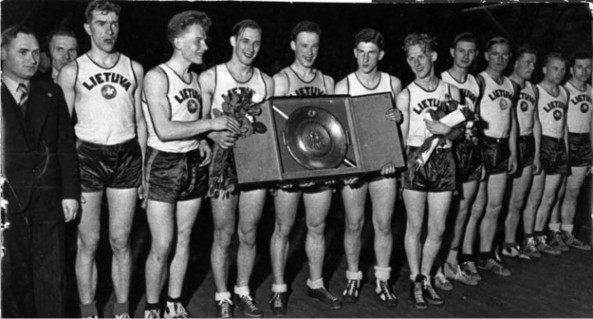
The first championships was held three years after the establishment of FIBA, in 1935. Switzerland was chosen as the host country, and ten countries joined. Only one qualifying match was played between Portugal and Spain. With a complicated formula, the final would see Latvia as champions. According to the rule at the time, the winner had to hold the following games. The following two tournaments would be won by Lithuania and would see the introduction of Egypt who would compete in EuroBasket until 1953 winning one championship at home in 1949 along the way. The 1941 edition of the tournament was scheduled be held in Lithuania as well, but was cancelled due to WWII.
Soviet dominance
After the 1946 edition saw the first jump shot performed by Italian player Giuseppe Stefanini, the following edition would see the Soviet Union compete in their first edition in the 1947 edition and would see the Soviets win the first of eleven out of the next thirteen European championships. During the 50s, the Soviet Union won four of the five competitions held during the decade with the only tournament that they did not win being the 1955 edition. This was won by Hungary as they finished top while the Soviets finished in third place. It was also during that edition that the thirty-second shot clock was introduced, which changed the style of basketball.
The Soviets would win all championships of the 60s. They had a fifty-five game winning streak which would be broken by Yugoslavia in 1969. The 1960s would see also a change in how the competition was viewed and run with FIBA putting a limit on the number of countries that entered to 16 with qualifiers being the way to bring them down to that number as it first appeared in 1963. The following edition would see the competition not be held in one city with Tbilisi joining Moscow in hosting games and in 1967 the first modern games were held, because the games were televised and international media were present.
Rise of Yugoslavia
The 1970s were the competition between Yugoslavia and the Soviet Union. During the decade Yugoslavia won three gold medals and the Soviet Union taking out the remaining two. After the Soviets won 1971, the 1973 edition would finally see Yugoslavia win their first championship after Spain defeated the Soviets in the semi-finals to qualify for their first final since the first edition way back in 1935. Yugoslavia would finally have a chance to defeat the Soviets as at home, they would get the chance to defeat them and they did as they won by six points to take home 1975 edition. After following that up in 1977, the Soviets would get their revenge in the final round at EuroBasket 1979 when they defeated them 96–77 to qualify through to the final where they would defeat Israel who shocked the basketball world as they defeated Yugoslavia in the opening round by a point.
Brewing under the Soviets and Yugoslavs, Western Europe was starting to appear with the 1980s seeing the change happen. In 1983, the Western side of Europe tasted success with Italy defeating Spain in the final to record their first of two titles. An important development happened in the following edition which was held in Germany. That edition saw the first three-point arc being used.
New winners emerge and Spanish dominance
Greece would win the next edition in 1987 at home after remarkable victory over heavily favored Soviet Union, with a 103–101 score in a gripping final decided in overtime. At the 1989 edition, Greece beat the Soviet team again in the semifinals with a one-point margin but then lost to hosts Yugoslavia in the final. EuroBasket 1991 was the first EuroBasket tournament in which currently active NBA players, that had also already played in an official NBA regular season game were allowed to participate. It would also be the first edition where the Soviets weren't entered into the competition, as the USSR didn't qualify for the main tournament and afterwards collapsed. Yugoslavia would take the title, but afterwards war would split the country up with Jure Zdovc being a "casualty" after Slovenia declared independence, two days into the tournament. 1993 saw a shock winner, with Germany taking the championship at home with a one-point victory over Russia. After being suspended in 1993, FR Yugoslavia came back and took the trophy after defeating Lithuania who was making its first appearance, since it had been a Soviet Republic. But politics came into play with the crowd protesting "Lithuania is the champions", while the Croatian team who had defeated Greece for bronze step down from the podium in protest of the war that was happening at the time. Nevertheless, FR Yugoslavia managed to repeat their success in 1997 after victory over Italy in the final match.
Italy managed to win the last title of the 20th century, defeating Spain in the 1999 final. In 2001, FR Yugoslavia regained European title but it was their last victory at the EuroBasket. In 2003, Lithuania defeated Spain in the final match and won their first European trophy since 1939. In 2005, Greece repeated success of 1987 after beating Germany in the final match.
2007 saw a shock winner, with Russia taking their first EuroBasket title since the dissolution of the Soviet Union with a one-point victory over heavily favored Spanish hosts in Madrid. However, the next tournaments were dominated by Spain who finally gained their maiden European title in 2009 and then won 3 of 5 next editions. In 2013, France won their first European title. In 2017, Slovenia won the trophy, becoming the 14th country to win the EuroBasket. But in general, the first decades of the 21st century have been characterized by the dominance of Spanish team who has reached at least the semifinals of the 11 last tournaments, obtaining at these editions a total of four gold, three silver and three bronze medals, including the current title of 2022.
Qualification
24 European teams take part in the final competition. The qualification format that existed until the 2011 EuroBasket permitted 16 teams to compete. Eight spots were determined by the host nation and the top seven finishers of the previous EuroBasket. The remaining Division A teams compete in a qualification tournament. There, they were divided into four groups. Each group played a double round-robin. The top team in each group qualified for EuroBasket. The best three of the four runners-up also qualified.
Of the ten teams that did not qualify in the qualification tournament, the six best got another chance in the additional qualification round. The remaining four competed in a relegation round, with two being sent to Division B for the next qualification cycle (and replaced by the two best teams from Division B).
The final spot was determined by the additional qualifying round. The six teams were divided into two groups of three, with each group playing a double round-robin. The top team in each group played in the final against the other group's top team; the winner of that game received the final EuroBasket qualification spot.
In 2015, the national team of Iceland became the smallest nation to ever qualify for a EuroBasket final stage at the population of around 330.000 people. The team was led by the former Dallas Maverick, Jón Arnór Stefánsson followed by a great performance which drove them through the qualifiers. In 2017, Iceland made back to back qualification to a EuroBasket final stage, then led by the young Martin Hermannsson.
Competition format
EuroBasket has used a number of different formats, ranging from the simple round-robin used in 1939, to a three-stage tournament, and now a two-stage tournament that is currently in use.
The current format begins with a preliminary round. The twenty-four qualified teams are placed into four groups of six, and each group plays a round-robin tournament. The top four teams in each group (16 overall) advance to the knockout stage. The knockout stage is a 16-team single-elimination tournament, with a bronze medal game for semi-final losers and classification games for the quarterfinal losers to determine fifth to eighth places.
Results
| # | Year | Hosts | Gold medal game | Bronze medal game | Teams | Gold | Score | Silver | Bronze | Score | Fourth place |
|---|---|---|---|---|---|---|---|---|---|---|---|
| 1 | 1935 | Switzerland | **** | **24–18** | **25–23** | 10 | |||||
| 2 | 1937 | Latvia | **** | **24–23** | **27–24** | 8 | |||||
| 3 | 1939 | Lithuania | **** | No playoffs | No playoffs | 8 | |||||
| - | 1941 | Lithuania | Cancelled due to World War II | ||||||||
| 4 | 1946 | Switzerland | **** | **34–32** | **38–32** | 10 | |||||
| 5 | 1947 | Czechoslovakia | **** | **56–37** | **50–48** | 14 | |||||
| 6 | 1949 | Egypt | **** | No playoffs | No playoffs | 7 | |||||
| 7 | 1951 | France | **** | **45–44** | **55–52** | 18 | |||||
| 8 | 1953 | Soviet Union | **** | No playoffs | No playoffs | 17 | |||||
| 9 | 1955 | Hungary | **** | No playoffs | No playoffs | 18 | |||||
| 10 | 1957 | Bulgaria | **** | No playoffs | No playoffs | 16 | |||||
| 11 | 1959 | Turkey | **** | No playoffs | No playoffs | 17 | |||||
| 12 | 1961 | Yugoslavia | **** | **60–53** | **55–46** | 19 | |||||
| 13 | 1963 | Poland | **** | **61–45** | **89–61** | 16 | |||||
| 14 | 1965 | Soviet Union | **** | **58–49** | **86–70** | 16 | |||||
| 15 | 1967 | Finland | **** | **89–77** | **80–76** | 16 | |||||
| 16 | 1969 | Italy | **** | **81–72** | **77–75** | 12 | |||||
| 17 | 1971 | West Germany | **** | **69–64** | **85–67** | 12 | |||||
| 18 | 1973 | Spain | **** | **78–67** | **90–58** | 12 | |||||
| 19 | 1975 | Yugoslavia | **** | No playoffs | No playoffs | 12 | |||||
| 20 | 1977 | Belgium | **** | **74–61** | **91–81** | 12 | |||||
| 21 | 1979 | Italy | **** | **98–76** | **99–92** | 12 | |||||
| 22 | 1981 | Czechoslovakia | **** | **84–67** | **101–90** | 12 | |||||
| 23 | 1983 | France | **** | **105–96** | **105–70** | 12 | |||||
| 24 | 1985 | West Germany | **** | **120–89** | **102–90** | 12 | |||||
| 25 | 1987 | Greece | **** | **103–101** | |||||||
| overtime | **98–87** | 12 | |||||||||
| 26 | 1989 | Yugoslavia | **** | **98–77** | **104–76** | 8 | |||||
| 27 | 1991 | Italy | **** | **88–73** | **101–83** | 8 | |||||
| 28 | 1993 | Germany | **** | **71–70** | **99–59** | 16 | |||||
| 29 | 1995 | Greece | **** | **96–90** | **73–68** | 14 | |||||
| 30 | 1997 | Spain | **** | **61–49** | **97–77** | 16 | |||||
| 31 | 1999 | France | **** | **64–56** | **74–62** | 16 | |||||
| 32 | 2001 | Turkey | **** | **78–69** | **99–90** | 16 | |||||
| 33 | 2003 | Sweden | **** | **93–84** | **69–67** | 16 | |||||
| 34 | 2005 | Serbia and Montenegro | **** | **78–62** | **98–68** | 16 | |||||
| 35 | 2007 | Spain | **** | **60–59** | **78–69** | 16 | |||||
| 36 | 2009 | Poland | **** | **85–63** | **57–56** | 16 | |||||
| 37 | 2011 | Lithuania | **** | **98–85** | **72–68** | 24 | |||||
| 38 | 2013 | Slovenia | **** | **80–66** | **92–66** | 24 | |||||
| 39 | 2015 | France | |||||||||
| Croatia | |||||||||||
| Germany | |||||||||||
| Latvia | **** | **80–63** | **81–68** | 24 | |||||||
| 40 | 2017 | Finland | |||||||||
| Israel | |||||||||||
| Romania | |||||||||||
| Turkey | **** | **93–85** | **93–85** | 24 | |||||||
| 41 | 2022 | Czech Republic | |||||||||
| Georgia (country) | |||||||||||
| Italy | |||||||||||
| Germany | **** | **88–76** | **82–69** | 24 | |||||||
| 42 | 2025 | Cyprus | |||||||||
| Finland | |||||||||||
| Latvia | |||||||||||
| Poland | **** | **88–83** | **92–89** | 24 | |||||||
| 43 | 2029 | Estonia | |||||||||
| Greece | |||||||||||
| Slovenia | |||||||||||
| Spain | 24 |
Medal table
The medal table below lists the national teams according to the respective table published by FIBA.
- Countries in italics no longer compete at the EuroBasket.
;Notes
Participating nations
| Total | 10 | 8 | 8 | 10 | 14 | 7 | 18 | 17 | 18 | 16 | 17 | 19 | 16 | 16 | 16 | 12 | 12 | 12 | 12 | 12 | 12 |
|---|
| Total | 12 | 12 | 12 | 12 | 8 | 8 | 16 | 14 | 16 | 16 | 16 | 16 | 16 | 16 | 16 | 24 | 24 | 24 | 24 | 24 | 24 | 24 |
|---|
;Notes
- According to FIBA, Yugoslavia competed until 2001.
Debut of teams
A total of 46 national teams have appeared in at least one FIBA EuroBasket in the history of the tournament through the 2025 competition. Each successive EuroBasket has had at least one team appearing for the first time. Countries competing in their first EuroBasket are listed below by year.
| Year | Debutants | Number | Total | 46 |
|---|---|---|---|---|
| 1935 | , , , , , , , , , | 10 | ||
| 1937 | , , , | 13 | ||
| 1939 | 14 | |||
| 1946 | , , | 17 | ||
| 1947 | , , , | 21 | ||
| 1949 | , , , | 25 | ||
| 1951 | , , , | 29 | ||
| 1953 | , | 31 | ||
| 1955 | *None* | 31 | ||
| 1957 | *None* | 31 | ||
| 1959 | , | 33 | ||
| 1961 | *None* | 33 | ||
| 1963 | *None* | 33 | ||
| 1965 | *None* | 33 | ||
| 1967 | *None* | 33 | ||
| 1969 | *None* | 33 | ||
| 1971 | *None* | 33 | ||
| 1973 | *None* | 33 | ||
| 1975 | *None* | 33 | ||
| 1977 | *None* | 33 | ||
| 1979 | *None* | 33 | ||
| 1981 | *None* | 33 | ||
| 1983 | *None* | 33 | ||
| 1985 | *None* | 33 | ||
| 1987 | *None* | 33 | ||
| 1989 | *None* | 33 | ||
| 1991 | *None* | 33 | ||
| 1993 | , , , | 37 | ||
| 1995 | *None* | 37 | ||
| 1997 | 38 | |||
| 1999 | , | 40 | ||
| 2001 | *None* | 40 | ||
| 2003 | *None* | 40 | ||
| 2005 | *None* | 40 | ||
| 2007 | 41 | |||
| 2009 | 42 | |||
| 2011 | , | 44 | ||
| 2013 | *None* | 44 | ||
| 2015 | 45 | |||
| 2017 | *None* | 45 | ||
| 2022 | *None* | 45 | ||
| 2025 | 46 | |||
| 2029 | *TBD* | 46 |
Most successful players
Boldface denotes active basketball players and highest medal count among all players (including these who not included in these tables) per type.
Multiple gold medalists
| Rank | Player | Country | From | To | Gold | Silver | Bronze | Total |
|---|---|---|---|---|---|---|---|---|
| 1 | Gennadi Volnov | 1959 | 1969 | **6** | – | – | 6 | |
| 2 | Sergei Belov | 1967 | 1979 | 4 | 2 | 1 | **7** | |
| 3 | Rudy Fernández | 2007 | 2022 | 4 | 1 | 1 | 6 | |
| 4 | Predrag Danilović | 1989 | 1999 | 4 | – | 1 | 5 | |
| Modestas Paulauskas | 1965 | 1973 | 4 | – | 1 | 5 | ||
| Zurab Sakandelidze | 1965 | 1973 | 4 | – | 1 | 5 | ||
| 7 | Armenak Alachachian | 1953 | 1965 | 4 | – | – | 4 | |
| Aleksandr Petrov | 1959 | 1965 | 4 | – | – | 4 | ||
| 9 | Krešimir Ćosić | 1969 | 1981 | 3 | **3** | 1 | **7** | |
| 10 | Pau Gasol | 2001 | 2017 | 3 | 2 | 2 | **7** |
Multiple medalists
The table shows players who have won at least 6 medals in total at the EuroBasket.
| Rank | Player | Country | From | To | Gold | Silver | Bronze | Total |
|---|---|---|---|---|---|---|---|---|
| 1 | Sergei Belov | 1967 | 1979 | 4 | 2 | 1 | **7** | |
| 2 | Krešimir Ćosić | 1969 | 1981 | 3 | **3** | 1 | **7** | |
| 3 | Pau Gasol | 2001 | 2017 | 3 | 2 | 2 | **7** | |
| 4 | Gennadi Volnov | 1959 | 1969 | **6** | – | – | 6 | |
| 5 | Rudy Fernández | 2007 | 2022 | 4 | 1 | 1 | 6 | |
| 6 | Felipe Reyes | 2001 | 2015 | 3 | 2 | 1 | 6 | |
| 7 | Alexander Belostenny | 1977 | 1989 | 3 | 1 | 2 | 6 | |
| 8 | Valdemaras Chomičius | 1979 | 1995 | 2 | 2 | 2 | 6 | |
| Juan Carlos Navarro | 2001 | 2017 | 2 | 2 | 2 | 6 |
Awards
Main article: FIBA EuroBasket MVP
Main article: FIBA EuroBasket Top Scorer
Main article: FIBA EuroBasket All-Tournament Team
Below are the lists of all players voted as the MVPs and the Top Scorers of each EuroBasket edition. Krešimir Ćosić and Pau Gasol are the only players to win the MVP award twice. Nikos Galis and Radivoj Korać were the Top Scorers 4 times each.
| Player (X) | Denotes the number of times the player was selected the MVP or was the Top Scorer. |
|---|
| Tournament | MVP | Top Scorer | PPG | ||
|---|---|---|---|---|---|
| EuroBasket 1935 | Spain Rafael Martín | Italy Livio Franceschini | |||
| EuroBasket 1937 | Lithuania Pranas Talzūnas | Latvia Rūdolfs Jurciņš | |||
| EuroBasket 1939 | Lithuania Mykolas Ruzgys | ||||
| (*de facto:* Lithuania Pranas Lubinas)‡ | Estonia Heino Veskila | ||||
| EuroBasket 1946 | Hungary Ferenc Németh | Poland Paweł Stok | |||
| EuroBasket 1947 | Soviet Union Joann Lõssov | France Jacques Perrier | |||
| EuroBasket 1949 | Turkey Hüseyin Öztürk | Turkey Hüseyin Öztürk | |||
| EuroBasket 1951 | Czechoslovakia Ivan Mrázek | Czechoslovakia Ivan Mrázek | |||
| EuroBasket 1953 | USSR Anatoly Konev | Lebanon Ahmed Idlibi | |||
| EuroBasket 1955 | Hungary János Greminger | Czechoslovakia Miroslav Škeřík | |||
| EuroBasket 1957 | Czechoslovakia Jiří Baumruk | Belgium Eddy Terrace | |||
| EuroBasket 1959 | USSR Viktor Zubkov | Yugoslavia Radivoj Korać | |||
| EuroBasket 1961 | YUG Radivoj Korać | YUG Radivoj Korać (2) | |||
| EuroBasket 1963 | ESP Emiliano Rodríguez | Yugoslavia Radivoj Korać (3) | |||
| EuroBasket 1965 | USSR Modestas Paulauskas | Yugoslavia Radivoj Korać (4) | |||
| EuroBasket 1967 | Czechoslovakia Jiří Zedníček | GRE Giorgos Kolokithas | |||
| EuroBasket 1969 | USSR Sergei Belov | GRE Giorgos Kolokithas (2) | |||
| EuroBasket 1971 | YUG Krešimir Ćosić | POL Edward Jurkiewicz | |||
| EuroBasket 1973 | ESP Wayne Brabender | BUL Atanas Golomeev | |||
| EuroBasket 1975 | YUG Krešimir Ćosić (2) | BUL Atanas Golomeev (2) | |||
| EuroBasket 1977 | YUG Dražen Dalipagić | NED Kees Akerboom | |||
| EuroBasket 1979 | ISR Miki Berkovich | POL Mieczysław Młynarski | |||
| EuroBasket 1981 | URS Valdis Valters | Poland Mieczysław Młynarski (2) | |||
| EuroBasket 1983 | ESP Juan Antonio Corbalán | GRE Nikos Galis | |||
| EuroBasket 1985 | URS Arvydas Sabonis | Israel Doron Jamchi | |||
| EuroBasket 1987 | GRE Nikos Galis | GRE Nikos Galis (2) | |||
| EuroBasket 1989 | YUG Dražen Petrović | GRE Nikos Galis (3) | |||
| EuroBasket 1991 | YUG Toni Kukoč | GRE Nikos Galis (4) | |||
| EuroBasket 1993 | GER Chris Welp | BIH Sabahudin Bilalović | |||
| EuroBasket 1995 | LTU Šarūnas Marčiulionis | LTU Šarūnas Marčiulionis | |||
| EuroBasket 1997 | FR Yugoslavia Saša Đorđević | ISR Oded Kattash | |||
| EuroBasket 1999 | ITA Gregor Fučka | ESP Alberto Herreros | |||
| EuroBasket 2001 | FR Yugoslavia Peja Stojaković | GER Dirk Nowitzki | |||
| EuroBasket 2003 | LTU Šarūnas Jasikevičius | ESP Pau Gasol | |||
| EuroBasket 2005 | GER Dirk Nowitzki | GER Dirk Nowitzki (2) | |||
| EuroBasket 2007 | RUS Andrei Kirilenko | GER Dirk Nowitzki (3) | |||
| EuroBasket 2009 | ESP Pau Gasol | ESP Pau Gasol (2) | |||
| EuroBasket 2011 | ESP Juan Carlos Navarro | FRA Tony Parker | |||
| EuroBasket 2013 | FRA Tony Parker | FRA Tony Parker (2) | |||
| EuroBasket 2015 | ESP Pau Gasol (2) | ESP Pau Gasol (3) | |||
| EuroBasket 2017 | SVN Goran Dragić | RUS Alexey Shved | |||
| EuroBasket 2022 | ESP Willy Hernangómez | GRE Giannis Antetokounmpo | |||
| EuroBasket 2025 | GER Dennis Schröder | SLO Luka Dončić |
MVP and Top scorer by country
| Country | Times MVP | Years | Country | Times Top Scorer | Years |
|---|---|---|---|---|---|
| 1935, 1963, 1973, 1983, 2009, 2011, 2015, 2022 | 1967, 1969, 1983, 1987, 1989, 1991, 2022 | ||||
| 1947, 1953, 1959, 1965, 1969, 1981, 1985 | 1999, 2003, 2009, 2015 | ||||
| 1961, 1971, 1975, 1977, 1989, 1991 | 1946, 1971, 1979, 1981 | ||||
| 1937, 1939, 1995, 2003 | 1959, 1961, 1963, 1965 | ||||
| 1951, 1957, 1967 | 1947, 2011, 2013 | ||||
| 1993, 2005, 2025 | 2001, 2005, 2007 | ||||
| 1997, 2001 | 1951, 1955 | ||||
| 1946, 1955 | 1973, 1975 | ||||
| 1949 | 1985, 1997 | ||||
| 1979 | 1935 | ||||
| 1987 | 1937 | ||||
| 1999 | 1939 | ||||
| 2007 | 1949 | ||||
| 2013 | 1953 | ||||
| 2017 | 1957 | ||||
| 1977 | |||||
| 1993 | |||||
| 1995 | |||||
| 2017 | |||||
| 2025 |
Most times MVP and Top scorer by players
| Player | Times MVP | Years | Player | Times Top Scorer | Years | One time MVP, earned by 36 players |
|---|---|---|---|---|---|---|
| YUG Krešimir Ćosić | 1971, 1975 | GRE Nikos Galis | 1983, 1987, 1989, 1991 | |||
| ESP Pau Gasol | 2009, 2015 | Yugoslavia Radivoj Korać | 1959, 1961, 1963, 1965 | |||
| GER Dirk Nowitzki | 2001, 2005, 2007 | |||||
| ESP Pau Gasol | 2003, 2009, 2015 | |||||
| GRE Giorgos Kolokithas | 1967, 1969 | |||||
| BUL Atanas Golomeev | 1973, 1975 | |||||
| POL Mieczysław Młynarski | 1979, 1981 | |||||
| FRA Tony Parker | 2011, 2013 |
Player scoring records
Main article: EuroBasket Records
Most career points scored
- Counting all games played through the end of EuroBasket 2022, and not counting qualification games.
| Player | Points scored | Games played | Scoring average |
|---|---|---|---|
| ESP Pau Gasol | 1,183 | 58 | 20.4 |
| FRA Tony Parker | 1,104 | 66 | 16.7 |
| GER Dirk Nowitzki | 1,052 | 49 | 21.4 |
| GRE Nikos Galis | 1,031 | 33 | 31.2 |
| TCH Kamil Brabenec | 918 | 60 | 15.3 |
| ISR Miki Berkovich | 917 | 49 | 18.7 |
| ESP Juan Antonio San Epifanio | 894 | 52 | 17.2 |
| ESP Emiliano Rodríguez | 864 | 53 | 16.3 |
| YUG Radivoj Korać | 844 | 34 | 24.8 |
| GRE Panagiotis Giannakis | 769 | 58 | 13.3 |
Highest career points per game average
- Counting all games played through the end of EuroBasket 2022, and not counting qualification games.
| Player | Points scored | Games played | Scoring average |
|---|---|---|---|
| Greece Nikos Galis | 1,031 | 33 | 31.2 |
| Yugoslavia Radivoj Korać | 844 | 34 | 24.8 |
| Great Britain Luol Deng | 123 | 5 | 24.6 |
| Belgium Eddy Terrace | 220 | 9 | 24.4 |
| BIH Sabahudin Bilalović | 217 | 9 | 24.1 |
| Yugoslavia Dražen Petrović | 604 | 26 | 23.2 |
| Germany Dennis Schröder | 448 | 20 | 22.4 |
| Netherlands Rik Smits | 154 | 7 | 22.0 |
| Poland Mieczysław Młynarski | 482 | 22 | 21.9 |
| Germany Michael Jackel | 347 | 16 | 21.6 |
FIBA EuroBasket 2000–2020 Dream Team
| Position | FIBA EuroBasket Dream Team | Years |
|---|---|---|
| PG | Lithuania Šarūnas Jasikevičius | 2000–2020 |
| SG | Greece Vassilis Spanoulis | 2000–2020 |
| SF | Greece Dimitris Diamantidis | 2000–2020 |
| PF | Germany Dirk Nowitzki | 2000–2020 |
| C | Spain Pau Gasol | 2000–2020 |
References
References
- "EuroBasket History – The 30s". [[FIBA Europe]].
- "Federation focus: Lithuania".
- "EuroBasket History – The 40s". [[FIBA Europe]].
- "EuroBasket History – The 50s". [[FIBA Europe]].
- "EuroBasket History – The 60s". [[FIBA Europe]].
- "EuroBasket History – The 70s". [[FIBA Europe]].
- "EuroBasket History – The 80s". [[FIBA Europe]].
- (3 July 1995). "BASKETBALL; Politics Take Center Court as Yugoslavs Win Title". The New York Times.
- "EuroBasket History – The 90s". [[FIBA Europe]].
- "FIBA EuroBasket Medal Count".
- "FIBA Archive". [[International Basketball Federation.
- "FIBA EuroBasket - Editions". FIBA Basketball.
- (28 January 2020). "The Guide of FIBA Women's Olympic Qualifying Tournament 2020". FIBA.
- (2024). "Paris 2024 Women's Olympic Basketball Tournament Media Guide". FIBA.
- [https://archive.fiba.com/pages/eng/fa/p/lid_38138_cp/1/rpp/100/tid/390/_//teams.html Yugoslavia participation – FIBA archive]
- The country was previously a FIBA member under the name of '''the former Yugoslav Republic (FYR) of Macedonia''' due to the now-resolved [[Macedonia naming dispute]].
- [[Czechoslovakia]] qualified four times prior to [[Dissolution of Czechoslovakia. being divided]] into the [[Czech Republic]] and [[Slovakia]] in 1993. FIBA does not consider any of these nations as the successor team of Czechoslovakia.
- Egypt took part until they return to Africa for the [[AfroBasket]]
- The [[Soviet Union]] qualified nine times prior to [[History of the Soviet Union (1985–1991). being dissolved]] in 1991. The 15 nations that were former [[Republics of the Soviet Union. Soviet Republics]] now compete separately. FIBA does not consider any of these nations as the successor team of the Soviet Union.
- The ''[[Socialist Federal Republic of Yugoslavia]]'' (1950–1990) qualified ten times under the name ''Yugoslavia'' prior to its [[Yugoslavia#Breakup. breakup]] by the secession of many of its constituent republics in 1992. The ''[[Federal Republic of Yugoslavia]]'' qualified twice in 1998 and 2002 as ''Yugoslavia'' and in 2006 as ''[[Serbia and Montenegro]]'' after a name change in 2003. ''FR Yugoslavia'' and ''Serbia and Montenegro'' are considered the predecessors of the current [[Serbia]] team by FIBA; the latter competed for the first time as ''Serbia'' in the 2009 EuroBasket. These teams along with the other national teams which resulted from the breakup of the original ''Yugoslavia'' ([[Croatia]], [[Slovenia]], [[Bosnia and Herzegovina. Bosnia-Herzegovina]] and [[North Macedonia]]) are considered distinct entities from the Yugoslavia team of 1930–1990. [[Montenegro]] now also compete separately after independence in 2006.
- Lebanon took part until they return to Asia for the [[FIBA Asia Cup]]
- Syria took part until they return to Asia the [[FIBA Asia Cup]]
- Germany took part as West Germany until 1987
- Iran took part until they return to Asia for the [[FIBA Asia Cup]]
- [http://www.europapress.es/noticia.aspx?cod=20070830112543&ch=67 Baloncesto/Eurobasket.- Gasol, Parker y Papaloukas, en busca del título de MVP de Nowitzki]
- "Basketball / European Championships".
- [https://web.archive.org/web/20150829191944/http://archive.fiba.com/pages/eng/fa/keyfigures/p/tid/tid2/lid_38179_ct/2/cid/EMSM/rc/TSEE/_/index.html Top scorer of each EuroBasket (Top 3)]
- [https://web.archive.org/web/20130923083401/http://archive.fiba.com/pages/eng/fa/keyfigures/p/tid//tid2//lid_38179_ct/2/cid/EMSM/rc/ATHSA/_//index.html All time highest scoring average (Top 10).]
- (16 August 2023). "Διαμαντίδης και Σπανούλης στην κορυφαία πεντάδα της 20ετιας των EuroBasket". FIBA.
This article was imported from Wikipedia and is available under the Creative Commons Attribution-ShareAlike 4.0 License. Content has been adapted to SurfDoc format. Original contributors can be found on the article history page.
Ask Mako anything about EuroBasket — get instant answers, deeper analysis, and related topics.
Research with MakoFree with your Surf account
Create a free account to save articles, ask Mako questions, and organize your research.
Sign up freeThis content may have been generated or modified by AI. CloudSurf Software LLC is not responsible for the accuracy, completeness, or reliability of AI-generated content. Always verify important information from primary sources.
Report