From Surf Wiki (app.surf) — the open knowledge base
Euro banknotes
none
none

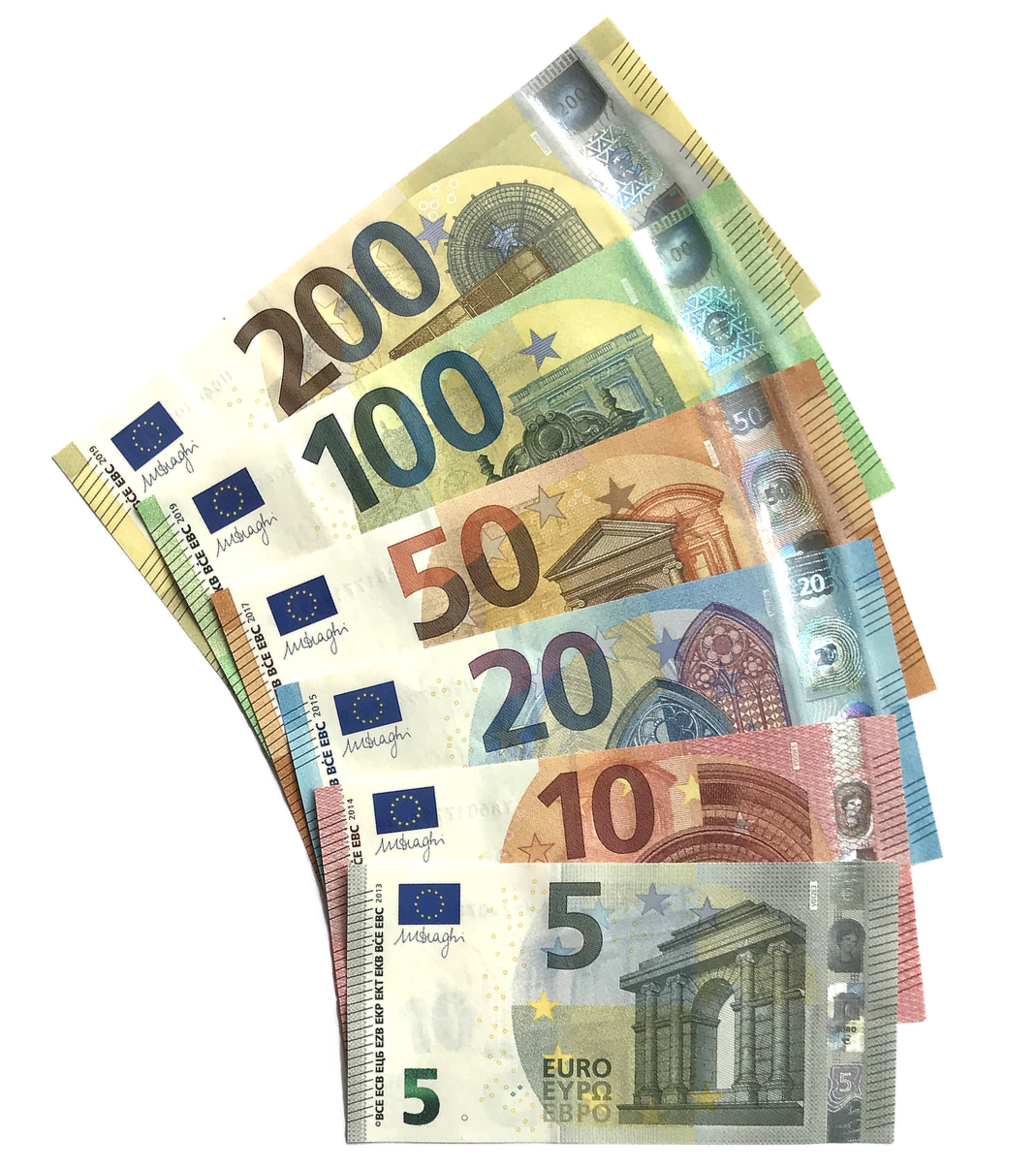
Depending on the denomination, they continued to be printed until 2019. Both series are legal tender in the eurozone.]]
Banknotes of the euro, the common currency of the eurozone (euro area members), have been in circulation since the first series (also called ES1) was issued in 2002. They are issued by the national central banks of the Eurosystem or the European Central Bank. The euro was established in 1999, but "for the first three years it was an invisible currency, used for accounting purposes only, e.g. in electronic payments". In 2002, notes and coins began to circulate. The euro rapidly took over from the former national currencies and slowly expanded around the European Union.
Denominations of the notes range from €5 to €500 and, unlike euro coins, the design is identical across the whole of the eurozone, although they are issued and printed in various member states. The euro banknotes are pure cotton fibre, which improves their durability as well as giving the banknotes a distinctive feel. They have a variety of color schemes and measure from 120 x to 160 x (first series) and from 120 x to 153 x (second series). The euro notes contain many complex security features such as watermarks, invisible ink characteristics, holograms, optically variable inks and microprinting that document their authenticity. While euro coins have a national side indicating the country of issue (although not necessarily of minting), euro notes lack this. Instead, this information is shown by the first character of each note's serial number.
According to European Central Bank estimates, in July 2023, there were about 29.624 billion banknotes in circulation around the eurozone, with a total value of about €1.569 trillion. On 8 November 2012, the ECB announced that the first series of notes would be replaced by the Europa series (also called ES2), starting with the 5 euro note. This series does not have a €500 note, as the ECB have decided to permanently cease its production over concerns that it could facilitate illicit activities.
Estimates suggest that the average life of a euro banknote is about three years before replacement due to wear, but with a wide variation by denomination level, from less than a year for €5 banknotes to over 30 years for €500 banknotes, on average. High denomination banknotes (€100, €200, €500) typically last longer as they are less frequently used. The Europa series lower denomination €5 and €10 banknotes are designed to last longer, thanks to additional coating.
History
Main article: History of the euro
The euro came into existence on 1 January 1999. The euro's creation had been a goal of the European Union (EU) and its predecessors since the 1960s. The Maastricht Treaty entered into force in 1993 with the goal of creating economic and monetary union by 1999 for all EU states except the UK and Denmark (though Denmark has a policy of a fixed exchange rate with the euro).
Though the currency was born virtually in 1999, notes and coins did not begin to circulate until 2002. The euro rapidly took over from the former national currencies and slowly expanded around the growing EU. In 2009, the Lisbon Treaty formalised the euro's political authority, the Eurogroup, alongside the European Central Bank.
Slovenia joined the eurozone in 2007, Cyprus and Malta in 2008, Slovakia in 2009, Estonia in 2011, Latvia in 2014, Lithuania in 2015, Croatia in 2023 and Bulgaria in 2026.
Specification
There are seven different denominations of euro banknotes: €5, €10, €20, €50, €100, €200, and €500. Each has a distinctive colour and size, and displays examples of a historical European architectural style: windows or gateways on the obverse, and bridges on the reverse. The architectural examples featured are stylised illustrations of the corresponding style, rather than representations of existing structures.
The euro banknotes are made of pure cotton fibre, which improves their durability as well as giving the banknotes a distinctive feel.
First series
The following table depicts the design characteristics of the 1st series (ES1) of euro notes.
| Image | Value | Year | Dimensions | ||||||||||||||||||||||
|---|---|---|---|---|---|---|---|---|---|---|---|---|---|---|---|---|---|---|---|---|---|---|---|---|---|
| (millimetres) | Main colour | Design | Printer code position | Issue | Issue suspended | Replacement | Status | Obverse | Reverse | Architecture | Century | [€5](5-euro-note)5 | [€10](10-euro-note)10 | [€20](20-euro-note)20 | [€50](50-euro-note)50 | [€100](100-euro-note)100 | [€200](200-euro-note)200 | [€500](500-euro-note)500 | |||||||
| [[File:EUR 5 obverse (2002 issue).jpg | border | 86px]] | [[File:EUR 5 reverse (2002 issue).jpg | border | 86px]] | 2002 | 120 × 62 mm | Grey | Classical | 8th BC–4th AD | Left image edge | 1 January 2002 | 10 January 2013 | 2 May 2013 | Current | ||||||||||
| [[File:EUR 10 obverse (2002 issue).jpg | border | 91px]] | [[File:EUR 10 reverse (2002 issue).jpg | border | 91px]] | 127 × 67 mm | Red | Romanesque | 11–12th | 8 o'clock star | 13 January 2014 | 23 September 2014 | |||||||||||||
| [[File:EUR 20 obverse (2002 issue).jpg | border | 95px]] | [[File:EUR 20 reverse (2002 issue).jpg | border | 95px]] | 133 × 72 mm | Blue | Gothic | 13–14th | 9 o'clock star | 24 February 2015 | 25 November 2015 | |||||||||||||
| [[File:EUR 50 obverse (2002 issue).jpg | border | 100px]] | [[File:EUR 50 reverse (2002 issue).jpg | border | 100px]] | 140 × 77 mm | Orange | Renaissance | 15–16th | Right image edge | 5 July 2016 | 4 April 2017 | |||||||||||||
| [[File:EUR 100 obverse (2002 issue).jpg | border | 105px]] | [[File:EUR 100 reverse (2002 issue).jpg | border | 105px]] | 147 × 82 mm | Green | Baroque and Rococo | 17–18th | Right of 9 o'clock star | 17 September 2018 | 28 May 2019 | |||||||||||||
| [[File:EUR 200 obverse (2002 issue).jpg | border | 109px]] | [[File:EUR 200 reverse (2002 issue).jpg | border | 109px]] | 153 × 82 mm | Yellow | Art Nouveau | 19th | Above 7 o'clock star | |||||||||||||||
| [[File:EUR 500 obverse (2002 issue).jpg | border | 114px]] | [[File:EUR 500 reverse (2002 issue).jpg | border | 114px]] | 160 × 82 mm | Purple | Modern architecture (20th century) | 20th | 9 o'clock star | 1 January 2019 | Last of denomination | Limited |
All the notes of the initial series of euro notes bear the European flag, a map of the continent on the reverse, the name "euro" in both Latin and Greek script (EURO / ΕΥΡΩ) and the signature of a president of the ECB, depending on when the banknote was printed. The 12 stars from the flag are also incorporated into every note.
The notes also carry the acronyms of the name of the European Central Bank in five linguistic variants, covering all official languages of the EU in 2002 (the time of the banknote introduction), and now 19 out of 24 official languages of the EU27, in the following order:
- BCE (, , , , )
- ECB (, , , )
- EZB ()
- ΕΚΤ ()
- EKP () The order is determined by the EU country listing order, with BCE ahead of ECB because of the national precedence of Belgium's two main languages, followed by the remaining languages of Germany and Austria (Deutschland, Österreich), Greece (Ελλάδα, el) and Finland (Suomi), in that order.
The initial designs for the banknotes were chosen from 44 proposals in a design competition, launched by the Council of the European Monetary Institute (EMI) on 12 February 1996. The winning entry, created by Robert Kalina from the Oesterreichische Nationalbank, was selected on 3 December 1996.
In the first and Europa series, the Azores, French Guiana, Guadeloupe, Madeira, alba, Réunion, and the Canary Islands, overseas territories of the eurozone member states, which also use the euro, were shown under the map in separate boxes. Cyprus and Malta were not shown on the first series because they were not in the EU in 2002, when the banknotes were issued, even though they joined the eurozone in 2008. The map did not stretch as far east as Cyprus, while Malta was too small to be depicted. Both Cyprus and Malta are however depicted on the Europa series note.
Second series
The following table depicts the design characteristics of the second series of euro banknotes (ES2), also known as the Europa series, after the holographic depiction of the mythological Europa common to these banknotes.
| Image | Value | Year | Dimensions | |||||||||||||||||||
|---|---|---|---|---|---|---|---|---|---|---|---|---|---|---|---|---|---|---|---|---|---|---|
| (millimetres) | Main colour | Design | Printer code position | Issue | Status | Obverse | Reverse | Architecture | Century | [€5](5-euro-note)5 | [€10](10-euro-note)10 | [€20](20-euro-note)20 | [€50](50-euro-note)50 | [€100](100-euro-note)100 | [€200](200-euro-note)200 | |||||||
| [[File:EUR 5 obverse (2013 issue).png | border | 86px]] | [[File:EUR 5 reverse (2013 issue).png | border | 86px]] | 2013 | 120 × 62 mm | Grey | Classical | 8th BC–4th AD | Top right | 2 May 2013 | Current | |||||||||
| [[File:EUR 10 obverse (2014 issue).png | border | 91px]] | [[File:EUR 10 reverse (2014 issue).png | border | 91px]] | 2014 | 127 × 67 mm | Red | Romanesque | 11–12th | 23 September 2014 | |||||||||||
| [[File:The Europa series 20 € obverse side.jpg | border | 95px]] | [[File:The Europa series 20 € reverse side.jpg | border | 95px]] | 2015 | 133 × 72 mm | Blue | Gothic | 13–14th | 25 November 2015 | |||||||||||
| [[File:The Europa series 50 € obverse side.png | border | 100px]] | [[File:The Europa series 50 € reverse side.png | border | 100px]] | 2017 | 140 × 77 mm | Orange | Renaissance | 15–16th | 4 April 2017 | |||||||||||
| [[File:The Europa series 100 € obverse side.jpg | border | 105px]] | [[File:The Europa series 100 € reverse side.jpg | border | 105px]] | 2019 | 147 × 77 mm | Green | Baroque & Rococo | 17–18th | 28 May 2019 | |||||||||||
| [[File:The Europa series 200 € obverse side.jpg | border | 109px]] | [[File:The Europa series 200 € reverse side.jpg | border | 109px]] | 153 × 77 mm | Yellow | Art Nouveau | 19th |
The Europa series banknotes, similarly to the first series, bear the European flag, a map of the continent on the reverse and the signature of Mario Draghi, since 1 November 2011 president of the ECB. The 12 stars from the flag are also incorporated into the notes. On 4 May 2016 the European Central Bank decided not to issue a 500 euro banknote for the Europa series.
The series also bears the name of the currency in capital letters, but in three scripts: Latin (EURO), Greek (ΕΥΡΩ), and Cyrillic (ЕВРО).
The 2nd series €100 and €200 notes are a different size to the €100 and €200 notes from the 1st series. Both denominations are now the same height (77 mm) as the €50 banknote, which makes them more comfortable to use. Their length remains unchanged.
The design for the 50, 100 and 200 euro notes features the acronyms of the name of the European Central Bank in ten linguistic variants, covering all official languages of the European Union, in the following order:
- BCE (, , , , , )
- ECB (, , , , , , , , )
- ЕЦБ ()
- EZB ()
- EKP (, )
- ΕΚΤ ()
- ESB ()
- EKB ()
- BĊE ()
- EBC () The 5 euro, 10 euro and 20 euro notes do not feature ESB, as Croatian became an official language only in July 2013 with the accession of Croatia, after the introduction of the banknote design earlier that year. The order in which the acronyms are shown is determined by the same principles as for Series 1: the language of Bulgaria (България/Bulgaria) precedes that of Germany (Deutschland); EKP now precedes ΕΚΤ due to the accession of Estonia (Eesti); and the languages of Croatia (Hrvatska), Hungary (Magyarország), Malta and Poland (Polska) trail the list.
The notes of the Europa series do not show the same year. The year shown is the year the note is issued.
Reinhold Gerstetter, an independent banknote designer (and one of participants of the 1996 design contest), was chosen by the European Central Bank to redesign the euro notes.
The Europa series euro banknotes are supposedly more durable than the first series banknotes.
Design
Bridges


Due to the great number of historic bridges, arches, and gateways throughout the European continent, all the structures represented on the notes are entirely stylized illustrations of the relevant architectural styles, designed to evoke the landmarks within the European Union, representing various European ages and styles. For example, the 5 euro note has a generic rendition of Classical architecture, the 10 euro note of Romanesque architecture, the 20 euro note of Gothic architecture, the 50 euro note of the Renaissance, the 100 euro note of Baroque and Rococo, the 200 euro note of Art Nouveau and the 500 euro note of modern architecture. The initial designs by Robert Kalina were of actual bridges, including the Rialto Bridge in Venice and the Pont de Neuilly in Paris, and were subsequently rendered more generic. In 2011, Dutch artist Robin Stam and the town of Spijkenisse in the Netherlands built seven bridges of colored concrete after the designs on the seven euro banknotes.
Signature
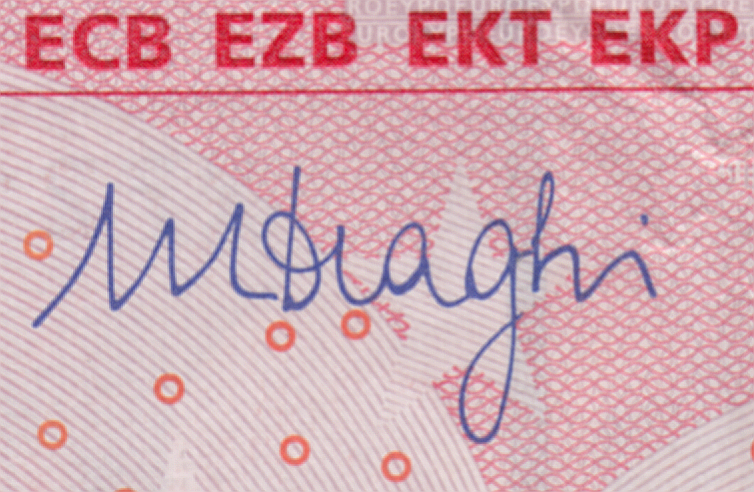
The euro banknotes bear the signature of the President of the European Central Bank.
Wim Duisenberg was the first ECB president when the first euro banknotes and coins were issued until 2003. Notes printed between November 2003 and March 2012 show the signature of Jean-Claude Trichet, the second President of the ECB. Banknotes printed after March 2012 bear the signature of the third ECB President Mario Draghi.
From 2020, Christine Lagarde's signature would gradually begin to appear on banknotes entering circulation, becoming the fourth signature to appear on euro banknotes.
As a curiosity, the five euro banknotes of the first series did not bear the signature of Mario Draghi, despite the fact that his mandate began on 1 November 2011 and the design of the five euro banknotes of the second series is from January 2013.
Security features

The European Central Bank has described some of the basic security features of the euro notes that allow the general public to recognise the authenticity of their currency at a glance:
- For the first series: the firm and crisp paper, the raised print, the watermark, the security thread, the see-through number, the hologram, the micro-perforations, the glossy stripe for €20 and below, the color-changing number for €50 and above, UV light, infrared and the microprint.
- For the Europa series: the firm and crisp paper, the raised print, the portrait watermark, the security thread, the emerald number, the portrait hologram, UV and UV-C, infrared and the microprint. However, in the interest of advanced security of the euro notes, the full list of these features is a closely guarded secret of the European Central Bank and the National Central Banks of the Eurosystem.

Still, between the official descriptions and independent discoveries made by observant users, it is thought that the euro notes have at least eleven different security features, which are:
- Holograms – The lower value notes carry a holographic band to the right of the obverse. This band contains the denomination, the euro sign, the stars of the EU flag and perforations in the shape of the euro sign. In the Europa series €5 banknote, there is Europa, a gate, 'EURO' and the euro sign, the number 5 and perforations in the shape of a euro sign. The higher-value notes include a holographic decal containing the denomination, the obverse illustration, microprinting, and perforations in the shape of the euro sign.
- Variable colour ink – This appears on the lower right-hand side corner of the reverse of the higher-value notes. When observed from different angles, the colour will change from purple to olive green or brown. This special ink is also on the left bottom on the Europa series notes.
- Checksum – Each note has a unique serial number. The remainder from dividing the serial number by 9 gives checksum corresponding to the initial letter indicated on the note. Using a variation of the divisibility rule shortcut, the remainder from division by 9 can easily be found by adding the constituent digits and, if the sum still does not make the remainder obvious, adding the digits of the sum. Alternatively, substituting the letter with its ASCII value makes the resulting number exactly divisible by 9. Taking the same example, Z10708476264, the ASCII code for Z is 90, so the resulting number is 9010708476264. Dividing by 9 yields a remainder of 0. Using the divisibility rule again, the result can be checked speedily since the addition of all digits gives 54; 5 + 4 = 9—so the number is divisible by 9, or 9010708476264 modulo 9 is 0.
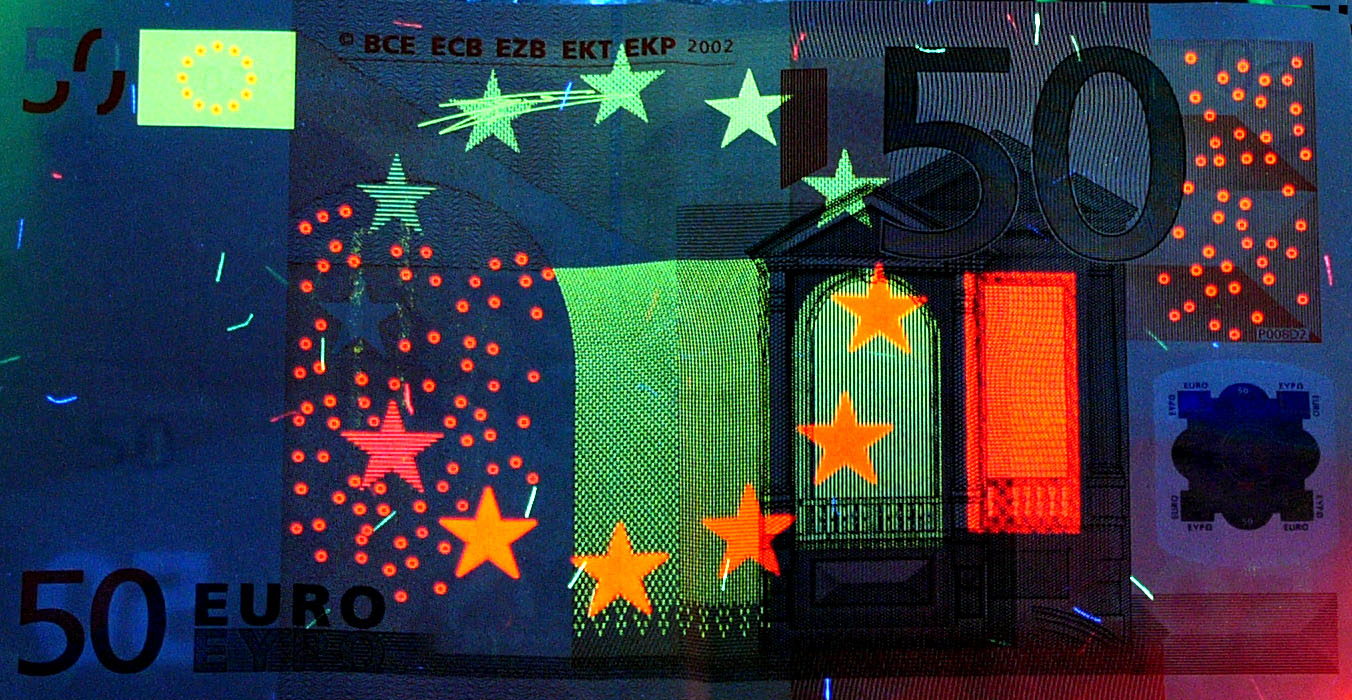
- EURion constellation – Euro banknotes contain a pattern known as the EURion constellation that can be used to detect their identity as banknotes to prevent copying and counterfeiting. Some photocopiers are programmed to reject images containing this pattern.
- Watermarks – There are possibly two watermarks on the euro notes. They are:
- Standard watermark – Each denomination is printed on uniquely watermarked paper. This may be observed by holding the note up to the light. The thinner parts will show up brighter with backlight illumination and darker with a dark background. In the first series, the standard watermark is a gate/window that is depicted on the note and the denomination, for the €5 of the Europa series, it is the face of Europa and the denomination as well.
- Digital watermark – Like the EURion constellation, a Digimarc digital watermark is embedded in the banknotes' designs. Recent versions of image editors, such as Adobe Photoshop or Paint Shop Pro refuse to process banknotes. This system is called Counterfeit Deterrence System (CDS) and was developed by the Central Bank Counterfeit Deterrence Group.
- Infrared and fluorescent printing patterns – When seen in the near infrared, the banknotes will show darker areas in different zones depending on the denomination. Ultraviolet light will make the EURion constellation show in sharper contrast, and also some fluorescent fibres stand out.
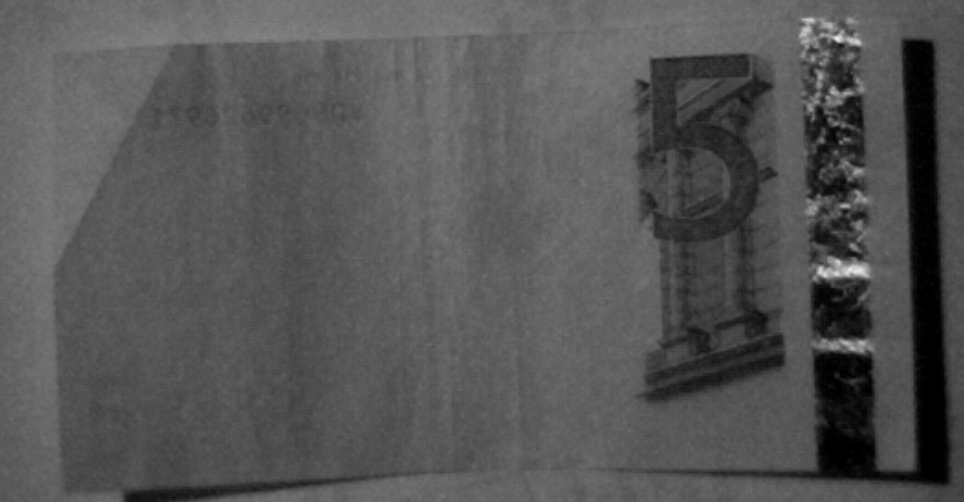
- Security thread – A black magnetic thread in the centre of the note is only seen when held up to the light. It features the denomination of the note, along with the word "euro" in the Latin alphabet and the Greek alphabet.
- Magnetic ink – Some areas of the euro notes feature magnetic ink. For example, the rightmost church window on the €20 note is magnetic, as well as the large zero above it.
.jpg)
- Microprinting – The texture lines to the bottom, like those aligned to the right of ΕΥΡΩ mark on the €5 note, consist of the sequence "EURO ΕΥΡΩ" in microprinting.
- Matted surface – The euro sign and the denomination are printed on a vertical band that is only visible when illuminated at an angle of 45°. This only exists for the lower-value notes.
- Raised print – On every banknote, the initials of the ECB are in raised print. In the first series, every banknote has a bar with raised print lines. On the €200 note of the first series, there are lines at the bottom which are raised to allow blind people to identify the note. On the €500 note of the first series, these lines are on the right-hand side. On the Europa series, there are lines on both sides of the banknote.
- Bar code – When held up to the light, dark bars can be seen to the right of the watermark. The number and width of these bars indicates the denomination of the note. When scanned, these bars are converted to Manchester code.
| Note | Barcode | Manchester | |
|---|---|---|---|
| €5 | 0110 10 | 100 | |
| €10 | 0101 10 | 110 | |
| €20 | 1010 1010 | 0000 | |
| €50 | 0110 1010 | 1000 | |
| €100 | 0101 1010 | 1100 | |
| €200 | 0101 0110 | 1110 | |
| €500 | 0101 0101 | 1111 |
(looked at from the reverse, a dark bar is 1, a bright bar 0)
Europa series
The European Central Bank intends to redesign the notes every seven or eight years. A new series, called the "Europa series", was released from 2013; the first notes entered circulation on 2 May 2013. The new series includes slight changes, notably the inclusion of the face of the mythological princess Europa in the watermark and in the hologram stripe.
New production and anti-counterfeiting techniques are employed on the new notes, but the design shares the colours of the first series and the theme of bridges and arches. The new notes are nonetheless recognisable as a new series.
The new notes also reflect the expansion of the European Union: every member of the EU is depicted on it. The initial series did not include the recent members Cyprus and Malta (Cyprus was off the map to the east and Malta was too small to be depicted.)
The Bulgarian Cyrillic alphabet features on the Europa series banknotes, as a result of Bulgaria joining the European Union in 2007. Thus this series includes "ЕВРО", which is the Bulgarian spelling for EURO, as well as the abbreviation "ЕЦБ" (short for Европейска централна банка in Bulgarian), with Bulgaria scheduled to join the eurozone and abandon the Bulgarian lev in 2026. The new banknotes also feature the Maltese abbreviation BĊE (Bank Ċentrali Ewropew), the Hungarian abbreviation EKB (Európai Központi Bank) and the Polish abbreviation EBC (Europejski Bank Centralny). The modified 5 euro note features the initials of the European Central Bank in each of the contemporary EU member languages in a column on the left-hand side of the obverse. The word "euro" in Latin, Greek, and Cyrillic lettering has also been moved to a more central position.
The full design of the Europa series 5 euro banknote was revealed on 10 January 2013. The new note entered circulation on 2 May 2013. The full design of the Europa series 10 euro note was revealed on 13 January 2014 and it entered circulation on 23 September 2014. The full design of the Europa series 20 euro banknote was revealed on 24 February 2015, and it was launched on 25 November 2015. The full design of the Europa series 50 euro note was revealed on 5 July 2016 and the new 50 note was released on 4 April 2017. The full design of the Europa series 100 euro banknote and 200 euro banknote was revealed on 17 September 2018 and the new notes entered circulation on 28 May 2019 therefore "will complete the issuance of the Europa series."
On 4 May 2016, the European Central Bank announced that a Europa series 500 euro banknote would not be released, due to fears of facilitating criminal activity. "The ECB has decided to stop producing the €500 banknote, although the first series €500 remains legal tender."
The old series will gradually be withdrawn. The ECB will announce "well in advance" when the old notes will lose their legal tender status. However, they will not lose their value and it will be possible to exchange them for new notes at Eurosystem central banks indefinitely.
Security features

- Watermark: When the note is held under a normal light source, a portrait of Europa and an electrotype denomination appear on either side.
- Portrait hologram: When the note is tilted, the silver-coloured holographic stripe reveals the portrait of Europa – the same one as in the watermark. The stripe also reveals a window and the value of the banknote.
- Colour changing ink: When the note is tilted, the number on the note displays an effect of light that moves up and down. The number also changes colour from emerald green to deep blue.
- Raised printing: On the front of the note, there is a series of short raised lines on the left and right edges. The main edge, the lettering and the large value numeral also feel thicker.
- Security thread: When the note is held against the light, the security thread appears as a dark line. The euro symbol (€) and the value of the banknote can be seen in tiny white lettering in the thread.
- Microprinting: Tiny letters which can be read with a magnifying glass. The letters should be sharp, not blurred.
- Ultraviolet ink: Some parts of the banknote shine when under UV or UV-C light. These are the stars in the flag, the small circles, the large stars and several other areas on the front. On the back, a quarter of a circle in the centre as well as several other areas glow green. The horizontal serial number and a stripe appear in red.
- Infrared light: Under infrared light, the emerald number, the right side of the main image and the silvery stripe are visible on the obverse of the banknote, while on the reverse, only the denomination and the horizontal serial number are visible.
- Glossy stripe: On the back side, over the map of Europe. Depending on the viewing angle, the glossy stripe appears golden or is nearly invisible.
Features for people with impaired sight
"A good design for the blind and partially sighted is a good design for everybody" was the principle behind the cooperation of the European Central Bank and the European Blind Union during the design phase of the first series banknotes in the 1990s. As a result, the design of the first euro banknotes include several characteristics which help both the blind and partially sighted to use the notes with greater confidence.
Features for blind and visually impaired users include:
- Different banknote sizes – the bigger the value, the larger the note.
- Clearly contrasting, striking banknote colours. The €5 note is grey, the €10 note red, the €20 note blue, the €50 note orange, the €100 note green, the €200 note yellow-brown and the €500 note is purple.
- Large numerals for the denomination.
- Raised print.
- Tactile marks on the €200 and €500 of the first series and on all the notes of the Europa series.
As in the design process of the first series of euro notes, visually impaired users were consulted during the design phase of the Europa series, and their feedback included in the final designs.
New series and plans for a redesign
On 6 December 2021, the ECB announced its intention to redesign the banknotes. ECB President Christine Lagarde stated in a press release that it was time to "review the look of [the] banknotes and make them more relatable to the public".
A 19-member advisory board, with one member from each eurozone member state, was appointed and tasked with proposing a shortlist of themes for the new banknotes. On 30 November 2023, the ECB announced that the new theme for future banknotes had been narrowed down to either "European culture" or "rivers and birds". On 31 January 2025, the ECB's Governing Council selected motifs for the two possible themes.
| Value | Concept | Obverse | Reverse | [€5](5-euro-note) | [€10](10-euro-note) | [€20](20-euro-note) | [€50](50-euro-note) | [€100](100-euro-note) | [€200](200-euro-note) | ||
|---|---|---|---|---|---|---|---|---|---|---|---|
| Performing arts | Maria Callas | [[File:Maria Callas 1958 (cropped).jpg | 90px]] | Buskers | [[File:Street musicians Plëss.jpg | 120px]] | |||||
| Music | Ludwig van Beethoven | [[File:Beethoven.jpg | 90px]] | Choir performing at a song festival | [[File:Public opening event of EU2017EE Performers (35615133625).jpg | 120px]] | |||||
| Universities and schools | Marie Curie (born Skłodowska) | [[File:Marie Curie (Nobel-Chem).jpg | 90px]] | Teacher and students in a classroom | [[File:Froken seth 3rd grade matteus skola.jpg | 120px]] | |||||
| Libraries | Miguel de Cervantes | [[File:Cervantes Jáuregui.jpg | 90px]] | Library with patrons reading physical | |||||||
| and digital books | [[File:056 Biblioteca Pública Arús, pg. de Sant Joan 26 (Barcelona), sala d'exposicions.jpg | 120px]] | |||||||||
| Museums and exhibitions | Leonardo da Vinci | [[File:Possible Self-Portrait of Leonardo da Vinci.jpg | 90px]] | People admiring street art and contemporary art | [[File:2011-09-17 UrbanArt10.jpg | 120px]] | |||||
| Public squares | Bertha von Suttner | [[File:Bertha von Suttner nobel.jpg | 90px]] | People in a public square with trees | [[File:Place d'Armes Luxembourg.jpg | 120px]] |
| Value | Obverse | Reverse | [€5](5-euro-note) | [€10](10-euro-note) | [€20](20-euro-note) | [€50](50-euro-note) | [€100](100-euro-note) | [€200](200-euro-note) | ||
|---|---|---|---|---|---|---|---|---|---|---|
| Wallcreeper with mountain spring | [[File:Tichodroma muraria02 cropped.jpg | 120px]] | European Parliament | [[File:Drapeaux du parlement européen, Strasbourg juillet 2019.jpg | 120px]] | |||||
| Kingfisher by a waterfall | [[File:Common_kingfishers_(Alcedo_atthis_ispida)_male_passing_fish_to_female.jpg | 120px]] | European Commission | [[File:Belgique - Bruxelles - Schuman - Berlaymont - 01.jpg | 120px]] | |||||
| Bee-eater colony along a river in a valley | [[File:019 Stacked images of an European Bee-eater in flight Photo by Giles Laurent.jpg | 120px]] | European Central Bank | [[File:Europäische Zentralbank - European Central Bank (19190136328).jpg | 120px]] | |||||
| White stork flying over a meandering river | [[File:White Stork (Ciconia ciconia) (4).jpg | 120px]] | Court of Justice of the European Union | [[File:Sign in front of the CJEU complex March 2023.png | 120px]] | |||||
| Avocet over a mudflat at a river mouth | [[File:Avocette élégante Thyna020.jpg | 120px]] | European Council and Council of the European Union | [[File:Europa building February 2016 (cropped).jpg | 120px]] | |||||
| Northern gannet over the ocean | [[File:Basstoelpel (Morus bassanus) Helgoland 1 (DSC 6996).jpg | 120px]] | European Court of Auditors | [[File:ECA building.jpg | 120px]] |
The ECB's choice to use the working form "Marie Curie (born Skłodowska)" in their communication led to criticism from some Polish commentators, who argued that the decision to include Curie's Polish maiden name only between parentheses represented a lack of recognition for Poland's contributions to European history. In response, a spokesperson for the ECB called the form used a "draft" and stated that the institution would take the name dispute into account, consulting "various historical and linguistic sources" ; during her life, Curie variously used "Skłodowska-Curie" and "M. Curie" when signing papers. She has previously appeared on French and Polish currency, respectively on the 500 franc banknote and 50-euro cent coin (as Marie Curie) and on the 20 000 złoty banknote (as Maria Skłodowska-Curie).
The ECB launched a public contest for the redesign on 15 July 2025, opening applications to EU-based graphic designers. Successful candidates, who were selected in September 2025, will have until March 2026 to submit design proposals, after which a jury will shortlist up to five designs per theme, with the selection taking place by June of that year. After receiving feedback from the public, the ECB's governing council will decide on the final design by the end of 2026. Plans for the timing of introduction, and possible phaseout of older banknotes, have not been announced, though Lagarde stated in an interview that the new banknotes would "see the light of day" by 2028.
Circulation
The European Central Bank closely monitors the circulation and stock of euro coins and banknotes. It is a task of the Eurosystem to ensure an efficient and smooth supply of euro notes and to maintain their integrity throughout the eurozone.
Statistics

As of April 2025, there were about 30 billion banknotes in circulation around the eurozone, totaling about €1,578 billion worth of banknotes.
| Note | Quantity | Value (€) | Share of total (%) | Quantity | Value | €5 | €10 | €20 | €50 | €100 | €200 | €500 | Total |
|---|---|---|---|---|---|---|---|---|---|---|---|---|---|
| 2,244,172,329 | 11,220,861,645 | 7.4 | 0.7 | ||||||||||
| 3,067,171,673 | 30,671,716,730 | 10.2 | 1.9 | ||||||||||
| 4,794,514,991 | 95,890,299,820 | 15.9 | 6.1 | ||||||||||
| 14,904,867,170 | 745,243,358,500 | 49.4 | 47.2 | ||||||||||
| 4,104,365,734 | 410,436,573,400 | 13.6 | 26.0 | ||||||||||
| 857,634,995 | 171,526,999,000 | 2.8 | 10.9 | ||||||||||
| 226,864,870 | 113,432,435,000 | 0.8 | 7.2 | ||||||||||
| 30,199,591,762 | 1,578,422,244,095 | 100 | 100 |
Figures since 2012
| Date | Banknotes | ||||||||||
|---|---|---|---|---|---|---|---|---|---|---|---|
| (millions) | Value | ||||||||||
| (€ billions) | December 2012 | December 2013 | December 2014 | December 2015 | December 2016 | December 2017 | December 2018 | December 2019 | December 2020 | December 2021 | December 2022 |
Counterfeiting
The European Central Bank publishes information on the amount of counterfeit banknotes removed from circulation every 6 months. In 2009, the ECB reported the highest-ever amount of counterfeits with 860,000 removed items, a rate of 64 per million banknotes in circulation. According to an investigation of the University of Lausanne, the ratio of counterfeited banknotes was about 10 in one million real banknotes for the Swiss franc, of 100 in one million for United States dollar and of 300 in one million for pound sterling.
In 2011, 606,000 euro counterfeits were removed from circulation (41 per million). In 2012, it was lower at 531,000 euro counterfeits (34 per million). In 2014, the ECB removed 838,000 counterfeit euro banknotes from circulation (48 per million). Since then, these values have continuously decreased, mainly due to the improved security features of the Europa series.
In 2021, 347,000 euro counterfeits were seized, equivalent to a rate of 12 counterfeits per million banknotes in circulation. The majority of counterfeit items were €50 (33.8%) and €20 (32.1%) banknotes.
In 2024, the amount of counterfeit banknotes was still on a relative low, after a sharp decrease due to the COVID-19 pandemic. The central bank states that "Most counterfeits are easy to detect as they have no, or only very poor, imitations of security features." This, together with the gradual decline after 2013 suggests that the improved security features on the Europa edition make it increasingly difficult to create a convincing fake.
Legal information
Legally, both the European Central Bank and the national central banks (NCBs) of the eurozone countries have the right to issue the seven different euro banknotes. In practice, only the NCBs of the zone physically issue and withdraw euro notes. The European Central Bank does not have a cash office and is not involved in any cash operations. However, the European Central Bank is responsible for overseeing the activities of national central banks in order to harmonise cash services in the eurozone.
Issuance and printing
The ECB has the exclusive right to authorise the issue of notes within the eurozone, but most notes are actually issued by the National Central Banks (NCBs) of the eurozone. As of 2004, 8% of banknotes issues were allocated to the European Central Bank and 92% were allocated to eurozone NCBs (in practice, the ECB issues no notes and the NCBs' issues may deviate from the statutory allocation). The issuing central bank can be seen on the banknote serial number. Each NCB is now responsible for the production of certain denominations, as assigned by the ECB.
1st series
Since 2002, euro notes have been printed by the National Central Banks of the Eurosystem, with each Central Bank being responsible for and bearing the cost of producing a proportion of the notes. The production of notes needs to be sufficient to meet expected and unexpected surges in demand and to replace unfit notes. Production volumes are forecast jointly by the National Central Banks and the European Central Bank, and it needs to be approved by the Governing Council of the ECB.
Printing works

There is a six-character printing code on every euro banknote which gives the printer of the note. These printing codes have an initial letter, followed by three digits, then by a single letter, and ending in a digit, for example, "R001A1".
The initial letter identifies the printing facility (the facilities are described below): "R" for example would be Bundesdruckerei, a printer in Berlin, Germany. The three digits state sequential printing plates: "001", for example, would be the first printing plate created by the printer. The fifth and sixth characters, a letter followed by a number, represent the row and column, respectively, of the particular banknote on the particular plate: "A" would be the first row and "1" the first column.
Banknotes are printed in sheets. Different printers use different sheet sizes and sheets of higher denominations, which are larger in size, would have fewer notes printed per sheet. For example, two German printers print €5 banknotes in sheets of 60 (10 rows, designated "A" to "J" and six columns), the sheets of €10 notes have 54 banknotes (nine rows, six columns), and €20 banknotes are printed in sheets of 45 banknotes (nine rows, five columns).
The printer code does not need to be the same as the country code, i.e. notes issued by a particular country may have been printed in another country. The printers used to print euro banknotes include commercial printers as well as national printers, some of which have been privatised, some previously produced national notes before the adoption of the euro. There is one former or current national printer in each of the countries which issue euro notes, with the exception of Germany, where the former East German and West German printers now produce euro notes. France also has two printers, F. C. Oberthur (a private printer) and the printing works of the Bank of France, and two more in the United Kingdom: Thomas De La Rue (another private printer) and the Bank of England printing house, although the latter does not produce euro banknotes.
| Code | Printer | Location | Country | NCB(s) produced for |
|---|---|---|---|---|
| (Bank of England Printing Works) | (Loughton) | (United Kingdom) | — | |
| Unassigned | ||||
| (Tumba Bruk) | (Tumba) | (Sweden) | — | |
| Setec Oy | Vantaa | Finland | L (Finland Finland) | |
| F. C. Oberthur | Chantepie | France | E (Slovakia Slovakia), F (Malta Malta), G (Cyprus Cyprus), H (Slovenia Slovenia), L (Finland Finland), P (Netherlands Netherlands), U (France France), X (Germany Germany) | |
| Österreichische Banknoten‐ und Sicherheitsdruck GmbH | Vienna | Austria | N (Austria Austria), P (Netherlands Netherlands), S (Italy Italy), T (Ireland Ireland), Y (Greece Greece) | |
| Koninklijke Joh. Enschedé | Haarlem | Netherlands | E (Slovakia Slovakia), F (Malta Malta), G (Cyprus Cyprus), H (Slovenia Slovenia), L (Finland Finland), N (Austria Austria), P (Netherlands Netherlands), V (Spain Spain), X (Germany Germany), Y (Greece Greece) | |
| De La Rue | Gateshead | United Kingdom | L (Finland Finland), M (Portugal Portugal), P (Netherlands Netherlands), T (Ireland Ireland) | |
| Unassigned | ||||
| Banca d'Italia | Rome | Italy | S (Italy Italy) | |
| *Banc Ceannais na hÉireann* / Central Bank of Ireland | Dublin | Ireland | T (Ireland Ireland) | |
| Banque de France | Chamalières | France | U (France France) | |
| Fábrica Nacional de Moneda y Timbre | Madrid | Spain | V (Spain Spain) | |
| Bank of Greece | Athens | Greece | Y (Greece Greece) | |
| Unassigned | ||||
| Giesecke & Devrient | Munich & Leipzig | Germany | L (Finland Finland), M (Portugal Portugal), P (Netherlands Netherlands), U (France France), V (Spain Spain), X (Germany Germany), Y (Greece Greece) | |
| Unassigned | ||||
| Bundesdruckerei | Berlin | Germany | D (Estonia Estonia), E (Slovakia Slovakia), F (Malta Malta), G (Cyprus Cyprus), H (Slovenia Slovenia), L (Finland Finland), P (Netherlands Netherlands), X (Germany Germany), Y (Greece Greece) | |
| (Danmarks Nationalbank) | (Copenhagen) | (Denmark) | — | |
| National Bank of Belgium | Brussels | Belgium | U (France France), V (Spain Spain), Z (Belgium Belgium) | |
| Valora—Banco de Portugal | Carregado | Portugal | M (Portugal Portugal) | |
| Unassigned |
- The A, C and S codes have been reserved for the British, Swedish and Danish printers not printing euro banknotes.
- Where a printer is listed as producing banknotes for a particular country, this may apply to a single denomination, or as many as all seven denominations. Some NCBs source different denominations from different printers, and some source even a single denomination from multiple printers. NCBs that issue banknotes are free to source from any authorized printers, and do so in varying quantities.
Serial number
Unlike euro coins, euro notes do not have a national side indicating which country issued them. The country that issued them is not necessarily where they were printed. The information about the issuing country is encoded within the first character of each note's serial number instead.
The first character of the serial number is a letter which uniquely identifies the country that issues the note. The remaining 11 characters are numbers which, when their digital root is calculated, give a checksum also particular to that country.
The W, K and J codes have been reserved for the three EU member states that did not adopt the euro in 1999, while the R prefix is reserved for Luxembourg, which, at present, does not issue euro banknotes. The first series of uncirculated notes from Luxembourg use the prefix belonging to the country where they were printed.
| Code | Country | Checksum(1) | in English | in official language(s) |
|---|---|---|---|---|
| **A** | Unassigned | |||
| **B** | Lithuania | Lietuva | ||
| **C** | Latvia | Latvija | ||
| **D** | Estonia | Eesti | 4 | |
| **E** | Slovakia | Slovensko | 3 | |
| **F** | Malta | Malta | 2 | |
| **G** | Cyprus | Κύπρος [Kypros]/Kıbrıs | 1 | |
| **H** | Slovenia | Slovenija | 9 | |
| **I** | Unassigned | |||
| **J**(2) | United Kingdom | United Kingdom | 7 | |
| **K**(2) | Sweden | Sverige | 6 | |
| **L** | Finland | Suomi/Finland | 5 | |
| **M** | Portugal | Portugal | 4 | |
| **N** | Austria | Österreich | 3 | |
| **O** | Unassigned | |||
| **P** | Netherlands | Nederland | 1 | |
| **Q** | Unassigned | |||
| **R** | Luxembourg | Lëtzebuerg/Luxembourg/Luxemburg | 8 | |
| **S** | Italy | Italia | 7 | |
| **T** | Ireland | Ireland | 6 | |
| **U** | France | France | 5 | |
| **V** | Spain | España | 4 | |
| **W**(2) | Denmark | Danmark | 3 | |
| **X** | Germany | Deutschland | 2 | |
| **Y** | Greece | Ελλάδα [Ellada] | 1 | |
| **Z** | Belgium | België/Belgique/Belgien | 9 |
(1) checksum of the 11 digits without the letter
(2) Denmark, the United Kingdom and Sweden presently do not use the Euro, but had these serial number prefixes reserved for the first series of notes.
Although the Slovenian letter had been reserved since the eurozone enlargement in January 2007, the country initially used previously issued banknotes issued from other member states. The first banknotes bearing the "H" letter, produced in France specifically on behalf of Slovenia, were witnessed no sooner than April 2008. The 'Cypriot banknotes' (G) appeared in circulation in November 2009, whereas, those from Malta (F) appeared 3 months later (February 2010). Slovak notes (E) first appeared in October 2010 .
2nd series
In the new series, there are two codes, like in the first series. They are the printer code in the top right hand corner and the serial number. Part of the serial number is horizontal and part of it is vertical. The serial number begins with a letter indicating the printer, which is broadly similar to the first series (Z for Belgium, Y for Greece, etc.). The second letter of the new serial numbers is part of the serial number itself, and has no further significance.
However, as the code indicates the printer, rather than the issuing national central bank, certain letters have been reassigned from NCBs which do not maintain their own printing facilities. In the first series, H denoted Slovenia. As there is no Slovene printer of euro banknotes, H represents De La Rue (Loughton) in the second series. Several of the printers which replaced what were NCB codes maintain their printing code from the first series (De La Rue, mentioned, and Bundesdruckerei, which replaced Luxembourg as R, its previous printing code).
| Code | Printer | Country |
|---|---|---|
| **A** | Unassigned | |
| **B** | ||
| **C** | ||
| **D** | Polska Wytwórnia Papierów Wartościowych | Poland |
| **E** | Oberthur | France |
| **F** | Oberthur Fiduciaire AD Bulgaria | Bulgaria |
| **G** | Unassigned | |
| **H** | De La Rue (Loughton) | UK |
| **I** | Omitted | |
| **J** | De La Rue (Gateshead) | UK |
| **K** | Unassigned | |
| **L** | ||
| **M** | Valora | Portugal |
| **N** | Oesterreichische Banknoten‐ und Sicherheitsdruck GmbH | Austria |
| **O** | Omitted | |
| **P** | Joh. Enschedé | Netherlands |
| **Q** | Omitted | |
| **R** | Bundesdruckerei | Germany |
| **S** | Banca d'Italia | Italy |
| **T** | Central Bank of Ireland | Ireland |
| **U** | Banque de France | France |
| **V** | IMBISA (owned by Banco de España) | Spain |
| **W** | Giesecke+Devrient (Leipzig) | Germany |
| **X** | Giesecke+Devrient (Munich) | |
| **Y** | Bank of Greece | Greece |
| **Z** | Nationale Bank van België/Banque Nationale de Belgique | Belgium |
Production statistics
The European Central Bank publishes details about euro notes produced every year.
| Denomination | Quantity (millions) | Value (€ millions) | NCBs commissioning production | €5 | €10 | €20 | €50 | €100 | €200 | €500 | TOTAL |
|---|---|---|---|---|---|---|---|---|---|---|---|
| 500.9 | 2,504.5 | Belgium, Greece, Austria, Portugal | |||||||||
| 488.2 | 4,881.5 | Estonia, Ireland, Cyprus, Luxembourg, Malta, Netherlands, Slovenia, Slovakia, Finland | |||||||||
| 563.5 | 11,269.6 | Bulgaria, Germany, Croatia, Italy, Latvia, Lithuania | |||||||||
| 1,089.8 | 54,492.0 | Spain, France, Italy | |||||||||
| 469.3 | 46,929.0 | Germany | |||||||||
| — | |||||||||||
| — | |||||||||||
| 3,111.7 | 120,076.6 |
| Denomination | Quantity (millions) | Value (€ millions) | NCBs commissioning production | €5 | €10 | €20 | €50 | €100 | €200 | €500 | TOTAL |
|---|---|---|---|---|---|---|---|---|---|---|---|
| 500.1 | 2,500.6 | Belgium, Greece, France, Austria, Portugal | |||||||||
| 575.8 | 5,757.7 | Germany, Spain | |||||||||
| 297.5 | 5,949.0 | France, Italy | |||||||||
| 326.6 | 16,332.0 | Estonia, Ireland, Italy, Cyprus, Luxembourg, Malta, Netherlands, Slovenia, Slovakia, Finland | |||||||||
| 254.9 | 25,489.0 | Germany, Croatia, Latvia, Lithuania | |||||||||
| — | |||||||||||
| — | |||||||||||
| 1,954.9 | 56,028.3 |
| Denomination | Quantity (millions) | Value (€ millions) | NCBs commissioning production | €5 | €10 | €20 | €50 | €100 | €200 | €500 | TOTAL |
|---|---|---|---|---|---|---|---|---|---|---|---|
| 495.0 | 2,475.2 | Greece, Spain | |||||||||
| 1016.4 | 10,164.1 | Belgium, Germany, Croatia, Latvia, Lithuania, Austria, Portugal | |||||||||
| 1,267.1 | 25,341.2 | Germany, Estonia, Ireland, France, Italy, Cyprus, Luxembourg, Malta, Netherlands, Slovenia, Slovakia, Finland | |||||||||
| 643.0 | 32,149.0 | Spain, France, Italy | |||||||||
| — | |||||||||||
| — | |||||||||||
| — | |||||||||||
| 3,421.5 | 70,129.5 |
| Denomination | Quantity (millions) | Value (€ millions) | NCBs commissioning production | €5 | €10 | €20 | €50 | €100 | €200 | €500 | TOTAL |
|---|---|---|---|---|---|---|---|---|---|---|---|
| 313.8 | 1,568.9 | Greece, Spain | |||||||||
| 424.2 | 4,241.5 | Spain | |||||||||
| 564.9 | 11,297.6 | Belgium, Germany, Croatia, Latvia, Lithuania, Austria, Portugal | |||||||||
| 1,538.4 | 76,920.0 | Estonia, Ireland, France, Italy, Cyprus, Luxembourg, Malta, Netherlands, Slovenia, Slovakia, Finland | |||||||||
| 527.5 | 52,751.0 | Germany | |||||||||
| 164.2 | 32,846.0 | ||||||||||
| — | |||||||||||
| 3,533.0 | 179,625.0 |
| Denomination | Quantity (millions) | Value (€ millions) | NCBs commissioning production | €5 | €10 | €20 | €50 | €100 | €200 | €500 | TOTAL |
|---|---|---|---|---|---|---|---|---|---|---|---|
| 131.7 | 658.5 | Greece | |||||||||
| — | |||||||||||
| 985.0 | 19,700.0 | Belgium, Germany, Italy, Latvia, Lithuania, Austria, Portugal | |||||||||
| 1,645.0 | 82,250.0 | Estonia, Ireland, Spain, France, Italy, Cyprus, Luxembourg, Malta, Netherlands, Slovenia, Slovakia, Finland | |||||||||
| 220.0 | 22,000.0 | Germany | |||||||||
| 160.0 | 32,000.0 | ||||||||||
| — | |||||||||||
| 3,141.7 | 156,608.5 |
| Denomination | Quantity (millions) | Value (€ millions) | NCBs commissioning production | €5 | €10 | €20 | €50 | €100 | €200 | €500 | TOTAL |
|---|---|---|---|---|---|---|---|---|---|---|---|
| 316.0 | 1,580.0 | France | |||||||||
| 918.0 | 9,180.0 | Belgium, Germany, Greece, Austria | |||||||||
| 1,215.0 | 24,300.0 | Belgium, France, Italy, Portugal | |||||||||
| 2,767.0 | 138,350.0 | Germany, Estonia, Ireland, Spain, France, Italy, Cyprus, Latvia, Lithuania, Luxembourg, Malta, Netherlands, Slovenia, Slovakia, Finland | |||||||||
| 420.0 | 42,000.0 | Germany | |||||||||
| 452.0 | 90,400.0 | ||||||||||
| — | |||||||||||
| 6,088.0 | 305,810.0 |
| Denomination | Quantity (millions) | Value (€ millions) | NCBs commissioning production | €5 | €10 | €20 | €50 | €100 | €200 | €500 | TOTAL |
|---|---|---|---|---|---|---|---|---|---|---|---|
| 973.8 | 4,869.1 | Belgium, Spain, Austria, Portugal | |||||||||
| 1,176.1 | 11,761.2 | Germany, Greece | |||||||||
| 1,403.6 | 28,071.2 | Germany, Estonia, Ireland, France, Italy, Cyprus, Luxembourg, Malta, Netherlands, Slovenia, Slovakia, Finland | |||||||||
| 1,951.4 | 97,572.0 | Germany, Spain, France, Italy, Latvia, Lithuania | |||||||||
| — | |||||||||||
| 335.0 | 67,000.0 | Germany, Austria | |||||||||
| — | |||||||||||
| 5,839.9 | 209,273.5 |
| Denomination | Quantity (millions) | Value (€ millions) | NCBs commissioning production | €5 | €10 | €20 | €50 | €100 | €200 | €500 | TOTAL |
|---|---|---|---|---|---|---|---|---|---|---|---|
| 751.6 | 3,757.8 | Belgium, Ireland, Austria, Portugal | |||||||||
| 1,185.8 | 11,858.1 | Germany, Spain | |||||||||
| 1,271.0 | 25,419.8 | Estonia, France, Cyprus, Luxembourg, Malta, Netherlands, Slovenia, Slovakia, Finland | |||||||||
| 1,751.9 | 87,596.5 | Greece, Spain, France, Italy, Austria | |||||||||
| 763.8 | 76,380 | Germany, Latvia, Lithuania | |||||||||
| — | |||||||||||
| 5,724.1 | 205,012.2 |
| Denomination | Quantity (millions) | Value (€ millions) | NCBs commissioning production | €5 | €10 | €20 | €50 | €100 | €200 | €500 | TOTAL |
|---|---|---|---|---|---|---|---|---|---|---|---|
| 613.3 | 3,066 | Belgium, Spain, Austria, Portugal | |||||||||
| 424.6 | 4,245 | Germany | |||||||||
| 970.9 | 19,417 | Estonia, Ireland, France, Cyprus, Luxembourg, Malta, Netherlands, Slovenia, Slovakia, Finland | |||||||||
| 1729.2 | 86,457 | Germany, Greece, Spain, France, Italy, Latvia, Lithuania | |||||||||
| — | |||||||||||
| 3,738 | 113,187.50 | Belgium, Spain, France, Italy, Austria, Germany, Greece, Ireland, Portugal, Cyprus, Estonia, Malta, Latvia, Lithuania, Luxembourg, Netherlands, Slovenia, Slovakia, Finland |
| Denomination | Quantity (millions) | Value (€ millions) | NCBs commissioning production | €5 | €10 | €20 | €50 | €100 | €200 | €500 | TOTAL |
|---|---|---|---|---|---|---|---|---|---|---|---|
| 448.4 | 2,241 | Estonia, Greece, Cyprus, Luxembourg, Malta, Netherlands, Slovenia, Slovakia, Finland | |||||||||
| — | |||||||||||
| 526.5 | 10,530 | Belgium, Ireland, Spain, Portugal | |||||||||
| — | |||||||||||
| 2,300 | 230,000 | Germany, Spain, France, Italy, Latvia, Lithuania, Austria | |||||||||
| 715 | 143,000 | France, Italy, Austria | |||||||||
| — | |||||||||||
| 3,989.90 | 385,771.90 | Belgium, Spain, France, Italy, Austria, Germany, Greece, Ireland, Portugal, Cyprus, Estonia, Malta, Latvia, Lithuania, Luxembourg, Netherlands, Slovenia, Slovakia, Finland |
| Denomination | Quantity (millions) | Value (€ millions) | NCBs commissioning production | €5 | €10 | €20 | €50 | €100 | €200 | €500 | TOTAL |
|---|---|---|---|---|---|---|---|---|---|---|---|
| 390 | 1,948 | Ireland, Greece | |||||||||
| — | |||||||||||
| 900 | 18,000 | France, Italy, Portugal | |||||||||
| 3,300 | 164,998 | Belgium, Germany, Estonia, Spain, France, Italy, Cyprus, Latvia, Lithuania, Luxembourg, Malta, the Netherlands, Slovenia, Slovakia, Finland | |||||||||
| 850 | 85,002 | Germany, Spain, Austria | |||||||||
| 284 | 56,752 | Belgium, Germany | |||||||||
| — | |||||||||||
| 5,723 | 326,700 | Belgium, Spain, France, Italy, Austria, Germany, Greece, Ireland, Portugal, Cyprus, Estonia, Malta, Latvia, Lithuania, Luxembourg, Netherlands, Slovenia, Slovakia, Finland |
| Denomination | Quantity (millions) | Value (€ millions) | NCBs commissioning production | €5 | €10 | €20 | €50 | €100 | €200 | €500 | TOTAL |
|---|---|---|---|---|---|---|---|---|---|---|---|
| — | |||||||||||
| 1,000 | 10,000 | Ireland, Greece, Spain, France | |||||||||
| 500 | France | ||||||||||
| 4,541 | 227,050 | Belgium, Germany, Estonia, Spain, France, Italy, Cyprus, Latvia, Lithuania, Luxembourg, Malta, the Netherlands, Portugal, Slovenia, Slovakia, Finland | |||||||||
| 176 | 17,640 | Austria | |||||||||
| — | |||||||||||
| 6,217 | 264,690 | Belgium, Spain, France, Italy, Austria, Germany, Greece, Ireland, Portugal, Cyprus, Estonia, Malta, Latvia, Lithuania, Luxembourg, Netherlands, Slovenia, Slovakia, Finland |
| Denomination | Quantity (millions) | Value (€ millions) | NCBs commissioning production | €5 | €10 | €20 | €50 | €100 | €200 | €500 | TOTAL |
|---|---|---|---|---|---|---|---|---|---|---|---|
| 600 | 3,000 | Belgium, Spain, Portugal | |||||||||
| 1,200 | 12,000 | Estonia, Ireland, Greece, France, Cyprus, Luxembourg, Malta, the Netherlands, Austria, Slovenia, Slovakia, Finland | |||||||||
| 1,700 | 34,000 | Germany, France, Italy | |||||||||
| 2,500 | 125,000 | Belgium, Germany, Estonia, Spain, France, Italy, Cyprus, Luxembourg, Malta, the Netherlands, Latvia, Portugal, Slovenia, Slovakia, Finland | |||||||||
| — | |||||||||||
| 6,000 | 171,300 | Belgium, Spain, France, Italy, Austria, Germany, Greece, Ireland, Portugal, Cyprus, Estonia, Malta, Latvia, Luxembourg, Netherlands, Slovenia, Slovakia, Finland |
| Denomination | Quantity (millions) | Value (€ millions) | NCBs commissioning production | €5 | €10 | €20 | €50 | €100 | €200 | €500 | TOTAL |
|---|---|---|---|---|---|---|---|---|---|---|---|
| 825 | 4,125 | Belgium, Greece, Spain, Ireland | |||||||||
| 94 | 940 | Greece | |||||||||
| 3,994 | 79,880 | Germany, Spain, France, Italy, Austria, Portugal | |||||||||
| 2,800 | 140,000 | Belgium, Germany, Cyprus, Estonia, Spain, Italy, Malta, Luxembourg, the Netherlands, Slovenia, Slovakia, Finland | |||||||||
| 500 | 50,000 | Germany | |||||||||
| 47 | 9,400 | ||||||||||
| 85 | 42,500 | Austria | |||||||||
| 8,345 | 326,845 | Belgium, Spain, France, Italy, Austria, Germany, Greece, Ireland, Portugal, Cyprus, Estonia, Malta, Luxembourg, Netherlands, Slovenia, Slovakia, Finland |
| Denomination | Quantity (millions) | Value (€ millions) | NCBs commissioning production | €5 | €10 | €20 | €50 | €100 | €200 | €500 | TOTAL |
|---|---|---|---|---|---|---|---|---|---|---|---|
| — | |||||||||||
| 4,500 | 45,000 | Germany, Cyprus, Estonia, Greece, Spain, France, Ireland, Italy, Malta, Luxembourg, Netherlands, Austria, Slovenia, Slovakia, Finland | |||||||||
| 2,500 | 50,000 | Germany, Cyprus, Estonia, Greece, France, Italy, Malta, Luxembourg, Netherlands, Portugal, Slovenia, Slovakia, Finland | |||||||||
| 1,000 | 50,000 | Belgium, Germany, Spain | |||||||||
| — | |||||||||||
| 8,000 | 145,000 | Belgium, Spain, France, Italy, Austria, Germany, Greece, Ireland, Portugal, Cyprus, Estonia, Malta, Luxembourg, Netherlands, Slovenia, Slovakia, Finland |
| Denomination | Quantity (millions) | Value (€ millions) | NCBs commissioning production | €5 | €10 | €20 | €50 | €100 | €200 | €500 | TOTAL |
|---|---|---|---|---|---|---|---|---|---|---|---|
| 2,915.30 | 14,576.52 | Belgium, Spain, France, Italy, Austria | |||||||||
| 1,959.04 | 19,590.45 | Germany, Greece, France, Ireland, Portugal | |||||||||
| 1,703.95 | 34,079.03 | Cyprus, Estonia, France, Italy, Malta, Luxembourg, Netherlands, Slovenia, Slovakia, Finland | |||||||||
| 1,530.43 | 76,521.70 | Belgium, Germany, Spain, Italy | |||||||||
| 298.13 | 29,813.20 | Germany | |||||||||
| 50.00 | 10,000.04 | ||||||||||
| — | |||||||||||
| 8,456.87 | 184,580.95 | Belgium, Spain, France, Italy, Austria, Germany, Greece, Ireland, Portugal, Cyprus, Estonia, Malta, Luxembourg, Netherlands, Slovenia, Slovakia, Finland |
| Denomination | Quantity (millions) | Value (€ millions) | NCBs commissioning production | €5 | €10 | €20 | €50 | €100 | €200 | €500 | TOTAL |
|---|---|---|---|---|---|---|---|---|---|---|---|
| 1,714.80 | 8,574.00 | Germany, Cyprus, Spain, France, Ireland, Malta Luxembourg, Netherlands, Slovenia, Slovakia, Finland | |||||||||
| 1,541.20 | 15,412.00 | Germany, Greece, France, Austria, Portugal | |||||||||
| 536.60 | 10,732.00 | Cyprus, France, Malta, Luxembourg, Netherlands, Slovenia, Slovakia, Finland | |||||||||
| 2,169.10 | 108,455.00 | Belgium, Germany, Spain, Italy | |||||||||
| — | |||||||||||
| 56.20 | 28,100.00 | Austria | |||||||||
| 6,017.90 | 171,273.00 | Belgium, Spain, France, Italy, Austria, Germany, Greece, Ireland, Portugal, Cyprus, Estonia, Malta, Luxembourg, Netherlands, Slovenia, Slovakia, Finland |
€1 and €2 notes
On 18 November 2004 the ECB decided that there was insufficient demand across the eurozone for very low-denomination banknotes. On 25 October 2005, however, a majority of MEPs supported a motion calling on the European Commission and the European Central Bank to recognise the need for the introduction of €1 and €2 banknotes. There have not been any official calls for these in recent years.
€0 notes
In 2015, French entrepreneur Richard Faille developed the idea of souvenir euro notes made to the same standards as the currency, but without value, to commemorate places or events. Such notes are not printed or sanctioned by the European Central Bank. For the Spanish banknotes, it includes the design of the Aqueduct of Segovia and the Sagrada Familia.
Notes
References
References
- Hanspeter K. Scheller. (2004). "The European Central Bank – History, Role and Functions". [[European Central Bank]].
- "ECB: Introduction". European Central Bank.
- Bank, European Central. (8 November 2012). "Eurosystem to introduce second series of euro banknotes – the “Europa” series".
- "Eurozone's new 5-euro note: Coming to a wallet near you". Deutsche Welle.
- (4 October 2016). "Circulation of euro banknotes". La Banque de France.
- (2017). "Modelling euro banknote quality in circulation". European Central Bank.
- (21 May 2002). "FT.com – The history of the euro". Financial Times.
- (3 January 2013). "History of the Eurogroup – Eurozone". Eurozone Portal.
- (16 June 2011). "Slovenia joins the euro area – European Commission". European Commission.
- (1 January 2008). "Cyprus and Malta adopt the euro – BBC NEWS". BBC News.
- Kubosova, Lucia. (31 December 2008). "Slovakia Joins Decade-Old Euro Zone – Businessweek". Bloomberg Businessweek.
- (13 July 2010). "Estonia to join euro zone in 2011". RTÉ News.
- Kaza, Juris. (9 July 2013). "Latvia Gets Green Light to Join Euro Zone -WSJ.com". Wall Street Journal.
- Seputyte, Milda. (1 January 2015). "Lithuania Adopts Euro as Russian Worries Rattle Baltics". [[Bloomberg News]].
- (1 January 2002). "ECB: Banknotes". European Central Bank.
- (2008). "The Security Features of Euro Banknotes". Europa.
- (13 September 2018). "Denominations first series €5". European Central Bank.
- (2002). "EuroTracer – Information Notes – €5 note". EuroTracer.
- (13 September 2018). "Denominations first series €10". European Central Bank.
- (2002). "EuroTracer – Information Notes – €10 note". EuroTracer.
- (13 September 2018). "Denominations first series €20". European Central Bank.
- (2002). "EuroTracer – Information Notes – €20 note". EuroTracer.
- (13 September 2018). "Denominations first series €50". European Central Bank.
- (2002). "EuroTracer – Information Notes – €50 note". EuroTracer.
- (13 September 2018). "Denominations first series €100". European Central Bank.
- (2002). "EuroTracer – Information Notes – €100 note". EuroTracer.
- (13 September 2018). "Denominations first series €200". European Central Bank.
- (2002). "EuroTracer – Information Notes – €200 note". EuroTracer.
- (13 September 2018). "Denominations first series €500". European Central Bank.
- (2002). "EuroTracer – Information Notes – €500 note". EuroTracer.
- (2001). "BCE: La Banque centrale européenne". La Banque centrale européenne (European Central Bank).
- "an Banc Ceannais Eorpach (BCE)". European Union (an tAontas Eorpach).
- (2001). "BCE: La Banca centrale europea". La Banca Centrale Europea (European Central Bank).
- (2001). "BCE: O Banco Central Europeu". O Banco Central Europeu (European Central Bank).
- (2001). "BCE: El Banco Central Europeo". El Banco Central Europeo (European Central Bank).
- (2001). "ECB: The European Central Bank". European Central Bank.
- (2001). "ECB: Den Europæiske Centralbank". Den Europæiske Centralbank (European Central Bank).
- (2001). "ECB: De Europese Centrale Bank". De Europese Centrale Bank (European Central Bank).
- (2001). "ECB: Europeiska centralbanken". Europeiska centralbanken (European Central Bank).
- (2001). "EZB: Die Europäische Zentralbank". Die Europäische Zentralbank (European Central Bank).
- (2001). "ΕΚΤ: H Ευρωπαϊκή Κεντρική Τράπεζα". H Ευρωπαϊκή Κεντρική Τράπεζα (European Central Bank).
- (2001). "EKP: Euroopan keskuspankki". Euroopan keskuspankki (European Central Bank).
- (2015). "Interinstitutional style guide — 7.1.2. Country listing order". Publications Office - OP/B.3/CRI.
- (2016). "Interinstitutional style guide — 7.1.1. Designations and abbreviations to use". Publications Office - OP/B.3/CRI.
- "ECB: Banknotes". European Central Bank.
- European Central Bank. "The Euro: Banknotes: Design elements". Europa.
- Bank, European Central. (13 September 2018). "Denominations".
- (13 September 2018). "Denominations Europa series (interactive selection of denominations with design elements and security features)". European Central Bank.
- (13 September 2018). "Denominations Europa series €5". European Central Bank.
- (13 September 2018). "Denominations Europa series €10". European Central Bank.
- (13 September 2018). "Denominations Europa series €20". European Central Bank.
- (13 September 2018). "Denominations Europa series €50". European Central Bank.
- (13 September 2018). "Denominations Europa series €100". European Central Bank.
- (13 September 2018). "Denominations Europa series €200". European Central Bank.
- (2016). "ECB ends production and issuance of €500 banknote". European Central Bank.
- (2007). "BCE: An Banc Ceannais Eorpach". An Banc Ceannais Eorpach (European Central Bank).
- (2007). "BCE: Banca Centrală Europeană". Banca Centrală Europeană (European Central Bank).
- (2004). "ECB: Evropská centrální banka". Evropská centrální banka (European Central Bank).
- (2004). "ECB: Eiropas Centrālā banka". Eiropas Centrālā banka (European Central Bank).
- (2004). "ECB: Europos Centrinis Bankas". Europos Centrinis Bankas (European Central Bank).
- (2004). "ECB: Európska centrálna banka". Európska centrálna banka (European Central Bank).
- (2004). "ECB: Evropska centralna banka". Evropska centralna banka (European Central Bank).
- (2007). "ЕЦБ: Languages". Европейската централна банка (European Central Bank).
- (2004). "EKP: Euroopa Keskpank". Euroopa Keskpank (European Central Bank).
- (2013). "EBC: Languages". Europska središnja banka (European Central Bank).
- (2004). "EKB: Languages". Európai Központi Bank (European Central Bank).
- (2004). "BĊE". Bank Ċentrali Ewropew (European Central Bank).
- (2004). "EBC: Languages". Europejski Bank Centralny (European Central Bank).
- Bank, European Central. (17 January 2023). "Europa series of euro banknotes".
- Schmid, John. (3 August 2001). "Etching the Notes of a New European Identity". New York Times.
- Kristen Allen, "[http://www.spiegel.de/international/zeitgeist/euro-bridges-an-uncommon-monument-to-the-common-currency-a-795930.html Euro Bridges: An Uncommon Monument to the Common Currency]", ''[[Spiegel Online]]'', 4 November 2011. Retrieved 13 January 2014.
- Benjamin Starr, "[https://archive.today/20150408214706/http://www.visualnews.com/2014/12/bridges-euro-banknotes-fictional-dutch-designer-built-anyway/ Bridges on Euro Banknotes Were Fictional, But This Dutch Designer Built Them Anyway]", ''Visual News'', 17 December 2014. Retrieved 23 March 2015.
- [https://www.coinworld.com/news/paper-money/2017/07/euro-note-fantasy-bridges-are-real-in-one-country.html Those fantasy bridges on euro notes? They're real, now, and all in one place] [[Coin World]] (www.coinworld.com). 24 July 2017. Retrieved on 25 July 2017.
- [https://www.atlasobscura.com/places/euro-banknote-bridges Euro Banknote Bridges] [[Atlas Obscura]] (www.atlasobscura.com). Retrieved on 25 June 2018.
- (13 January 2011). "The signature of Mario Draghi on euro banknotes".
- (27 November 2019). "Christine Lagarde has already put her signature on EURO banknotes".
- (2008). "ECB: Security features". European Central Bank.
- (February 2022). "ECB: Security features Europa series". European Central Bank.
- (2013). "ECB: Europa series". European Central Bank.
- (2007–2013). "The Euro Information Website – Banknote Serial Numbers". The Euro Information Website.
- Kuhn, Markus. (2 August 2002). "The EURion Constellation". University of Cambridge.
- Murdoch, Steven J.. (10 December 2009). "Software Detection of Currency :: Projects :: Steven J. Murdoch". University of Cambridge.
- (2007–2013). "The Euro Information Website". The Euro Information Website.
- (8 November 2012). "AFP: ECB to launch new euro banknotes in May".
- "The life cycle of a banknote – De Nederlandsche Bank". De Nederlandsche Bank.
- "Superimpose – ECB – Our Money". European Central Bank.
- "The New €5 – ECB – Our Money". European Central Bank.
- (10 January 2013). "European Central Bank unveils new 5-euro note due 02.05.2013". Banknote News.
- "Europa Series Introduction". European Central Bank.
- (24 February 2015). "New €20 banknote unveiled in Frankfurt today".
- (19 December 2014). "Eurosystem to unveil the new €20 and support banknote equipment manufacturers and suppliers".
- (5 July 2016). "ECB unveils new €50 banknote".
- (4 April 2017). "New €50 banknote starts circulating today".
- (4 April 2017). "New €50 aims to beat counterfeits". Connexion France.
- (17 September 2018). "ECB unveils new €100 and €200 banknotes".
- (8 December 2020). "Europa series".
- Ewing, Jack. (4 May 2016). "Europe to Remove 500-Euro Bill, the 'Bin Laden' Bank Note Criminals Love". The New York Times.
- (September 2017). "ECB 'planning to axe €500 note'". The Connexion }}{{dead link.
- (2013). "ECB: Europa series". European Central Bank.
- (2013). "THE NEW €5 – ECB – Our Money". Our Money (European Central Bank).
- [https://www.bundesbank.de/en/tasks/cash-management/counterfeit-money/counterfeit-detection Counterfeit detection. Deutsche Bundesbank], Details of the security features for both series.
- (2002). "ECB: For the visually impaired". European Central Bank.
- European Central Bank. (6 December 2021). "ECB to redesign euro banknotes by 2024".
- (30 November 2023). "ECB selects "European culture" and "Rivers and birds" as possible themes for future euro banknotes".
- (31 January 2025). "ECB selects motifs for future euro banknotes". [[European Central Bank]].
- Bank, European Central. (31 January 2025). "ECB selects motifs for future euro banknotes".
- Glogowski, Pawel. (31 July 2025). "New euro banknotes spark Franco-Polish dispute over Marie Curie's name".
- (31 July 2025). "Marie Curie name on proposed €20 note stirs Franco-Polish tensions".
- (15 July 2025). "ECB launches design contest for future euro banknotes".
- (4 August 2025). "FREQUENTLY ASKED QUESTIONS".
- (5 June 2025). "Euro : de nouveaux billets verront le jour "avec un nouveau format et de nouveaux dessins", confirme Christine Lagarde".
- (2025). "Banknotes and coins circulation". European Central Bank.
- (16 January 2012). "Biannual information on euro banknote counterfeiting". European Central Bank Directorate Communications.
- (9 May 2011). "Les mystères de la fausse monnaie".
- (10 January 2013). "Biannual information on euro banknote counterfeiting". European Central Bank Directorate General Communications and Language Services.
- (23 January 2015). "More counterfeits in second half of 2014 but overall number remains very low".
- (28 January 2022). "Euro banknote counterfeiting at historically low level in 2021".
- Bank, European Central. (29 January 2024). "Number of counterfeit euro banknotes remains low in 2023".
- (2025). "EBanknotes and coins production". European Central Bank.
- "The preparation of euro banknotes". Ecu-activities.be.
- (2007–2013). "The Euro Information Website – Banknote Print Code". The Euro Information Website.
- "The Euro Information Website". ibiblio.org.
- "Design elements".
- (18 February 2021). "Banknotes".
- "Slovenian notes, serial number H - EuroBillTracker".
- "euroHOBBY". Eurocollection.ning.com.
- (19 April 2013). "New Series of Euro Banknotes as from 2013". World of Coins.
- (10 January 2013). "EuroBillTracker – "Europa":2nd series of euro banknotes". EuroBillTracker.
- (2013). "Europa Series Design – ECB – Our Money". Our Money (European Central Bank).
- (25 October 2005). "European Parliament declaration on the introduction of 1 and 2 euro banknotes". European Parliament.
- (25 June 2017). ""Zero euro" banknote creator Richard FAILLE strikes again!".
- "European Central Bank on Twitter: "@SavasKarakapln The ECB does not regulate or approve souvenir banknotes like...".
- (16 December 2017). "El Acueducto ya tiene su propio billete de 0 euros". Turismo de Segovia.
- Reig López, Paula. (22 August 2023). "El billete legal de cero euros que cuesta 2,5 y que arrasa en ventas". [[BBVA]].
This article was imported from Wikipedia and is available under the Creative Commons Attribution-ShareAlike 4.0 License. Content has been adapted to SurfDoc format. Original contributors can be found on the article history page.
Ask Mako anything about Euro banknotes — get instant answers, deeper analysis, and related topics.
Research with MakoFree with your Surf account
Create a free account to save articles, ask Mako questions, and organize your research.
Sign up freeThis content may have been generated or modified by AI. CloudSurf Software LLC is not responsible for the accuracy, completeness, or reliability of AI-generated content. Always verify important information from primary sources.
Report