From Surf Wiki (app.surf) — the open knowledge base
Eurasian otter
Species of carnivore
Species of carnivore
Lutra vulgaris Erxleben, 1777
The Eurasian otter (Lutra lutra), also known as the European otter, Eurasian river otter, European river otter, common otter, and Old World otter, is a semiaquatic mammal native to Eurasia and the Maghreb. The most widely distributed member of the otter subfamily (Lutrinae) of the weasel family (Mustelidae), it is found in the waterways and coasts of Europe, many parts of Asia, and parts of northern Africa. The Eurasian otter has a diet mainly of fish, and is strongly territorial. It is endangered in some parts of its range, but is recovering in others.
Description
The Eurasian otter is a typical species of the otter subfamily. Brown above and cream below, these long, slender creatures are well-equipped for their aquatic habits. Their bones show osteosclerosis, increasing their density to reduce buoyancy. This otter differs from the North American river otter by its shorter neck, broader visage, the greater space between the ears and its longer tail. However, the Eurasian otter is the only otter in much of its range, so it is rarely confused for any other animal. Normally, this species is 57 to long, not counting a tail of 35 –. The female is shorter than the male. The otter's average body weight is 7 to, although occasionally a large old male may reach up to 17 kg. The record-sized specimen, reported by a reliable source but not verified, weighed over 24 kg.
Distribution and habitat
The Eurasian otter is the most widely distributed otter species, its range including Europe, northern Africa and parts of Asia to the Palestine region. Though currently thought to be extinct in Liechtenstein and Switzerland, it is now common in Latvia, along the coast of Norway, in the western regions of Spain and Portugal and across Great Britain and Ireland. In Italy, it lives in southern parts of the peninsula. It inhabits unpolluted bodies of fresh water such as lakes, streams, rivers, canals and ponds, as long as the food supply is adequate. In Andalusia, it uses artificial lakes on golf courses. It prefers the open areas of streams and also lives along the coast in salt water, but requires regular access to fresh water to clean its fur.
In Syria, the Eurasian otter was recorded in montane creeks in Latakia and Raqqa Governorates and in the lower Euphrates valley in Deir ez-Zor Governorate. In western Nepal, its presence was documented at elevations of around 1600 m in Barekot river in Jajarkot District and at 1337 m in Tubang river in Eastern Rukum District. In India, it is distributed in the Himalayan foothills, southern Western Ghats and the central Indian landscape.
Behaviour and ecology
Diet
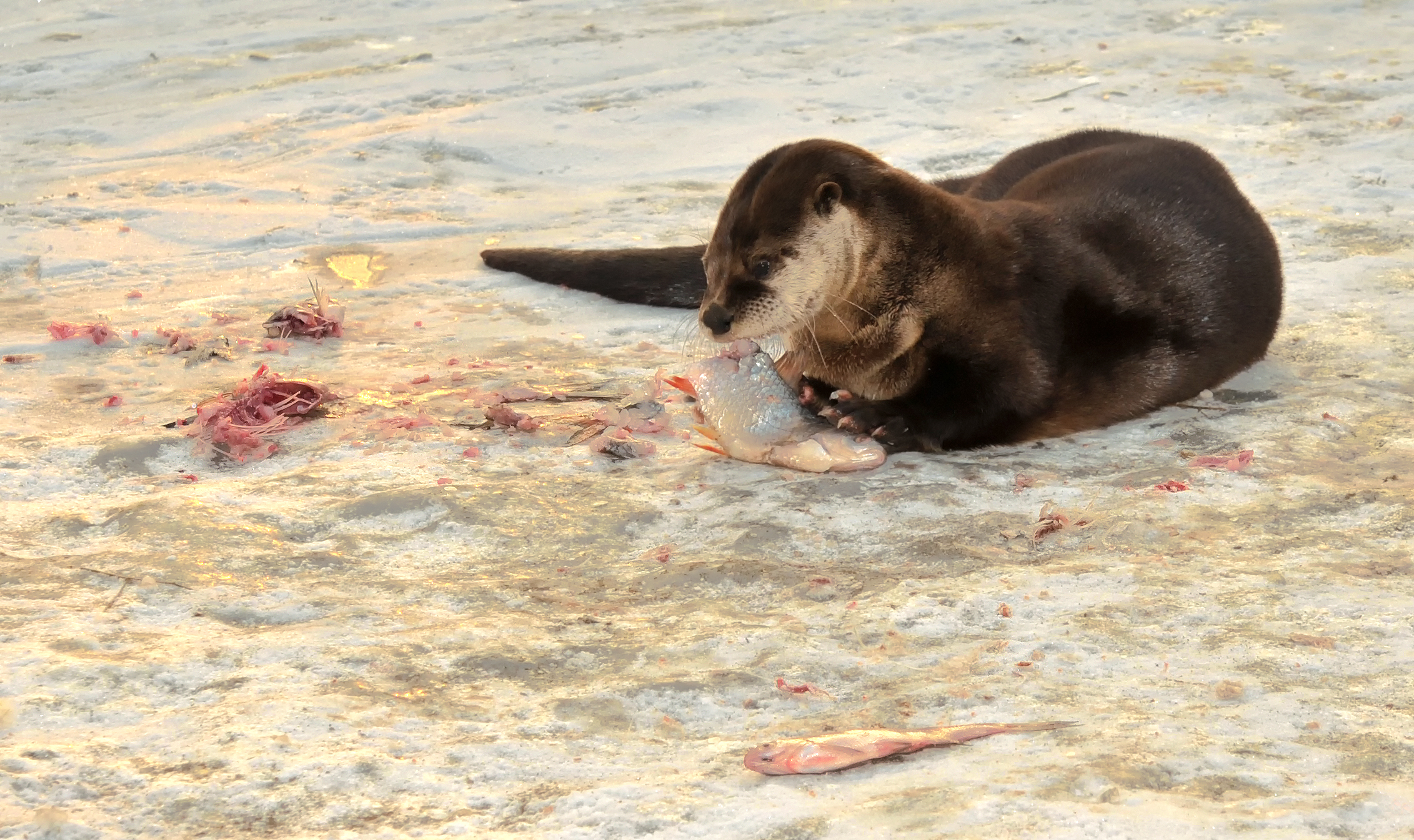
The Eurasian otter's diet consists primarily of fish, particularly in Mediterranean and temperate freshwater habitats where fish are most abundant.
During winter or in colder climates, otters expand their diet to include amphibians, along with worms, clams, crustaceans, insects, eggs, birds, and small mammals, including young European beavers. They also consume small amounts of vegetation.
Eurasian otters, like other mustelids, are capable of overpowering prey significantly larger than themselves. They occasionally hunt large waterbirds such as adult greylag geese.
Breeding
The Eurasian otter is strongly territorial, living alone for the most part. An individual's territory may vary between about 1 and(-) long, with about 18 km being usual. The length of the territory depends on the density of food available and the width of the water suitable for hunting; it is shorter on coasts, where the available width is much wider, and longer on narrower rivers. The Eurasian otter uses its feces, called spraints, to mark its territory and prioritize the use of resources to other group members. The territories are only held against members of the same sex, so those of males and females may overlap. Mating takes place in water. Males and females breed at any time of the year, and the mating season is most likely determined by reproductive maturity and physiological state. Females become sexually mature at the age of 18–24 months, and the average age of first breeding is years. Gestation lasts 60–64 days, and one to four pups are born weighing about 10% of the female's body weight. The pups remain dependent on the mother for about 13 months. The male plays no direct role in parental care, although the territory of a female with her pups is usually entirely within that of the male.
Taxonomy
The extinct Japanese otter is sometimes considered a subspecies; recent studies have found it to fall outside the subspecific clades comprising L. lutra, so it has been reclassified as a distinct species, but uncertainty remains.
Conservation
The Eurasian otter declined across its range in the second half of the 20th century primarily due to pollution from polychlorinated biphenyls and pesticides such as organochlorine. Other threats included habitat loss and hunting, both legal and illegal. Eurasian otter populations are now recovering in many parts of Europe. In the United Kingdom, the number of sites with an otter presence increased by 55% between 1994 and 2002. In August, 2011, the Environment Agency announced that otters had returned to every county in England since vanishing from every county except the West Country and parts of Northern England. Recovery is partly due to a ban on the most harmful pesticides that has been in place across Europe since 1979, partly to improvements in water quality leading to increases in prey populations, and partly to direct legal protection under the European Union Habitats Directive and national legislation in several European countries. In Hong Kong, it is a protected species under Wild Animals Protection Ordinance Cap 170. It is listed as Near Threatened by the IUCN Red List.
In Germany, the Eurasian otter is nearly extinct in the wild, being listed as critically endangered. As part of a protection and conservation effort the "Aktion Fischotterschutz" was founded in 1979, which aims to fund habitat protection and expansion. Further, the Hankensbüttler Otter Centre provides protection to the species in captivity.
It is listed as endangered in Pakistan, India, Bangladesh, Myanmar and Thailand, and critically endangered in Mongolia. and first-class endangered species.
Most species that are victims of population decline or a loss of habitat tend to eventually lose their genetic difference due to inbreeding from small populations. A study conducted in 2001, examined whether or not the populations of Eurasian otters suffered from a lack of genetic variability. In the study, they examined teeth of otter skulls at the Zoological Museum, Copenhagen and the Natural History Museum, Aarhus. The samples were collected between 1883 and 1963 in Denmark (Funen, Zealand, and Jutland). The study examined the tissue on the teeth of the skulls and determined the genetic variability based on DNA analysis. In conclusion, the study discovered that despite the population declines, the Eurasian otter was not a victim of declining genetic variability.
The decline in population of native freshwater fishes in the rivers of Iberia, which is the preferred food of Eurasian otters, along with the expansion of exotic fish species like centrarchids could potentially put Eurasian otters at risk for extinction.
References
References
- Loy, A.. (2022). "''Lutra lutra''".
- (2013). "Bone Inner Structure Suggests Increasing Aquatic Adaptations in Desmostylia (Mammalia, Afrotheria)". PLOS ONE.
- Godman, John Davidson (1836) ''American Natural History'', Hogan & Thompson.
- Hans, Kruuk. (2007). "Otters ecology, behavior and conservation". Oxford University Press.
- [http://www.theanimalfiles.com/mammals/carnivores/otter_european.html European Otter]. theanimalfiles.com
- {{usurped
- Wood, Gerald L. (1983) ''The Guinness Book of Animal Facts and Feats''. Sterling Pub Co Inc., {{ISBN. 978-0-85112-235-9
- (2011). "The use of artificial lakes on golf courses as feeding areas by the Otter (''Lutra lutra'') in southern Spain". IUCN Otter Specialist Group Bulletin.
- (2019). "The habitat, ecological life conditions, and usage characteristics of the otter (''Lutra lutra'' L. 1758) in the Balikdami Wildlife Development Area". Environmental Monitoring and Assessment.
- (2021). "The first photographic records of the Eurasian Otter ''Lutra lutra'' in Syria: Its mysterious occurrence is revealed". IUCN Otter Specialist Group Bulletin.
- (2021). "First evidence of Eurasian Otter in Nepal in three decades". IUCN Otter Specialist Group Bulletin.
- (2016). "Photographic records of Eurasian Otter ''Lutra lutra'' from the Central Indian landscape". IUCN Otter Specialist Group Bulletin.
- (2001). "Feeding habits of the otter and the American mink in Białowieża Primeval Forest (Poland) compared to other Eurasian populations". Ecography.
- (2003-05-01). "Trophic diversity of the otter (''Lutra lutra'' L.) in temperate and Mediterranean freshwater habitats". Journal of Biogeography.
- (2010). "Intensive exploitation of amphibians by Eurasian otter (''Lutra lutra'') in the Wolosaty stream, southeastern Poland". Annales Zoologici Fennici.
- (1990). "Seasonal exploitation of amphibians by otters (''Lutra lutra'') in north-east Scotland". Journal of Zoology.
- Kitchener, A.. (2001). "Beavers". Whittet Books.
- "Lutra lutra (European otter)".
- Yardley, Adam. (2016-06-07). "Goslings & Otters".
- (2022-06-30). "Ullswater geese deaths: Park rangers probe mystery of vanishing birds". BBC News.
- Kruuk, H.. (1992). "Scent marking by otters (''Lutra lutra''): signaling the use of resources". Behavioral Ecology.
- Erlinge, S.. (1968). "Territoriality of the otter ''Lutra lutra'' L.". Oikos.
- (2002). "Reproductive performance of otters ''Lutra lutra'' (Linnaeus, 1758) in Eastern Germany: Low reproduction in a long-term strategy". Biological Journal of the Linnean Society.
- (2019). "What is the taxonomic status of East Asian otter species based on molecular evidence?: focus on the position of the Japanese otter holotype specimen from museum". Animal Cells and Systems.
- "The Eurasian Otter (''Lutra lutra'')". [[English Nature]].
- "Otter: Background to selection". Jncc.gov.uk.
- "Fourth Otter Survey of England".
- Michael McCarthy. (2011-08-18). "Otters return to every county in England". The Independent.
- "Council Directive 79/117/EEC of 21 December 1978 prohibiting the placing on the market and use of plant protection products containing certain active substances". EUR-Lex.
- "Council Directive 92/43/EEC of 21 May 1992 on the conservation of natural habitats and of wild fauna and flora". EUR-Lex.
- (2005). "Species other than birds specially protected under The Wildlife and Countryside Act, 1981: Schedule 5 (Animals)". JNCC.
- (1976). "Wildlife Act 1976 (Ireland)". International Wildlife Law.
- "[https://web.archive.org/web/20070928081910/http://www.otter.org/news/world4.html Otters of the world - Europe]". IOSF.
- "Start - Aktion Fischotterschutz e.V.".
- "Tier- und Freizeitpark {{!}} Otter-Zentrum Hankensbüttel".
- "천연기념물 제330호 수달". heritage.go.kr.
- "국립생물자원관 한반도의 생물다양성-수달". species.nibr.go.kr.
- (2001). "Genetic consequences of population decline in the European otter (''Lutra lutra''): an assessment of microsatellite DNA variation in Danish otters from 1883 to 1993". Proceedings of the Royal Society of London B: Biological Sciences.
- (2008). "Eurasian otter (''Lutra lutra'') diet and prey selection in Mediterranean streams invaded by centrarchid fishes". Biological Invasions.
This article was imported from Wikipedia and is available under the Creative Commons Attribution-ShareAlike 4.0 License. Content has been adapted to SurfDoc format. Original contributors can be found on the article history page.
Ask Mako anything about Eurasian otter — get instant answers, deeper analysis, and related topics.
Research with MakoFree with your Surf account
Create a free account to save articles, ask Mako questions, and organize your research.
Sign up freeThis content may have been generated or modified by AI. CloudSurf Software LLC is not responsible for the accuracy, completeness, or reliability of AI-generated content. Always verify important information from primary sources.
Report