From Surf Wiki (app.surf) — the open knowledge base
Ethnicity in Myanmar
none
none
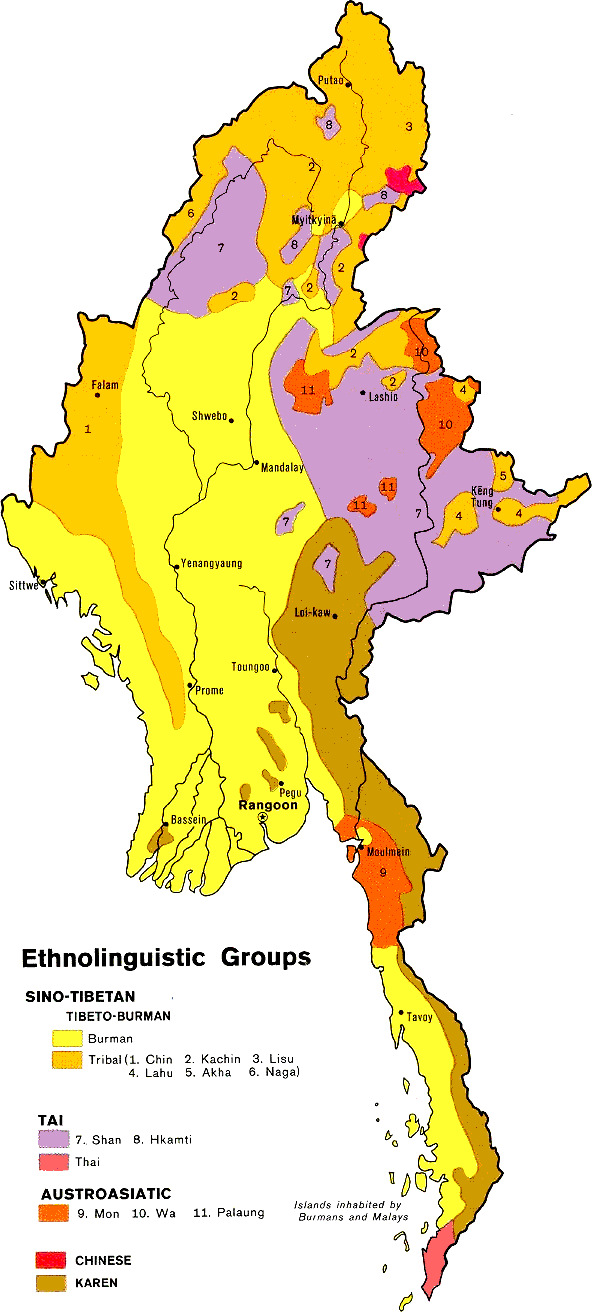
Myanmar (Burma) is an ethnically diverse nation with 135 distinct ethnic groups officially recognised by the Burmese government, which are grouped into eight "major national ethnic races" — the Bamar, Kayin, Rakhine, Shan, Mon, Chin, Kachin, and Karenni. The Bamar (Burman) make up approximately 68% of the population, while the remainder belongs to various major and minor ethnic and linguistic groups.
The "major national ethnic races" are grouped primarily according to geographic region rather than ethnolinguistic affiliation. For example, the Shan national race includes 33 ethnic groups that live in Shan State and speak languages in at least four language families. Myanmar's contemporary politics around ethnicity surround treating ethnicity as a minoritising discourse, pitting a "pan-ethnic" national identity against minority groups. Often ethnicity identities in practice are flexible — sometimes as flexible as simply changing clothes — in part due to a lack of religious or ethnic stratification prior to British colonialism.
Ethnic identity in modern-day Myanmar has been significantly shaped by British colonial rule, Christian missionaries, and decolonisation in the post-independence era. To this day, the Burmese language does not have precise terminology that distinguishes the European concepts of race and ethnicity; the term lu-myo (လူမျိုး, ) can reference race, ethnicity, and religion. For instance, many Bamar self-identify as members of the 'Buddhist *lu-myo''' or the 'Myanmar *lu-myo'',' which has posed a significant challenge for census-takers.
Many unrecognised ethnic groups exist in the country, the largest being the Burmese Chinese and Panthay (who together form 3% of the population), Burmese Indians (who form 2% of the population), Rohingya, Anglo-Burmese and Gurkha. There are no official statistics regarding the population of the latter two groups, although unofficial estimates place around 52,000 Anglo-Burmese in Burma with around 1.6 million outside the country.
History
Pre-colonial era
In the pre-colonial era, ethnic identity was fluid and dynamic, marked by patron-client relationships, religion, and regional origins, not ethnicity. Lowland valley populations were mainly Theravada Buddhists who spoke Burmese and practiced settled rice cultivation, while minority groups in the surrounding highlands had distinct cultures based on shifting cultivation and local clan or kinship-based loyalties. Pre-colonial Burmese kingdoms were defined by cultural exchange and contact, especially between the Buddhist Bamar, Shan, Rakhine and Mon peoples. Peripheral groups were more likely to adopt the cultural norms and institutions of dominant centers of power, like the Kingdom of Ava.
The Konbaung dynasty incorporated diverse peoples—such as the Shan, Mon, Arakanese, and Tai—into its Theravada Buddhist cultural system through rituals, religious monuments, and royal merit practices. Provincial leaders were required to participate in royal ceremonies, spreading court culture across regions. Intermarriage between the central court and provincial elites also strengthened this cultural integration, making Burmese Theravada orthodoxy a hegemonic force across the empire.
British colonial rule
During British rule in Burma (1896–1948), colonial authorities developed formal classifications to label groups of people, using language as a key criterion, which led to inconsistencies —for instance, some groups labeled as Kachin were not linguistically, ethnically, or racially related to others.
The British transformed the previously fluid nature of ethnic identity by categorizing people based on language in census records and linking ethnic groups to specific territories. They divided the colony into “Ministerial Burma” (directly ruled lowland areas populated mostly by the Bamar, Mon, and Rakhine) and “Frontier Areas” (indirectly ruled highlands inhabited by ethnic minorities like the Kachin, Shan, Chin, and Karen), which reinforced ethnic divisions and limited political interaction.
Christian missionaries converted many minority groups—especially the Karen, Kachin, and Chin—creating religious divides with the Buddhist Bamar majority. These groups also benefited more from colonial recruitment into military and civil service, intensifying Bamar resentment. Economic and political tensions further escalated due to mass immigration encouraged by the British, particularly of Indians and Chinese. Colonial historiography helped perpetuate ethnic categories in Burma, which in turn, became the criteria for conceptualizing and organizing precolonial Myanmar’s history.
These colonial developments promulgated the creation of pan-ethnic identities among minority groups like the Karen, Chin, and Kachin, while politically sidelining the Bamar majority, fueling future ethnic armed resistance and communal violence. For instance, Tai peoples in the country, who now identify as part of the Shan ethnic group, became a distinct ethno-cultural community only during British colonial rule with the creation of the “Shan States” in 1886.
During World War II, the Bamar nationalists aligned with Japan to expel British colonial rulers, while many minority groups supported the British. In 1947, independence leader Aung San secured minority support with promises of autonomy in the 1947 Panglong Agreement, but his assassination later that year destabilised the burgeoning movement.
Decolonisation
After independence, postcolonial Burmese governments adopted rigid colonial ethnic classifications, officially recognizing 135 “national races” called taing-yin-tha (တိုင်းရင်းသား). These identities have become the basis for citizenship and access to rights. The 1982 citizenship law reserved full citizenship for those classified as taing-yin-tha, effectively excluding groups like the Rohingya.
These imposed identities often grouped diverse subgroups together and became institutionalised over time, with post-independence governments continuing to use them to determine access to territory, political power, and economic opportunities—leading to ongoing grievances and struggles among excluded groups. These ethnic classifications have been criticised as arbitrary and exclusionary. While some blame ethnic diversity for ongoing military rule and conflict, the country's political institutions and elite actions have politicised ethnic identities and deepened divisions and conflict.
Ideological disputes and unmet promises to ethnic minorities led to ongoing civil wars between the central government and ethnic armed organisations. During the 1962 Burmese coup d'état, General Ne Win seized power to halt perceived threats of secession and further minority concessions. Consequently, Myanmar has faced continuous armed struggles between the Bamar-majority central government and minority ethnic groups demanding greater autonomy. Harsh military rule and brutal campaigns against ethnic insurgencies have hundreds of thousands and pushing many into refugee camps, particularly in Thailand.
The 1948 Constitution of Burma granted statehood to Kachin, Karenni (now Kayah), Shan and Karen States (now Kayin). The 1974 Constitution granted statehood to Chin State by upgrading its former status as the Special Division of the Chins, to Mon State by carving up the upper half of Tenasserim Division, and to Arakan State by upgrading its former status as Arakan Division. In 2010, in accordance with the 2008 Constitution, several ethnic groups were granted self-administered zones:
- Danu Self-Administered Zone: consisting of Ywangan and Pindaya townships in Shan State
- Kokang Self-Administered Zone: consisting of Konkyan and Laukkai townships in Shan State
- Naga Self-Administered Zone: consisting of Leshi, Lahe, and Namyun townships in Sagaing Region
- Pa Laung Self-Administered Zone: consisting of Namhsan and Manton townships in Shan State
- Pa-O Self-Administered Zone: consisting of Hopong, Hsihseng, and Pinlaung townships in Shan State
- Wa Self-Administered Division: consisting of Hopang, Mongmao, Panwai, Nahpan, Metman, and Pangsang (Pankham) townships in Shan State
Ethnic makeup
After the 2014 Census in Myanmar, the Burmese government indefinitely withheld release of detailed ethnicity data, citing concerns around social unrest and political sensitivity surrounding the issue of ethnicity in Myanmar. In February 2018, Thein Swe, the minister of labor, immigration, and population did not provide a timeline, and stated that more discussions with ethnic leaders, historians, anthropologists, and cultural experts were necessary to finalise the terminology and classifications of ethnic groups. As of March 2018, the census data remains unreleased.
In 2022, researchers analysed the General Administration Department's nationwide township reports compiled between October 2018 and September 2019 to tabulate the ethnic makeup of the country.{{cite book
The GAD used only 22 ethnic groups in its reports, reflecting the lack of standardisation within the Burmese government to classify ethnic groups, and disaggregation of several "national races." The GAD's list includes entries not found in the country's 135 officially recognised ethnic groups, including Mong Wong, Lishaw, and Ying.
Officially recognised ethnic groups
The Burmese government recognises 8 "national races" that are made up of 135 ethnic groups. The list has faced criticism for overcounting the number of ethnic groups and classifying groups that speak unrelated languages under the same "national race." Specifically, it represents clans and people with dialectical differences as distinct ethnic groups, sometimes even repeating the same group under a different name. According to Gamanii, a researcher who scrutinised the claim, only 59 out of the 135 recognised ethnic groups can be verified as existing entities.
The following language families are associated the ethnic groups:
Note: The list is very controversial. Many of the names and spelling variants are known only from this list.
Kachin
According to the Burmese government, the Kachin comprises 12 different sub-groups:
| № | Group | Native language | Language family | Language sub-family | |||||
|---|---|---|---|---|---|---|---|---|---|
| 1 | Kachin | Various Kachin languages | Sino-Tibetan – Tibeto-Burman | Various | |||||
| 2 | Tarone (*Derung, Drung*) | Derung | Sino-Tibetan – Tibeto-Burman | Nungish | |||||
| 4 | Jinghpaw (*Jingpo*) | Jinghpaw | Sino-Tibetan – Tibeto-Burman | Sal | |||||
| 3 | url=http://www.ethnologue.com/ | title=Ethnologue | access-date=1 May 2006 | archive-date=13 October 2011 | archive-url=https://web.archive.org/web/20111013215305/http://www.ethnologue.com/show_lang_family.asp?code=haw | url-status=live }} | Jinghpaw (Dalaung dialect) | Sino-Tibetan – Tibeto-Burman | Sal |
| 5 | Guari, see Jingpo people | Jinghpaw (Guari dialect) | Sino-Tibetan – Tibeto-Burman | Sal | |||||
| 6 | Hkahku, see Jingpo people | Jinghpaw (Hkahku dialect) | Sino-Tibetan – Tibeto-Burman | Sal | |||||
| 7 | Duleng | Sino-Tibetan – Tibeto-Burman | |||||||
| 8 | Maru (*Lhao Vo, Langsu*) | Maru | Sino-Tibetan – Tibeto-Burman | Lolo–Burmese | |||||
| 9 | Rawang (*Nung*) | Rawang | Sino-Tibetan – Tibeto-Burman | Nungish | |||||
| 10 | Lashi (*La Chit*) | Lashi | Sino-Tibetan – Tibeto-Burman | Lolo–Burmese | |||||
| 11 | Zaiwa (*Atsi*) | Zaiwa (*Atsi*) | Sino-Tibetan – Tibeto-Burman | Lolo–Burmese | |||||
| 12 | Lisu (*Yawyin*) | Lisu | Sino-Tibetan – Tibeto-Burman | Lolo–Burmese |
Kayah
According to the Burmese government, the Kayah comprise nine sub-groups:
| № | Group | Native language | Language family | Language sub-family |
|---|---|---|---|---|
| 1 | Kayah (*Karenni*) | Karenni | Sino-Tibetan – Tibeto-Burman | Karenic |
| 2 | Zayein (*Lahta; Gaungto; Loilong Karens*) | Lahta | Sino-Tibetan – Tibeto-Burman | Karenic |
| 3 | Ka-Yun (*Kayan; Padaung*) | Kayan | Sino-Tibetan – Tibeto-Burman | Karenic |
| 4 | Gheko (*Karen, Geko*) | Geko | Sino-Tibetan – Tibeto-Burman | Karenic |
| 5 | Kebar (*Geba*) | Geba | Sino-Tibetan – Tibeto-Burman | Karenic |
| 6 | Bre (*Ka-Yaw; Kayaw*) | Kayaw | Sino-Tibetan – Tibeto-Burman | Karenic |
| 7 | Manu Manaw (*Manumanaw*) | Manumanaw | Sino-Tibetan – Tibeto-Burman | Karenic |
| 8 | Yin Talai (*Yintale*) | Yintale | Sino-Tibetan – Tibeto-Burman | Karenic |
| 9 | Yin Baw (*Yinbaw*) | Yinbaw | Sino-Tibetan – Tibeto-Burman | Karenic |
Kayin
According to the Burmese government, the Kayin comprise 11 sub-groups:
| № | Group | Native language | Language family | Language sub-family |
|---|---|---|---|---|
| 1 | Kayin (*Karen*) | Various Karen languages | Sino-Tibetan – Tibeto-Burman | Karenic |
| 2 | (*Geba Karen*) | Geba | Sino-Tibetan – Tibeto-Burman | Karenic |
| 3 | (*Paleki,* possibly Mobwa) | Mobwa (tentative) | Sino-Tibetan – Tibeto-Burman | Karenic |
| 4 | Mon Kayin (*Saphyu*) | Various Pwo Karen languages | Sino-Tibetan – Tibeto-Burman | Karenic |
| 5 | Sgaw (*S’gaw Karen*) | S'gaw Karen | Sino-Tibetan – Tibeto-Burman | Karenic |
| 6 | (*Thalebwa*) | Thalebwa (tentative) | Sino-Tibetan – Tibeto-Burman | Karenic |
| 7 | (*Paku Karen*) | Paku | Sino-Tibetan – Tibeto-Burman | Karenic |
| 8 | Bwe (*Bwe Karen*) | Bwe | Sino-Tibetan – Tibeto-Burman | Karenic |
| 9 | (*Paku Karen*) | Possibly Paku (variant) | Sino-Tibetan – Tibeto-Burman | Karenic |
| 10 | Unknown | Sino-Tibetan – Tibeto-Burman | Karenic | |
| 11 | (*Pwo Kayin*, *Pwo Karen*) | Various Pwo Karen languages | Sino-Tibetan – Tibeto-Burman | Karenic |
Chin
According to the Burmese government, the Chin comprise 53 sub-groups. This list was possibly originally a list of colonial tax rate districts. The groupings have long been contested by ethnic Chin leaders, and some subgroups like the Zomi refute their categorization as Chins. Ahead of the 2014 Myanmar census, the Chin National Action Committee on Census produced a list of mistakes and incoherencies with the government's list:
- Overarching category ambiguity: "Chin" is treated as just another coded category, rather than a distinct ethnolinguistic umbrella.
- Misclassification under "Chin": Some ethnic groups (e.g. Naga, Thanghkul, Meithei) do not self-identify as Chin.
- Non-ethnonyms listed: Some names (e.g. Saline, Mi-er) are not actual ethnonyms.
- Inconsistent spelling: Many group names are spelled inconsistently across languages (e.g. Khami/Khumi, Tiddim/Tedim).
- Merged identities: Some single names represent multiple distinct groups (e.g. Dai (Yinthu) representing both Dai and Daa Yinthu).
- Redundant listings: Some groups appear multiple times under different spellings (e.g. Lushai and Lushei for Lashai).
- Missing groups: Several well-defined groups are entirely omitted from the list (e.g. Ng’gha, Hlawn Ceu, Sometu, Larktu, Laisaw, Laitu, Mayin, Lungpaw, Minkya, Bawm).
The presence of 53 Chin sub-groups prompted confusion among census participants. Chin civil society groups called for a future revision to the number of Chin subgroups. In 2019, the national government confirmed it had no plans to correct the nomenclature.
| № | Group | Native language | Language family | Language sub-family |
|---|---|---|---|---|
| 1 | Chin | Various Kuki-Chin languages | Sino-Tibetan – Tibeto-Burman | Kuki-Chin |
| 2 | Meithei (*Meitei; Kathe*) | Meitei (Manipuri) | Sino-Tibetan – Tibeto-Burman | Kuki-Chin |
| 3 | Unknown | Unknown | ||
| 4 | Ka-lin-kaw (*Mizo, Lushay, Kalinko*) | Mizo | Sino-Tibetan – Tibeto-Burman | Kuki-Chin |
| 5 | Khami (*Khumi*) | Khumi | Sino-Tibetan – Tibeto-Burman | Kuki-Chin |
| 6 | Awa Khami (*Mro-Khimi*) | Mro-Khimi | Sino-Tibetan – Tibeto-Burman | Kuki-Chin |
| 7 | Khawno (*Khuano*) | Possibly a Chin dialect | Sino-Tibetan – Tibeto-Burman | |
| 8 | (*Hkongso*) | Possibly a Chin dialect | Sino-Tibetan – Tibeto-Burman | |
| 9 | Kaung Saing Chin | Possibly a Chin dialect | Sino-Tibetan – Tibeto-Burman | |
| 10 | (*Khualsim*) | Dialect of Falam | Sino-Tibetan – Tibeto-Burman | Kuki-Chin |
| 11 | Kwangli (*Sim*) | Possibly a Chin dialect | Sino-Tibetan – Tibeto-Burman | |
| 12 | Gunte (*Gangte, Lyente; Falam*) | Dialect of Falam | Sino-Tibetan – Tibeto-Burman | Kuki-Chin |
| 13 | Gwete (*Guite, Nguite*) | Chin | Sino-Tibetan – Tibeto-Burman | Kuki-Chin |
| 14 | Ngorn (*Chin, Ngawn*) | Ngawn | Sino-Tibetan – Tibeto-Burman | Kuki-Chin |
| 15 | Sizang (*Siyin*) | Sizang (Siyin) | Sino-Tibetan – Tibeto-Burman | Kuki-Chin |
| 16 | Possibly a Chin dialect | Sino-Tibetan – Tibeto-Burman | ||
| 17 | Possibly a Chin dialect | Sino-Tibetan – Tibeto-Burman | ||
| 18 | (*Zahau*) | Zahau | Sino-Tibetan – Tibeto-Burman | Kuki-Chin |
| 19 | Zotung | Zotung | Sino-Tibetan – Tibeto-Burman | Kuki-Chin |
| 20 | Zo-Pe (*Zophei, Zyphe*) | Zyphe | Sino-Tibetan – Tibeto-Burman | Kuki-Chin |
| 21 | Zo (*Zou*) | Zou (Zo) | Sino-Tibetan – Tibeto-Burman | Kuki-Chin |
| 22 | Zahnyet (*Zanniet*) | Zanniat | Sino-Tibetan – Tibeto-Burman | Kuki-Chin |
| 23 | Tapong | Tapong | Sino-Tibetan – Tibeto-Burman | Kuki-Chin |
| 24 | Tiddim (*Tedim, Haidim*) | Tedim | Sino-Tibetan – Tibeto-Burman | Kuki-Chin |
| 25 | Possibly a Chin dialect | Sino-Tibetan – Tibeto-Burman | ||
| 26 | Taishon (*Tashon*) | Taishon | Sino-Tibetan – Tibeto-Burman | Kuki-Chin |
| 27 | Thado | Thadou | Sino-Tibetan – Tibeto-Burman | Kuki-Chin |
| 28 | Torr people (*Tawr*) | Tawr | Sino-Tibetan – Tibeto-Burman | Kuki-Chin |
| 29 | Dim | Unknown | Sino-Tibetan – Tibeto-Burman | |
| 30 | Daai (*Yindu, Dai*) | Daai | Sino-Tibetan – Tibeto-Burman | Kuki-Chin |
| 31 | Naga | Various Naga languages | Sino-Tibetan – Tibeto-Burman | Kuki-Chin |
| 32 | Tangkhul | Tangkhul | Sino-Tibetan – Tibeto-Burman | |
| 33 | Malin | Possibly Chin or Mizo dialect | Sino-Tibetan – Tibeto-Burman | |
| 34 | Possibly Chin dialect | Sino-Tibetan – Tibeto-Burman | ||
| 35 | Possibly Chin dialect | Sino-Tibetan – Tibeto-Burman | ||
| 36 | Matu | Matu | Sino-Tibetan – Tibeto-Burman | Kuki-Chin |
| 37 | Miram (*Mara*) | Mara | Sino-Tibetan – Tibeto-Burman | Kuki-Chin |
| 38 | Mi-er | Possibly Chin dialect | Sino-Tibetan – Tibeto-Burman | |
| 39 | Mgan (*Kaang*) | Kaang | Sino-Tibetan – Tibeto-Burman | Kuki-Chin |
| 40 | Lushei (*Lushay, Duhlian*) | Mizo | Sino-Tibetan – Tibeto-Burman | Kuki-Chin |
| 41 | Laymyo | Laymyo | Sino-Tibetan – Tibeto-Burman | Kuki-Chin |
| 42 | Lyente | Possibly Falam-related dialect | Sino-Tibetan – Tibeto-Burman | Kuki-Chin |
| 43 | Lautu (*Lutuv, Lawhtu*) | Lautu | Sino-Tibetan – Tibeto-Burman | Kuki-Chin |
| 44 | Lai (*Hakha Chin*) | Lai (Hakha Chin) | Sino-Tibetan – Tibeto-Burman | Kuki-Chin |
| 45 | Possibly Lai dialect | Sino-Tibetan – Tibeto-Burman | Kuki-Chin | |
| 46 | Wakim (*Mro*) | Mro | Sino-Tibetan – Tibeto-Burman | Kuki-Chin |
| 47 | Hualngo | Hualngo | Sino-Tibetan – Tibeto-Burman | Kuki-Chin |
| 48 | Possibly Chin dialect | Sino-Tibetan – Tibeto-Burman | ||
| 49 | Anun | Possibly Chin dialect | Sino-Tibetan – Tibeto-Burman | |
| 50 | Oo-Pu (*Shö, Uppu*) | Shö | Sino-Tibetan – Tibeto-Burman | Kuki-Chin |
| 51 | Lhinbu | Possibly Chin dialect | Sino-Tibetan – Tibeto-Burman | |
| 52 | Asho (*Plain*) | Asho | Sino-Tibetan – Tibeto-Burman | Kuki-Chin |
| 53 | Rongtu (*Rungtu*) | Rongtu | Sino-Tibetan – Tibeto-Burman | Kuki-Chin |
Bamar
According to the Burmese government, the Bamar comprise nine sub-groups, several of which speak variants of Burmese. In 2016, the Thein Sein government officially recognised the Chinese-speaking Mong Wong in northern Shan State as the Mong Wong Bamar.
| № | Group | Native language | Language family | Language sub-family |
|---|---|---|---|---|
| 1 | Burman (*Bamar*) | Burmese | Sino-Tibetan – Tibeto-Burman | Lolo-Burmese |
| 2 | Dawei (*Tavoyan*) | Burmese: Tavoyan dialect | Sino-Tibetan – Tibeto-Burman | Lolo-Burmese |
| 3 | Myeik (*Beik,* *Merguese*) | Burmese: Myeik dialect | Sino-Tibetan – Tibeto-Burman | Lolo-Burmese |
| 4 | Yaw | Burmese: Yaw dialect | Sino-Tibetan – Tibeto-Burman | Lolo-Burmese |
| 5 | Yabein (*defunct*) | Burmese: Yabein dialect | Sino-Tibetan – Tibeto-Burman | Lolo-Burmese |
| 6 | Kadu (*Kado*) | Kadu | Sino-Tibetan – Tibeto-Burman | Sal |
| 7 | Ganan | Sino-Tibetan – Tibeto-Burman | Sal | |
| 8 | Salone (*Salon; Moken*) | Moken | Austronesian | Malayo-Polynesian |
| 9 | Hpon people | Hpon | Sino-Tibetan – Tibeto-Burman | Lolo-Burmese |
Mon
| № | Group | Native language | Language family | Language sub-family |
|---|---|---|---|---|
| 1 | Mon | Mon | Austroasiatic | Monic |
Rakhine
According to the Burmese government, the Rakhine comprise seven sub-groups. The groupings have been criciticised for including culturally different groups like the Mro and Thet under the Rakhine umbrella.
| № | Group | Native language | Language family | Language sub-family |
|---|---|---|---|---|
| 1 | Rakhine (*Arakanese*) | Rakhine (Arakanese) | Sino-Tibetan – Tibeto-Burman | Lolo-Burmese |
| 2 | Kamein (*Kaman*) | Rakhine (Arakanese) | Sino-Tibetan – Tibeto-Burman | Lolo-Burmese |
| 3 | Kwe Myi (*Khami*) | Khumi | Sino-Tibetan – Tibeto-Burman | Kuki-Chin |
| 4 | Daingnet (*Thetkama, Chakma*) | Chakma | Indo-European | Indo-Aryan |
| 5 | Maramagyi (*Barua*) | Rakhine, Bengali | Indo-European | Indo-Aryan |
| 6 | Mro | Mro | Sino-Tibetan – Tibeto-Burman | Kuki-Chin |
| 7 | Thet (*Chak*) | Chak | Indo-European | Indo-Aryan |
Shan
According to the Burmese government, the Shan comprise 33 sub-groups. The groupings have been criciticised for including culturally different groups like the Kokang, Palaung, and Pa-O under the Shan umbrella. The list also includes redundant groups that go by different names, such as the Tai Leng, who are also called Shan Galay or Red Shan.
| № | Group | Native language | Language family | Language sub-family |
|---|---|---|---|---|
| 1 | Shan (*Tai*) | Various Tai languages | Kra–Dai | Tai – Southwestern Tai |
| 2 | Yun (*Tai Yuan, Lanna*) | Northern Thai | Kra–Dai | Tai – Southwestern Tai |
| 3 | Possibly a Tai dialect | Kra–Dai | ||
| 4 | Pyin | Possibly a Tai dialect | Kra–Dai | |
| 5 | Yao (*Mien*) | Iu Mien | Hmong–Mien | Mienic |
| 6 | (*Danau*) | Danau | Austroasiatic | Palaungic |
| 7 | (*Ruching*) | Palaung: Ruching dialect | Austroasiatic | Palaungic |
| 8 | Eng (*En*) | Possibly a Palaungic language | Austroasiatic | Palaungic |
| 9 | Son | Possibly a Palaungic language | Austroasiatic | Palaungic |
| 10 | Khamu (*Khmu*) | Khmu | Austroasiatic | Khmuic |
| 11 | Kaw (*Akha*) | Akha | Sino-Tibetan – Tibeto-Burman | Lolo–Burmese |
| 12 | Kokant (*Kokang*) | Mandarin | Sino-Tibetan – Tibeto-Burman | Sinitic |
| 13 | Khamti Shan (*Hkamti*) | Khamti | Kra–Dai | Tai – Southwestern Tai |
| 14 | Hkun (*Tai Khün*) | Khün | Kra–Dai | Tai – Southwestern Tai |
| 15 | Taungyo | Taungyo | Sino-Tibetan – Tibeto-Burman | Lolo–Burmese |
| 16 | Danu | Danu | Sino-Tibetan – Tibeto-Burman | Lolo–Burmese |
| 17 | Palaung (*Ta'ang*) | Palaung | Austroasiatic | Palaungic |
| 18 | Myaungzi (*Hmong, Man Zi*) | Hmong | Hmong–Mien | Hmongic |
| 19 | Possibly a Palaungic language | Austroasiatic | Palaungic | |
| 20 | Riang | Austroasiatic | Palaungic | |
| 21 | Shan Gale | Tai Leng | Kra–Dai | |
| 22 | Shan Gyi (*Tai Long*) | Tai Long | Kra–Dai | Tai – Southwestern Tai |
| 23 | Lahu | Lahu | Sino-Tibetan – Tibeto-Burman | Lolo–Burmese |
| 24 | Intha | Burmese: Intha dialect | Sino-Tibetan – Tibeto-Burman | Lolo–Burmese |
| 25 | Possibly a Tai dialect | Kra–Dai | ||
| 26 | Pa-O (*Taungthu; Black Karen*) | Pa-O | Sino-Tibetan – Tibeto-Burman | Karenic |
| 27 | Tai-Loi | Tai Loi | Austroasiatic | Palaungic |
| 28 | (*Red Shan, Tai Laing*) | Tai Leng | Kra–Dai | Tai – Southwestern Tai |
| 29 | Tai-Lon (*Tai Long*) | Tai Long | Kra–Dai | Tai – Southwestern Tai |
| 30 | Tai-Lay (*Chinese Shan, Tai Nua*) | Tai Nüa | Kra–Dai | Tai – Southwestern Tai |
| 31 | Maingtha (*Achang*) | Achang | Sino-Tibetan – Tibeto-Burman | Lolo–Burmese |
| 32 | (*Tai Mao*) | Tai Mao | Kra–Dai | Tai – Southwestern Tai |
| 33 | Wa (*Va*) | Wa | Austroasiatic | Palaungic |
Unrecognised ethnic groups
The government of Myanmar does not officially recognise several ethnic groups:
| № | Group | Native language | Language family | Language sub-family |
|---|---|---|---|---|
| 1 | Anglo-Burmese | Burmese, English | Various, inc. Sino-Tibetan and Indo-European | Various |
| 2 | Burmese Chinese *(Sino-Burmese)* | Burmese, Chinese dialects (e.g. Hokkien, Cantonese) | Sino-Tibetan | Sinitic |
| 3 | Panthay (*Hui*) | Mandarin Chinese | Sino-Tibetan | Sinitic |
| 4 | Burmese Indians, inc. Myanmar Tamils | Burmese, Hindi, Tamil, Urdu, etc. | Various, inc. Indo-European and Dravidian | Various |
| 5 | Taungtha people | Burmese, Rungtu | Sino-Tibetan | Lolo–Burmese |
| 6 | Rohingya people | Rohingya | Indo-European | Indo-Aryan |
| 7 | Burmese Gurkhas (*Burmese Gorkhas, Nepalese*) | Nepali | Indo-European | Indo-Aryan |
| 8 | Burmese Mizos | Mizo | Sino-Tibetan | Kuki-Chin |
| 9 | Burmese Jews | Hebrew, Burmese | Afro-Asiatic | Semitic |
| 10 | Bamar Muslims (Pathi) | Burmese, Urdu, Arabic (liturgical) | Indo-European | Lolo–Burmese, Indo-Aryan |
| 11 | Burmese Malays | Burmese, Malay | Austronesian | Malayo-Polynesian |
| 12 | Bayingyi | Burmese | Sino-Tibetan | Lolo–Burmese |
References
Books
References
- "Myanmar People & Races".
- Cho, Violet. (2020). "Routledge Handbook of Contemporary Myanmar". Routledge.
- (2020-08-28). "Identity Crisis: Ethnicity and Conflict in Myanmar".
- Callahan, Mary P.. (2017). "Distorted, Dangerous Data? Lumyo in the 2014 Myanmar Population and Housing Census". Sojourn: Journal of Social Issues in Southeast Asia.
- Thawnghmung, Ardeth Maung. (2022-04-20). ""National Races" in Myanmar". Oxford University Press.
- Aung-Thwin, Michael A.. (2017-05-31). "The Ava Convention". University of Hawai'i Press.
- Schober, Juliane. (2010-11-30). "Theravada Cultural Hegemony in Precolonial Burma". University of Hawai'i Press.
- (2024-03-12). "State Institutions, Civic Associations, and Identity Demands: Regional Movements in Greater Southeast Asia". University of Michigan Press.
- Aung, San Yamin. (2018-02-21). "Still No Date for Release of Census Findings on Ethnic Populations".
- Aung, San Yamin. (2018-02-21). "Still No Date for Release of Census Findings on Ethnic Populations".
- Zaw, John. (2018-03-01). "Ethnic groups blast Myanmar for gaps in 2014 census".
- "PoneYate ethnic population dashboard".
- . (5 December 2017). ["2014 Population Census: The problematic of 135 ethnic groups categorization"](https://english.shannews.org/archives/16850). *Shan Herald*.
- Gamanii. (25 September 2012). "135: Counting Races in Burma". Shan Herald.
- "Composition of the Different Ethnic Groups".
- "Ethnologue".
- (1902). "I Ghekù, tribù cariana della Birmania orientale {{!}} WorldCat.org". Tipografia pontificia S. Giuseppe.
- Saning, Yen. (2014-05-09). "Chin Group Says Myanmar Census Ethnicity Question Caused Confusion".
- (November 2020). "How Many Chin Languages Should Be Taught in Government Schools? Ongoing developments and structural challenges of language-in-education policy in Chin State". Parami Journal of Education.
- Tickner, Steve. (2016-08-22). "Identity politics and the Mong Wong".
- (2025-04-10). "Ethnicity without Meaning, Data without Context".
This article was imported from Wikipedia and is available under the Creative Commons Attribution-ShareAlike 4.0 License. Content has been adapted to SurfDoc format. Original contributors can be found on the article history page.
Ask Mako anything about Ethnicity in Myanmar — get instant answers, deeper analysis, and related topics.
Research with MakoFree with your Surf account
Create a free account to save articles, ask Mako questions, and organize your research.
Sign up freeThis content may have been generated or modified by AI. CloudSurf Software LLC is not responsible for the accuracy, completeness, or reliability of AI-generated content. Always verify important information from primary sources.
Report