From Surf Wiki (app.surf) — the open knowledge base
Ethnic groups in Pakistan
none
none
Refugees
Pakistan's census does not include the 1.4 million citizens of Afghanistan who are temporarily residing in Pakistan. The majority of them were born in Pakistan within the last four decades and mostly belong to the Pashtun ethnic group. They also include Tajiks, Uzbeks and others.
Major ethnic groups
Punjabis
Main article: Punjabi Muslims, Punjab, Pakistan, Punjabi language
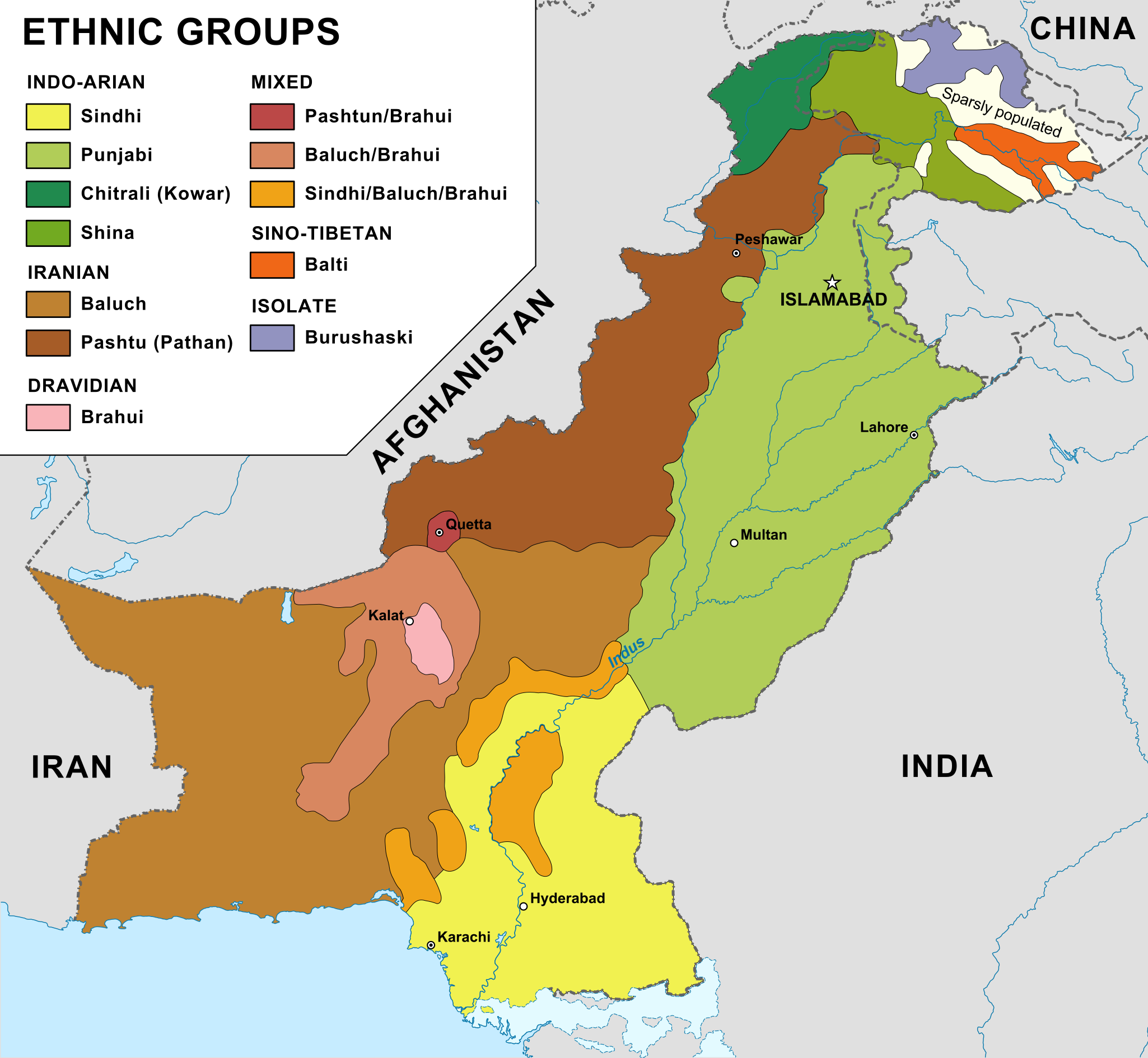
Punjabis are an Indo-Aryan ethnolinguistic group native to the Punjab region between India and Pakistan. They are the largest ethnic group of Pakistan. Punjabi Muslims are the third-largest Islam-adhering Muslim ethnicity in the world, globally, after Arabs and Bengalis.
Traditionally, Punjabi identity is primarily linguistic, geographical and cultural. Its identity is independent of historical origin or religion and refers to those who reside in the Punjab region or associate with its population and those who consider the Punjabi language and its dialects as their mother tongue. Integration and assimilation are important parts of Punjabi culture, since Punjabi identity is not based solely on tribal connections.
Pashtuns
Main article: Pashtuns, Pashtunistan, Pashtuns in Punjab
Pashtuns are an Iranic ethnolinguistic group and are Pakistan's second largest ethnicity. They speak Pashto as their first language and are divided into multiple tribes such as Afridi, Durrani, Yousafzai and Khattak, which are notably the main Pashtun tribes in Pakistan. They make up an estimated 38 million of Pakistan's total population and are mostly adherent to Sunni Islam.
Sindhis
Main article: Sindhis, Sindh
The Sindhis are an Indo-Aryan ethnolinguistic group who speak the Sindhi language and are native to the Sindh province of Pakistan. Sindhis are predominantly Muslim, but have a minority Hindu population, making up the largest Hindu minority population in Pakistan. Sindhi Muslim culture is highly influenced by Sufi doctrines and principles and some of the popular cultural icons of Sindh are Shah Abdul Latif Bhitai, Lal Shahbaz Qalandar, Jhulelal and Sachal Sarmast.
Saraikis
Main article: Saraiki people
The Saraikis are an Indo-Aryan ethnolinguistic group inhabiting parts of central and southeastern Pakistan, primarily in the southern part of the Pakistani province of Punjab. They are mainly found in Derajat, a cultural region of central Pakistan, located in the region where the provinces of Punjab, Khyber Pakhtunkhwa, and Balochistan meet. Derajat is bound by the Indus River and the Sulaiman Mountains to the west.
Muhajirs
Main article: Muhajir (Pakistan)
Muhajirs (meaning "migrants"), are a collective multiethnic group who emerged through the migration of Indian Muslims from various parts of India to Pakistan starting in 1947, as a result of the world's largest mass migration. The majority of Muhajirs are settled in Sindh mainly in Karachi and Hyderabad. Sizable communities of Muhajirs are also present in cities including Lahore, Multan, Islamabad, Mirpur Khas, Sukkur and Peshawar. The term Muhajir is also used for descendants of Muslims who migrated to Pakistan after the 1947 partition of India. Notable Muhajirs include Liaquat Ali Khan, Abdul Qadeer Khan, Pervez Musharraf, Hakeem Muhammad Saeed and Abdul Sattar Edhi.
Baloch
Main article: Baloch people
The Baloch are an Iranian ethnolinguistic group, and are principally found in the south of Balochistan province of Pakistan. Despite living in the southeastern side towards the Indian subcontinent for centuries, they are classified as a northwestern Iranian people in accordance to their language which belongs to the northwestern subgroup of Iranian languages.
According to Dr. Akhtar Baloch, Professor at University of Karachi, the Balochis migrated from Balochistan during the Little Ice Age and settled in Sindh and Punjab. The Little Ice Age is conventionally defined as a period extending from the sixteenth to the nineteenth centuries or alternatively, from 1300 to 1850, although climatologists and historians working with local records no longer expect to agree on either the start or end dates of this period, which varied according to local conditions. According to Professor Baloch, the climate of Balochistan was very cold and the region was uninhabitable during the winter so the Baloch people migrated in waves and settled in Sindh and Punjab.
Hindkowans/Hazarewals
Hindkowans, also known as the Hindki, is a contemporary designation for speakers of Hindko dialects of Western Punjabi, primarily living in the Hazara region of northern Pakistan. The origins of the term refer merely to the speakers of Indo-Aryan languages rather than to any particular ethnic group. However, the Hindko-speaking community belonging to the Hazara region of northern Pakistan are recognised collectively as Hazarewal.
Brahuis
Main article: Brahui people
The Brahui, Brahvi or Brohi, are an ethnic group principally found in Balochistan, Pakistan. They speak the Brahui language, which belongs to the Dravidian language family, although ethnically they tend to identify as Baloch.
They are a small minority group in Afghanistan, where they are native, but they are also found in their diaspora in West Asian states. They mainly occupy the area in Balochistan from Bolan Pass through the Bolan Hills to Ras Muari (Cape Monze) on the sea, separating the Baloch people living to the east and west. The Brahuis are almost entirely Sunni Muslims.
Meos
Meo, also spelled Mayo or occasionally, Mewati, are a Muslim ethnic group originating from the Mewat region of north-western India. During the Partition of India, several Meo were displaced from Alwar and Bharatpur districts in India, mostly settling in Pakistani districts of Sialkot, Lahore, Karachi, Narowal, Dera Ghazi Khan, Sheikhupura, Gujranwala, Multan, Haiderabad and Kasur, among others.
Kohistanis
According to the 2023 census, speakers of the Kohistani languages accounted around 1 million of the Khyber Pakhtunkhwa province population. Kohistani is an umbrella term encompassing several languages spoken in the north of the province, including Indus Kohistani, Bateri, Chilisso, Gawri, Gawro, Torwali, and Mankiyali.
Notes
References
Works cited
- (access limited).
References
- (2025). "Pakistan". Central Intelligence Agency.
- "A revealing map of the world's most and least ethnically diverse countries". Washington Post.
- Morin, Rich. (18 July 2013). "The most (and least) culturally diverse countries in the world".
- (2 August 2022). "Pakistan". Central Intelligence Agency.
- "POPULATION BY MOTHER TONGUE, SEX AND RURAL/ URBAN". Pakistan Bureau of Statistics.
- Qadeer, Mohammad. (2006-11-22). "Pakistan - Social and Cultural Transformations in a Muslim Nation". Routledge.
- (2013-02-01). "Indigenous Peoples and Ethnic Minorities of Pakistan: Constitutional and Legal Perspectives". Routledge.
- (March–April 2021). "Onward Movements of Afghan Refugees". UNHCR.
- (May 25, 2021). "Government delivered first new Proof of Registration smartcards to Afghan refugees".
- (December 31, 2020). "Registered Afghan Refugees in Pakistan". UNHCR.
- (November 2016). "Voluntary Repatriation Update". UNHCR.
- Gandhi, Rajmohan. (2013). "Punjab: A History from Aurangzeb to Mountbatten". Aleph Book Company.
- 1-931930-25-2, page xxiii, 14
- roughly 152 million Bengali Muslims in [[Bangladesh]] and 36.4 million Bengali Muslims in the [[Republic of India]] ([[CIA Factbook]] 2014 estimates, numbers subject to rapid population growth); about 10 million [[Bangladeshis in the Middle East]], 1 million [[Bengalis in Pakistan]], 5 million [[British Bangladeshi]].
- (1999). "Punjabi identity in a global context". [[Oxford University Press]].
- Qadeer, Mohammad. (2006-11-22). "Pakistan - Social and Cultural Transformations in a Muslim Nation". Routledge.
- Singh, Prtiam. (2012). "Globalisation and Punjabi Identity: Resistance, Relocation and Reinvention (Yet Again!)". Journal of Punjab Studies.
- [https://www.cia.gov/the-world-factbook/countries/pakistan/ The World Factbook]
- (May 19, 2017). "Population Census".
- (2 August 2022). "CIA Factbook Pakistan".
- Minahan, James. (2012). "Ethnic Groups of South Asia and the Pacific: An Encyclopedia". ABC-CLIO.
- "About Punjab: Geography". Tourism Development Corporation, Government of the Punjab.
- "People & Culture". Government of the North-West Frontier Province.
- Qadeer, Mohammad. (2006-11-22). "Pakistan - Social and Cultural Transformations in a Muslim Nation". Routledge.
- "Rupture in South Asia". UNHCR.
- Dr Crispin Bates. (2011-03-03). "The Hidden Story of Partition and its Legacies". BBC.
- Nazir, P., 1993. Social structure, ideology and language: caste among Muslims. Economic and Political Weekly, pp. 2897-2900.
- (2014-11-07). "Muhajirs in historical perspective". The Nation.
- Paracha, Nadeem F.. (2014-04-20). "The evolution of Mohajir politics and identity". DAWN.COM.
- "Urdu-speaking to Muhajir politics".
- Blood, Peter, ed. [http://lcweb2.loc.gov/cgi-bin/query/r?frd/cstdy:@field(DOCID+pk0055) "Baloch"]. ''Pakistan: A Country Study''. Washington: GPO for the Library of Congress, 1995.
- "Balochi and the Concept of North-Western Iranian". Agnes Korn.
- Mann, Michael. (2003). "Encyclopedia of Global Environmental Change, Volume 1, The Earth System: Physical and Chemical Dimensions of Global Environmental Change". John Wiley & Sons.
- Lamb, HH. (1972). "Climate: present, past and future". Methuen.
- "Earth observatory Glossary L-N". NASA.
- Miller ''et al''. 2012. "Abrupt onset of the Little Ice Age triggered by volcanism and sustained by sea-ice/ocean feedbacks" ''Geophysical Research Letters'' '''39''', 31 January: [https://web.archive.org/web/20120202002252/http://www.agu.org/pubs/crossref/pip/2011GL050168.shtml abstract (formerly on AGU website)] (accessed via wayback machine 11 July 2015); see [http://news.agu.org/press-release/unusual-volcanic-episode-rapidly-triggered-little-ice-age-researchers-find/ press release on AGU website] (accessed 11 July 2015).
- Grove, J.M., ''Little Ice Ages: Ancient and Modern,'' Routledge, London (2 volumes) 2004.
- Matthews, J.A. and Briffa, K.R., [https://www.lakeheadu.ca/sites/default/files/uploads/53/outlines/2014-15/NECU5311/MatthewsBriffa_2005_GA_LIAconcept.pdf "The 'Little Ice Age': re-evaluation of an evolving concept"], ''Geogr. Ann., 87,'' A (1), pp. 17–36 (2005). Retrieved 17 July 2015.
- "1.4.3 Solar Variability and the Total Solar Irradiance - AR4 WGI Chapter 1: Historical Overview of Climate Change Science". Ipcc.ch.
- [http://tribune.com.pk/story/688234/from-zardaris-to-makranis-how-the-baloch-came-to-sindh/ From Zardaris to Makranis: How the Baloch came to Sindh]
- (1992). "Hindko and Gujari". National Institute of Pakistan Studies, Quaid-i-Azam University.
- (1992). "Sociolinguistic Survey of Northern Pakistan: Hindko and Gujari". National Institute of Pakistan Studies, Quaid-i-Azam University.
- (2010). "Encyclopedia of the Peoples of Asia and Oceania". Infobase Publishing.
- "The rise and development of Urdu and the importance of regional languages in Pakistan". Christian Study Centre.
- (2014-04-12). "Four years on, the voice of Hazara 'martyrs' still resonates".
- (2019). "The Dravidian Languages". Routledge.
- Elfenbein, Josef. (1989). "BRAHUI".
- James B. Minahan. (30 August 2012). "Brahuis".
- Shah, Mahmood Ali. (1992). "Sardari, jirga & local government systems in Balochistan". Qasim Printers.
- Minahan, James B.. (31 August 2016). "Encyclopedia of Stateless Nations: Ethnic and National Groups around the World, 2nd Edition: Ethnic and National Groups around the World". ABC-CLIO.
- (2004-03-01). "Dictionary of Languages: The Definitive Reference to More Than 400 Languages". Columbia University Press.
- (30 March 2016). "Meet the Muslims who consider themselves descendants of Arjuna". Scroll.in.
- (16 September 2016). "What you should know about the Meo Muslims of Mewat". Hindustan Times.
- Sardar Azeemullah Khan Meo. "Meo Rajput".
- https://www.pbs.gov.pk/sites/default/files/population/2023/tables/kp/dcr/table_11.pdf {{Bare URL PDF. (August 2024)
- "How to ignore a language".
- (2023-04-04). "My Language, My Identity: The Census Form Will Include Torwali, Gawri And Gujari Languages".
This article was imported from Wikipedia and is available under the Creative Commons Attribution-ShareAlike 4.0 License. Content has been adapted to SurfDoc format. Original contributors can be found on the article history page.
Ask Mako anything about Ethnic groups in Pakistan — get instant answers, deeper analysis, and related topics.
Research with MakoFree with your Surf account
Create a free account to save articles, ask Mako questions, and organize your research.
Sign up freeThis content may have been generated or modified by AI. CloudSurf Software LLC is not responsible for the accuracy, completeness, or reliability of AI-generated content. Always verify important information from primary sources.
Report