From Surf Wiki (app.surf) — the open knowledge base
Erythrite
Hydrated cobalt arsenate mineral
_-_Bou_Azzer,_Atlas,_Maroko.jpg)
Hydrated cobalt arsenate mineral
| Field | Value |
|---|---|
| name | Erythrite |
| category | Arsenate mineral |
| boxbgcolor | #b72659 |
| boxtextcolor | white |
| image | Érythrite (Maroc).jpg |
| imagesize | 260px |
| formula | Co3(AsO4)2·8H2O |
| IMAsymbol | Ery |
| strunz | 8.CE.40 |
| dana | 40.03.06.03 |
| system | Monoclinic |
| class | Prismatic (2/m) |
| (same H-M symbol) | |
| symmetry | *C2/m* |
| color | Crimson to peach-red, pale rose, or pink, may be zoned |
| habit | Radial or stellate aggregates, fibrous, drusy; usually powdery and massive – rarely as striated prismatic crystals |
| cleavage | Perfect on ; poor on and . |
| tenacity | Sectile |
| mohs | 1.5–2.5 |
| luster | Subadamantine, pearly on cleavages |
| streak | Pale red to pink |
| diaphaneity | Transparent to translucent |
| gravity | 3.06 |
| opticalprop | Biaxial (+) |
| refractive | nα = 1.626 – 1.629 nβ = 1.662 – 1.663 nγ = 1.699 – 1.701 |
| birefringence | δ = 0.073 |
| pleochroism | Visible: X = pale pinkish to pale rose; Y = pale violet to pale violet-rose; Z = deep red |
| references |
(same H-M symbol) | length fast/slow =
Erythrite, also known as red cobalt, previously cobalt ochre is a secondary hydrated cobalt arsenate mineral with the formula . Erythrite and annabergite, chemical formula , or nickel arsenate form a complete series with the general formula .
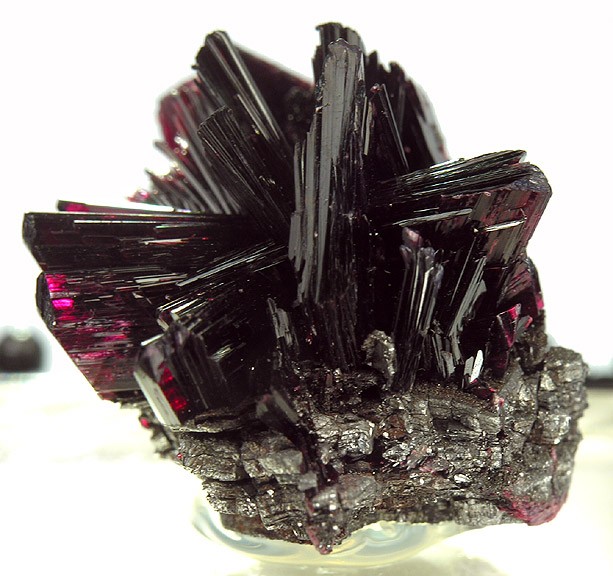
Erythrite crystallizes in the monoclinic system and forms prismatic crystals. The color is crimson to pink and occurs as a secondary coating known as cobalt bloom on cobalt arsenide minerals. Well-formed crystals are rare, with most of the mineral manifesting in crusts or small reniform aggregates.
Erythrite was first described in 1832 for an occurrence in Grube Daniel, Schneeberg, Saxony, and takes its name from the Greek έρυθρος (erythros), meaning red. Historically, erythrite itself has not been an economically important mineral, but the prospector may use it as a guide to associated cobalt and native silver.
Erythrite occurs as a secondary mineral in the oxide zone of Co–Ni–As bearing mineral deposits. It occurs in association with cobaltite, skutterudite, symplesite, roselite-beta, scorodite, pharmacosiderite, adamite, morenosite, retgersite, and malachite.
Notable localities are Cobalt, Ontario; La Cobaltera, Chile, Schneeberg, Saxony, Germany; Joachimsthal, Czech Republic; Cornwall, England; Bou Azzer, Morocco; the Blackbird mine, Lemhi County, Idaho; Sara Alicia mine, near Alamos, Sonora, Mexico; Mt. Cobalt, Queensland and the Dome Rock copper mine, Mingary, South Australia.
Other varieties
The nickel variety, annabergite, occurs as a light green nickel bloom on nickel arsenides. In addition iron, magnesium and zinc can also substitute for the cobalt position, creating three other minerals: parasymplesite (Fe), hörnesite (Mg) and köttigite (Zn).
References
References
- Warr, L.N.. (2021). "IMA–CNMNC approved mineral symbols". Mineralogical Magazine.
- (2005). "Erythrite". Mineral Data Publishing.
- "Erythrite".
- (2014). "Erythrite Mineral Data".
- ''Krivovichev V. G.'' Mineralogical glossary. Scientific editor [[:uk:Булах Андрій Глібович. A. G. Bulakh]]. — St.Petersburg: St.Petersburg Univ. Publ. House. 2009. — 556 p. — ISBN 978-5-288-04863-0
This article was imported from Wikipedia and is available under the Creative Commons Attribution-ShareAlike 4.0 License. Content has been adapted to SurfDoc format. Original contributors can be found on the article history page.
Ask Mako anything about Erythrite — get instant answers, deeper analysis, and related topics.
Research with MakoFree with your Surf account
Create a free account to save articles, ask Mako questions, and organize your research.
Sign up freeThis content may have been generated or modified by AI. CloudSurf Software LLC is not responsible for the accuracy, completeness, or reliability of AI-generated content. Always verify important information from primary sources.
Report