From Surf Wiki (app.surf) — the open knowledge base
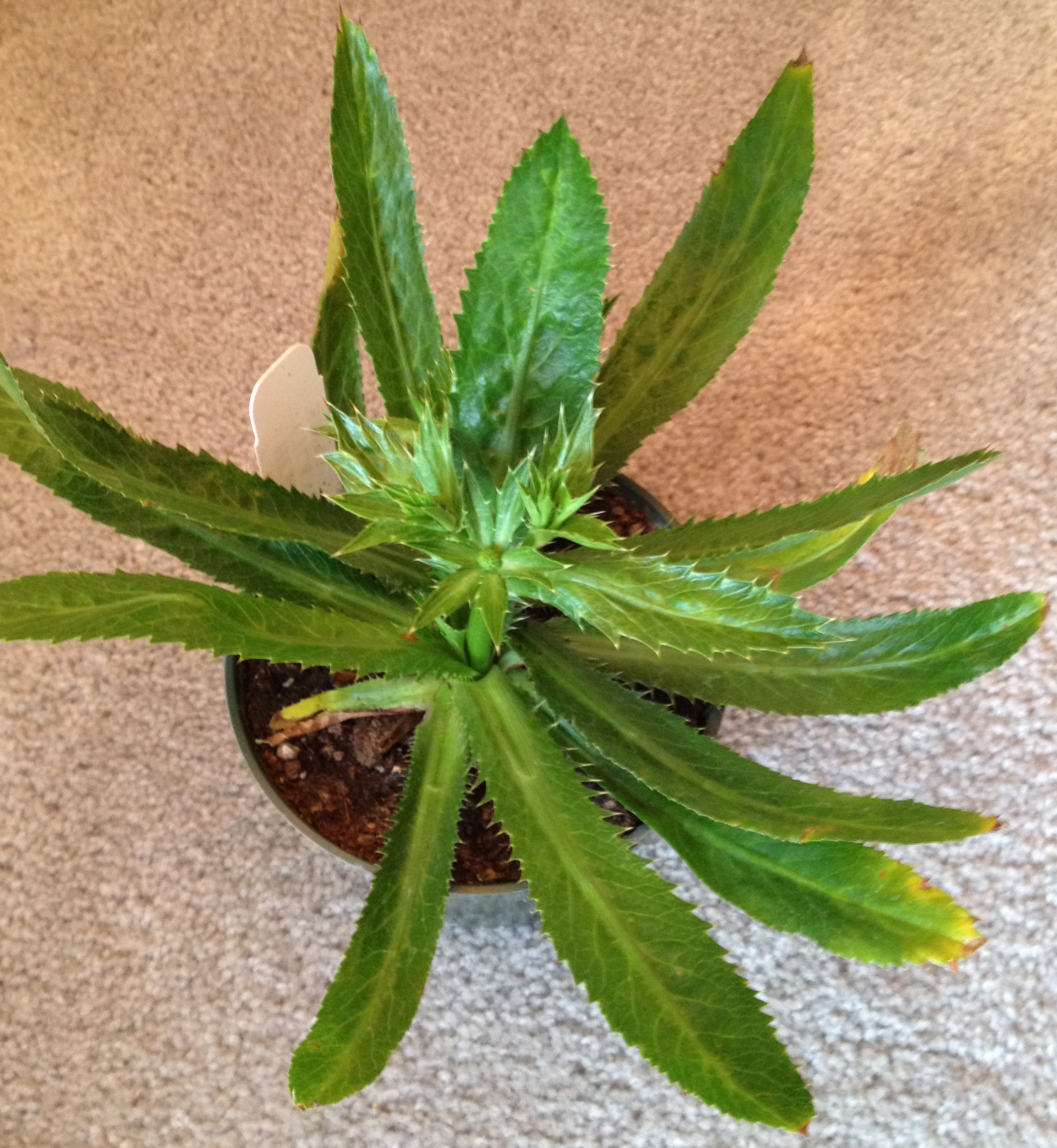
Eryngium foetidum
Species of flowering plant in the celery family
Species of flowering plant in the celery family
- Eryngium antihystericum Rottler |access-date=October 1, 2015}}
Eryngium foetidum is a tropical perennial herb in the family Apiaceae. Common names include culantro (Costa Rica and Panama) ( or ), cimarrón, recao (Puerto Rico), chardon béni (Martinique), Mexican coriander, samat, ban dhaniya, wide coriander, Burmese coriander, sawtooth coriander, Shadow Beni (Trinidad and Tobago), and ngò gai (Vietnam). It is native to Mexico, the Caribbean, and Central and South America, but is cultivated worldwide, mostly in the tropics as a perennial, but sometimes in temperate climates as an annual. In India it is called "Nagadhonia", specifically in the Northeast.
In the United States, the common name culantro sometimes causes confusion with cilantro, a common name for the leaves of Coriandrum sativum (also in Apiaceae but in a different genus), of which culantro is said to taste like a stronger version.
Uses
Culinary
Eryngium foetidum is widely used in seasoning, marinating and garnishing in the Caribbean (particularly in Cuba, the Dominican Republic, Haiti, Puerto Rico, and Trinidad and Tobago), as well as Guatemala, El Salvador, Honduras, Nicaragua, Panama, Costa Rica, Ecuador, Colombia and in Brazil's and Peru's Amazon regions. It is also used extensively as a culinary herb in the North-Eastern States of India (Tripura, Mizoram, Meghalaya, Assam, Nagaland, Manipur, Arunachal Pradesh and Sikkim), Cambodia [where it is called Chi Banla, Chi baraing ជីរបន្លា, ជីរបារាំង], Thailand, India, Nepal, Vietnam, Laos, Myanmar, Bangladesh, southwestern China and other parts of tropical Asia. It is sometimes used as a substitute for coriander leaves, but has a stronger, tangier taste. Unlike coriander, Eryngium foetidum dries well, retaining good color and flavor, which makes it valuable in the dried herb industry.
In the United States, E. foetidum grows naturally in Florida, Georgia, Hawaii, Puerto Rico, and the Virgin Islands.
The flower heads are not edible.
Traditional medicine
Eryngium foetidum has been used in traditional medicine in tropical regions for burns, earache, fevers, hypertension, constipation, fits, asthma, stomachache, worms, infertility complications, snake bites, diarrhea, and malaria.
Eryngium foetidum is also known as E. antihystericum. The specific name antihystericum reflects the fact that this plant has traditionally been used for epilepsy. The plant is said to calm a person's 'spirit' and thus prevents epileptic 'fits', so is known by the common names spiritweed and fitweed. The anticonvulsant properties of this plant have been scientifically investigated. A decoction of the leaves has been shown to exhibit anti-inflammatory and analgesic effects in rats.
Eryngial (trans-2-dodecenal) is the main constituent of essential oil of E. foetidum. The University of the West Indies at Mona, Jamaica, has investigated the use of eryngial as a treatment for human Strongyloides stercoralis infection (strongyloidiasis).
It is used as an ethnomedicinal plant for the treatment of a number of ailments such as chills, vomiting, burns, fevers, hypertension, headache, earache, stomachache, asthma, arthritis, snake bites, scorpion stings, diarrhea, malaria and epilepsy. A pharmacological investigation claims to have demonstrated anthelmintic, anti-inflammatory, analgesic, anticonvulsant, anticlastogenic, anticarcinogenic, antidiabetic, and antibacterial activity.
Chemistry
Qualitative analysis of the leaves demonstrated the presence of tannins and saponin, as well as some flavonoids; no alkaloids have been reported yet. Caffeic acid, chlorogenic acid, and kaempferol have been among the phenolic compounds found in E. foetidum leaves.
References
References
- {{GRIN
- "Culantro". WorldCrops.
- Ramcharan, C. (1999). [http://www.hort.purdue.edu/newcrop/proceedings1999/v4-506.html "Culantro: A much utilized, little understood herb"]. In: J. Janick (ed.), ''Perspectives on new crops and new uses''. ASHS Press, Alexandria, Virginia; p. 506–509.
- Singh BK, Ramakrishna Y and Ngachan SV. 2014. Spiny coriander (Eryngium foetidum L.): A commonly used, neglected spicing-culinary herb of Mizoram, India. Genetic Resources and Crop Evolution 61 (6): 1085-1090.
- [https://plants.usda.gov/java/profile?symbol=ERFO5 Distribution of ''Eryngium foetidum'' in the United States] United States Department of Agriculture
- (2011). "Eryngium foetidum L.: A review". [[Fitoterapia]].
- "Atlas of Florida Vascular Plants".
- Culantro. "Herbalpedia". The Herb Growing & Marketing Network.
- (1986). "Demonstration of anticonvulsant properties of an aqueous extract of Spirit Weed (''Eryngium foetidum'' L.)". The West Indian Medical Journal.
- (1997). "Antiinflammatory and analgesic properties from leaves ofEryngium foetidum L. (Apiaceae)". Phytotherapy Research.
- Yarnell, A. [http://pubs.acs.org/cen/science/8223/8223sci1a.html "Home Field Advantage"] ''[[Chemical & Engineering News]],'' June 7, 2004. Volume 82, Number 23, p. 33.
- (October 21, 2013). "Eryngial ( trans -2-dodecenal), a bioactive compound from Eryngium foetidum : its identification, chemical isolation, characterization and comparison with ivermectin in vitro". Parasitology.
- "Web of Science Beta".
This article was imported from Wikipedia and is available under the Creative Commons Attribution-ShareAlike 4.0 License. Content has been adapted to SurfDoc format. Original contributors can be found on the article history page.
Ask Mako anything about Eryngium foetidum — get instant answers, deeper analysis, and related topics.
Research with MakoFree with your Surf account
Create a free account to save articles, ask Mako questions, and organize your research.
Sign up freeThis content may have been generated or modified by AI. CloudSurf Software LLC is not responsible for the accuracy, completeness, or reliability of AI-generated content. Always verify important information from primary sources.
Report