From Surf Wiki (app.surf) — the open knowledge base
Erlitou culture
Bronze Age culture in China

Bronze Age culture in China
| Field | Value | |
|---|---|---|
| name | Erlitou culture | |
| map | Erlitou map.svg | |
| mapalt | Relief map of eastern China with oval marking an area in western Henan, and the Erlitou site just south of the Yellow River | |
| mapcaption | Erlitou in eastern China | |
| region | Western Henan | |
| period | Bronze Age China | |
| dates | ||
| definedby | Xu Xusheng | |
| typesite | Erlitou | |
| precededby | Longshan culture | |
| followedby | Erligang culture | |
| module | {{Infobox Chinese | child=yes |
| t | 二里頭文化 | |
| s | 二里头文化 | |
| p | Èrlǐtóu wénhuà |
The Erlitou culture () was an early Bronze Age society and archaeological culture. It existed in the Yellow River valley from approximately 1900 to 1500 BC. A 2007 study using radiocarbon dating proposed a narrower date range of 1750–1530 BC. The culture is named after Erlitou, an archaeological site in Yanshi, Henan. It was widely spread throughout Henan and Shanxi and later appeared in Shaanxi and Hubei. Most archaeologists consider Erlitou the first state-level society in China. Chinese archaeologists generally identify the Erlitou culture as the site of the Xia dynasty, but there is no firm evidence, such as surviving written records, to substantiate such a linkage, as the earliest evidence of Chinese writing dates to the Late Shang period.
Erlitou site
Main article: Erlitou
The Erlitou culture may have evolved from the matrix of Longshan culture. Originally centered around Henan and Shanxi province, the culture spread to Shaanxi and Hubei provinces. After the rise of the Erligang culture, the site at Erlitou diminished in size but remained inhabited.
Discovered in 1959 by Xu Xusheng, Erlitou is the largest site associated with the culture, with palace buildings and bronze smelting workshops. Erlitou monopolized the production of ritual bronze vessels, including the earliest recovered dings. The city is on the Yi River, a tributary of the Luo River, which flows into the Yellow River. The city was 2.4 by 1.9 km; however, because of flood damage only 3 km2 are left.
The Erlitou Site Museum of the Xia Capital, located in Luoyang, Henan province, which has more than 2,000 items excavated from the Erlitou site in its collection, opened in October 2019.
Phases
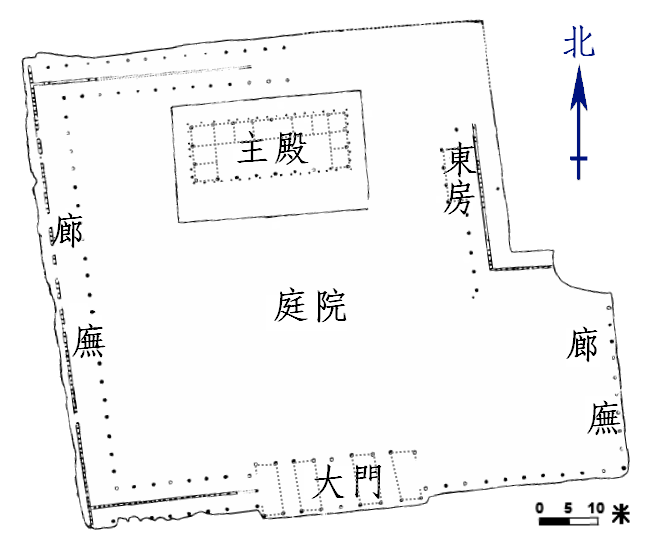
The site's growth is divided into four phases.
During Phase I, covering 100 ha, Erlitou was a rapidly growing regional center with an estimated population of several thousand people, but not yet an urban civilization.
Urbanization began in Phase II, expanding to 300 with a population of around 11,000. A palace area of 12 was demarcated by four roads. It contained the 150 x 50 m Palace 3, composed of three courtyards along a 150-metre axis, and Palace 5. A bronze foundry was established to the south of the palatial complex and was controlled by the elite. Tracks of vehicles were discovered near the palace. This is the earliest example of the usage of wheeled wagons in China.
The city reached its peak in Phase III, and may have had a population of around 24,000. The palatial complex was surrounded by a two-meter-thick rammed-earth wall, and Palaces 1, 7, 8 and 9 were built. Palace 1, the largest, had an area of 9600. Palaces 3 and 5 were abandoned and replaced by Palace 2, measuring 4200, and Palace 4.
In Phase IV, the population decreased to around 20,000, but building continued. Palace 6 was built as an extension of Palace 2, and Palaces 10 and 11 were built. Phase IV overlaps with the Lower Phase of the Erligang culture (1600–1450 BC). Around 1600 BC, a walled city was built at Yanshi, about 6 northeast of Erlitou.
Production of bronzes and other elite goods ceased at the end of Phase IV, at the same time as the Erligang city of Zhengzhou was established 85 to the east. There is no evidence of destruction by fire or war, but, during the Upper Erligang phase (1450–1300 BC), all the palaces were abandoned, and Erlitou was reduced to a village of 30.
Bronzeworking
The Erlitou culture is the earliest large-scale bronze producing culture in China, with the new-fashioned section-mold process there to produce ritual vessels and other bronzes.
Although the remains of bronze have been found in the Qijia and Siba Cultures, Erlitou bronzes are significantly more advanced and prolific. The Erlitou culture not only has bronze tools and bell musical instruments, but also bronze weapons and unique animal-faced plaques, especially more than ten kinds of bronze vessels have been unearthed. This shows that the bronze casting of Erlitou is diverse and systematic.
There are no copper resources in the Luoyang Plain. It has been suggested the Eridou culture acquired the ore in the Zhongtiao Mountains of southern Shanxi, the same place they probably acquired salt.
Erlitou bronzes have obvious features imitating pottery, with plain surfaces or simple geometric patterns. In the third phase of the Erlitou culture, the perforated decoration that was very popular throughout the Erlitou culture appeared on the bronze jue.
Many archetypal Chinese artifacts were first found in Erlitou culture sites. The earliest bronze ding in China were found in the fourth stage of the Erlitou culture, decorated with striped grid patterns. The earliest metal bells, with one found in the Taosi site, and four in the Erlitou site, dated to about 2000 BC, may have been derived from the earlier pottery prototype. The first bronze dagger-axe or ge appeared at the Erlitou site, where two were found among over 200 bronze artifacts (as of 2002) at the site. Three jade ge were also discovered from the same site.
洛阳博物馆 Bronze tripod jue.jpg|Bronze jue goblet 18th cent BC wine vessel.jpg|Bronze jue goblet Turquoise-Inlaid Plaque with Stylized Animal-Mask Decoration, 1900-1350 BC, Neolithic to Shang period, Erlitou culture, China, bronze with turquoise inlay - Sackler Museum - DSC02627.JPG|Ornamental bronze plaque inlaid with turquoise pieces Turquoise-Inlaid Plaque with Stylized Animal-Mask Decoration and Elongated Extension, 1900-1350 BC, Neolithic to Shang period, Erlitou culture, China, bronze with turquoise inlay - Sackler Museum - DSC02630.JPG File:20210529 Bronze Ding with mesh pattern on display at Zhengzhou Museum.jpg|Bronze ding cauldron
Jadeworking
Like other contemporaneous cultures in China, jade was worked into ritual objects at Erlitou sites. These included ceremonial blades (zhang) as well as ritual dagger-axes (ge).
Xia Dynasty jade knife 2.jpg|Jade ritual blade with seven holes Xia Jade Zhang.jpg|Jade ritual blade with ornate edges Dagger-axe (ge 戈).jpg|Jade ritual dagger-axe (ge)
Symbols
Symbols on ceramic pieces have been found at Erlitou culture sites, leading to speculation about possible connections with early Chinese characters, which appear several centuries later in the same region. However, no clear linkage has been proven yet, thus the symbols are currently considered markings or proto-writing.
二里头遗址发现的二十四种陶纹符号.png|Early symbols appearing on ceramics; from the site of Yanshi 二里头遗址三期陶纹.png Characters from Erlitou Culture, Yanshi, Henan (10185242295).jpg
Relation to traditional accounts
A major goal of archaeology in China has been the search for the capitals of the Xia and Shang dynasties described in traditional accounts as inhabiting the Yellow River valley. These originally oral traditions were recorded much later in histories such as the Bamboo Annals () and the Records of the Grand Historian (1st century BC), and their historicity, particularly regarding the Xia, was challenged by the Doubting Antiquity School of Chinese history. The discovery of writing in the form of oracle bones at Yinxu in Anyang definitively established the site as the last capital of the Shang, but such evidence is unavailable for earlier sites.
The Erlitou culture is found in broadly the same area (southern Shanxi and western Henan) and same period (early second millennium BC) as the received texts indicate for the Xia, leading many scholars, especially in China, to identify the Erlitou culture as the material residue of the Xia, with Erlitou as its capital.
When Xu Xusheng first discovered Erlitou, he suggested that it was Bo, the first capital of the Shang under King Tang in the traditional account. Since the late 1970s, archaeologists in China have tended to identify the site with Zhenxun, the last Xia capital. The traditional account of the overthrow of the Xia by the Shang has been identified with the ends of each of the four phases of the site by different authors. The Xia–Shang–Zhou Chronology Project identified all four phases of Erlitou as Xia, and the construction of the Yanshi walled city as the founding of the Shang. As the period indicated by the Bamboo Annals was longer than the span of the Erlitou culture, the project also assigned the later phases of the Wangwan III variant of the Longshan culture to the Xia period. Other scholars, particularly outside China, point to the lack of any firm evidence for such an identification, and argue that the historiographical focus of Chinese archaeology is unduly limiting.
Archaeological evidence of a large outburst flood at Jishi Gorge that destroyed the Lajia site on the upper reaches of the Yellow River has been dated to about 1920 BC. This date is shortly before the rise of the Erlitou culture in the middle Yellow River valley and the Yueshi culture in Shandong, following the decline of the Longshan culture in the North China Plain. The authors suggest that this flood may have been the basis for the later myth, and contributed to the transition of cultures. They further argue that the timing is further evidence for the identification of the Xia with the Erlitou culture.{{cite journal However, no evidence of contemporaneous widespread flooding in the North China Plain has yet been found.{{cite web | access-date = 5 August 2016
References
Works cited
- {{cite journal
- {{cite journal
- {{cite book
- {{cite journal
- {{cite book
- {{cite web | access-date = 2009-02-03 | archive-url = https://web.archive.org/web/20150321013017/http://www.china.org.cn/english/2003/Nov/79635.htm | archive-date = March 21, 2015 | url-status = dead
- {{cite journal
- {{cite book
- {{cite book
- {{cite book | editor-given = Glenn | editor-surname = Storey
- {{cite journal
- {{cite book
- {{cite journal
- {{cite book
- {{cite journal | translator-surname1 = Zhang | translator-given1 = Xuelian | translator-given2 = Yun Kuen | translator-surname2 = Lee
References
- [https://www.shanghaimuseum.net/mu/frontend/pg/article/id/CI00004282 Shanghai Museum]
- "Erlitou Relic Museum opens in Central China – China.org.cn".
- (2020). "Metalworking in Bronze Age China: The Lost-Wax Process". Cambria Press.
- (2020). "On the Casting Technique of Bronze Vessels of Erlitou and Erligang Culture in the Perspective of Decorative Complication".
- (1991). "河南偃师二里头遗址发现新的铜器 New bronze ware found at Erlitou site in Yanshi, Henan". Kaogu.
- (2007). "Archaeologica". Global Book.
- (2004). "Identification of Writing in the Xia Period: A Study of Pottery Glyphs in the Erlitou Culture". Chinese Archaeology.
- (2010). "Chinese City And Urbanism: Evolution And Development". World Scientific.
This article was imported from Wikipedia and is available under the Creative Commons Attribution-ShareAlike 4.0 License. Content has been adapted to SurfDoc format. Original contributors can be found on the article history page.
Ask Mako anything about Erlitou culture — get instant answers, deeper analysis, and related topics.
Research with MakoFree with your Surf account
Create a free account to save articles, ask Mako questions, and organize your research.
Sign up freeThis content may have been generated or modified by AI. CloudSurf Software LLC is not responsible for the accuracy, completeness, or reliability of AI-generated content. Always verify important information from primary sources.
Report