From Surf Wiki (app.surf) — the open knowledge base
English Phonotypic Alphabet
Phonetic alphabet developed by Isaac Pitman and Alexander John Ellis

Phonetic alphabet developed by Isaac Pitman and Alexander John Ellis


.png)
The English Phonotypic Alphabet is a phonetic alphabet developed by Sir Isaac Pitman and Alexander John Ellis originally as an English language spelling reform. Although never gaining wide acceptance, elements of it were incorporated into the modern International Phonetic Alphabet.
It was originally published in June 1845. Subsequently, adaptations were published which extended the alphabet to the German, Arabic, Spanish, Tuscan, French, Welsh, Italian, Dutch, Polish, Portuguese and Sanskrit languages.
26 EPA letters are in the pipeline for publication by Unicode in 2026.
Etymology
The English Phonotypic Alphabet was a phonotype, which is a phonetic form of printing derived from the Greek root "phon-" for voice and "-typ" for type. As such, Pitman and Ellis gave their alphabet the alternative name of Phonotypy or, even more phonetically, Fonotypy. It was designed to be the print form extension of Pitman Shorthand, a form of abbreviated phonetic handwriting.** It is closely associated with Phonetic Longhand, which is the handwritten, or script, form of Phonotypy.
Purpose
The philosophical case for the English Phonotypic Alphabet was made by Alexander John Ellis, who conducted an extensive study of the problems with English orthography, which he published in his treatise Plea for Phonetic Spelling, or the Necessity of Orthographic Reform, in 1848. Learned societies such as the London Philological Society and education journals such as The Massachusetts Teacher debated the arguments for reform and the utility of the English Phonotypic Alphabet.
Unexpectedly, when the English Phonotypic Alphabet was trialled to teach literacy, it was discovered that after learning to read & write, students effortlessly transitioned their literacy skills to traditional English orthography. This also gave purpose to the English Phonotypic Alphabet being used as a transitional mechanism to improve the teaching of literacy.
Letters
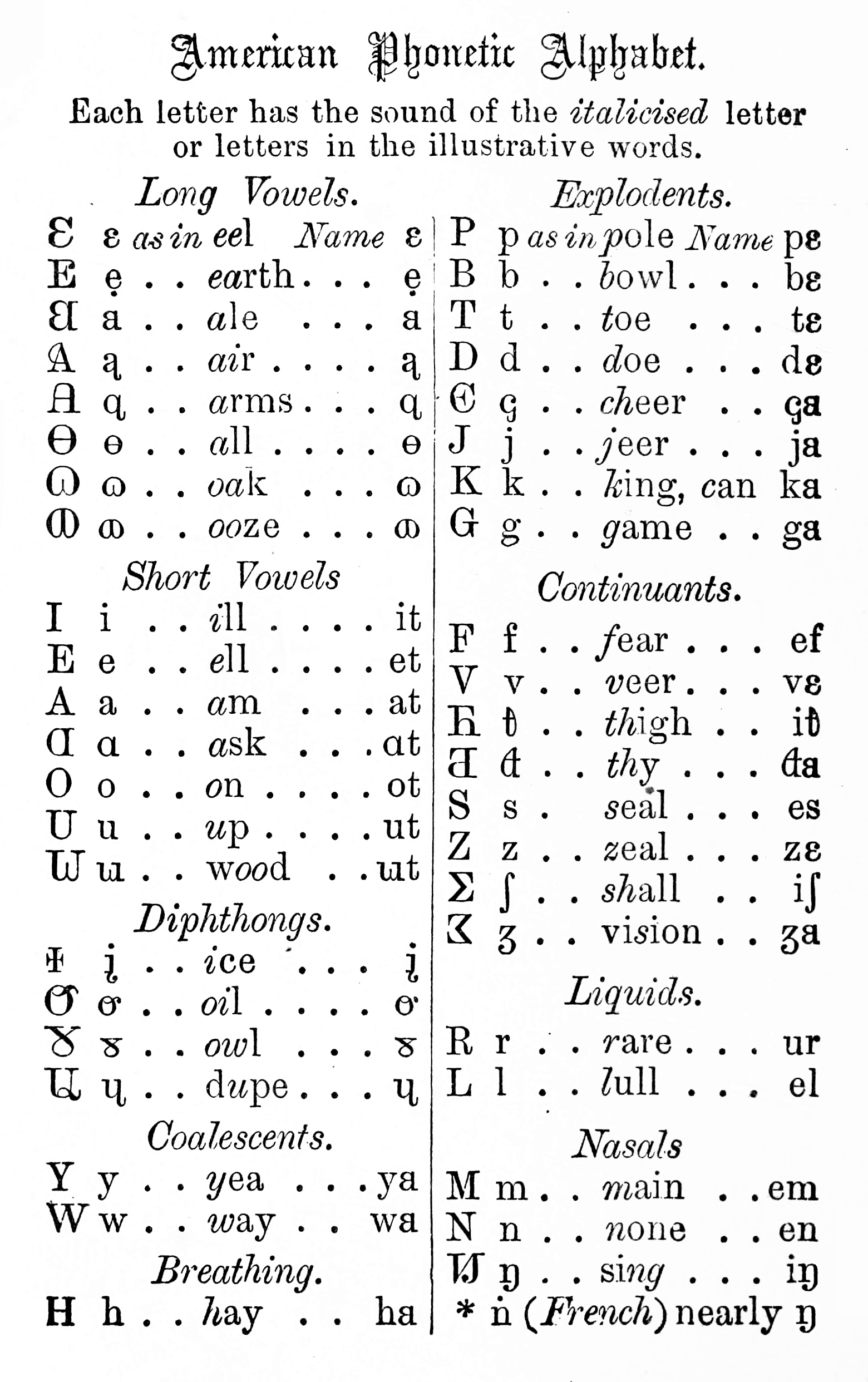
The letters are as follows:
Late 1843 (English)
At this stage, long vowels had a cross-bar, and short vowels did not
;Long vowels Ɨ /iː/, E /eɪ/, A /ɑː/, Ɵ /ɔː/, Ʉ /oʊ/?, ᗻ (for some fonts ᗼ) /uː/
;Short vowels I /ɪ/, ⵎ /ɛ/, Ʌ /æ/, O /ɒ/, U /ʌ/, ᗯ /ʊ/
(the letter for /ʊ/ was like but with the middle stem not so tall as the others, and did not have a serif at the bottom right)
;Diphthongs Ɯ /juː/ (like Iᗯ), ⅄ /aɪ/ (like ɅI), Ȣ /aʊ/ (like Oᗯ)?
;Reduced ('obscure') vowels Ǝ /ə/, ⵎ /ᵊ/
;Consonants P B, T D, Є J /tʃ dʒ/, K G
F V, Θ Δ /θ ð/, S Z, Σ Σ /ʃ ʒ/,
L R, M N, [[File:Latin capital letter phonotypic Eng.svg|7px]] /ŋ/, Y W H.
1847
; Vowels
| Front | Back | Close | Near-close | Open-mid | Near-open | ||
|---|---|---|---|---|---|---|---|
| Ɛɛ• | •[[File:Latin capital letter UU.svg | 18px]]ɯ | |||||
| Ii• | •[[File:Latin capital letter u with notch.svg | 16px]][[File:Latin small letter u with notch.svg | 16px]] | ||||
| Ee• | Uu•Oo | ||||||
| Aɑ• | [[File:Latin capital letter A with topbar.svg | 14px]][[File:Latin small letter Alpha with u-turned tail.svg | 10px]]•Ɵɵ |
| Back | Close | ||
|---|---|---|---|
| •[[File:Latin capital letter u with flourish.svg | 16px]][[File:Latin small letter U with u-turned tail.svg | 10px]] |
| Front | Back | Close-mid | Near-open | Open | ||
|---|---|---|---|---|---|---|
| [[File:Latin capital letter roundtop A.svg | 13px]]a• | |||||
| •[[File:Latin capital letter O with curl.svg | 15px]][[File:Latin small letter O with curl.svg | 10px]] | ||||
| [[File:Latin capital letter I with long stroke overlay.svg | 10px]][[File:Latin small letter I with spiral tail.svg | 7px]]• |
| Front | Back | Close-mid | Open | ||
|---|---|---|---|---|---|
| •[[File:Latin capital letter closed Omega.svg | 14px]]ɷ | ||||
| [[File:Latin capital letter Ow.svg | 15px]][[File:Latin small letter Ow.svg | 10px]]• |
| **Pulmonic section** | Labial | Coronal | Dorsal | Laryngeal | Bilabial | Labiodental | Dental | Alveolar | Postalveolar | Palatal | Velar | Glottal | Nasal | Plosive | Sibilant affricate | Sibilant fricative | Non-sibilant fricative | Approximant | Lateral approximant | **Co-articulated** section | Labial-velar | ||
|---|---|---|---|---|---|---|---|---|---|---|---|---|---|---|---|---|---|---|---|---|---|---|---|
| •Mm | •Nn | •[[File:Latin capital letter phonotypic Eng.svg | 10px]]ŋ | ||||||||||||||||||||
| Pp•Bb | Tt•Dd | Cc•Gg | |||||||||||||||||||||
| [[File:Latin capital letter C with middle serifed bar.svg | 10px]]ꞔ•Jj | ||||||||||||||||||||||
| Ss•Zz | Σʃ•[[File:Latin capital letter angular Ezh.svg | 10px]]ʒ | |||||||||||||||||||||
| Ff•Vv | Ꞁ[[File:Latin small letter phonotypic Th early Pitman form.svg | 7px]]•Ƌ[[File:Latin small letter phonotypic Dh.svg | 9px]] | Hh• | |||||||||||||||||||
| •Rr | •Yy | ||||||||||||||||||||||
| •Ll | |||||||||||||||||||||||
| •Ww |
Teaching Literacy

These trials culminated in the adoption of the English Phonotypic Alphabet in two public school districts in the United States: - Waltham, Massachusetts, between 1852 & 1860 and Syracuse, New York, between 1850 & 1866. Both districts used a variant of the English Phonotypic Alphabet known as the Cincinnati Phonotypy or the American Phonetic Alphabet. This type was used by Longley Brothers to publish a set of reading-books: - a first phonetic reader, a second phonetic reader, and a transition reader.
Waltham

In the 1852-53 annual report of Waltham's school committee, the chairman, Reverend Thomas Hill, reported the effect of Phonotypy on the 800 pupils within the ten schools: –**"It has been proved in repeated experiment that if a child upon his first learning his letters, is taught the Phonetic Alphabet, and is confined to Phonetic books for the first six to eight months of schooling, he will at the end of the first year's schooling read common print and spell in common spelling better than children will ordinarily do at the end of four or five year's instruction."
Syracuse

Bothe's analysis of the course of study for the Syracuse school district measured the improvement from using Phonotypy: - In 1855, before the introduction of the transitional alphabet, the student was expected to finish reading Webb's Second Reader by the end of the third grade. In 1858, the first year in which phonetic texts appeared in the course of study, Webb's Second Reader was entirely completed two-thirds through the second grade (four trimesters gained).
Successor
.png)
Dr Edwin Leigh extensively practised using Phonotypy to teach literacy. He became persuaded of its efficacy and a passionate advocate but failed to convince his own St. Louis school district to adopt it. He concluded that Phonotypy was not widely accepted because parents, teachers, and district officials could not understand the orthography themselves.

Phonotypy had never been designed as a transitionary mechanism to attain literacy in standard English; instead, people had only realised it could be used this way after it was launched. Subsequently, Leigh designed a successor, Pronouncing Orthography, which was explicitly designed for this purpose, and to this end, it superseded Phonotypy as a transitory orthography toward literacy.
Citations
References
References
- (25 January 2019). "Bath Abbey: Revelations from Abbey Chambers, Kingston Buildings and the 4th Fonetik Institut".
- (1996). "The World's Writing Systems". Oxford University Press.
- Coulmas, Florian. (1999-03-12). "The Blackwell Encyclopedia of Writing Systems". Wiley.
- (June 1845). "Completion of the Phonotypic Alphabet". Phonographic Institution.
- (June 1845). "Extension of the Phonotypic Alphabet". Phonographic Institution.
- [https://www.unicode.org/L2/L2025/25003.htm#182-C7]
- "Word Root: typ (Root)".
- "Word Root: phon (Root)".
- Longley, Elias [Secretary of the American Phonetic Association]. (1878). "The Phonetic Educator: Devoted to Phonography and the Spelling Reform". Phonetic Publishing Company.
- Blake, F.N.. (1850-03-01). "Spelling Reform". The Massachusetts Teacher.
- Hill, Thomas. (1856-07-03). "The Four Ways of Teaching to Read: An Address Delivered Before the Ohio Teachers' Association, July 3rd, 1856". Longley Brothers.
This article was imported from Wikipedia and is available under the Creative Commons Attribution-ShareAlike 4.0 License. Content has been adapted to SurfDoc format. Original contributors can be found on the article history page.
Ask Mako anything about English Phonotypic Alphabet — get instant answers, deeper analysis, and related topics.
Research with MakoFree with your Surf account
Create a free account to save articles, ask Mako questions, and organize your research.
Sign up freeThis content may have been generated or modified by AI. CloudSurf Software LLC is not responsible for the accuracy, completeness, or reliability of AI-generated content. Always verify important information from primary sources.
Report