From Surf Wiki (app.surf) — the open knowledge base
Economy of Nigeria
none

none
| Field | Value | ||||||||
|---|---|---|---|---|---|---|---|---|---|
| country | Nigeria | ||||||||
| image | Aerial view of victoria island in Lagos, Nigeria with habours for yatches.jpg | ||||||||
| caption | Lagos, the financial centre of Nigeria | ||||||||
| currency | Nigerian naira (NGN, ₦) | ||||||||
| year | 1 April – 31 March | ||||||||
| organs | AU, AfCFTA, ECOWAS, WTO | ||||||||
| group | {{plainlist | ||||||||
| *Developing/Emerging<ref>{{cite web | url | https://www.imf.org/external/pubs/ft/weo/2019/01/weodata/weoselco.aspx?g=2200&sg=All+countries+%2f+Emerging+market+and+developing+economies | title=World Economic Outlook Database, April 2019 | website=IMF.org | publisher=International Monetary Fund | access-date=29 September 2019 | archive-date=10 October 2020 | archive-url=https://web.archive.org/web/20201010203013/https://www.imf.org/external/pubs/ft/weo/2019/01/weodata/weoselco.aspx?g=2200&sg=All+countries+%2F+Emerging+market+and+developing+economies | url-status=live }} |
| *Lower-middle income economy<ref>{{cite web | url | https://datahelpdesk.worldbank.org/knowledgebase/articles/906519-world-bank-country-and-lending-groups | title=World Bank Country and Lending Groups | publisher=World Bank | access-date=29 September 2023 | archive-date=28 October 2019 | archive-url=https://web.archive.org/web/20191028223324/https://datahelpdesk.worldbank.org/knowledgebase/articles/906519-world-bank-country-and-lending-groups | url-status=live }}}} | |
| population | 223,804,632 | ||||||||
| (2023)<ref>{{cite web | url | https://data.worldbank.org/indicator/SP.POP.TOTL?locations=NG | title=Population, total | publisher=World Bank | access-date=24 June 2021 | archive-date=29 October 2017 | archive-url=https://web.archive.org/web/20171029012507/https://data.worldbank.org/indicator/SP.POP.TOTL?locations=NG | url-status=live }} | |
| gdp | {{plainlist | ||||||||
| * $285.003 billion (nominal; )<ref name | "IMF DataMapper" | ||||||||
| * $2.254 trillion (PPP; )<ref name | "IMF DataMapper"/ | ||||||||
| gdp rank | {{plainlist | ||||||||
| growth | {{plainlist | ||||||||
| * 3.9% (2025)<ref name | "IMF DataMapper" / | ||||||||
| * 4.2% (2026)<ref name | "IMF DataMapper" / | ||||||||
| * 4.0% ()<ref name | "IMF DataMapper" / | ||||||||
| * 4.0% ()<ref name | "IMF DataMapper" / | ||||||||
| per capita | {{plainlist | ||||||||
| * $1,200 (nominal; )<ref name | "IMF DataMapper"/ | ||||||||
| * $9,488 (PPP; )<ref name | "IMF DataMapper"/ | ||||||||
| per capita rank | {{plainlist | ||||||||
| sectors | {{plainlist | ||||||||
| *(2020 est.)<ref>{{Cite web | title | Nigeria's GDP Grew By 1.87% YoY in Real Terms in Q1 2020 | url=https://www.proshareng.com/news/Nigeria-Economy/Nigeria-s-GDP-Grew-By--1.87Percent-YoY-in-Real-Terms-in-Q1-2020/51230 | access-date=2020-08-24 | website=Proshareng | language=en | archive-date=17 December 2020 | archive-url=https://web.archive.org/web/20201217171206/https://www.proshareng.com/news/Nigeria-Economy/Nigeria-s-GDP-Grew-By--1.87Percent-YoY-in-Real-Terms-in-Q1-2020/51230 | url-status=live }}}} |
| inflation | 33.20% (2024 est.) | ||||||||
| poverty | 31,21% on less than $2,15/ day (2025 est) | ||||||||
| 48,82% on less than $3,65/ day (2025 est)<ref>{{cite web | title | Nigeria SDR | url=https://dashboards.sdgindex.org/profiles/nigeria/indicators | website=sdgindex.org | publisher=SDR | access-date=19 October 2025 | date=October 2025}} | ||
| gini | 35.1 (2020) | ||||||||
| hdi | {{plainlist | ||||||||
| * 0.548 (2022)<ref>{{cite web | url | http://hdr.undp.org/en/indicators/137506 | title=Human Development Index (HDI) | website=hdr.undp.org | publisher=HDRO (Human Development Report Office) United Nations Development Programme | access-date=26 March 2024 | archive-date=19 March 2022 | archive-url=https://web.archive.org/web/20220319173759/http://hdr.undp.org/en/indicators/137506 | url-status=live }} (161st)}} |
| cpi | 25 out of 100 points (2023, 145th rank) | ||||||||
| labor | {{plainlist | ||||||||
| * 100,571,000 (Q1 2024)<ref name | "NBS Unemployment"}} | ||||||||
| occupations | {{plainlist | ||||||||
| *(2010)<ref>{{cite web | url | http://www.nigerianstat.gov.ng/pages/download/41 | title=Labour Force Statistics, 2010 | publisher=Nigerian Bureau of Statistics | year=2010 | access-date=22 June 2015 | url-status=dead | archive-url=https://web.archive.org/web/20150424153316/http://www.nigerianstat.gov.ng/pages/download/41 | archive-date=24 April 2015 }}}} |
| unemployment | 22.6% (Q1 2025 est) | ||||||||
| industries | Cement, oil refining, construction and construction materials, food processing and food products, beverages and tobacco, textiles, apparel and footwear, pharmaceutical products, wood products, pulp paper products, chemicals, ceramic products, plastic and rubber products, electrical and electronic products, base metals: iron and steel, information technology, automobile manufacturing, and other manufacturing (2015) | ||||||||
| <!--DUPLICATE | exports | $53.617 billion (2019) DUPLICATE-- | exports = $42.4 billion (2022) | ||||||
| export-goods | Petroleum and petroleum products, chemicals, vehicles, aircraft parts, vessels, vegetable products, processed food, beverages, spirits and vinegar, cashew nuts, processed leather, cocoa, tobacco, aluminum alloys | ||||||||
| (2015) | |||||||||
| export-partners | {{plainlist | ||||||||
| *(2020)<ref name | "OEC"}} | ||||||||
| imports | $52 billion (2022) | ||||||||
| import-goods | Industry supplies, machinery, appliances, vehicles, aircraft parts, chemicals, base metals | ||||||||
| (2015) | |||||||||
| import-partners | {{plainlist | ||||||||
| *(2020)<ref name | "OEC"/}} | ||||||||
| current account | $10.38 billion (2017 est.) | ||||||||
| FDI | {{plainlist | ||||||||
| * $116.9 billion (31 December 2017 est.)<ref name | "CIA World Fact Book - Nigeria"/ | ||||||||
| * Abroad: $16.93 billion (31 December 2017 est.)<ref name | "CIA World Fact Book - Nigeria"/}} | ||||||||
| gross external debt | $85.9 billion (31 December 2020 est.) | ||||||||
| debt | 36.6% of GDP (2021 est.) | ||||||||
| revenue | ₦11.045 trillion | ||||||||
| 14.16% of GDP (2023) | |||||||||
| expenses | ₦21.827 trillion | ||||||||
| 27.99% of GDP (2023) | |||||||||
| balance | $5.2 billion; 1% of GDP (2014) | ||||||||
| credit | {{plainlist | ||||||||
| *Standard & Poor's:<ref>{{cite web | title | Sovereigns rating list | publisher=Standard & Poor's | url=http://www.standardandpoors.com/ratings/sovereigns/ratings-list/en/eu/?subSectorCode=39 | access-date=26 May 2011 | archive-date=26 June 2015 | archive-url=https://web.archive.org/web/20150626122915/http://www.standardandpoors.com/ratings/sovereigns/ratings-list/en/eu/?subSectorCode=39 | url-status=live }} | |
| *Outlook: Stable<ref name | guardian | ||||||||
| *Fitch:<ref name | guardian/ | ||||||||
| reserves | $38.77 billion (31 December 2017 est.) |
- Developing/Emerging
- Lower-middle income economy}} (2023)
- $285.003 billion (nominal; 2025)
- $2.254 trillion (PPP; 2025)
- 52nd (nominal; 2025)
- 19th (PPP; 2025)
- 3.9% (2025)
- 4.2% (2026)
- 4.0% (2027f)
- 4.0% (2028f)
- $1,200 (nominal; 2025)
- $9,488 (PPP; 2025)
- 173rd (nominal; 2025)
- 135th (PPP; 2025)
- Agriculture: 21.96%
- Industry: 23.65%
- Services: 54.39%
- (2020 est.)}} 48,82% on less than $3,65/ day (2025 est)
- 0.548 (2022) (161st)}}
- 100,571,000 (Q1 2024)}}
- Accommodation, food, transportation, and real estate: 12.2%
- Education, health, science, and technology: 6.3%
- Farming, forestry and fishing: 30.5%
- Manufacturing, mining, and quarrying: 11.3%
- Retail, maintenance, repair, and operations: 24.9%
- Managerial, finance and insurance: 4.2%
- Telecommunications, arts, and entertainment: 1.8%
- Other services: 8.8%
- (2010)}} | export-goods = Petroleum and petroleum products, chemicals, vehicles, aircraft parts, vessels, vegetable products, processed food, beverages, spirits and vinegar, cashew nuts, processed leather, cocoa, tobacco, aluminum alloys (2015) | export-partners = {{plainlist|
- India 14.8%
- Spain 11.3%
- China 5.99%
- Netherlands 5.27%
- South Africa 5.12%
- France 4.65%
- (2020)}} | import-goods = Industry supplies, machinery, appliances, vehicles, aircraft parts, chemicals, base metals (2015) | import-partners = {{plainlist|
- China 33.6%
- Netherlands 8.82%
- United States 8.63%
- India 6.65%
- Belgium 3.82%
- (2020)}}
- $116.9 billion (31 December 2017 est.)
- Abroad: $16.93 billion (31 December 2017 est.)}} 14.16% of GDP (2023) 27.99% of GDP (2023)
- Standard & Poor's:
- B+ (Domestic)
- B+ (Foreign)
- B+ (T&C Assessment)
- Outlook: Stable
- Fitch:
- BB-
- Outlook: Stable}}
The economy of Nigeria is a lower-middle-income, mixed economy and emerging market with expanding manufacturing, financial, service, communications, technology, and entertainment sectors. It is ranked as the 52nd-largest economy in the world in terms of nominal GDP, the second largest in Africa in terms of purchasing power parity, and the 19th-largest in terms of purchasing power parity.
The country's re-emergent manufacturing sector became the largest on the continent in 2013, and it produces a large proportion of goods and services for the region of West Africa. Nigeria's debt-to-GDP ratio was 36.63% in 2021 according to the IMF.
Although oil revenues contributed 2/3 of state revenues, oil only contributes about 9% to the GDP. Nigeria produces about 2.7% of the world's oil supply. Although the petroleum sector is important, as Nigeria's government revenues still heavily rely on this sector, it remains a small part of the country's overall economy. The largely subsistence agricultural sector has not kept up with the country's rapid population growth. Nigeria was once a large net exporter of food, but currently imports some of its food products. Mechanization has led to a resurgence in the manufacturing and exporting of food products, and there was consequently a move towards food sufficiency. In 2006, Nigeria came to an agreement with the Paris Club to buy back the bulk of its owed debts from them, in exchange for a cash payment of roughly US$12 billion.
According to a report by Citigroup, published in February 2011, Nigeria had the highest projected average GDP growth in the world between 2010 and 2050. Nigeria is one of two countries from Africa among the 11 Global Growth Generators countries.
Overview
In 2014, Nigeria rebased its GDP to account for fast-growing contributors such as telecommunications, banking, and its film industry to its economy. Human capital is underdeveloped, as Nigeria ranked 161 out of 189 countries in the United Nations Development Index in 2019—and non-energy-related infrastructure is inadequate.
Nigeria has advanced efforts to provide universal primary education, and protect the environment.
A requirement for achieving many of its objectives is reducing endemic corruption, which obstructs development and stains Nigeria's business environment. However, while broad-based progress has been slow, these efforts are becoming visible in international surveys of corruption. Nigeria's ranking has mostly improved since 2001, ranking 154 out of 180 countries in Transparency International's 2021 Corruption Perceptions Index.
The Nigerian economy suffers from an ongoing supply crisis in the power sector. Despite a rapidly growing economy, some of the world's largest deposits of coal, oil, and gas and the country's status as Africa's largest oil producer, power supply difficulties are frequently experienced by residents. Two-thirds of Nigerians expect living conditions to improve in the coming decades. According to the National Bureau of Statistics (NBS) Nigeria's GDP grew by 3.19% in Q2 2024. The non-oil sector drove growth, expanding by 4.13%, while the oil sector contracted by -3.83%.
Economic history
The following table shows the main economic indicators in 1990–2023 (with IMF staff estimates in 2024–2029). Inflation under 10% is in green.
| Year | GDP | ||||||
|---|---|---|---|---|---|---|---|
| (in bn. US$PPP) | GDP per capita | ||||||
| (in US$ PPP) | GDP | ||||||
| (in bn. US$nominal) | GDP per capita | ||||||
| (in US$ nominal) | GDP growth | ||||||
| (real) | Inflation rate | ||||||
| (in Percent) | Government debt | ||||||
| (in % of GDP) | |||||||
| 1990 | 165.5 | 1,739 | 62.2 | 653 | n/a | n/a | 71.7% |
| 1991 | 170.2 | 1,743 | 60.1 | 616 | -0.6% | n/a | 75.0% |
| 1992 | 177.9 | 1,776 | 52.3 | 522 | 2.2% | n/a | 70.2% |
| 1993 | 185.0 | 1,801 | 56.8 | 553 | 1.6% | n/a | 71.0% |
| 1994 | 189.4 | 1,799 | 80.1 | 761 | 0.3% | n/a | 55.9% |
| 1995 | 197.0 | 1,825 | 132.2 | 1,225 | 1.9% | n/a | 34.0% |
| 1996 | 208.7 | 1,886 | 172.7 | 1,560 | 4.1% | 29.3% | 25.2% |
| 1997 | 218.5 | 1,925 | 187.9 | 1,656 | 2.9% | 10.7% | 24.1% |
| 1998 | 226.4 | 1,947 | 209.7 | 1,803 | 2.5% | 7.9% | 22.3% |
| 1999 | 230.8 | 1,935 | 57.5 | 482 | 0.5% | 6.6% | 64.9% |
| 2000 | 249.1 | 2,037 | 67.8 | 555 | 5.5% | 6.9% | 57.6% |
| 2001 | 271.7 | 2,167 | 73.1 | 583 | 6.7% | 18.9% | 53.1% |
| 2002 | 316.2 | 2,459 | 94.0 | 731 | 14.6% | 12.9% | 43.3% |
| 2003 | 353.1 | 2,677 | 102.9 | 780 | 9.5% | 14.0% | 42.1% |
| 2004 | 400.4 | 2,959 | 130.3 | 963 | 10.4% | 15.0% | 35.5% |
| 2005 | 441.9 | 3,182 | 169.6 | 1,222 | 7.0% | 17.9% | 18.9% |
| 2006 | 486.2 | 3,411 | 222.8 | 1,563 | 6.7% | 8.2% | 9.4% |
| 2007 | 535.9 | 3,662 | 262.2 | 1,792 | 7.3% | 5.4% | 8.1% |
| 2008 | 585.5 | 3,897 | 330.3 | 2,198 | 7.2% | 11.6% | 7.3% |
| 2009 | 638.4 | 4,137 | 297.5 | 1,927 | 8.4% | 12.5% | 8.6% |
| 2010 | 718.9 | 4,535 | 369.1 | 2,328 | 11.3% | 13.7% | 9.4% |
| 2011 | 769.6 | 4,727 | 414.1 | 2,544 | 4.9% | 10.8% | 17.4% |
| 2012 | 817.4 | 4,888 | 461.0 | 2,756 | 4.3% | 12.2% | 17.6% |
| 2013 | 876.2 | 5,101 | 515.0 | 2,998 | 5.4% | 8.5% | 18.3% |
| 2014 | 947.7 | 5,372 | 568.5 | 3,223 | 6.3% | 8.0% | 17.5% |
| 2015 | 981.9 | 5,421 | 492.4 | 2,719 | 2.7% | 9.0% | 20.3% |
| 2016 | 975.2 | 5,244 | 404.6 | 2,176 | -1.6% | 15.7% | 23.4% |
| 2017 | 1,000.7 | 5,242 | 375.7 | 1,969 | 0.8% | 16.5% | 24.3% |
| 2018 | 1,041.7 | 5,318 | 421.7 | 2,153 | 1.9% | 12.1% | 27.7% |
| 2019 | 1,123.3 | 5,590 | 474.5 | 2,361 | 2.2% | 11.4% | 29.2% |
| 2020 | 1,145.7 | 5,558 | 432.7 | 2,099 | -1.8% | 13.2% | 34.5% |
| 2021 | 1,200.1 | 5,677 | 441.6 | 2,089 | 3.6% | 17.0% | 35.7% |
| 2022 | 1,327.5 | 6,124 | 476.5 | 2,198 | 3.3% | 18.8% | 39.7% |
| 2023 | 1,414.6 | 6,367 | 363.8 | 1,637 | 2.9% | 24.7% | 46.4% |
| 2024 | 1,489.8 | 6,543 | 199.7 | 877 | 2.9% | 32.5% | 51.3% |
| 2025 | 1,564.9 | 6,706 | 195.0 | 835 | 3.2% | 25.0% | 50.0% |
| 2026 | 1,641.5 | 6,866 | 224.8 | 940 | 3.0% | 15.2% | 48.9% |
| 2027 | 1,727.6 | 7,054 | 239.4 | 978 | 3.3% | 15.4% | 48.5% |
| 2028 | 1,818.0 | 7,248 | 261.0 | 1,040 | 3.3% | 14.0% | 49.0% |
| 2029 | 1,912.8 | 7,447 | 268.9 | 1,047 | 3.3% | 14.0% | 49.3% |
| Year | Gross domestic product, | |||
|---|---|---|---|---|
| (PPP, in billions) | US dollar exchange | Inflation index | ||
| (2000=100) | Per capita income | |||
| (as % of USA) | ||||
| 1980 | ||||
| 1985 | ||||
| 1990 | ||||
| 1995 | ||||
| 2000 | ||||
| 2005 | ||||
| 2010 | ||||
| 2012 | ||||
| 2014 | ||||
| 2015 | ||||
| 2016 | ||||
| 2017 |
NOTES:
The US dollar exchange rate is an estimated average of the official rate throughout a year and does not reflect the parallel market rate at which the general population accesses foreign exchange. This rate ranged from a high of 520 in March 2017 to a low of 350 in August 2017, due to a scarcity of forex (oil earnings had dropped by half), and speculative activity as alleged by the Central Bank. All the while the official rate was pegged at 360.
Per capita income (as % of USA) is calculated using data from estimates in the PPP link above, and census estimates, based on growth rates between census periods. For instance, 2017 GDPs were 1,125 billion (Nigeria) vs. 19,417 billion (USA) and populations were estimated at 320 million vs 190 million. The ratio is, therefore (1125/19417) / (190/320), which roughly comes to 0.0975. These are estimates and are intended to get a feel for the relative wealth and standard of living, as well as the market potential of its middle class.
This is a chart of trends of the global ranking of the Nigerian economy, in comparison with other countries of the world, derived from the historical List of countries by GDP (PPP).
| Year | 2005 | 2006 | 2007 | 2008 | 2009 | 2010 | 2011 | 2012 | 2013 | 2014 | 2015 | 2016 | 2017 (est.) | |||||||||||||
|---|---|---|---|---|---|---|---|---|---|---|---|---|---|---|---|---|---|---|---|---|---|---|---|---|---|---|
| Ranking |
This chart shows the variance in the parallel exchange rate at which the Dollar can be obtained with Naira in Lagos, with "Best" being cheaper for a Nigerian (i.e. stronger Naira).
| Year | 2015 | 2016 | 2017 | 2018 | 2019 | |||||
|---|---|---|---|---|---|---|---|---|---|---|
| Best | ||||||||||
| Worst |
For purchasing power parity comparisons, the US dollar is exchanged at US$1 to 314.27 Nigerian naira (as of 2017).
The current GDP per capita of Nigeria expanded 132% in the sixties reaching a peak growth of 283% in the seventies. But this proved unsustainable, and it consequently shrank by 66% in the 1980s. In the 1990s, diversification initiatives finally took effect and decadal growth was restored to 10%. Although GDP on a PPP basis did not increase until the 2000s.
In 2012, the GDP was composed of the following sectors: agriculture: 40%; services: 30%; manufacturing: 15%; oil: 14%. By 2015, the GDP was composed of the following sectors: agriculture: 18%; services: 55%; manufacturing: 16%; oil: 8%
In 2005 Nigeria's inflation rate was an estimated 15.6%. Nigeria's goal under the National Economic Empowerment Development Strategy (NEEDS) program is to reduce inflation to the single digits. By 2015, Nigeria's inflation stood at 9%. In 2005, the federal government had expenditures of US$13.54 billion but revenues of only US$12.86 billion, resulting in a budget deficit of 5%. By 2012, expenditures stood at $31.61 million, while revenues were $54.48 billion. In 2024, the Central Bank of Nigeria (CBN) raised the Monetary Policy Rate (MPR) again, this time to 18.5%, the 6th consecutive increase since September 2022.
Agriculture
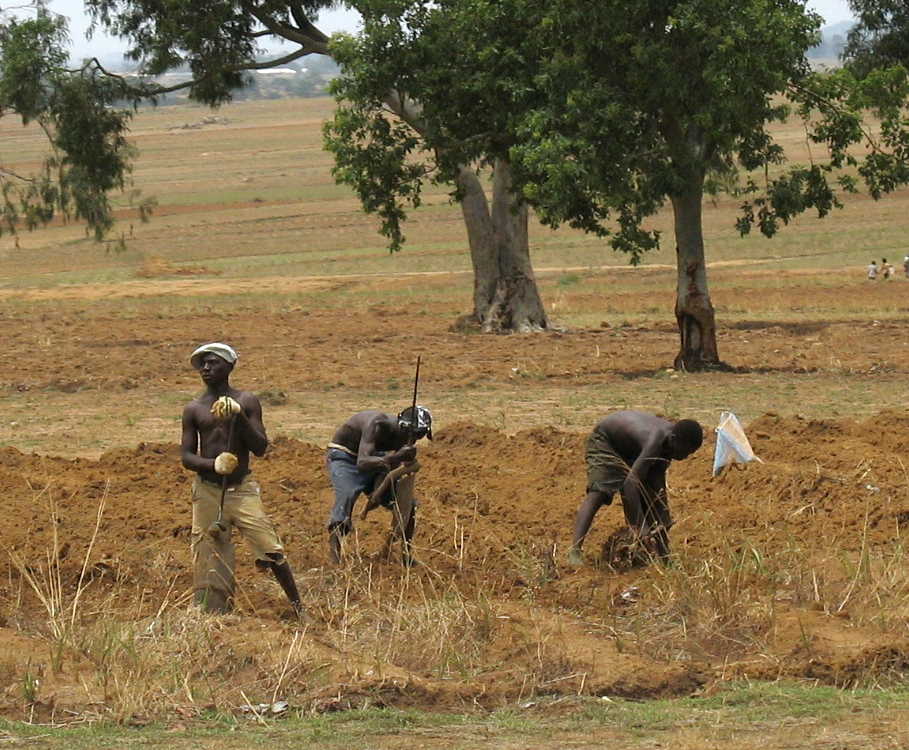
Crop production

Nigeria ranks sixth worldwide and first in Africa in farm output. The sector accounts for about 18% of GDP and almost one-third of employment. Though Nigeria is no longer a major exporter, due to local consumer boom, it is still a major producer of many agricultural products. Further agricultural products include palm oil and rubber.
Roots and tubers

Counting by weight, this "underground food" is the largest group of food produced in Nigeria, with 118 million tonnes in 2020. This group includes yam, cassava, potatoes and sweet potatoes. These food products are cultivated mostly in the south of Nigeria ("Roots economy").
Cereals
The group of sorghum, Pearl millet etc. is the second-largest group of food produced in Nigeria, with 28.6 million tonnes in 2020. 50% or 14 million tonnes of this is sorghum. The sugar cane production adds another 1.5 million tonnes to this. Cereals are mostly cultivated in the savannah zone of the country, and on the 23rd of June Nigeria's grain market report, the International Grains Council (IGC) placed Nigeria's total 2022-23 grains production at 21.6 million tonnes, this specific figure was reviewed from the previous month's forecast which was 21.1 million, It set the production in the year 2021–22 at 21.5 million which demonstrates and proves that there is an increase in the production of grains on the 23rd of June 2022 – 2023.
Rice and paddy
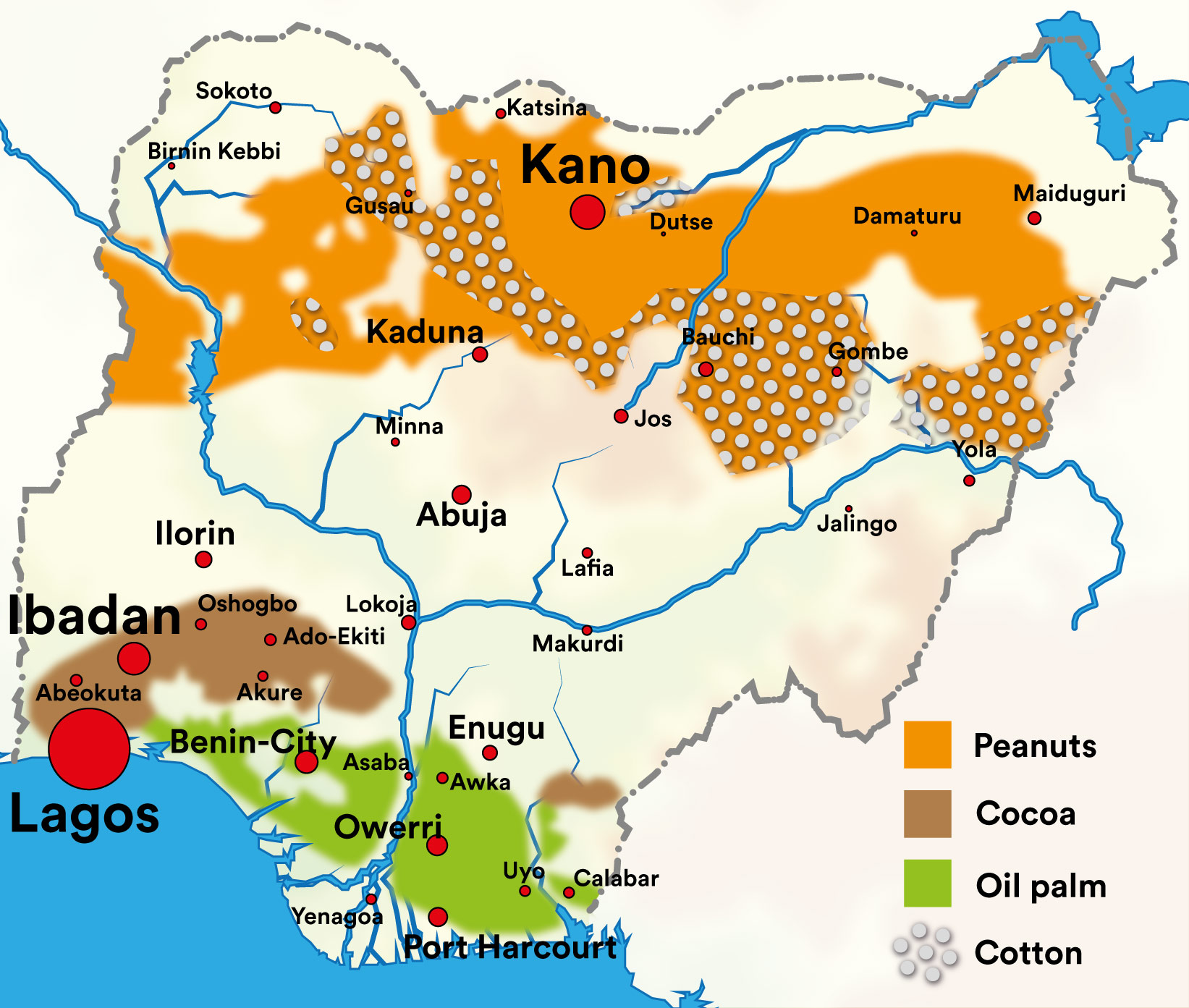
The third-largest group of food produced in Nigeria is rice and paddy. In 2020, 8.2 million tonnes were produced.
Oil crops
Nigeria produced a good 4 million tonnes of oil crops in 2020. These are e.g. soybeans, sunflower seed, canola and peanuts.
Citrus fruit
Nigeria produced close to 4 million tonnes of citrus fruit in 2020. Main Nigerian citrus fruits are tangerine, grape, lemon and lime.
Cocoa
Cocoa production, mostly from obsolete varieties and overage trees has increased from around 180,000 tons annually to 350,000 tons.
More products
Beans, melons, pepper and vegetables are grown on chopping fields. Oil palms, rubber and bananas are grown for export. Palm oil plays a major role in Nigeria's burgeoning personal care products industry.
Livestock
Cattle

In total, about 15 million head are kept. In addition, about five million pigs are kept. Small livestock such as sheep, goats and chickens are kept mainly for subsistence.
Poultry and Eggs
An estimated 42% of Nigerians own chicken. As a result, poultry and eggs represent a popular commodity within the food industry. 46% of the poultry is kept in an extensive / free-range system. 300 thousand tonnes of poultry meat and 650 thousand tonnes of eggs are produced annually in Nigeria (estimation).
Fishing

In 2003, Nigeria recorded a fish production of 505.8 metric tons. In 2015, production stood at 1 027 000 tonnes.
Timber
Roundwood removals totaled slightly less than 70 million cubic meters, and sawn wood production was estimated at 2 million cubic meters.
The paper industry in Nigeria has a long history that dates back to the 1960s and 1970s, when the government established three integrated pulp and paper mills: the Nigerian Paper Mill in Jebba; the Nigeria Newsprint Manufacturing Company, Oku Iboku; and the Iwopin Pulp and Paper Company. These mills were meant to meet the domestic demand for paper products and reduce import dependence.
However, these mills have faced various challenges over the years, such as lack of maintenance, obsolete equipment, inadequate power supply, and scarcity of raw materials. As a result, they have either become moribund or are operating at low capacity. According to a report by allAfrica.com, only the Jebba mill still has a showing of life.
The local production of paper products in Nigeria is estimated at 265,000 metric tons per year, while the domestic demand is estimated at 3 million metric tons per annum. This means that Nigeria relies heavily on importation of paper products to meet its needs, which costs the country about N182 billion annually. Importing paper products also exposes the country to fluctuations in foreign exchange rates and international market prices.
Food processing
Peeling / Milling
Main article: Imota rice mill
Until now, Nigeria exported unhusked rice but imported husked rice, the country's staple food. The rice mill in Imota, near Lagos, is expected to do the relevant processing domestically, improve the balance of trade and the labour market, and save unnecessary costs for transport and middlemen. It began operations in 2023 at low levels, and is expected to employ 250,000 people and produce 2.4 million 50-kg bags of rice annually when fully operational.
Coconut oil milling and refining
A multi-billion Naira coconut oil refinery, first of its kind in Africa started business in Akwa Ibom State. The St.Gabriel Coconut Refinery in Mkpat Enin was inaugurated in May 2022. The governor of Akwa Ibom promised to commence immediate training of indigenous hands to man the refinery, said the facility has a daily capacity to crack 1,000,000 coconuts and will employ no fewer than 3,000 direct and indirect staff. Coconut oil goes for $1,326 per barrel, according to Governor Emmanuel.
Dairy and meat
Nigeria has 19 million head of cattle, the largest number in Africa. Yet the dairy sector in Nigeria is only able to supply less than 10% of the country's demand for dairy products (as of June 2021), a gap expected to grow in line with population growth.
Fan Milk, a Danone Group company, manufacturer of popular frozen dairy and ice cream brands, unveiled its newly completed model dairy in Odeda, Ogun state, in June 2022. This dairy farm is Danone's first investment in dairy farming in sub-Saharan Africa to boost local milk production in Nigeria. Fan Milk will launch a world-class dairy farm and training institute, leveraging the expertise of parent company Danone.
In Lekki's Free Trade Zone, the Dano Milk Factory (Arla) opened in 2022. - In 2021 farmer owned dairy co-operative Arla Foods started to build a dairy farm in Kaduna state with 200 hectares. It will keep 400 dairy cows and will have modern milking parlors and technology, also grass lands and living facilities for 25 employees.
Bakery, household cereals, etc.
Nigeria's bread sector is growing rapidly, with 72 percent dominated by small- and medium-scale bakers, according to a 2016 KPMG report. The bakery market of Nigeria is a $621 million industry.
"Fresh bread and miscellaneous bakery" is the bakery product group with the highest consumption (8.5M tonnes), which is 91% of total volume. "Fresh bread and miscellaneous bakery" exceeded the figures recorded for the second-largest product group "gingerbread, sweet biscuits and waffles" (689K tonnes), more than tenfold. The Nigerian bakery product market size is expected to show significant growth in the forecast period 2020–2026.
Primera Food in cooperation with Michael Foods started production of noodles on a big scale in Ogun state in 2022.
Kellogg's opened a production plant for her products in the Lekki Free Trade Zone in Lagos in 2022. It is the second factory Kellogg's has built in Africa.
In Jos, NASCO Foods produces biscuits and corn flakes. In 2022 they expanded their Jos factory.
Mining and fossil fuels
Mining
The mining of minerals in Nigeria accounts for 0.3% of its gross domestic product. The domestic mining industry is largely underdeveloped, and minerals that it could produce domestically, such as salt or iron ore, are imported. Rights to ownership of mineral resources is held by the Federal Government of Nigeria, which grants titles for mineral exploration, mining, and sale of mineral resources.
Mining regulation is handled by the Ministry of Solid Minerals Development, which oversees the management of all mineral resources. Mining law is codified in the Federal Minerals and Mining Act of 1999.
Oil

The types of crude oil exported by Nigeria are Bonny light oil, Forcados crude oil, Qua Ibo crude oil and Brass River crude oil. The U.S. remains Nigeria's largest buyer of crude oil, accounting for 40% of the country's total oil exports; Nigeria provides about 10% of overall U.S. oil imports and ranks as the fifth-largest source of U.S. imported oil.
The United Kingdom is Nigeria's largest trading partner followed by the United States. The stock of U.S. investment is nearly $7 billion, mostly in the energy sector. ExxonMobil and Chevron are the two largest U.S. corporations in offshore oil and gas production.
Natural gas pipeline Nigeria–Morocco
The supply of natural gas to Europe, which is threatened by the Russian invasion of Ukraine, is pushing projects to transport Nigerian natural gas via pipelines to Morocco or Algeria. In December 2022, Morocco's National Office of Hydrocarbons and Mines signed Momoranda of Understanding with Nigeria, Gambia, Guinea Bissau, Guinea, Sierra Leone, and Ghana to start building the pipeline through the countries.
Process and Industrial Developments dispute
Process and Industrial Developments Ltd (P&ID) entered into a 20-year contract with the Nigerian government for natural gas supply and processing. Nigeria was to provide the gas, which PI&D was to refine so that it could be used to power the Nigerian electrical grid. PI&D could keep valuable byproducts for its own use. In 2012, PI&D demanded arbitration in London, alleging that Nigeria had not supplied the agreed quantity of gas or to construct the infrastructure it had agreed to build. The arbitral tribunal awarded damages of more than £4.8 billion. The compensation was valued £8.15 billion with interest when the case was heard in London High Court in December 2022.
Industry
Cement
Dangote and BUA are the dominating companies in the cement market of Nigeria. In May 2022, BUA opened a new, large-scale cement plant in Sokoto, including its own 50 MW power station.
Oil-based products
Historically, Nigeria has exported crude oil, but imported the majority of petroleum products consumed in the country. In September 2024, Dangote Oil Refinery began operations with capacity to produce 650,000 barrels (~103 m liters) of petrol per day and the potential to significantly reduce Nigeria's reliance on imported petroleum products. NNPC, Nigeria's state-owned oil firm, is the sole customer of the refinery.
Fertiliser and paint
On 3 May 2022, after years of construction, a fertiliser production plant was commissioned near Lagos that will be able to produce 3 million tonnes of fertiliser a year. With no more Russian fertiliser coming onto the world market in 2022 due to the invasion of Ukraine, Nigeria is filling a gap in the market. "The fertiliser market is a seller's market", enthused company boss Dangote at the plant's opening. "People are begging for us to sell and we are choosy about who we sell to".
Not far from the Dangote refinery, BASF opened a factory in Lekki. BASF is mostly known for fertilisers, paints, and lacquers.
Bodycare products, cleaning detergents
The Colgate factory in the Lekki Free Trade Zone close to Lagos started to produce body care products in 2022.
Pharmaceutical industry
Nigeria hosts about 60 percent of the pharmaceutical production capacity in Africa (status 2022) and is projected to grow between $60 billion to $70 billion after COVID-19, experts say. The pharmaceutical industry in Nigeria has headroom for growth and can potentially reach $4 billion over the next 10 years. Goldstein Market Intelligence analyst forecast the Nigeria pharmaceuticals market size is set to grow at a CAGR of 9.1% over the forecast years of 2017–2030. Most large pharmaceutical companies in Nigeria are located in Lagos.
The pharmaceutical producer with the most employees in Nigeria appears to be Emzor Pharmaceutical Industries Ltd. They produce more than 140 pharmaceutical products, including painkillers, vitamins, haematinics, antimalarials, antitussives, antibiotics, anthelmintics, antihistamines, antacids and cardioprotectants.
Fidson Healthcare Plc produces painkillers, anti-allergies, blood pressure medicines, digestive aids, sleeping pills and cough syrup. May & Baker Nig. Plc produces remedies against malaria, hypertension, diabetes, depressions and pain. Swiss Pharma Nigeria produces pharmaceutical products of BAYER.[[File:Innoson factory entrance.jpg|thumb|Innoson Vehicle Manufacturing in Nweri]]
Vehicle industry
Main article: Automotive industry in Nigeria
Nigerians buy 720,000 cars per year. Of those, less than 20% of these are produced within Nigeria itself.
Indigenous manufacturers
Innoson Vehicle Manufacturing is located in Nnewi. It produces buses, SUVs and since May 2022 tricycles which are locally known as "kekes".
Nord Automobiles Ltd has two assembly plants: one in Sangotedo, where all eight models are currently assembled; a plant in Epe is still under construction. The company currently manufactures its own plastic parts and plans to add steel stamping in the future.
30 km north-east of Lagos Proforce Ltd. produces armoured vehicles. Proforce sold an unknown number of armoured vehicles to Belarus in March 2022. This is the first time that vehicles manufactured in Nigeria have been supplied to a European country.
Jet Motor Company in Epe, Lagos State, is producing Nigeria's first electric-powered delivery trucks in partnership with GIG Logistics.
In Idah, Kogi State, Electric Motor Vehicle Company manufactures electrically powered vehicles. The company is owned by Prince Mustapha Mona Audu, a Glasgow-educated computer specialist and son of a former governor. In May 2022, Audu unveiled the four-seater Adoja, which he claims is the most environmentally friendly vehicle in Nigeria.
Foreign manufacturers
The Stallion Group assembles 45,000 Volkswagen models in Lagos per annum.
Peugeot Automobiles Nigeria (PAN) operates in Kaduna. In April 2022, Peugeot left the conglomerate and Aliko Dangote bought its shares. The company name was changed to DPAN. DPAN will assemble mainly the Chinese brands Chery and Higer using pre-produced parts. A new production line, Greenfield, will increase the output to 120 cars per day.
Toolmaking industry
In Oshogbo, there is a modest toolmaking industry. Products are e.g. CNC turning machines and industrial drilling machines, but also stud bolts and flanges. Target market is the oil industry in the Niger delta.
Electronics
The most successful manufacturer of laptops in Nigeria is, by their own admission, the indigenous Zinox Technologies in Lagos.
Steel production
According to its website, Ajaokuta Steel Company Limited produces 1.3 million tonnes of steel per year. Steel plants in Katsina, Jos and Osogbo no longer appear to be active.
Services
Nigeria ranks 27th worldwide and first in Africa in services output.[[File:2010 Lagos Nigeria 5284107494.jpg|thumb|Financial district in Lagos]]
Finance sector
Main article: Banking in Nigeria
Nigeria is the largest financial market in Africa. As of November 2018, 21 commercial banks were licensed by the Central Bank of Nigeria (CBN). Nigeria has a relatively well-developed banking sector by regional standards, with regionally high level of banking penetration (44.2% vs. regional average of 17.8% for West Africa) and robust use of advanced financial instruments in the local economy. The country is also well connected to international financial markets and following the 2016–17 oil crisis, the country has seen an increasing influx of foreign capital over the past 12–18 months – capital importation in Nigeria jumped to US$6.3 billion in Q1–18 (594% yoy growth) vs. $12.3 billion for full year 2017 and $5.1 billion in 2016). However, the country is weighed down by high lending rates, which limits access to credit for smaller firms, particularly in the non-oil economy. In 2024, the country's National Assembly denied that it had proposed to strip the central bank of the power to set interest rates.
Nigeria leads the fintech sector, accounting for 28% of all fintech companies on the continent. As of January 2024, Africa has over 1,263 active fintech companies.
Telecommunication
Main article: Telecommunications in Nigeria
The Nigerian Communications Commissions (NCC) said on January 14, 2022, the telecommunications sector contributed 12.45per cent to Nigeria's Gross Domestic Product (GDP). The commission through its chief executive officer (CEO), Prof Umar Garba Danbatta, during his convocation lecture, titled, "Empowering the Nigeria Youth Through Information and Communications Technology (ICT)" held at Fountain University, Osogbo, made this known. Prof Garba disclosed that the ICT sector has been consistently contributing above 10% of Nigeria's GDP for over 10 years. He noted, "Nigeria is Africa's largest ICT market with 82per cent of the continent's telecoms subscribers and 29per cent of internet usage."
Nigeria ranks 11th in the world in the absolute number of internet users and 7th in the absolute number of mobile phones.
Transport sector, forwarding, shipment
Main article: Transport in Nigeria

Due to Nigeria's location in the centre of Africa, transport plays a major role in the national service sector.
The Buhari administration made improvements to the infrastructure after 2015. Extensive road repairs and new construction have been carried out gradually as states in particular spend their share of increased government allocations. Representative of these improvements is the Second Niger Bridge at Onitsha, which is nearly completed in May 2022.
Since 2009, Nigeria has been laying new railway tracks. These are operated by the state-owned Nigerian Railway Corporation. This has apparently generated a surplus since 2019, despite the covid epidemic.
Principal ports are at Lagos (Apapa and Tin Can Island), Port Harcourt (Onne), and Calabar. A deep seaport in Lekki, 50 km east of Lagos, is about to open in 2022.
Five of Nigeria's airports (Lagos, Kano, Port Harcourt, Enugu and Abuja) currently fly to international destinations. The new national airline, "Nigeria Air", was scheduled to start operations in mid-2022. It was suspended indefinitely in 2024.
Entertainment
Movie industry, Television, Streaming
Main article: Cinema of Nigeria
From Nollywood, films and soaps are broadcast to the whole of Africa. Nigeria is the second largest film nation in the world after India and ahead of the US.
Music industry
Main article: Music of Nigeria
Perhaps Nigeria's most famous musician is the inventor of Afrobeat Fela Anikulapo Kuti, who gave legendary concerts with his band "Africa 70" at the "Shrine" in Lagos. Other characteristic musical styles include Jùjú, Apala, Fuji and Sakara. In the field of pop music, Nigerian musicians living in Europe such as Sade Adu or Dr. Alban were very successful in the 1980s and 1990s. In Europe, Nneka is one of the best-known Nigerian pop musicians. One of the very few Nigerian artists living in Nigeria who has had commercial success in Europe is D'Banj. He even reached the European singles charts in summer 2012 with Oliver Twist. Wizkid reached number 1 in 2016 alongside Drake.
Social media
Nigerians are passionate users of social media. In 2021 Nigerians spent 3 hours and 41 minutes on social media in average every day. This is much higher than the global average of 2 hours 22 minutes. The number of active social media users in Nigeria increased in 2021 by 22 percent, compared with a global average increase of 13 per cent. WhatsApp and Facebook are the most used social media platforms in Nigeria.
Fashion
The Lagos Leather Fair is the largest leather fair in West Africa. Nigeria is the sixth largest leather exporter in the world, with brands such as Prada, Gucci and Louis Vuitton sourcing their goods here. Fashion journalist Waridi Schrobsdorff even puts ‘Milan, Paris, Lagos’ on the same level on news channel N-tv.
Tourism
Data
Electricity – production: 18.89 billion kWh (2009)
Electricity – production by source:
fossil fuel: 61.69%
hydro: 38.31%
nuclear: 0%
other:
Electricity - consumption: 17.66 billion kWh (2009)
Electricity - exports: 40 million kWh (2003)
Electricity - imports: 0 kWh (1998)
Oil - production: 2.35 Moilbbl/d (July 2006 est.)
Oil - consumption: 310000 oilbbl/d (2003 est.)
Overseas remittances
A major source of foreign exchange earnings for Nigeria are remittances sent home by Nigerians living abroad.
According to the International Organization for Migration, Nigeria witnessed a dramatic increase in remittances sent home from overseas Nigerians, going from US$2.3 billion in 2004 to $17.9 billion in 2007, representing 6.7% of GDP. The United States accounts for the largest portion of official remittances, followed by the United Kingdom, Italy, Canada, Spain and France. On the African continent, Egypt, Equatorial Guinea, Chad, Libya, and South Africa are important source countries of remittance flows to Nigeria, while China is the biggest remittance-sending country in Asia.
Labour force
In 2015, Nigeria had a labour force of 74 million. In 2003, the unemployment rate was 10.8% overall; by 2015, unemployment stood at 6.4%.
Since 1999, the Nigerian Labor Congress (NLC) a union umbrella organization, has called six general strikes to protest domestic fuel price increases. However, in March 2005 the government introduced legislation ending the NLC's monopoly over union organizing. In December 2005, the Nigerian Labour Congress (NLC) was lobbying for an increase in the minimum wage for federal workers. The existing minimum wage, which was introduced six years earlier but has not been adjusted since, has been whittled away by inflation to only US$42.80 per month.
According to the International Organization for Migration, the number of immigrants residing in Nigeria has more than doubled in recent decades – from 477,135 in 1991 to 971,450 in 2005. The majority of immigrants in Nigeria (74%) are from neighbouring Economic Community of West African States (ECOWAS), and that this number has increased considerably over the last decade, from 63% in 2001 to 97% in 2005.
The government has to pay a high interest rate on bonds in part because of the high fertility rate; there are many children and less savings.
Human capital
As of 2019, Nigeria's HDI (Human Development Index) is ranked 161st at 0.539. The comparative value for Sub-Saharan Africa is 0.547, 0.926 for the US, and 0.737 for the world average.
The value for the education index is 0.499, compared to the average in the US of 0.900. The expected years of schooling in Nigeria is 10.0 (16.3 in the US), while the mean years of schooling for adults over 25 years is 6.7 years (13.4 years in the US). Additionally, Nigeria is also facing a relatively high inequality, worsening the problem regarding the formation of human capital.
Child labour
Government policy
Inflation

In 2016, the black-market exchange rate of the Naira was about 60% above the official rate. The central bank releases about $200 million each week at the official exchange rate. However, some companies cite that budgets now include a 30% "premium" to be paid to central bank officials to get dollars.
Nigeria's inflation rate rose to 15.63 per cent in December 2021 compared to 15.40 per cent in November, the National Bureau of Statistics announced on January 17, 2022. The statistics office said the prices of goods and services, measured by the Consumer Price Index, increased by 15.63 per cent in December 2021 when compared to December 2020. According to the NBS, this rise in the food index was caused by increases in prices of bread and cereals, food products, meat, fish, potatoes, yam and other tubers, soft drinks and fruits.
In 2024 President Bola Tinubu sought to increase the 2024 budget by $13.7 billion to $77.3 billion. The proposed additional funds were $7.1 billion for infrastructure projects and $6.7 billion for recurrent expenditure.
Foreign economic relations
Nigeria's foreign economic relations revolve around its role in supplying the world economy with oil and natural gas, even as the country seeks to diversify its exports, harmonize tariffs in line with a potential customs union sought by the Economic Community of West African States (ECOWAS), and encourage inflows of foreign portfolio and direct investment. In October 2005, Nigeria implemented the ECOWAS common external tariff, which reduced the number of tariff bands.
Prior to this revision, tariffs constituted Nigeria's second largest source of revenue after oil exports. In 2005 Nigeria achieved a major breakthrough when it reached an agreement with the Paris Club to eliminate its bilateral debt through a combination of write-downs and buybacks. Nigeria joined the Organization of the Petroleum Exporting Countries in July 1971 and the World Trade Organization in January 1995.
If the global transition to renewable energy is completed and international demand for Nigeria's petroleum resources ceases, Nigeria will be significantly weakened. It is ranked 149 out of 156 countries in the index of Geopolitical Gains and Losses after energy transition (GeGaLo).
External trade
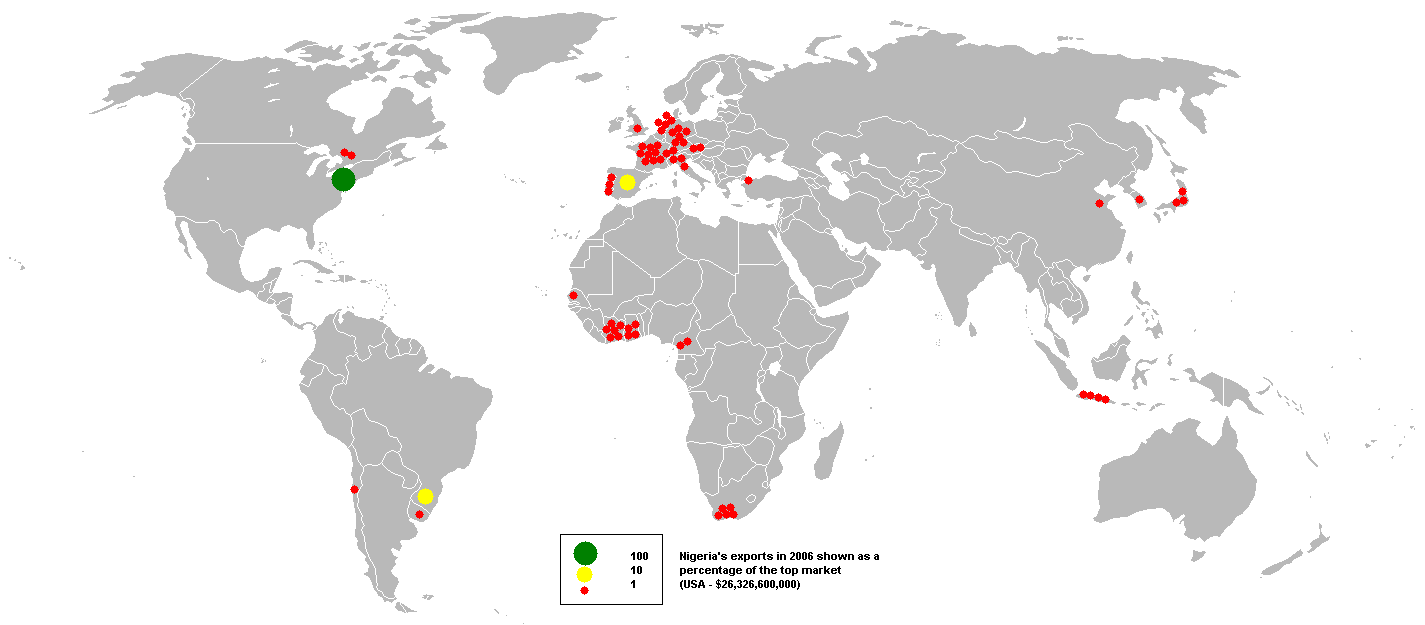
In 2017, Nigeria imported about US$34.2 billion of goods. In 2017 the leading sources of imports were China (28%), the Belgium-Luxembourg (8.9%), the Netherlands (8.3%), South Korea (6.4%), the United States (6.0%) and the India (4.6%). Principal imports were manufactured goods, machinery and transport equipment, chemicals, and food and live animals.
In 2017, Nigeria exported about US$46.68 billion worth of goods. In 2017, the leading destinations for exports were India (18%), the United States (14%), Spain (9.7%), France (6.0%) and the Netherlands (4.9%). In 2017 oil accounted for 83% of merchandise exports. Natural rubber and cocoa are the country's major agricultural exports.
In 2005, Nigeria posted a US$26 billion trade surplus, corresponding to almost 20% of gross domestic product. In 2005, Nigeria achieved a positive current account balance of US$9.6 billion. The Nigerian currency is the naira (NGN). As of June 2006, the exchange rate was about US$1=NGN128.4. As of June 2019, it stands at US$1 =NGN357. In recent years, Nigeria has expanded its trade relations with other developing countries such as India. Nigeria is the largest African crude oil supplier to India – it annually exports 400000 oilbbl/d to India valued at US$10 billion annually.
India is the largest purchaser of Nigeria's oil which fulfills 20% to 25% of India's domestic oil demand. Indian oil companies are also involved in oil drilling operations in Nigeria and have plans to set up refineries there.
The trade volume between Nigeria and the United Kingdom rose by 35% from US$6.3 billion in 2010 to US$8.5 billion in 2011.{{Citation | access-date = 27 September 2012 | archive-date = 6 March 2014 | archive-url = https://web.archive.org/web/20140306054222/http://allafrica.com/stories/201209261080.html | url-status = live
In Q1 2024, Nigeria's exports were dominated by petroleum products, including crude oil and liquefied natural gas. Major export destinations included China, India, and the Netherlands.
This period saw a notable increase in energy exports, reinforcing Nigeria's role as a key player in the global energy market. The Apapa Port in Lagos handled the bulk of these exports, showcasing the port's significance in the country's trade infrastructure.
Foreign trade statistics
| Year | Goods Export | ||
|---|---|---|---|
| (million US$) | Goods Imports | ||
| (in million US$) | Net trade | ||
| (in million US$) | |||
| 2023 | $55,820 | $47,746 | $8,075 |
| 2022 | $64,227 | $58,229 | $5,998 |
| 2021 | $46,859 | $51,421 | $-4,561 |
| 2020 | $35,944 | $52,346 | $-16,402 |
| 2019 | $64,978 | $62,110 | $2,868 |
| 2018 | $61,221 | $40,754 | $20,467 |
| 2017 | $45,817 | $32,669 | $13,148 |
| 2016 | $34,701 | $35,240 | $-536 |
| 2015 | $45,888 | $52,335 | $-6,447 |
| 2010 | $79,618 | $49,520 | $30,098 |
| 2000 | $19,132 | $8,717 | $10,415 |
| 1990 | $13,585 | $4,932 | $8,653 |
| 1980 | $25,945 | 14,728 | $11,217 |
External debt
In 2012, Nigeria's external debt was an estimated $5.9 billion and N5.6 trillion domestic, putting total debt at $44 billion.
In April 2006, Nigeria became the first African country to fully pay off its debt owed to the Paris Club. This was structured as a debt write off of approximately $18 billion and a cash payment of approximately $12 billion.
Foreign investment
In 2012, Nigeria received a net inflow of US$85.73 billion foreign direct investment (FDI), much of which came from Nigerians in the diaspora. Most FDI is directed toward the energy and banking sectors. Any public designed to encourage inflow of foreign capital is capable of generating employment opportunities within the domestic economy. The Nigerian Enterprises Promotion (NEP) Decree of 1972 (revised in 1977) was intended to reduce foreign investment in the Nigerian economy.
The stock market capitalisation of listed companies in Nigeria was valued at $97.75 billion on 15 February 2008 by the Nigerian Stock Exchange.
Swiss Banks to return Abacha Stolen Funds
The Swiss foreign ministry says it has done all it can to ensure that funds stolen by the late Nigerian dictator Sani Abacha were used properly in his homeland. The authorities were responding to allegations that $200 million (SFr240 million) of $700 million handed back by the Swiss Banks to Nigeria had been misappropriated.
References
Sources
- Nigerian Federal government Recruitment careerwatch.ng 23 February 2020
References
- "2020 Appropriation Act - Budget Office of the Federation - Federal Republic of Nigeria".
- "World Economic Outlook Database, April 2019". [[International Monetary Fund]].
- "World Bank Country and Lending Groups". World Bank.
- "Population, total". World Bank.
- (2025). "IMF DataMapper: Nigeria".
- "Nigeria's GDP Grew By 1.87% YoY in Real Terms in Q1 2020".
- "World Economic Outlook Database, April 2020". International Monetary Fund.
- (October 2025). "Nigeria SDR". SDR.
- (October 2025). "Nigeria SDR". SDR.
- "Poverty and Inequality Index".
- "Human Development Index (HDI)". [[Human Development Report.
- (Third Quarter 2018). "Labour Force and Unemployment Report".
- (2010). "Labour Force Statistics, 2010". Nigerian Bureau of Statistics.
- link. (April 2025). IMF
- "Nigerian Gross Domestic Product Report Q2 2015". National Bureau of Statistics.
- "Nigeria". The Observatory of Economic Complexity.
- (2015). "Foreign Trade Statistics". National Bureau of Statistics.
- "The World Factbook". [[Central Intelligence Agency]].
- "DEBT - EXTERNAL". [[Central Intelligence Agency]].
- "IMF Central Government Debt".
- (June 2024). "Approved 2023 Budget of Fiscal Consolidation and Transition". Budget Office of the Federation.
- "Report for Selected Countries and Subjects: June 2023". [[International Monetary Fund]].
- (27 May 2014). "Nigeria's budget deficit now 1% after rebasing". News 24.
- "Sovereigns rating list". Standard & Poor's.
- (15 April 2011). "How Fitch, Moody's, and S&P rate each country's credit rating". The Guardian.
- Duntoye, Sunday Joseph. (2020-10-08). "With Lived Poverty on the Rise, Nigerians Rate Government Performance as Poor".
- Healthcare, Expatriate. (2017-12-09). "How Much Does It Cost to Live in Nigeria? - Expatriate Healthcare".
- "Nigeria Economy".
- (2017-04-19). "Economic Growth and Trade {{!}} Nigeria".
- (2015). "Manufacturing Sector Report, 2015: Manufacturing in Africa". [[KPMG]].
- (April 2017). "Low oil price and currency controls hit Nigeria hard".
- "Nigeria at a glance {{!}} FAO in Nigeria {{!}} Food and Agriculture Organization of the United Nations".
- (3 August 2005). "Resolving Nigeria's Debt Through a Discounted Buyback". Center for Global Development.
- (2015-01-20). "The Economic Development of Nigeria from 1914 to 2014".
- Buiter, Willem. (21 February 2011). "Global Growth Generators: Moving beyond 'Emerging Markets' and 'BRIC'". Citi.
- (22 February 2011). "FORGET THE BRICs: Citi's Willem Buiter Presents The 11 "3G" Countries That Will Win The Future". Business Insider.
- "Economic and fiscal implications of Nigeria's rebased GDP".
- (12 April 2014). "Africa's new Number One". The Economist.
- "2020 Human Development Report".
- (2017-01-19). "Why innovation must be the new development strategy". Christensen Institute.
- (May 2013). ""Nigeria's challenge – universal primary education" {{!}} YourCommonwealth".
- "The economic context of Nigeria - Economic and Political Overview - Nordea Trade Portal".
- "Report corruption in Nigeria".
- (2019-09-29). "Finding Lasting Solution to Nigeria's Power Problem".
- (2023-02-16). "Economic Growth and Trade".
- The Economist, 28 March 2020, page 4.
- Udi, Aghogho. (2024-08-26). "Nigeria's GDP grows by 3.19% in Q2, 2024 – NBS".
- "Report for Selected Countries and Subjects".
- "GDP per capita (current US$) - Nigeria {{!}} Data".
- "Your daily Naira exchange rate".
- "Daily Parallel Market Exchange Rate".
- "Dollar to Naira Exchange Rates Today".
- "XE: Convert USD/NGN. United States Dollar to Nigeria Naira".
- "Nigeria GDP 1960-2020".
- "factfish Gross domestic product per capita, constant 2005 US $ for Nigeria".
- "News 2012". Nigerian National Bureau of Statistics.
- Bodedandyin #africa • 2 Years Ago. (2018-01-12). "Africa Economy and Crypto-Currency; How Crypto-Currency Can Help To Boost Africa Economy.".
- (2012-10-02). "Nigeria's 2012 t0 2014 Revenue and expenditure framework".
- Adegboyega, Ayodeji. (2024-07-23). "Again, CBN raises interest rate".
- Olomola Ade S. (2007) "Strategies for Managing the Opportunities and Challenges of the Current Agricultural Commodity Booms in SSA" in Seminar Papers on Managing Commodity Booms in Sub-Saharan Africa: A Publication of the AERC Senior Policy Seminar IX. African Economic Research Consortium (AERC), Nairobi, Kenya
- Iloani, Francis Arinze. (2019-08-15). "Nigeria spent N40trn on food imports in 21yrs – Data".
- "BusinessDay News".
- "Nigeria Vegetables primary production, 1961-2021 - knoema.com".
- "Countries ranked by Agriculture, value added (current US$) - Africa".
- "Reviving the Cocoa Industry in Nigeria".
- "Nigeria Vegetables primary production, 1961-2021 - knoema.com".
- Extquest. (2019-06-01). "Cereals production in Nigeria: Problems, constraints and opportunities for betterment.".
- "Focus on Nigeria {{!}} World Grain".
- (October 30, 2020). "FOOD AND BEVERAGE INDUSTRY IN NIGERIA". Flanders Investment and Trade Office.
- "Nigeria: ECONOMY".
- "FAO Fisheries & Aquaculture".
- (March 2019). "Sustainable Production and Consumption of Paper and Paper Products in Nigeria: A Review". Resources.
- (15 February 2022). "Nigeria: Paper Industry - a Sector in Death Throes". This Day.
- (7 February 2022). "Nigeria misses out on $351bn market as paper mills remain moribund".
- (22 January 2024). "Lagos Targets 100,000 Metric Tons of Rice Paddy - AgroNigeria".
- Nigeria, Guardian. (22 January 2024). "Lagos requires N50b to produce 100,000MT of paddy rice".
- (16 May 2022). "First Multi-billion Naira Coconut Oil Refinery in Africa Inaugurated in A'Ibom – THISDAYLIVE".
- (16 May 2014). "Nigeria to Increase Beef Consumption to 1.3 Million Tonnes By 2050 - Adesina".
- dairyreporter.com. (21 June 2021). "Arla builds dairy farm in Nigeria to support local milk production".
- (2022-06-20). "Fan Milk Danone model dairy farm ready for commissioning".
- (2021-07-26). "Nigeria: The Lagos Free Zone - complete with port - aims to transform industrial growth".
- (2017-03-26). "72% of Nigeria's $621m bread industry dominated by small-scale bakers".
- Ajansı, Newclick Dijital Reklam. "Bread and bakery market overview in Nigeria".
- (29 June 2022). "Massive New Factories As Investors Scramble For Nigeria's Market".
- (25 February 2021). "NASCO FOODS - Food manufacturer in Jos, Nigeria".
- "Investment and Mining Opportunities". Ministry of Solid Minerals Development.
- (2020-04-23). "Qua Iboe, Brass crude up by $5, trades at $21 per barrel".
- "International - U.S. Energy Information Administration (EIA)".
- (27 April 2022). "Morocco closer to activating the gas pipeline with Nigeria".
- "Nigeria's president launches new gas pipeline project".
- (2022-05-09). "Nigeria-Morocco Gas Pipeline (NMGP) Project Updates".
- Kasraoui, Safaa. (March 2023). "Nigeria-Morocco Gas Pipeline Faces Construction Delays Amid Challenges".
- (2022-12-06). "Nigeria-Morocco Gas Pipeline - NNPCL Signs MOU With Ghana, Gambia, Guinea Bissau Oil Firms". Leadership.
- Folkman, Ted. (2022-03-14). "Case of the Day: Process & Industrial Developments v. Nigeria".
- (2 December 2022). "Nigerian government mired in corruption tries to stop £8.15 billion gas contract compenstation – Court News UK".
- (28 April 2022). "Africa's richest man betting $21bn on oil and fertiliser".
- Abiodun, Eromosele. (2022-04-28). "Nigeria's Path to Irreversible Industrial Revolution".
- (2022-05-05). "Dangote's timely fertiliser plant pays off as prices soar".
- Onyesi, Chika. (2021-10-06). "'Nigeria's pharmaceutical sector dwindling despite 60 percent production capacity'".
- (27 December 2019). "The Prospects of Nigeria's Pharma Industry".
- Goldstein Market Intelligence. "Nigeria Pharmaceutical Market Outlook: Market Segmentation By Type, & By Region With Forecast 2017-2030".
- Yahaya, Abdulwali. (2019-09-19). "Top 10 Best Pharmaceutical Companies in Nigeria & Their Products".
- (27 December 2018). "About Emzor Pharmaceutical Industries Limited".
- Fidson. "Our Company – Fidson Healthcare PLC".
- "May and Baker Plc. – Supporting your Health for Life".
- "Welcome to swiss pharma nigeria limited".
- "A new car assembly plant begins operation in Nigeria".
- (2018-12-18). "5 Advantages Of Driving An Innoson Vehicle".
- Obafemee80. (20 May 2022). "Innoson Introduces IVM-branded Tricycles 'Keke Marwa' Into The Nigerian Market".
- (24 May 2022). "Innoson Sets Unit Price of its IVM Keke".
- (2021-03-07). "How this entrepreneur started a Nigerian car brand".
- "Proforce Limited armored vehicles manufacturer Nigeria {{!}} Nigeria Defence and Security Industry {{!}} Africa defence industry company UK".
- (15 March 2022). "Nigeria's Proforce to Supply Armored Vehicles to Belarus".
- Brand Spur. (2021-07-30). "GIGL Partners JET Motor To Launch First Electric Vehicle For Deliveries In Nigeria".
- (19 August 2019). "A GLANCE AT PRINCE MUSTAPHA MONA AUDU (PMMA)".
- admin. (2022-05-07). "History Made as Prince Mustapha Mona Audu Unveils ADOJA - An".
- (25 April 2022). "Prince Mustapha Mona Audu inventor of Electric powered Engines in Nigeria...".
- (2022-04-29). "PAN Nigeria parts ways with Peugeot, settles for Higer, Chery".
- Odunewu, Segun. (2022-02-18). "We're ready to roll out Chery and Higer vehicles – PAN Nigeria".
- AutoReportAfrica. (2022-02-07). "Dangote Peugeot Begins Operations at New Green Field Ultima Assembly Plant in Kaduna".
- "CNC/Conventional Machine Manufacturing".
- "Zinox Technologies".
- "Products : Ajaokuta Steel Company: ...the Bedrock of Nigeria's Industrialization.".
- (2014-04-28). "Nigeria to revive steel rolling mills – Official {{!}} Premium Times Nigeria".
- (3 March 2020). "Nigeria Tops South Africa as the Continent's Biggest Economy".
- "Sustainability In The Nigerian Financial Sector – ESRM Africa".
- Aduloju, Bunmi. (May 31, 2024). "Senate panel: no plan to strop CBN of power to set interest rate".
- Bank, European Investment. (2024-11-07). "Finance in Africa: Unlocking investment in an era of digital transformation and climate transition". European Investment Bank.
- Smith, Theresa. (2024-12-02). "Banking in Africa: Unlocking investment".
- (2022-01-14). "'Telecoms add 12.45% to Nigeria's GDP' - The Nation Newspaper".
- (2022-05-15). "Nigeria". Central Intelligence Agency.
- (8 April 2022). "2nd Niger Bridge Section Completed Ahead Of Schedule, Open To Traffic In July".
- (2022-05-04). "Lekki deep seaport to create 170,000 jobs – Minister - The Nation Newspaper".
- (2022-05-04). "FG says Lekki deep seaport to generate $201 billion revenue, to create 170,000 jobs".
- (28 May 2024). "Nigeria Air remains suspended indefinitely —Aviation Minister".
- Liston, Enjoli. (10 April 2014). "Hello Nollywood: how Nigeria became Africa's biggest economy overnight". The Guardian Newspaper.
- Hazlewood, Phil. (7 April 2014). "Nollywood helps Nigeria kick South Africa's economic butt". Sowetan Live.
- (2021-12-06). "Uses and Abuses: How increased Social Media usage threatens Nigeria's democracy - Premium Times Nigeria".
- NACHRICHTEN, n-tv. "Die Zukunft kommt aus Afrika".
- link. (17 March 2015)
- Cuevas-Mohr, Hugo. (21 August 2019). "Nigerian Diaspora and Remittances: Transparency and Market Development - IMTC".
- Onuba, Ifeanyi. (15 May 2015). "Only 4.67 million Nigerians are unemployed —NBS". The Punch Newspaper.
- (13 November 2018). "The struggle for a minimum wage in Nigeria".
- "Nigeria {{!}} OIM".
- The Economist, 28 March 2020, page 5.
- Elliott, Larry. (2019-01-21). "World's 26 richest people own as much as poorest 50%, says Oxfam". The Guardian.
- "World Poverty Clock".
- (2020-01-22). "Human capital development as key to solving Nigeria's economic challenges".
- "Can you spare a dollar?". The Economist.
- (2022-01-17). "Nigeria's annual inflation rate up after eight-month decline".
- TheCable. (2024-07-17). "JUST IN: Tinubu asks n'assembly to increase 2024 budget by N6.2trn".
- "Nigeria implements ECOWAS common external tariff - Africa - Angola Press - ANGOP".
- "Debt Relief Development: 2005 Debt Relief Agreement Nigeria".
- (2019). "The GeGaLo index: Geopolitical gains and losses after energy transition". Energy Strategy Reviews.
- "OEC - Nigeria (NGA) Exports, Imports, and Trade Partners".
- "Nigeria". The Observatory of Economic Complexity.
- "Nigeria facts and figures". [[OPEC]].
- (2018-05-23). "India largest importer of Nigeria's crude oil in 2017 – NNPC".
- (15 July 2013). "India now Nigeria's biggest crude oil buyer". The Hindu.
- (2024-06-09). "Nigeria's Q1 2024 Foreign Trade Report: A Comprehensive Overview".
- "Goods exports (BoP, current US$) - Nigeria".
- "Goods imports (BoP, current US$) - Nigeria".
- "Net trade in goods (BoP, current US$) - Nigeria".
- "Nigeria's Domestic, External Debts Now $44bn, Articles - THISDAY LIVE".
- (2006-04-21). "Nigeria settles Paris Club debt".
- (5 December 2006). "Swiss respond to Abacha funds allegation".
This article was imported from Wikipedia and is available under the Creative Commons Attribution-ShareAlike 4.0 License. Content has been adapted to SurfDoc format. Original contributors can be found on the article history page.
Ask Mako anything about Economy of Nigeria — get instant answers, deeper analysis, and related topics.
Research with MakoFree with your Surf account
Create a free account to save articles, ask Mako questions, and organize your research.
Sign up freeThis content may have been generated or modified by AI. CloudSurf Software LLC is not responsible for the accuracy, completeness, or reliability of AI-generated content. Always verify important information from primary sources.
Report