From Surf Wiki (app.surf) — the open knowledge base
Echinopsis pachanoi
Mescaline-containing cactus
Mescaline-containing cactus
|Cereus pachanoi|(Britton & Rose) Werderm. |Echinopsis pachanoi|(Britton & Rose) H.Friedrich & G.D.Rowley |Echinopsis santaensis|(Rauh & Backeb.) H.Friedrich & G.D.Rowley |Echinopsis schoenii|(Rauh & Backeb.) H.Friedrich & G.D.Rowley |Trichocereus macrogonus subsp. pachanoi|(Britton & Rose) Lodé |Trichocereus macrogonus var. pachanoi|(Britton & Rose) Albesiano & R.Kiesling |Trichocereus macrogonus subsp. sanpedro|M.H.J.van der Meer |Trichocereus pachanoi|Britton & Rose |Trichocereus santaensis|Rauh & Backeb. |Trichocereus schoenii|Rauh & Backeb. |Trichocereus torataensis|F.Ritter
Echinopsis pachanoi, synonyms including Trichocereus pachanoi and Trichocereus macrogonus var. pachanoi, is a fast-growing columnar cactus found in the Andes at 2000 – in altitude. It is one of a number of kinds of cacti known as San Pedro cactus. It is native to Ecuador, and Peru, but is also found in Bolivia, Colombia, central Chile, the Canary Islands, and mainland Spain, and is cultivated in other parts of the world. Uses for it include traditional medicine and traditional veterinary medicine, and it is widely grown as an ornamental cactus. It has been used for healing and religious divination in the Andes Mountains region for over 3,000 years.{{cite book |author1=Bigwood, Jeremy |author2=Stafford, Peter J. |title=Psychedelics encyclopedia |publisher=Ronin Pub |location=Berkeley, CA |year=1992 |pages=118–9 |isbn=978-0-914171-51-5
Description
Echinopsis pachanoi has light to dark green stems, sometimes glaucous, with a diameter of 6 - and usually 6–8 ribs. The whitish areoles may produce up to seven yellow to brown spines, each up to 2 cm long although typically shorter in cultivated varieties, sometimes being mostly spineless. The areoles are spaced evenly along the ribs, approximately 2 cm apart. E. pachanoi is normally 3 - tall and has multiple branches, usually extending from the base but will emerge around broken branches. The tallest recorded specimen was 12.2 m tall. White flowers are produced at the end of the stems; they open at night and last for about two days. Large numbers can be produced by well established cacti and may open new flowers over a period of weeks. The flowers are large, around 19 - long with a diameter of up to 20 cm and are highly fragrant. There are black hairs along the length of the thick base leading to the flower. Oblong dark green fruits are produced after fertilization, about 3 cm across and 5 - long, eventually bursting open to reveal a white flesh filled with small seeds.
Taxonomy
Echinopsis pachanoi was first described as the species Trichocereus pachanoi by Britton and Rose in 1920. It was reduced to the variety of T. macrogonus var. pachanoi in 2012. , Plants of the World Online regarded Trichocereus as a synonym of Echinopsis, and reinstated the original name Echinopsis pachanoi.
Traditional uses

Echinopsis pachanoi is known by many names throughout South America such as achuma, huachuma, wachuma, aguacolla, hahuacollay, lapituq, tsuná, San Pedro or giganton. It has a long history of being used in Andean traditional medicine.
Archaeological studies have found evidence of use going back two thousand years, to Moche culture, Nazca culture, and Chavín culture. Although Roman Catholic church authorities after the Spanish conquest attempted to suppress its use, this failed, as shown by the Christian element in the common name "San Pedro cactus" – Saint Peter cactus. The name is attributed to the belief that just as St Peter holds the keys to heaven, the effects of the cactus allow users "to reach heaven while still on earth."
In Peruvian shamanism, called mesa norteña, healers (curanderos) boil the San Pedro cactus, with spines removed, into a bitter drink called cimora, often mixed with tobacco to enhance spiritual visions. This brew helps shamans gain "vista" (magical vision) to diagnose illnesses, cleanse spirits, and connect with ancestors or nature spirits at sacred sites like the Las Huaringas lagoons. The practice also exists in Ecuador, Bolivia, and parts of Chile and Argentina, where indigenous groups like the yachakkuna use San Pedro for healing and spiritual guidance.
The early 2000s saw the first major international coverage of traditional plant medicine in publications such as The New York Times Magazine and National Geographic Adventure, which featured the Blue Morpho retreat center.
In 2022, the Peruvian Ministry of Culture declared the traditional use of San Pedro cactus in northern Peru as cultural heritage.
Alkaloids

Echinopsis pachanoi contains a number of alkaloids (especially cactus alkaloids), including the well-studied chemical mescaline (from 0.053% up to 4.7% of dry cactus weight), and also 3,4-dimethoxyphenethylamine, 3-Methoxytyramine, 4-hydroxy-3,5-dimethoxyphenethylamine, anhalonidine, anhalinine, hordenine, and tyramine.
Mescaline is a psychedelic drug and entheogen, which is also found in some other species of the genus Echinopsis (e.g. Echinopsis lageniformis and Echinopsis tacaquirensis) and the species Lophophora williamsii (peyote). Mescaline induces a psychedelic state comparable to those produced by LSD and psilocybin, but with unique characteristics. According to a research project in the Netherlands, ceremonial San Pedro use seems to be characterized by relatively strong spiritual experiences, and low incidence of challenging experiences.
Anecdotal evidence suggests that the highest concentration of active substances is found in the layer of green photosynthetic tissue just beneath the skin. Mescaline is not evenly distributed within single specimens of San Pedro cactus.
Cultivation
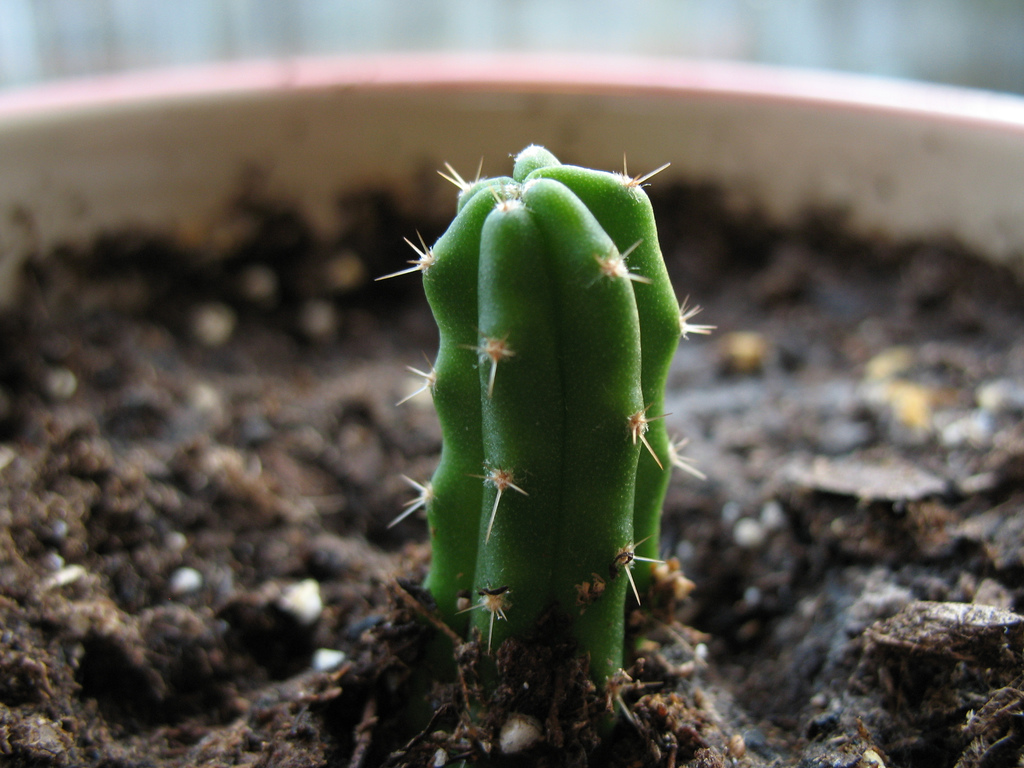
Echinopsis pachanoi is hardy in USDA hardiness zones 8b to 10. The range of minimum temperatures in which it is known to grow is between -9.4 °C and 10 °C. Because it grows naturally in the Andes at high altitude and with high rainfall, it can for a day or two withstand temperatures far below that of many other cacti if they are dry. It requires fertile, free-draining soil. A good soil mix includes an inorganic lightweight substrate such as pumice or perlite. Plants grow up to 30 cm per year. They are susceptible to fungal diseases if over-watered, but are not nearly as sensitive as many other cacti, especially in warm weather when they are in their growth phase. They can be sunburned and display a yellowing chlorotic reaction to overexposure to sunlight.
In winter, plants will etiolate, or become thin, due to lower levels of light. This may be problematic if the etiolated zone is not sufficiently strong to support future growth as the cactus may break in strong winds.
In Oaxaca, Mexico, they are commonly planted close together to make an impenetrable cactus fence.
Propagation from cuttings
Like many other plants, Echinopsis pachanoi can be propagated from cuttings. The result is a genetic clone of the parent plant. It is therefore a popular method of propagating highly prized cultivars, sometimes by grafting small cuttings onto fast-growing cultivars like the Predominant Cultivar (PC). Some names of cultivars that are highly prized by cactus collectors are Ogunbodede, Vilcabamba A, and Yowie.
A cactus column can be also laid on its side on the ground (like a log), and eventually roots will sprout from it and grow into the ground. After time, sprouts will form and cactus columns will grow upward out of it along its length.
From seed
Like a lot of its relatives, Echinopsis pachanoi is easily grown from seed, often by means of a so-called "Takeaway Tek". This term refers to the practice of sowing cactus seed into plastic containers, such as those many food takeaways are delivered in. This creates a semi-controlled humidity environment chamber for six months to a year, in which the seed may germinate and then grow relatively unbothered by environmental contamination. To accelerate the growth of seedlings, they can be grafted on Pereskiopsis.
Legal status
Main article: Legal status of psychoactive cacti by country
In most countries, it is legal to cultivate Echinopsis pachanoi. In countries where possession of mescaline and related compounds is illegal and highly penalized, cultivation for the purposes of consumption is most likely illegal and also highly penalized. This is the case in the United States, Australia, Canada, Sweden, Germany, and New Zealand, where it is currently legal to cultivate the San Pedro cactus for gardening and ornamental purposes, but not for consumption.
Gallery
File:Echinopsis pachanoi in bloom.jpg File:Echinopsis pachanoi in bloom nighttime.jpg File:Echinopsis pachanoi in bloom top view.jpg File:E pachanoi flower stalks.jpg File:Starr 070320-5797 Echinopsis pachanoi.jpg File:Starr 070320-5800 Echinopsis pachanoi.jpg File:Starr 070320-5796 Echinopsis pachanoi.jpg File:Starr 070320-5798 Echinopsis pachanoi.jpg File:Echinopsis-pachanoi-close-up.jpg File:Cactus in Huntington Library Botanical Garden, California.jpg File:Chavin-cactus-stone.jpg File:Pachanoi flower in bloom.jpg File:Sanpedroflower.jpg File:Seeds SanPedro (E. pachanoi).JPG|Seeds File:Echinopsis pachanoi jeune pousse.jpg|Three-week-old seedling File:San Pedro 5 months old 1.JPG|Five-month-old seedling File:Echinopsis pachanoi flowering at night in New Zealand.jpg File:Echinopsis pachanoi ripe fruit.jpg|The fruit after bursting open, revealing the seeds in a sweet flesh. File:E pachanoi ripe fruit.jpg|Ripe fruits File:San-pedro-timelapse.gif|Blooming habit
References
References
- Ostalaza, C., Cáceres, F. & Roque, J. 2017. Echinopsis pachanoi (amended version of 2013 assessment). The IUCN Red List of Threatened Species 2017: e.T152445A121474583. https://dx.doi.org/10.2305/IUCN.UK.2017-3.RLTS.T152445A121474583.en. Downloaded on 11 September 2021.
- "''Echinopsis pachanoi'' (Britton & Rose) H.Friedrich & G.D.Rowley".
- Rätsch, Christian. (2002). "Enzyklopädie der psychoaktiven Pflanzen. Botanik, Ethnopharmakologie und Anwendungen". AT-Verlag.
- "Visionary Cactus Guide". Erowid.org.
- Mchem, Benjamin Bury. (2021-08-02). "Could Synthetic Mescaline Protect Declining Peyote Populations?".
- (2012). "A New Taxonomic Treatment of the Genus ''Trichocereus'' (Cactaceae) in Chile". Haseltonia.
- "''Trichocereus'' (A.Berger) Riccob..".
- "Plantas de los dioses. Origenes del uso de los alucinogenos".
- (2019-09-20). "San Pedro: Basic Info".
- (2022-12-01). "Use of psychoactive and stimulant plants on the south coast of Peru from the Early Intermediate to Late Intermediate Period". Journal of Archaeological Science.
- (2008). "Más allá de los encantos – Documentos sobre extirpación de idolatrías, Trujillo". IFEA Instituto Francés de Estudios Andinos, Fondo Editorial de la Universidad Nacional Mayor de San Marcos.
- Anderson, Edward F.. (2001). "The Cactus Family". Timber Press.
- Sharon, Douglas. (1978). "Wizard of the Four Winds: A Shaman's Story". Free Press.
- Glass-Coffin, Bonnie. (2010). "Shamanism and San Pedro through Time: Some Notes on the Archaeology, History, and Continued Use of an Entheogen in Northern Peru". Anthropology of Consciousness.
- Glass-Coffin, Bonnie. (2010). "Shamanism and San Pedro through Time: Some Notes on the Archaeology, History, and Continued Use of an Entheogen in Northern Peru". Anthropology of Consciousness.
- "San Pedro Cactus (Echinopsis pachanoi)". Erowid.
- Rätsch, Christian. (2005). "The Encyclopedia of Psychoactive Plants: Ethnopharmacology and Its Applications". Park Street Press.
- Worcester, Sharon. (2004-09-12). "The Vision Seekers". The New York Times.
- Narby, Jeremy. (2006-03-01). "Peru: Hell and Back". National Geographic Adventure.
- (2022-11-17). "Declaran Patrimonio Cultural de la Nación a los conocimientos, saberes y usos del cactus San Pedro".
- (15 September 2010). "New mescaline concentrations from 14 taxa/cultivars of Echinopsis spp. (Cactaceae) ("San Pedro") and their relevance to shamanic practice". Journal of Ethnopharmacology.
- (Dec 1973). "Cactus Alkaloids. XIX Crystallization of Mescaline HCl and 3-Methoxytyramine HCl from Trichocereus panchanoi". Lloydia and the Journal of Natural Products.
- Bender, Eric. (2022-09-28). "Finding medical value in mescaline". Nature.
- (2022-12-05). "Altered States of Consciousness During Ceremonial San Pedro Use". The International Journal for the Psychology of Religion.
- (2023). "Natural or artificial: An example of topographic spatial distribution analysis of mescaline in cactus plants by matrix-assisted laser desorption/ionization mass spectrometry imaging". Frontiers in Plant Science.
- "Mescaline in Trichocereus".
- (2025-07-01). "A UHPLC-(ESI)MS/MS method for the determination of the psychedelic secondary metabolite mescaline in San Pedro (Trichocereus spp.) and its applicability for screening mescaline in other cacti varieties.". Forensic Chemistry.
- Van Der Sypt, Frederick. (2022-04-03). "Validation and exploratory application of a simple, rapid and economical procedure (MESQ) for the quantification of mescaline in fresh cactus tissue and aqueous cactus extracts". PhytoChem & BioSub Journal.
- "San Pedro Cactus (Echinopsis pachanoi)".
- (9 June 2018). "Echinopsis pachanoi (San Pedro Cactus)".
- Antosh, Gary. (2021-07-06). "Growing San Pedro Cactus: How To Care For Trichocereus Pachanoi".
- "Trichocereus pachanoi".
- "San Pedro Cactus: San Pedro Cactus Cutting".
- "What if the cut end doesn't dry properly and starts to mold".
- (2015-12-27). "Trichocereus 'Yowie' (Echinopsis)".
- "Grow Cacti from Seed - Enhanced Takeaway Tek".
- (2018-07-15). "How to Grow Trichocereus Cacti from Seed".
- (2015-07-07). "Takeaway Tek (How to germinate cacti seeds)".
- "Coke bottle tek: A terrarium technique".
- Herbalistics. (2015-07-08). "Grafting cacti to Pereskiopsis spathulata".
- "Pereskiopsis – Trout's Notes".
This article was imported from Wikipedia and is available under the Creative Commons Attribution-ShareAlike 4.0 License. Content has been adapted to SurfDoc format. Original contributors can be found on the article history page.
Ask Mako anything about Echinopsis pachanoi — get instant answers, deeper analysis, and related topics.
Research with MakoFree with your Surf account
Create a free account to save articles, ask Mako questions, and organize your research.
Sign up freeThis content may have been generated or modified by AI. CloudSurf Software LLC is not responsible for the accuracy, completeness, or reliability of AI-generated content. Always verify important information from primary sources.
Report