From Surf Wiki (app.surf) — the open knowledge base
East Asia
Subregion of the Asian continent
Subregion of the Asian continent
| Field | Value |
|---|---|
| title | East Asia |
| image | East Asia (orthographic projection).svg |
| area | 11840000 km2 (3rd) |
| population | 1.6 billion (2023; 2nd) |
| density | 141.9 km2 |
| GDP_nominal | $28 trillion (2025) |
| GDP_PPP | $55 trillion (2025) |
| GDP_per_capita | $17,500 (nominal) |
| demonym | East Asian |
| countries | {{collapsible list |
| list_style | text-align:left; |
| title | 6 countries |
| 1 | China |
| 2 | Japan |
| 3 | Mongolia |
| 4 | North Korea |
| 5 | South Korea |
| 6 | Taiwan |
| dependencies | {{collapsible list |
| list_style | text-align:left; |
| title | Two special administrative regions of China |
| 1 | |
| 2 | |
| time | UTC+7, UTC+8 & UTC+9 |
| cities | List of urban areas: |
| m49 | `030` – Eastern Asia |
| `142` – Asia | |
| `001` – World |
- Chinese
- Japanese
- Korean
- Mongolian
- Tibetan
- Others
142 – Asia
001 – World
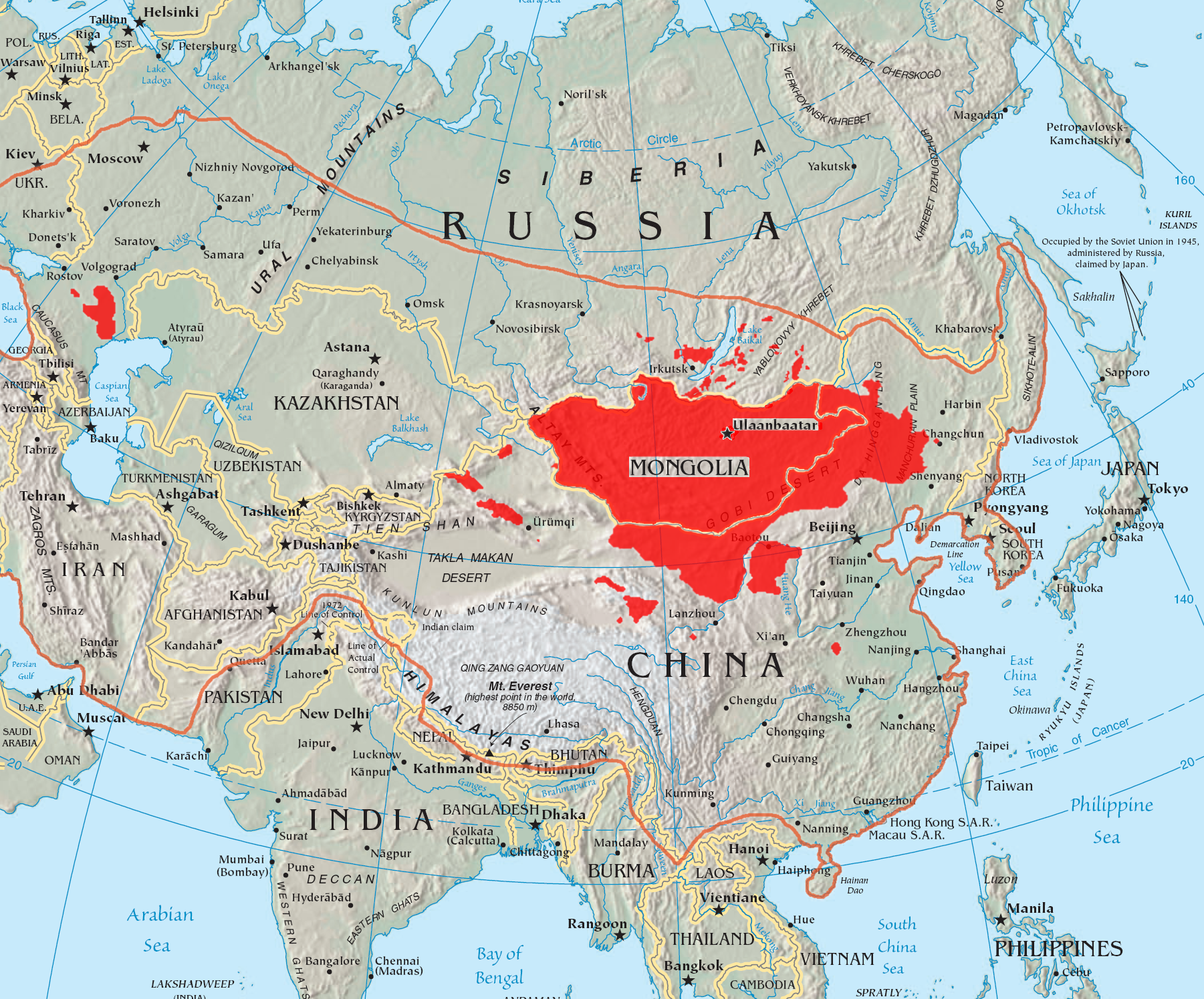
East Asia is a geocultural region of Asia. It includes China, Japan, Mongolia, North Korea, South Korea, and Taiwan, plus two special administrative regions of China, Hong Kong and Macau. The economies of China, Japan, South Korea, and Taiwan are among the world's largest and most prosperous. East Asia borders North Asia to the north, Southeast Asia to the south, South Asia to the southwest, and Central Asia to the west. To its east is the Pacific Ocean.
East Asia, especially Chinese civilization, is regarded as one of the earliest cradles of civilization. Other ancient civilizations in East Asia that still exist as independent countries in the present day include the Japanese, Korean, and Mongolian civilizations. Various other civilizations existed as independent polities in East Asia in the past but have since been absorbed into neighbouring civilizations in the present day, such as Tibet, Manchuria, and Ryukyu (Okinawa), among many others. Taiwan has a relatively young history in the region after the prehistoric era; originally, it was a major site of Austronesian civilisation prior to colonisation by European colonial powers and China from the 17th century onward. For thousands of years, China was the leading civilization in the region, exerting influence on its neighbours. Historically, societies in East Asia have fallen within the Chinese sphere of influence, and East Asian vocabularies and scripts are often derived from Classical Chinese and Chinese script. The Chinese calendar serves as the root from which many other East Asian calendars are derived.
Major religions in East Asia include Buddhism (mostly Mahayana), Confucianism and Neo-Confucianism, Taoism, ancestral worship, and Chinese folk religion in Mainland China, Hong Kong, Macau and Taiwan, Shinto in Japan, and Christianity and Musok in Korea. Tengerism and Tibetan Buddhism are prevalent among Mongols and Tibetans while other religions such as Shamanism are widespread among the indigenous populations of northeastern China such as the Manchus. The major languages in East Asia include Mandarin Chinese, Japanese, and Korean. The major ethnic groups of East Asia include the Han in China and Taiwan, Yamato in Japan, Koreans in North and South Korea, and Mongols in Mongolia. There are 76 officially-recognized minority or indigenous ethnic groups in East Asia; 55 native to mainland China (including Hui, Manchus, Chinese Mongols, Tibetans, Uyghurs, and Zhuang in the frontier regions), 16 native to the island of Taiwan (collectively known as Taiwanese indigenous peoples), one native to the major Japanese island of Hokkaido (the Ainu) and four native to Mongolia (Turkic peoples). The Ryukyuan people are an unrecognized ethnic group indigenous to the Ryukyu Islands in southern Japan, which stretch from Kyushu to Taiwan. There are also several unrecognized indigenous ethnic groups in mainland China and Taiwan.
East Asians comprise around billion people, making up about 33% of the population in continental Asia and 20% of the global population. The region is home to major world metropolises such as Beijing–Tianjin, Busan–Daegu–Ulsan–Changwon, Guangzhou, Hong Kong, Osaka–Kyoto–Kobe, Seoul, Shanghai, Shenzhen, Taipei, and Tokyo. Although the coastal and riparian areas of the region form one of the world's most populated places, the population in Mongolia and Western China, both landlocked areas, is very sparsely distributed, with Mongolia having the lowest population density of a sovereign state. The overall population density of the region is 133 PD/km2, about three times the world average of 45 /km2.
History
Main article: History of East Asia
Ancient era
China was the first region settled in East Asia and was undoubtedly the core of East Asian civilization from where other parts of East Asia were formed. The various other regions in East Asia were selective in the Chinese influences they adopted into their local customs. Historian Ping-ti Ho referred to China as the cradle of Eastern civilization, in parallel with the cradle of Middle Eastern civilization along the Fertile Crescent encompassing Mesopotamia and Ancient Egypt as well as the cradle of Western civilization encompassing Ancient Greece.
Chinese civilization emerged early, and prefigured other East Asian civilisations. Throughout history, imperial China would exert cultural, economic, technological, and political influence on its neighbours. Succeeding Chinese dynasties exerted enormous influence across East Asia culturally, economically, politically and militarily for over two millennia. The tributary system of China shaped much of East Asia's history for over two millennia due to Imperial China's economic and cultural influence over the region, and thus played a huge role in the history of East Asia in particular. Imperial China's cultural preeminence not only led the country to become East Asia's first literate nation in the entire region, it also supplied Japan and Korea with Chinese loanwords and linguistic influences rooted in their writing systems.
Under Emperor Wu of Han, the Han dynasty made China the regional powerhouse in East Asia, projecting much of its imperial influence onto its neighbours. Han China hosted the largest unified population in East Asia, the most literate and urbanised as well as being the most economically developed, as well as the most technologically and culturally advanced civilization in the region at the time. Cultural and religious interaction between the Chinese and other regional East Asian dynasties and kingdoms occurred. China's impact and influence on Korea began with the Han dynasty's northeastern expansion in 108 BC when the Han Chinese conquered the northern part of the Korean peninsula and established a province called Lelang. Chinese influences were transmitted and soon took root in Korea through the inclusion of the Chinese writing system, monetary system, rice culture, philosophical schools of thought, and Confucian political institutions. Jomon society in ancient Japan incorporated wet-rice cultivation and metallurgy through its contact with Korea. Starting in the fourth century AD, Japan adopted Chinese characters, which remain integral to the Japanese writing system. Utilizing the Chinese writing system allowed the Japanese to conduct their daily activities, maintain historical records and give form to various ideas, thoughts, and philosophies.
Medieval era
As full-fledged medieval East Asian states were established, Korea by the fourth century AD and Japan by the seventh century AD, Japan and Korea actively began to incorporate Chinese influences such as Confucianism, the use of Chinese characters, architecture, state institutions, political philosophies, religion, urban planning, and various scientific and technological methods into their culture and society through direct contacts with Tang China and succeeding Chinese dynasties. Drawing inspiration from the Tang political system, Prince Naka no oe launched the Taika Reform in 645 AD where he radically transformed Japan's political bureaucracy into a more centralised bureaucratic empire. The Japanese also adopted Mahayana Buddhism, Chinese style architecture, and the imperial court's rituals and ceremonies, including the orchestral music and state dances had Tang influences. Written Chinese gained prestige and aspects of Tang culture such as poetry, calligraphy, and landscape painting became widespread. During the Nara period, Japan began to aggressively import Chinese culture and styles of government which included Confucian protocol that served as a foundation for Japanese culture as well as political and social philosophy. The Japanese created laws adopted from the Chinese legal system that was used to govern in addition to the kimono, which was inspired from Chinese hanfu during the 8th century.
Modern era
For many centuries, most notably from the 7th to the 14th centuries, China stood as East Asia's most advanced civilization and foremost military and economic power, exerting its influence as the transmission of advanced Chinese cultural practices and ways of thinking greatly shaped the region up until the 19th century. From 3rd century through the 18th century, diplomatic and trade relations between China and other East Asian countries and the steppe kingdoms was governed through a tributary system. Under this system, the Chinese emperor received tribute from other rulers and in return received political benefits (like recognition or non-aggression agreements) or physical gifts, like porcelain and silks. Through this system, the Chinese emperor conferred legitimacy on other rulers.
As East Asia's connections with Europe and the Western world strengthened during the late 19th century, China's power began to decline. By the mid-19th century, the weakening Qing dynasty became fraught with political corruption, obstacles and stagnation that was incapable of rejuvenating itself as a world power in contrast to the industrializing Imperial European colonial powers and a rapidly modernizing Japan. The United States Commodore Matthew C. Perry would open Japan to Western influence, and the country would expand in earnest after the 1860s. Around the same time, the Meiji Restoration in Japan sparked rapid societal transformation from an isolated feudal state into East Asia's first industrialised nation. The modern and militarily powerful Japan would galvanise its position in the Orient as East Asia's greatest power with a global mission poised to advance to lead the entire world. By the early 1900s, the Empire of Japan succeeded in asserting itself as East Asia's most dominant geopolitical force.
With its newly found international status, Japan would begin to challenge the European colonial powers and inextricably took on a more active role within the East Asian geopolitical order and world affairs at large. Flexing its nascent political and military might, Japan soundly defeated the stagnant Qing dynasty during the First Sino-Japanese War as well as defeating Russia in the Russo-Japanese War in 1905; the first major military victory in the modern era of an East Asian power over a European one.
During World War I, European military presence in East Asia decreased. Japan viewed this as an opportunity to increase its power in China and shortly after the war began, occupied Germany's concessions in Shandong. In December 1914, Japan made its Twenty-One Demands to China. The Republic of China under Yuan Shikai conceded to most of the demands in 1915, and subsequent treaties and agreements further increased Japan's semi-colonial power in China.
Japan hegemony was the heart of an empire that would include Taiwan and Korea. During World War II, Japanese expansionism with its imperialist aspirations through the Greater East Asia Co-Prosperity Sphere would incorporate Korea, Taiwan, much of eastern China and Manchuria, Hong Kong, and Southeast Asia under its control establishing itself as a maritime colonial power in East Asia.
Contemporary era
After a century of exploitation by the European and Japanese colonialists, post-colonial East Asia saw the defeat and occupation of Japan by the victorious Allies. The end of World War II did not result in east Asian countries obtaining independence or national unification. Independence and national unification were primary concerns for the first generation of east Asian post-World War II leaders.
The Chinese Civil War resumed after the defeat of the Japanese, with the Communists defeating the Nationalist Republic of China government. The government of the Republic of China retreated to Taiwan and the People's Republic of China was proclaimed on 1 October 1949.
Post-war, the Korean peninsula was partitioned, leading to the development of the Democratic People's Republic of Korea (North Korea) and the Republic of Korea (South Korea). The Korean War (1950–1953) increased regional and international tensions. The northeast part of East Asia hardened along communist and anti-communist lines. South Korea, Taiwan, and the United States have increased their ties.
During the latter half of the 20th century, the region would see the post war economic miracle of Japan, which ushered in three decades of unprecedented growth, only to experience an economic slowdown during the 1990s, but nonetheless Japan continues to remain a global economic power. East Asia would also see the economic rise of Hong Kong, South Korea, and Taiwan, in addition to the respective handovers of Hong Kong and Macau near the end of the 20th century.
The onset of the 21st century in East Asia led to the integration of Mainland China into the global economy through its entry in the World Trade Organization while also enhancing its emerging international status as a potential world power reinforced with its aim of restoring its historical established significance and enduring international prominence in the world economy.
As of at least 2022, the region is more peaceful, integrated, wealthy, and stable than at any time in the previous 150 years.
Definitions
In common usage, the term "East Asia" typically refers to a region including Greater China, Japan, Korea and Mongolia.
China, Japan, and Korea represent the three core countries and civilizations of traditional East Asia, as they once had a shared written language, a shared culture, and a shared Confucian societal value system (involving shared Confucian philosophical tenets) once instituted by Imperial China. Other usages define China, Hong Kong, Macau, Japan, North Korea, South Korea and Taiwan as countries that constitute East Asia based on their geographic proximity as well as historical and modern cultural and economic ties, particularly with Japan and Korea in having retained strong cultural influences that originated from China. Some scholars include Vietnam as part of East Asia as it has been considered part of the greater Chinese cultural sphere. Though Confucianism continues to play an important role in Vietnamese culture, Chinese characters are no longer used in its written language and many scholarly organizations classify Vietnam as a Southeast Asian country. Mongolia is geographically north of Mainland China yet Confucianism and the Chinese writing system and culture had limited impact on Mongolian society. Thus, Mongolia is sometimes grouped with Central Asian countries such as Turkmenistan, Kyrgyzstan, and Kazakhstan. Xinjiang and Tibet are sometimes seen as part of Central Asia (see also Greater Central Asia).
Broader and looser definitions by international agencies and organisations such as the World Bank refer to East Asia as the "three major Northeast Asian economies, i.e. mainland China, Japan, and South Korea", as well as Mongolia, North Korea, the Russian Far East, and Siberia. The Council on Foreign Relations includes the Russia Far East, Mongolia, and Nepal. The World Bank also acknowledges the roles of Chinese special administrative regions Hong Kong and Macau, as well as Taiwan, a country with limited recognition. The Economic Research Institute for Northeast Asia defines the region as "China, Japan, the Koreas, Nepal, Mongolia, and eastern regions of the Russian Federation".
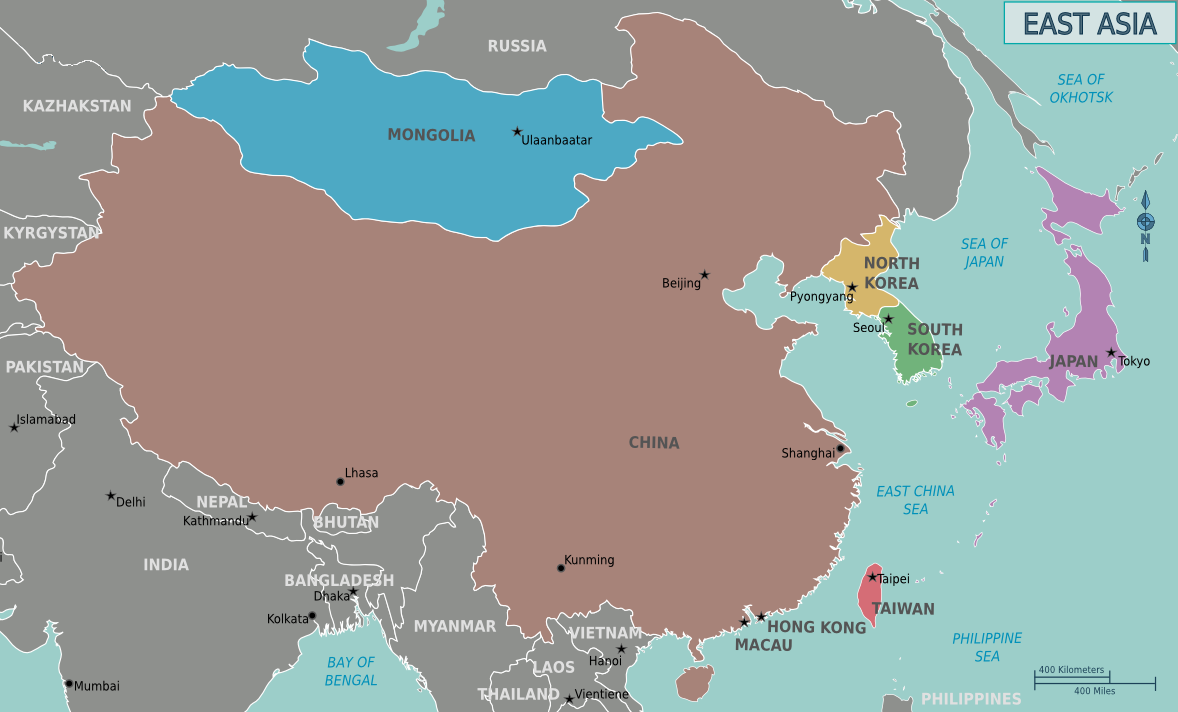
]] The UNSD definition of East Asia is based on statistical convenience, but others commonly use the same definition of Mainland China, Hong Kong, Macau, Mongolia, North Korea, South Korea, Taiwan, and Japan.
Certain Japanese islands are associated with Oceania due to non-continental geology, distance from mainland Asia or biogeographical similarities with Micronesia. Some groups, such as the World Health Organization, categorize China, Japan and Korea with Australia and the rest of Oceania. The World Health Organization label this region the "Western Pacific", with East Asia not being used in their concept of major world regions. Their definition of this region further includes Mongolia and the adjacent area of Cambodia, as well as the countries of the South East Asia Archipelago (excluding East Timor, Thailand, Myanmar and Indonesia).
Alternative definitions
In the context of business and economics, "East Asia" is sometimes used to refer to the geographical area covering ten Southeast Asian countries in ASEAN, Greater China, Japan, and Korea. However, in this context, the term "Far East" is used by the Europeans to cover ASEAN countries and the countries in East Asia. On rare occasions, the term is also sometimes taken to include India and other South Asian countries that are not situated within the bounds of the Asia-Pacific, although the term Indo-Pacific is more commonly used for such a definition.
Observers preferring a broader definition of "East Asia" often use the term Northeast Asia to refer to China, the Korean Peninsula, and Japan, with the region of Southeast Asia covering the ten ASEAN countries. This usage, which is seen in economic and diplomatic discussions, is at odds with the historical meanings of both "East Asia" and "Northeast Asia". The Council on Foreign Relations of the United States defines Northeast Asia as Japan and Korea.
Climate
East Asia is home to many climatic zones. It also has unique weather patterns such as the East Asian rainy season and the East Asian Monsoon.
Climate change
Main article: Climate change in Asia

Like the rest of the world, East Asia has been getting warmer due to climate change, and there had been a measurable increase in the frequency and severity of heatwaves. The region is also expected to see the intensification of its monsoon, leading to more flooding. China has notably embarked on the sponge cities program, where cities are designed to increase the area of urban green spaces and permeable pavings in order to help deal with flash floods caused by greater precipitation extremes. Under high-warming scenarios, "critical health thresholds" for heat stress during the 21st century will be at times breached, in areas like the North China Plain.
China, Japan and the Republic of Korea are expected to see some of the largest economic losses caused by sea level rise. The city of Guangzhou is projected to experience the single largest annual economic losses from sea level rise in the world, potentially reaching US$254 million by 2050. Under the highest climate change scenario and in the absence of adaptation, cumulative economic losses caused by sea level rise in Guangzhou would exceed US$1 trillion by 2100. Shanghai is also expected to experience annual losses of around 1% of the local GDP in the absence of adaptation. The Yangtze River basin is a sensitive and biodiverse ecosystem, yet around 20% of its species may be lost throughout the century under 2 C-change and ~43% under 4.5 C-change.
Economy
Main article: Economy of East Asia
| Customs territory | GDP nominal | ||||||||
|---|---|---|---|---|---|---|---|---|---|
| millions of USD (2024) | GDP nominal per capita | ||||||||
| USD (2024) | GDP PPP | ||||||||
| millions of USD (2024) | GDP PPP per capita | ||||||||
| USD (2024) | East Asia | $25,690,385 | $15,612 | $47,583,868 | $28,916 | ||||
| 18,532,633 | 13,136 | 35,291,015 | 25,015 | ||||||
| 406,775 | 53,606 | 570,082 | 75,128 | ||||||
| 54,677 | 78,962 | 92,885 | 125,510 | ||||||
| 4,110,452 | 33,138 | 6,720,962 | 54,184 | ||||||
| 21,943 | 6,182 | 58,580 | 16,504 | ||||||
| N/A | N/A | N/A | N/A | ||||||
| 1,760,947 | 34,165 | 3,057,995 | 59,330 | ||||||
| 802,958 | 34,432 | 1,792,349 | 76,858 |
Territorial and regional data
China, North Korea, South Korea and Taiwan are all unrecognised by at least one other East Asian state because of severe ongoing political tensions in the region, specifically the division of Korea and the political status of Taiwan.
Etymology
| Flag | Common Name | Official name | ISO 3166 Country Codes | Exonym | Endonym | Exonym | Endonym | ISO Short Name | Alpha-2 Code | Alpha-3 Code | Numeric |
|---|---|---|---|---|---|---|---|---|---|---|---|
| CHN | China | 中国 | People's Republic of China | 中华人民共和国 | China | CN | CHN | 156 | |||
| HKG | Hong Kong | 香港 | Hong Kong Special Administrative Region | ||||||||
| of the People's Republic of China | 中華人民共和國香港特別行政區 | Hong Kong | HK | HKG | 344 | ||||||
| MAC | Macau | 澳門 | Macao Special Administrative Region | ||||||||
| of the People's Republic of China | 中華人民共和國澳門特別行政區 | Macao | MO | MAC | 446 | ||||||
| JPN | Japan | 日本 | Japan | 日本国 | Japan | JP | JPN | 392 | |||
| MNG | Mongolia | Монгол улс / {{MongolUnicode | ᠮᠣᠩᠭᠣᠯ | ||||||||
| ᠤᠯᠤᠰ}} | Mongolia | Монгол Улс () | Mongolia | MN | MNG | 496 | |||||
| PRK | North Korea | 조선 | Democratic People's Republic of Korea | 조선민주주의인민공화국 | Korea (the Democratic People's Republic of) | KP | PRK | 408 | |||
| KOR | South Korea | 한국 | Republic of Korea | 대한민국 | Korea (the Republic of) | KR | KOR | 410 | |||
| TWN | Taiwan | 臺灣 / 台灣 | Republic of China | 中華民國 | Taiwan (Province of China) | TW | TWN | 158 |
Demographics


| State/Territory | Area km2 | Population in | % of East Asia | % of World | Population density | ||||||||||
|---|---|---|---|---|---|---|---|---|---|---|---|---|---|---|---|
| per km2 | HDI | Capital/Administrative Centre | East Asia | 11,840,000 | 1,662,477 | **100%** | **20.66%** | 141 | |||||||
| PRC | 9,640,011 | 1,425,671{{efn | name=un-twn | A note by the United Nations: "For statistical purposes, the data for China do not include Hong Kong and Macao, Special Administrative Regions (SAR) of China, and Taiwan Province of China." | 85.76% | 17.72% | 138 | 0.788 | Beijing | ||||||
| 1,104 | 7,492 | 0.45% | 0.093% | 6,390 | 0.956 | Hong Kong | |||||||||
| 30 | 704 | 0.042% | 0.0087% | 18,662 | 0.925 | Macao | |||||||||
| 377,930 | 123,295 | 7.42% | 1.53% | 337 | 0.920 | Tokyo | |||||||||
| 1,564,100 | 3,447 | 0.2% | 0.042% | 2 | 0.741 | Ulaanbaatar | |||||||||
| 120,538 | 26,161 | 1.57% | 0.33% | 198 | 0.733 | ||||||||||
| Pyongyang | |||||||||||||||
| 100,210 | 51,784 | 3.11% | 0.64% | 500 | 0.929 | Seoul | |||||||||
| 36,197 | 23,923 | 1.44% | 0.297% | 639 | 0.926 | Taipei |
Religion
| Religion | Native name | Creator/Current Leader | Founded Time | Main Denomination | Major book | Type | Ethnic groups | States/territories |
|---|---|---|---|---|---|---|---|---|
| Chinese folk religion | 中國民間信仰 or 中国民间信仰 | Spontaneous formation | Prehistoric period | Salvationist, Wuism, Nuo | Chinese classics, Huangdi Sijing, precious scrolls, etc. | Prehistoric, pantheism, and polytheism | Han, Hmong, Qiang, Tujia (worship of the same ancestor-gods) | CHN (HKG MAC) TWN |
| Taoism | 道教 | Zhang Daoling, Wang Chongyang (Quanzhen School) | 125 AD Eastern Han dynasty | Zhengyi, Quanzhen | Tao Te Ching | Pantheism, polytheism | Han, Zhuang, Hmong, Yao, Qiang, Tujia | CHN (HKG MAC) TWN |
| East Asian Buddhism/Chinese Buddhism | 漢傳佛教 or 汉传佛教 | Emperor Ming of Han (introduced to China), Mālānanda (introduced to Baekje), King Seong of Baekje (introduced to Japan) | 67 AD Eastern Han dynasty | Mahayana | Diamond Sutra | Non-God, Dualism. | Han, Koreans, Yamato | CHN (HKG MAC) JPN PRK KOR TWN |
| Tibetan Buddhism | 藏傳佛教 or 藏传佛教/ | Tonpa Shenrab Miwoche | 1800 years ago | Mahayana, Bon | Anuttarayoga Tantra | Non-God | Tibetans, Manchus, Mongols | CHN MNG |
| Shamanism | 薩滿教 or Бөө мөргөл | Spontaneous formation | Prehistoric period | N/A | Prehistoric, polytheism, and pantheism | Manchus, Mongols, Oroqens | CHN MNG | |
| Shinto | 神道 | Spontaneous formation | Yayoi period | Shinto sects | Kojiki, Nihon Shoki | Prehistoric, pantheism, and polytheism | Yamato | JPN |
| Korean shamanism | 무속 (巫俗) or 무교 (巫敎) | Spontaneous formation | N/A | Shamanism sects | N/A | Prehistoric, pantheism, and polytheism | Koreans | PRK KOR |
| Ryukyuan religion | 琉球神道 or ニライカナイ信仰 | Spontaneous formation | N/A | N/A | N/A | Prehistoric, pantheism, and polytheism | Ryukyuans | JPN (Okinawa) |
Ethnic groups
Main article: East Asians, Ethnic groups of East Asia
| Ethnicity | Native name | Population | Language(s) | Writing system(s) | Major states/territories* | Traditional attire | ||
|---|---|---|---|---|---|---|---|---|
| Han/Chinese | 漢族 or 汉族 | 1,313,345,856 | Chinese (Mandarin, Min, Wu, Yue, Jin, Gan, Hakka, Xiang, Huizhou, Pinghua, etc.) | Simplified Han characters, Traditional Han characters | CHN(HKG MAC) TWN | [[File:兩漢服人hanfu.jpg | upright=0.45 | frameless]] |
| Yamato/Japanese | 大和民族 | 125,117,000 | Japanese | Han characters (Kanji), Katakana, Hiragana | JPN | [[File:Shinto married couple.jpg | upright=0.45 | frameless]] |
| Korean | 조선민족 (朝鮮民族) | |||||||
| 한민족 (韓民族) | 84,790,105 | Korean | Hangul, Han characters (Hanja) | ROK PRK | [[File:Hanbok Day 2016 29 (30467033136).jpg | upright=0.45 | frameless]] | |
| Bai | 白族 | 2,091,543 | Bai, Southwestern Mandarin | Simplified characters, Latin script | CHN | [[File:Bai 5.JPG | upright=0.45 | frameless]] |
| Hui | 回族 | 11,377,914 | Northwestern Mandarin, other Chinese Dialects, Huihui language, etc. | Simplified characters | CHN | [[File:HuiChineseMuslim3.jpg | upright=0.45 | frameless]] |
| Mongols | Монголчууд | |||||||
| Монгол/ | 8,942,528 | Mongolian | Mongol script, Cyrillic script | CHN MGL | [[File:Mongolian Musician.jpg | upright=0.45 | frameless]] | |
| Zhuang | 壮族/Bouxcuengh | 19,568,546 | Zhuang, Southwestern Mandarin, etc. | Simplified Han characters, Latin script | CHN | [[File:Zhuang's beautiful maiden in Chongzuo Fusui.jpg | upright=0.45 | frameless]] |
| Uyghurs | 维吾尔族/ئۇيغۇر | 11,774,538 | Uyghur | Arabic alphabet, Latin script | CHN | [[File:Uyghur-elders-sunday-market-Kashgar.jpg | upright=0.45 | frameless]] |
| Manchus | 满族/ | 10,423,303 | Northeastern Mandarin, Manchu language | Simplified Han characters, Mongol script | CHNTWN | [[File:Akšan.jpg | upright=0.45 | frameless]] |
| Hmong/Miao | 苗族/Ghaob Xongb/Hmub/Mongb | 11,067,929 | Hmong/Miao, Southwestern Mandarin | Latin script, Simplified Han characters | CHN | [[File:贵州黔东南苗族女性(a Miao woman in Qiandongnan,Guizhou).jpg | upright=0.45 | frameless]] |
| Tibetans | 藏族/ | 7,060,731 | Tibetan, Rgyal Rong, Rgu, etc. | Tibetan script | CHN | [[File:People of Tibet46.jpg | upright=0.45 | frameless]] |
| Yi | 彝族/ꆈꌠ | 9,830,327 | Various Loloish, Southwestern Mandarin | Yi script, Simplified Han characters | CHN | [[File:Ethnic Yi China Costume.jpg | upright=0.45 | frameless]] |
| Tujia | 土家族 | 9,587,732 | Northern Tujia, Southern Tujia | Simplified Han characters | CHN | [[File:Tujia women.jpg | upright=0.45 | frameless]] |
| Kam | 侗族/Gaeml | 3,495,993 | Gaeml | Simplified Han characters, Latin script | CHN | [[File:Ethic Dong Liping Guizhou China.jpg | upright=0.45 | frameless]] |
| Tu | 土族/Monguor | 289,565 | Tu, Northwestern Mandarin | Simplified Han characters | CHN | [[File:Nadun Picture 1.jpg | upright=0.45 | frameless]] |
| Daur | 达斡尔族/ | 131,992 | Daur, Northeastern Mandarin | Mongol script, Simplified Han characters | CHN MGL | [[File:Daur woman smiling.jpg | upright=0.45 | frameless]] |
| Indigenous Taiwanese | 臺灣原住民/ 高山族/ Yincomin/ Kasetaivang/ Inanuwayan | 533,600 | Austronesian languages (Amis, Yami), etc. | Latin script, Traditional Han characters | TWN | |||
| Ryukyuan | 琉球民族 | 1,900,000 | Japanese | |||||
| Ryukyuan | Han characters (Kanji), Katakana, Hiragana | JPN | [[File:Five men wearing Ryukyuan Dress.JPG | upright=0.45 | frameless]] | |||
| Ainu | アイヌ/ Aynu/ Айну | 200,000 | Japanese | |||||
| Ainu | Ainu uses both the Katakana and Latin scripts | JPN | [[File:AinuSan.jpg | upright=0.45 | frameless]] |
- Note: The order of states/territories follows the population ranking of each ethnicity, within East Asia only.
Culture
Main article: Sinosphere
Main article: Culture of East Asia
Overview
The culture of East Asia, has been deeply influenced by China, as it was the civilization that had the most dominant influence in the region throughout the ages that ultimately laid the foundation for East Asian civilization. The vast knowledge and ingenuity of Chinese civilization and the classics of Chinese literature and culture were seen as the foundations for a civilized life in East Asia. Imperial China served as a vehicle through which the adoption of Confucian ethical philosophy, Chinese calendar system, political and legal systems, architectural style, diet, terminology, institutions, religious beliefs, imperial examinations that emphasised a knowledge of Chinese classics, political philosophy and cultural value systems, as well as historically sharing a common writing system reflected in the histories of Japan and Korea.
The Imperial Chinese tributary system was the bedrock of network of trade and foreign relations between China and its East Asian tributaries, which helped to shape much of East Asian affairs during the ancient and medieval eras. Through the tributary system, the various dynasties of Imperial China facilitated frequent economic and cultural exchange that influenced the cultures of Japan and Korea and drew them into a Chinese international order. The Imperial Chinese tributary system shaped much of East Asia's foreign policy and trade for over two millennia due to Imperial China's economic and cultural dominance over the region, and thus played a huge role in the history of East Asia in particular. The relationship between China and its cultural influence on East Asia has been compared to the historical influence of Greco-Roman civilization on classical Western civilisation.
Since the late 19th century, the initially unequal encounter with Western influences has also shaped East Asia.
Festivals
| Festival | Native name | Other name | Calendar | Date | Gregorian date | Activity | Religious practices | Food | Major ethnicities | Major states/territories |
|---|---|---|---|---|---|---|---|---|---|---|
| Chinese New Year | 農曆新年/农历新年 or 春節/春节 | Spring Festival | Chinese | Month 1 Day 1 | 21 Jan–20 Feb | Family Reunion, Ancestors Worship, Tomb Sweeping, Fireworks | Worship the King of Gods | Nian gao | Han, Manchus etc. | CHN (HKG MAC) MNG TWN |
| Korean New Year | 설날 or 설 | Seollal | Korean | Month 1 Day 1 | 21 Jan–20 Feb | Ancestors Worship, Family Reunion, Tomb Sweeping | N/A | Tteokguk | Koreans | PRK KOR |
| Losar or Tsagaan Sar | 藏历新年/ or 查干萨日/Цагаан сар | White Moon | Tibetan, Mongolian | Month 1 Day 1 | 25 Jan – 2 Mar | Family Reunion, Ancestors Worship, Tomb Sweeping, Fireworks | N/A | Chhaang or Buuz | Tibetans, Mongols, Tu etc. | CHN MNG |
| New Year | 元旦 | Yuan Dan | Gregorian | 1 Jan | 1 Jan | Fireworks | N/A | N/A | N/A | CHN (HKG MAC) JPN MNG PRK KOR TWN |
| Lantern Festival | 元宵節 or 元宵节 | Upper Yuan Festival (上元节) | Chinese | Month 1 Day 15 | 4 Feb – 6 Mar | Lanterns Expo, Ancestors Worship, Tomb Sweeping | Birthdate of the God of Sky-officer | Yuanxiao | Han | CHN (HKG MAC) TWN |
| Daeboreum | 대보름 or 정월 대보름 | Great Full Moon | Korean | Month 1 Day 15 | 4 Feb – 6 Mar | Greeting of the moon, kite-flying, Jwibulnori, eating nuts (Bureom) | Bonfires (daljip taeugi) | Ogok-bap, namul, nuts | Korean | PRK KOR |
| Hanshi Festival | 寒食節 or 寒食节 | Cold Food Festival | Solar term | Traditionally, on the 105th day after the Winter solstice. Revised to 1 day before the Qingming Festival by Johann Adam Schall von Bell (Chinese: ) during the Qing dynasty. | April 3–5 | Ancestors Worship, Tomb Sweeping, No cooking hot meal/setting fire, Cold food only. Cuju, etc. (People used to mix this one with the Qingming Festival due to their close dates) | In Memory of a loyal Ancient named Jie Zhitui (Chinese: ), ordered by the Monarch of the Jin (Chinese state), Duke Wen of Jin (Chinese: ) | Cold Food, e.g. Qingtuan | Han, Koreans, Mongols | CHN (HKG MAC) PRK KOR TWN |
| Qingming Festival | 清明節 or 清明节 or Ханш нээх | Tomb Sweeping Day | Solar term | 15th day after the Vernal Equinox. Just 1 day after the Hanshi Festival, but in much higher repute. | April 4–6th | Ancestors Worship, Tomb Sweeping, Excursion, Planting trees, Flying kites, Tug of war, Cuju, etc. (Almost the same with the Hanshi Festival's, due to their close dates) | Burning Hell money for deceased family members. Planting willow branches to keep ghosts away from houses. | Boiled eggs | Han, Koreans, Mongols | CHN (HKG MAC) MNG PRK KOR TWN |
| Dragon Boat Festival | 端午節 or 端午节 or 단오 | Duanwu Festival / Dano (Surit-nal) | Chinese / Korean | Month 5 Day 5 | Driving poisons & plague away. (China: Dragon Boat Race, Wearing coloured lines, Hanging felon herb on the front door.) / (Korea: Washing hair with iris water, ssireum) | Worship various Gods | Zongzi / Surichwitteok (rice cake with herbs) | Han, Koreans, Yamato | CHN (HKG MAC) PRK KOR JPN TWN | |
| Ghost Festival | 中元節 or 中元节 or 백중 | Mid Yuan Festival | Chinese | Month 7 Day 15 | Ancestors Worship, Tomb Sweeping | Birthdate of the God of Earth-officer | Han, Koreans, Yamato | CHN (HKG MAC) PRK KOR JPN TWN | ||
| Mid-Autumn Festival | 中秋節 or 中秋节 | 中秋祭 | Chinese | Month 8 Day 15 | Family Reunion, Enjoying Moon view | Worship the Moon Goddess | Mooncake | Han | CHN (HKG MAC) TWN | |
| Chuseok | 추석 or 한가위 | Hangawi | Korean | Month 8 Day 15 | Family Reunion, Ancestors Worship, Tomb Sweeping, Enjoying Moon view | N/A | Songpyeon, Torantang (Taro soup) | Koreans | PRK KOR | |
| Tsukimi | 月見 or お月見 | Tsukimi or Otsukimi | Gregorian | Month 8 Day 15 | Family Reunion, Enjoying Moon view | Worship the Moon | Tsukimi Dango, Sweet Potato | Yamato | JPN * | |
| Double Ninth Festival | 重陽節 or 重阳节 | Double Positive Festival | Chinese | Month 9 Day 09 | Climbing Mountain, Taking care of elderly, Wearing Cornus. | Worship various Gods | Han, Korean, Yamato | CHN (HKG MAC) PRK KOR JPN TWN* | ||
| Lower Yuan Festival | 下元節 or 下元节 | N/A | Chinese | Month 10 Day 15 | Ancestors Worship, Tomb Sweeping | Birthdate of the God of Water-officer | Ciba | Han | CHN (HKG MAC) TWN | |
| Dongzhi Festival | 冬至 or 동지 or 冬至 | N/A | Gregorian | Between Dec 21 and Dec 23 | Between Dec 21 and Dec 23 | Ancestors Worship, Rites to dispel bad spirits | N/A | Tangyuan, Patjuk, Zenzai, Kabocha | Han, Koreans, Yamato | CHN (HKG MAC) PRK KOR JPN TWN |
| Small New Year | 小年 | Jizao (祭灶) | Chinese | Month 12 Day 23 | Cleaning Houses | Worship the God of Hearth | tanggua | Han, Mongols | CHN (HKG MAC) MNG TWN |
*Japan switched the date to the Gregorian calendar after the Meiji Restoration. *Not always on that Gregorian date, sometimes April 4.
Entertainment
East Asian popular culture, such as anime and manga from Japan and K-pop and K-dramas from South Korea, have become highly popular worldwide in the 21st century.
Sports
.jpg)
Baseball is one of the main sports in East Asia, having been introduced through mid-19th century American contact and further spread by the Japanese Empire. The game has gained millions of fans in China since the 2010s.
East Asian Youth Games
Main article: East Asian Youth Games
Formerly the East Asian Games, it is a multi-sport event organized by the East Asian Games Association (EAGA) and held every four years since 2019 among athletes from East Asian countries and territories of the Olympic Council of Asia (OCA), as well as the Pacific island of Guam, which is a member of the Oceania National Olympic Committees.
It is one of five Regional Games of the OCA. The others are the Central Asian Games, the Southeast Asian Games (SEA Games), the South Asian Games and the West Asian Games.
Collaboration
Free trade agreements
| Name of agreement | Parties | Leaders at the time | Negotiation begins | Signing date | Starting time | Current status |
|---|---|---|---|---|---|---|
| China–South Korea FTA | CHN KOR | Xi Jinping, Park Geun-hye | May, 2012 | Jun 01, 2015 | Dec 30, 2015 | Enforced |
| China–Japan–South Korea FTA | CHN JPN KOR | Xi Jinping, Shinzō Abe, Park Geun-hye | Mar 26, 2013 | N/A | N/A | 10 round negotiation |
| Japan-Mongolia EPA | JPN MNG | Shinzō Abe, Tsakhiagiin Elbegdorj | - | Feb 10, 2015 | - | Enforced |
| China-Mongolia FTA | CHN MNG | Xi Jinping, Tsakhiagiin Elbegdorj | N/A | N/A | N/A | Officially proposed |
| China-HK CEPA | CHN HKG | Jiang Zemin, Tung Chee-hwa | - | Jun 29, 2003 | - | Enforced |
| China-Macau CEPA | CHN MAC | Jiang Zemin, Edmund Ho Hau-wah | - | Oct 18, 2003 | - | Enforced |
| Hong Kong-Macau CEPA | HKG MAC | Carrie Lam, Fernando Chui | Oct 09, 2015 | N/A | N/A | Negotiating |
| ECFA | CHN TWN | Hu Jintao, Ma Ying-jeou | Jan 26, 2010 | Jun 29, 2010 | Aug 17, 2010 | Enforced |
| CSSTA (Based on ECFA) | CHN TWN | Xi Jinping, Ma Ying-jeou | Mar, 2011 | Jun 21, 2013 | N/A | Abolished |
| CSGTA (Based on ECFA) | CHN TWN | Hu Jintao, Ma Ying-jeou | Feb 22, 2011 | N/A | N/A | Suspended |
Military alliances
| Name | Parties within the region |
|---|---|
| Sino-North Korean Mutual Aid and Cooperation Friendship Treaty | CHN PRK |
| Treaty of Mutual Cooperation and Security between the United States and Japan | USA JPN |
| Mutual Defense Treaty Between the United States and the Republic of Korea | USA KOR |
Major cities
Main article: Cities of East Asia
File:Shinjuku skyline, Tokyo - Sony A7R (11831328835).jpg|Tokyo is the capital of Japan and the world's largest city, both in metropolitan population and economy. 景山公园 (20315852831)- cropped.jpg |Beijing is the capital of China. It has a history of over 3300 years. File:Namdaemun-ro, Seoul.jpg|Seoul is the capital of South Korea. File:Osaka Umeda Sky Building Panoramablick 05.jpg|Osaka is the second-largest metropolitan area in Japan. Huangpu Park 20124-Shanghai (32208802494).jpg |Shanghai is China's largest city and most important economic center. File:Nagoya Night View.jpg|Nagoya is the third-largest metropolitan area in Japan. Nagoya is a major port city and the location of Lexus headquarters. File:Kyoto, Japan (Unsplash UIN-pFfJ7c).jpg|Kyoto was the imperial capital of Japan for eleven centuries. File:UB downtown.jpg|Ulaanbaatar is the capital of Mongolia, with a population of 1.6 million as of 2021. File:Taipei Night Skyline from Hongludi 20240113.jpg|Taipei City is the capital of Taiwan, with a population of 2.6 million. File:Hong Kong Harbour Night 2019-06-11.jpg|Hong Kong is one of the global financial centres and is known as a cosmopolitan metropolis. File:Gwangandaegyo_Bridge_in_Busan,South_Korea(iau2207b).jpg|Busan is the second largest city in South Korea and a financial centre along with Seoul File:Pyongyang City - Ryugyong Hotel in Background (13913572409).jpg|Pyongyang is the capital of North Korea, and a major city on the Korean Peninsula. 202403 西安钟楼夜景.jpg|Xi'an or Chang'an is the oldest of the Four Great Ancient Capitals of China. File:Pass over Eastern Asia to Philippine Sea and Guam.ogv|Pass of the ISS over Mongolia, looking out west towards the Pacific Ocean, China, and Japan. As the video progresses, major cities along the Chinese coast and the Japanese islands on the Philippine Sea are visible. The island of Guam can be seen further down the pass into the Philippine Sea, and the pass ends just to the east of New Zealand.
Notes
References
References
- "Countries of Asia". Nations Online.
- Kort, Michael. (2005). "The Handbook Of East Asia". Lerner.
- "East Asia". [[RAND Corporation]].
- (2013). "Relational, Networked and Collaborative Approaches to Public Diplomacy: The Connective Mindshift". Routledge.
- Holcombe, Charles. (2017). "A History of East Asia: From the Origins of Civilization to the Twenty-First Century". Cambridge University Press.
- Szonyi, Michael. (2017). "A Companion to Chinese History". Wiley–Blackwell.
- Selin, Helaine. (2010). "Nature Across Cultures: Views of Nature and the Environment in Non-Western Cultures". Springer.
- (1998). "Tao Te Ching: The Classic Book of Integrity and the Way". [[Quality Paperback Book Club]].
- Salkind, Neil J.. (2008). "Encyclopedia of Educational Psychology". Sage Publications.
- Kim, Chongho. (2003). "Korean Shamanism: The Cultural Paradox". Ashgate.
- Andreas Anangguru Yewangoe, "Theologia crucis in Asia", 1987 Rodopi
- Heissig, Walther. (2000). "The Religions of Mongolia". Kegan Paul International.
- (2018). "Genetic structure, divergence and admixture of Han Chinese, Japanese and Korean populations". Hereditas.
- Holcombe, Charles. (2017). "A History of East Asia". Cambridge University Press.
- Ball, Desmond. (2005). "The Transformation of Security in the Asia/Pacific Region". Routledge.
- (2014). "The Triple Package: How Three Unlikely Traits Explain the Rise and Fall of Cultural Groups in America". Penguin.
- Kang, David C.. (2012). "East Asia Before the West: Five Centuries of Trade and Tribute". Columbia University Press.
- (2012). "World History: Journeys from Past to Present". Routledge.
- Smolnikov, Sergey. (2018). "Great Power Conduct and Credibility in World Politics". Springer.
- Lone, Stewart. (2007). "Daily Lives of Civilians in Wartime Asia: From the Taiping Rebellion to the Vietnam War". Greenwood.
- Cohen, Warren I.. (2000). "East Asia at the Center: Four Thousand Years of Engagement with the World". Columbia University Press.
- Norman, Jerry. (1988). "Chinese". Cambridge University Press.
- Chua, Amy. (2009). "Day of Empire: How Hyperpowers Rise to Global Dominance—and Why They Fall". Anchor.
- Leibo, Steve. (2012). "East and Southeast Asia 2012". Stryker-Post.
- Tsai, Henry. (2009). "Maritime Taiwan: Historical Encounters with the East and the West". Routledge.
- Lockard, Craig. (1999). "Tang Civilization and the Chinese Centuries". Encarta Historical Essays.
- {{harvnb. Lockard. 1999
- (2014). "Korean History in Maps". Cambridge University Press.
- Fagan, Brian M.. (1999). "The Oxford Companion to Archaeology". Oxford University Press.
- {{harvnb. Lockard. 1999
- Lockard, Craig A.. (2009). "Societies Networks And Transitions: Volume B From 600 To 1750". Wadsworth.
- (1997). "Asia in Western and World History: A Guide for Teaching". M. E. Sharpe.
- Lind, Jennifer. (February 13, 2018). "Life in China's Asia: What Regional Hegemony Would Look Like".
- {{harvnb. Lockard. 1999
- Ellington, Lucien. (2009). "Japan". Bloomsbury.
- Roberts, John M.. (1997). "A Short History of the World". Oxford University Press.
- Hayes, Louis D.. (2009). "Political Systems of East Asia: China, Korea, and Japan". Greenlight.
- {{harvnb. Hayes. 2009
- (2009). "America: A Narrative History". W. W. Norton.
- (2007). "Diversity: New Realities in a Changing World". Palgrave Macmillan.
- {{harvnb. Cohen. 2000
- Batty, David. (2005-01-17). "Japan's War in Colour". TWI.
- (2000). "Diversity: New Realities in a Changing World". Harvard University Press.
- (2014). "East Asian Development Model: Twenty-first century perspectives". Routledge.
- (2014). "China's Rise and Regional Integration in East Asia: Hegemony or community?". Routledge.
- "Sino-Japanese War (1894–95)".
- Hirata, Koji. (2024). "Making Mao's Steelworks: Industrial Manchuria and the Transnational Origins of Chinese Socialism". [[Cambridge University Press]].
- {{harvnb. Tindall. Shi. 2009
- Li, Xiaobing. (2018). "The Cold War in East Asia". [[Routledge]].
- (2024). "The Taiwan Question in Xi Jinping's Era: Beijing's Evolving Taiwan Policy and Taiwan's Internal and External Dynamics". [[Routledge]].
- (2004). "Encyclopedia of World Trade: From Ancient Times to the Present". Routledge.
- Paul, Erik. (2012). "Neoliberal Australia and US Imperialism in East Asia". Palgrave Macmillan.
- Maddison, Angus. (2007). "Contours of the World Economy 1–2030 AD: Essays in Macro-Economic History". [[Oxford University Press]].
- "China and the Knowledge Economy: Seizing the 21st Century. WBI Development Studies". Institute of Education Sciences.
- "Angus Maddison. Chinese Economic Performance in the Long Run. Development Centre Studies.".
- [http://www.eric.ed.gov/ERICWebPortal/custom/portlets/recordDetails/detailmini.jsp?nfpb=true&&ERICExtSearch_SearchValue_0=ED460052&ERICExtSearch_SearchType_0=no&accno=ED460052 Dahlman, Carl J; Aubert, Jean-Eric. ''China and the Knowledge Economy: Seizing the 21st Century'']. WBI Development Studies. [[World Bank]] publications. Accessed January 30, 2008.
- [[Angus Maddison]]. [http://browse.oecdbookshop.org/oecd/pdfs/product/4107091e.pdf ''Chinese Economic Performance in the Long Run''] {{webarchive. link. (2014-10-15 . Development Centre Studies. Accessed 2007. p.29 See the "Table 1.3. Levels of Chinese and European GDP Per Capita, 1–1700 AD" in page 29, Chinese GDP Per Capita was 450 and European GDP Per Capital was 422 in 960AD. Chinese GDP Per Capita was 600 while European was 576. During this time, Chinese per capita income rose by about a third.)
- (2024). "Beyond Power Transitions: The Lessons of East Asian History and the Future of U.S.-China Relations". [[Columbia University Press]].
- (September 10, 2016). "Introducing East Asian Peoples".
- [[Gilbert Rozman]] (2004), ''Northeast Asia's stunted regionalism: bilateral distrust in the shadow of globalization''. Cambridge University Press, pp. 3–4
- "[https://www.reuters.com/article/2011/02/09/us-technology-patents-idUSTRE7184CN20110209 Northeast Asia dominates patent filing growth]." Retrieved on August 8, 2001.
- "[http://www.iie.com/publications/papers/schott1001-1.pdf Paper: Economic Integration in Northeast Asia]." {{Webarchive. link. (2016-03-04 Retrieved on August 8, 2011.)
- (2014). "The Global Prehistory of Human Migration". Wiley-Blackwell.
- {{harvnb. Kort. 2005
- Prescott, Anne. (2015). "East Asia in the World: An Introduction". Routledge.
- Ikeo, Aiko. (1996). "Economic Development in Twentieth-Century East Asia: The International Context". Routledge.
- Yoshimatsu, H.. (2014). "Comparing Institution-Building in East Asia: Power Politics, Governance, and Critical Junctures". Palgrave Macmillan.
- Kim, Mikyoung. (2015). "Routledge Handbook of Memory and Reconciliation in East Asia". Routledge.
- (2005). "Building Area Studies Collections". Otto Harrassowitz.
- (2012). "Economic Development: A Regional, Institutional, and Historical Approach". Routledge.
- Currie, Lorenzo. (2013). "Through the Eyes of the Pack". Xlibris Corp.
- Asato, Noriko. (2013). "Handbook for Asian Studies Specialists: A Guide to Research Materials and Collection Building Tools". Libraries Unlimited.
- {{harvnb. Prescott. 2015
- Miller, David Y.. (2007). "Modern East Asia: An Introductory History". Routledge.
- "Central Themes for a Unit on China r Educators". Columbia University.
- Cummings, Sally N.. (2013). "Understanding Central Asia: Politics and Contested Transformations". Routledge.
- (2012). "The South Asian Association for Regional Cooperation (SAARC): An emerging collaboration architecture". Routledge.
- Cornell, Svante E.. "Modernization and Regional Cooperation in Central Asia: A New Spring?". Central Asia-Caucasus Institute and the Silk Road Studies.
- "Integration of Markets vs. Integration by Agreements". [[World Bank]].
- "Northeast Asia". [[Council on Foreign Relations]].
- Economic Research Institute for Northeast Asia. (1999). "Japan and Russia in Northeast Asia: Partners in the 21st Century". Greenwood.
- "UNSD — Methodology".
- (2015-05-06). "United Nations Statistics Division – Standard Country and Area Codes Classifications (M49)". [[United Nations Statistics Division]].
- "East Asia". Microsoft.
- (11 February 2013). "Composition of macro geographical (continental) regions, geographical sub-regions, and selected economic and other groupings". United Nations Statistics Division.
- Todd, Ian. (1974). "Island Realm: A Pacific Panorama". Angus & Robertson.
- "A Classification of the Biogeographical Provinces of the World". UNESCO.
- "IMAGE: Countries and areas in WHO's Western Pacific Region".
- (15 September 2021). "Forget Asia-Pacific, it's Indo-Pacific now. Where is that?".
- Dent, Christopher M.. (2008). "East Asian regionalism". Routledge.
- (2005). "New East Asian regionalism". Edward Elgar.
- (2006). "Beyond Japan: the dynamics of East Asian regionalism". Cornell University Press.
- An, Z. (April 2000). "Asynchronous Holocene optimum of the East Asian monsoon". Quaternary Science Reviews.
- (31 July 2018). "North China Plain threatened by deadly heatwaves due to climate change and irrigation". Nature Communications.
- Shaw, R., Y. Luo, T. S. Cheong, S. Abdul Halim, S. Chaturvedi, M. Hashizume, G. E. Insarov, Y. Ishikawa, M. Jafari, A. Kitoh, J. Pulhin, C. Singh, K. Vasant, and Z. Zhang, 2022: [https://www.ipcc.ch/report/ar6/wg2/downloads/report/IPCC_AR6_WGII_Chapter10.pdf Chapter 10: Asia]. In [https://www.ipcc.ch/report/ar6/wg2/ Climate Change 2022: Impacts, Adaptation and Vulnerability] [H.-O. Pörtner, D. C. Roberts, M. Tignor, E. S. Poloczanska, K. Mintenbeck, A. Alegría, M. Craig, S. Langsdorf, S. Löschke, V. Möller, A. Okem, B. Rama (eds.)]. Cambridge University Press, Cambridge, United Kingdom and New York, New York, US, pp. 1457–1579
- "Report for Selected Countries and Subjects: April 2024". [[International Monetary Fund]].
- "Country codes".
- (January 2018). "Human Development Reports".
- (21 December 2022). "Religious Composition by Country, 2010-2050".
- Hardacre, Helen. (2017). "Shinto: a history". Oxford University Press.
- "CIA Factbook".
- link. stat.go.jp
- [https://jumin.mois.go.kr/ 주민등록 인구통계]
- {{Cite CIA World Factbook
- (2021). Ministry of Foreign Affairs and Trade. link
- "China Statistical Yearbook 2021".
- (2005). "Ethnologue: Languages of the World". SIL International.
- "Ainu language and alphabet".
- Goscha, Christopher. (2016). "The Penguin History of Modern Vietnam: A History". Allen Lane.
- {{harvnb. Chua. Rubenfeld. 2014
- Lewis, Mark Edward. (2012). "China's Cosmopolitan Empire: The Tang Dynasty". Belknap.
- Reischauer, Edwin O.. (1974). "The Sinic World in Perspective". Foreign Affairs.
- {{harvnb. Chua. Rubenfeld. 2014
- Seo, Yongseok. (2006-04-30). "Chapter 22. East Asian Response to the Globalization of Culture: Perceptional Change and Cultural Policy". University of Hawaii Press.
- Hollingsworth, Julia. (2019-12-29). "Why the past decade saw the rise and rise of East Asian pop culture".
- Cho, Younghan. (2016). "Double binding of Japanese colonialism: trajectories of baseball in Japan, Taiwan, and Korea". Cultural Studies.
- 杜娟. "MLB's China operation knocking it out the ball park".
- United Nations. (March 12, 2017). "The World's Cities in 2016".
- link. Ministry of Government Administration and Home Affairs
This article was imported from Wikipedia and is available under the Creative Commons Attribution-ShareAlike 4.0 License. Content has been adapted to SurfDoc format. Original contributors can be found on the article history page.
Ask Mako anything about East Asia — get instant answers, deeper analysis, and related topics.
Research with MakoFree with your Surf account
Create a free account to save articles, ask Mako questions, and organize your research.
Sign up freeThis content may have been generated or modified by AI. CloudSurf Software LLC is not responsible for the accuracy, completeness, or reliability of AI-generated content. Always verify important information from primary sources.
Report