From Surf Wiki (app.surf) — the open knowledge base
E Scow
Sailboat class
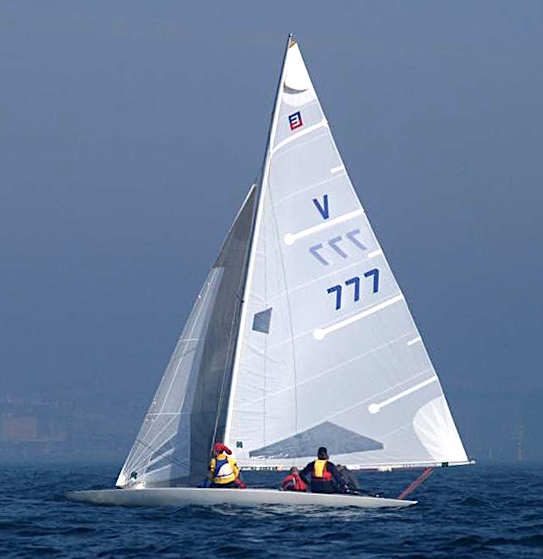
Sailboat class
| Field | Value |
|---|---|
| name | E Scow |
| insignia | File:E-Scow (logo).png |
| insignia size | 68px |
| line drawing | File:EScow sailplan 600 600.svg |
| designer | Arnold Meyer Sr |
| location | United States |
| year | 1924 |
| builder | Johnson Boat Works |
| Melges Performance Sailboats | |
| role | One-design racer |
| crew | 3-5 |
| draft | 3.75 ft with a centerboard down |
| displacement | 965 lb |
| hull type | monohull |
| construction | wood or fiberglass |
| loa | 28.00 ft |
| beam | 6.75 ft |
| keel type | twin centerboards |
| rudder type | spade-type rudder |
| rig type | Bermuda rig |
| sailplan | fractional rigged sloop |
| sailarea main | 228 sqft |
| sailarea headsail | 95 sqft |
| sailarea spin | 550 sqft |
| sailarea total | 323 sqft |
| d-pn | 73.2 |
Melges Performance Sailboats
|d-pn = 73.2 |rya-pn =
The E Scow is an American sailing dinghy that was designed by Arnold Meyer Sr as a one-design racer and first built in 1924.
Production
The design was initially built by Johnson Boat Works in White Bear Lake, Minnesota United States, but that company closed in 1998 and production passed to Melges Performance Sailboats, who continue to build it.
Design
The E Scow is a recreational sailboat, originally built of wood and now predominantly of fiberglass sandwich construction, with wood trim. It has a fractional sloop rig with either wooden or aluminum spars and running backstays. The forestay is attached well aft of the boat's bow. The hull is a scow design, with a vertical transom, a spade-type rudder controlled by a tiller and retractable dual centerboards (also called bilgeboards). It displaces 965 lb.
The boat has a draft of 3.75 ft with a centerboard extended. With the centerboards retracted it may be beached or transported on a trailer.
For sailing the design is equipped with jib and mainsail windows for visibility, plus automatic bailers. The mainsail is controlled by an outhaul, downhaul, Cunningham, boom vang and a leach cord. Under the class rules a jib luff wire and a downhaul are permitted. The boat also has a radiused mainsheet traveler and adjustable jib tracks. Only hiking straps are permitted.
The design has a Portsmouth Yardstick racing average handicap of 73.2 and is normally raced with a crew of three to five sailors.
Operational history

The boat is supported by an active class club that organizes racing events, the National Class E Scow Association. By 1994 racing fleets were sailing in Texas, Colorado, Wisconsin, Minnesota, Michigan, New York and New Jersey.
In a 1994 review Richard Sherwood wrote, "this is a very fast and sophisticated boat with a long history of development. Scows probably evolved from sharpies, and the first scows were in evidence around 1895. E Scows were born at a meeting of the Inland Lake Yachting Association in 1923. Wood has been used for many years, but since 1976 FRP has predominated."
References
References
- McArthur, Bruce. (2020). "E Scow sailboat". sailboatdata.com.
- Sherwood, Richard M.: ''A Field Guide to Sailboats of North America, Second Edition'', pages 128-129. [[Houghton Mifflin Company]], 1994. {{ISBN. 0-395-65239-1
- McArthur, Bruce. (2020). "Melges Performance Sailboats". sailboatdata.com.
- McArthur, Bruce. (2020). "Johnson Boat Works (USA) 1896 - 1998". sailboatdata.com.
- Melges Performance Sailboats. (2020). "The Melges E Scow". melges.com.
- McArthur, Bruce. (2020). "E Scow (National Class E Scow Association)". sailboatdata.com.
This article was imported from Wikipedia and is available under the Creative Commons Attribution-ShareAlike 4.0 License. Content has been adapted to SurfDoc format. Original contributors can be found on the article history page.
Ask Mako anything about E Scow — get instant answers, deeper analysis, and related topics.
Research with MakoFree with your Surf account
Create a free account to save articles, ask Mako questions, and organize your research.
Sign up freeThis content may have been generated or modified by AI. CloudSurf Software LLC is not responsible for the accuracy, completeness, or reliability of AI-generated content. Always verify important information from primary sources.
Report