From Surf Wiki (app.surf) — the open knowledge base
Drill bit sizes
Standard cutting tool sizes

Standard cutting tool sizes
Drill bits are the cutting tools of drilling machines. They can be made in any size to order, but standards organizations have defined sets of sizes that are produced routinely by drill bit manufacturers and stocked by distributors.
In the U.S., fractional inch and gauge drill bit sizes are in common use. In nearly all other countries, metric drill bit sizes are most common, and all others are anachronisms or are reserved for dealing with designs from the US. The British Standards on replacing gauge size drill bits with metric sizes in the UK was first published in 1959.
A comprehensive table for metric, fractional wire and tapping sizes can be found at the drill and tap size chart.
Metric drill bit sizes
Metric drill bit sizes define the diameter of the bit in terms of standard metric lengths. Standards organizations define sets of sizes that are conventionally manufactured and stocked. For example, British Standard BS 328 defines 230 sizes from 0.2 mm to 25.0 mm.
From 0.2 through 0.98 mm, sizes are defined as follows, where N is an integer from 2 through 9:
- N · 0.1 mm
- N · 0.1 + 0.02 mm
- N · 0.1 + 0.05 mm
- N · 0.1 + 0.08 mm
From 1.0 through 2.95 mm, sizes are defined as follows, where N is an integer from 10 through 29:
- N · 0.1 mm
- N · 0.1 + 0.05 mm
From 3.0 through 13.9 mm, sizes are defined as follows, where N is an integer from 30 through 139:
- N · 0.1 mm
From 14.0 through 25.0 mm, sizes are defined as follows, where M is an integer from 14 through 25:
- M · 1 mm
- M · 1 + 0.25 mm
- M · 1 + 0.5 mm
- M · 1 + 0.75 mm
In smaller sizes, bits are available in smaller diameter increments. This reflects both the smaller drilled hole diameter tolerance possible on smaller holes and the wishes of designers to have drill bit sizes available within at most 10% of an arbitrary hole size.
The price and availability of particular size bits does not change uniformly across the size range. Bits at size increments of 1 mm are most commonly available, and lowest price. Sets of bits in 1 mm increments might be found on a market stall. In 0.5 mm increments, any hardware store. In 0.1 mm increments, any engineers' store. Sets are not commonly available in smaller size increments, except for drill bits below 1 mm diameter. Drill bits of the less routinely used sizes, such as 2.55 mm, would have to be ordered from a specialist drill bit supplier. This subsetting of standard sizes is in contrast to general practice with number gauge drill bits, where it is rare to find a set on the market which does not contain every gauge.
There are also Renard series sequences of preferred metric drill bits:
- R5 (factor 1.58) : M2.5, M4, M6, M10, M16, M24
- R10 (factor 1.26): M3, M5, M8, M12, M20, M30
Metric dimensioning is routinely used for drill bits of all types, although the details of BS 328 apply only to twist drill bits. For example, a set of Forstner bits may contain 10, 15, 20, 25 and 30 mm diameter cutters.
Fractional-inch drill bit sizes

Fractional-inch drill bit sizes are still in common use in the United States and in any factory (around the globe) that makes inch-sized products for the U.S. market.
ANSI B94.11M-1979 sets size standards for jobber-length straight-shank twist drill bits from inch through 1 inch in -inch increments. For Morse taper-shank drill bits, the standard continues in -inch increments up to inches, then -inch increments up to inches, -inch increments up to 3 inches, -inch increments up to inches, and a single -inch increment to inches. One aspect of this method of sizing is that the size increment between drill bits becomes larger as bit sizes get smaller: 100% for the step from to , but a much smaller percentage between and .
Drill bit sizes are written as irreducible fractions. So, instead of inches, or inches, the size is noted as inches.
Below is a chart providing the decimal-fraction equivalents that are most relevant to fractional-inch drill bit sizes (that is, 0 to 1 by 64ths). (Decimal places for .25, .5, and .75 are shown to thousandths [.250, .500, .750], which is how machinists usually think about them ["two-fifty", "five hundred", "seven-fifty"]. Machinists generally truncate the decimals after thousandths; for example, a -inch drill bit may be referred to in shop-floor speech as a "four-twenty-one drill".)
Decimal-fraction equivalents

| fraction | in | mm |
|---|---|---|
| 1/64 in | ||
| 1/32 in | ||
| 3/64 in | ||
| 1/16 in | ||
| 5/64 in | ||
| 3/32 in | ||
| 7/64 in | ||
| 1/8 in | ||
| 9/64 in | ||
| 5/32 in | ||
| 11/64 in | ||
| 3/16 in | ||
| 13/64 in | ||
| 7/32 in | ||
| 15/64 in | ||
| 1/4 in |
| fraction | in | mm |
|---|---|---|
| 17/64 in | ||
| 9/32 in | ||
| 19/64 in | ||
| 5/16 in | ||
| 21/64 in | ||
| 11/32 in | ||
| 23/64 in | ||
| 3/8 in | ||
| 25/64 in | ||
| 13/32 in | ||
| 27/64 in | ||
| 7/16 in | ||
| 29/64 in | ||
| 15/32 in | ||
| 31/64 in | ||
| 1/2 in |
| fraction | in | mm |
|---|---|---|
| 33/64 in | ||
| 17/32 in | ||
| 35/64 in | ||
| 9/16 in | ||
| 37/64 in | ||
| 19/32 in | ||
| 39/64 in | ||
| 5/8 in | ||
| 41/64 in | ||
| 21/32 in | ||
| 43/64 in | ||
| 11/16 in | ||
| 45/64 in | ||
| 23/32 in | ||
| 47/64 in | ||
| 3/4 in |
| fraction | in | mm |
|---|---|---|
| 49/64 in | ||
| 25/32 in | ||
| 51/64 in | ||
| 13/16 in | ||
| 53/64 in | ||
| 27/32 in | ||
| 55/64 in | ||
| 7/8 in | ||
| 57/64 in | ||
| 29/32 in | ||
| 59/64 in | ||
| 15/16 in | ||
| 61/64 in | ||
| 31/32 in | ||
| 63/64 in | ||
| 1 in |
Number and letter gauge drill bit sizes {{anchor|Number drill sizes|Letter drill sizes}}

Number drill bit gauge sizes range from size 80 (the smallest) to size 1 (the largest) followed by letter gauge size A (the smallest) to size Z (the largest). Although the ASME B94.11M twist drill standard, for example, lists sizes as small as size 97, sizes smaller than 80 are rarely encountered in practice.
Number and letter sizes are commonly used for twist drill bits rather than other drill forms, as the range encompasses the sizes for which twist drill bits are most often used.
The gauge-to-diameter ratio is not defined by a formula; it is based on—but is not identical to—the Stubs Steel Wire Gauge, which originated in Britain during the 19th century. The accompanying graph illustrates the change in diameter with change in gauge, as well as the reduction in step size as the gauge size decreases. Each step along the horizontal axis is one gauge size.
Number and letter gauge drill bits are still in common use in the U.S. and to a lesser extent the UK, where they have largely been supplanted by metric sizes. Other countries that formerly used the number series have for the most part also abandoned these in favour of metric sizes.

Drill bit conversion table

| gauge | in | mm |
|---|---|---|
| 104 | 0.0031 in | |
| 103 | 0.0035 in | |
| 102 | 0.0039 in | |
| 101 | 0.0043 in | |
| 100 | 0.0047 in | |
| 99 | 0.0051 in | |
| 98 | 0.0055 in | |
| 97 | 0.0059 in | |
| 96 | 0.0063 in | |
| 95 | 0.0067 in | |
| 94 | 0.0071 in | |
| 93 | 0.0075 in | |
| 92 | 0.0079 in | |
| 91 | 0.0083 in | |
| 90 | 0.0087 in | |
| 89 | 0.0091 in | |
| 88 | 0.0095 in | |
| 87 | 0.010 in | |
| 86 | 0.0105 in | |
| 85 | 0.011 in | |
| 84 | 0.0115 in | |
| 83 | 0.012 in | |
| 82 | 0.0125 in | |
| 81 | 0.013 in | |
| 80 | 0.0135 in | |
| 79 | 0.0145 in |
| gauge | in | mm |
|---|---|---|
| 78 | 0.016 in | |
| 77 | 0.018 in | |
| 76 | 0.020 in | |
| 75 | 0.021 in | |
| 74 | 0.0225 in | |
| 73 | 0.024 in | |
| 72 | 0.025 in | |
| 71 | 0.026 in | |
| 70 | 0.028 in | |
| 69 | 0.0292 in | |
| 68 | 0.031 in | |
| 67 | 0.032 in | |
| 66 | 0.033 in | |
| 65 | 0.035 in | |
| 64 | 0.036 in | |
| 63 | 0.037 in | |
| 62 | 0.038 in | |
| 61 | 0.039 in | |
| 60 | 0.040 in | |
| 59 | 0.041 in | |
| 58 | 0.042 in | |
| 57 | 0.043 in | |
| 56 | 0.0465 in | |
| 55 | 0.052 in | |
| 54 | 0.055 in | |
| 53 | 0.0595 in |
| gauge | in | mm |
|---|---|---|
| 52 | 0.0635 in | |
| 51 | 0.067 in | |
| 50 | 0.070 in | |
| 49 | 0.073 in | |
| 48 | 0.076 in | |
| 47 | 0.0785 in | |
| 46 | 0.081 in | |
| 45 | 0.082 in | |
| 44 | 0.086 in | |
| 43 | 0.089 in | |
| 42 | 0.0935 in | |
| 41 | 0.096 in | |
| 40 | 0.098 in | |
| 39 | 0.0995 in | |
| 38 | 0.1015 in | |
| 37 | 0.104 in | |
| 36 | 0.1065 in | |
| 35 | 0.110 in | |
| 34 | 0.111 in | |
| 33 | 0.113 in | |
| 32 | 0.116 in | |
| 31 | 0.120 in | |
| 30 | 0.1285 in | |
| 29 | 0.136 in | |
| 28 | 0.1405 in | |
| 27 | 0.144 in |
| gauge | in | mm |
|---|---|---|
| 26 | 0.147 in | |
| 25 | 0.1495 in | |
| 24 | 0.152 in | |
| 23 | 0.154 in | |
| 22 | 0.157 in | |
| 21 | 0.159 in | |
| 20 | 0.161 in | |
| 19 | 0.166 in | |
| 18 | 0.1695 in | |
| 17 | 0.173 in | |
| 16 | 0.177 in | |
| 15 | 0.180 in | |
| 14 | 0.182 in | |
| 13 | 0.185 in | |
| 12 | 0.189 in | |
| 11 | 0.191 in | |
| 10 | 0.1935 in | |
| 9 | 0.196 in | |
| 8 | 0.199 in | |
| 7 | 0.201 in | |
| 6 | 0.204 in | |
| 5 | 0.2055 in | |
| 4 | 0.209 in | |
| 3 | 0.213 in | |
| 2 | 0.221 in | |
| 1 | 0.228 in |
| gauge | in | mm |
|---|---|---|
| A | 0.234 in | |
| B | 0.238 in | |
| C | 0.242 in | |
| D | 0.246 in | |
| E | 0.250 in | |
| F | 0.257 in | |
| G | 0.261 in | |
| H | 0.266 in | |
| I | 0.272 in | |
| J | 0.277 in | |
| K | 0.281 in | |
| L | 0.290 in | |
| M | 0.295 in | |
| N | 0.302 in | |
| O | 0.316 in | |
| P | 0.323 in | |
| Q | 0.332 in | |
| R | 0.339 in | |
| S | 0.348 in | |
| T | 0.358 in | |
| U | 0.368 in | |
| V | 0.377 in | |
| W | 0.386 in | |
| X | 0.397 in | |
| Y | 0.404 in | |
| Z | 0.413 in |
Screw-machine-length drill
The shortest standard-length drills (that is, lowest length-to-diameter ratio) are screw-machine-length drills (sometimes abbreviated S/M). They are named for their use in screw machines. Their shorter flute length and shorter overall length compared to a standard jobber bit results in a more rigid drill bit, reducing deflection and breakage. They are rarely available in retail hardware stores or home centers.
Types of Drill Bits
- Twist Drills: Most common, general-purpose drilling
- Brad Point: Woodworking, precise holes
- Spade Bits: Fast, rough holes in wood
- Forstner Bits: Clean, flat-bottom holes
- Step Bits: Multiple diameter holes
Jobber-length drill
Jobber-length drills are the most commonly found type of drill. The length of the flutes is between 9 and 14 times the diameter of the drill, depending on the drill size. So a 1//2 in diameter drill will be able to drill a hole 4+1//2 in deep, since it is 9 times the diameter in length. A 1//8 in diameter drill can drill a hole 1+5//8 in deep, since it is 13 times the diameter in flute length.
The term jobber refers to a wholesale distributor—a person or company that buys from manufacturers and sells to retailers. Manufacturers producing drill bits "for the trade" (as opposed to for specialized machining applications with particular length and design requirements) made ones of medium length suitable for a wide variety of jobs, because that was the type most desirable for general distribution. Thus, at the time that the name of jobber-length drill bits became common, it reflected the same concept that names like general-purpose and multipurpose reflect.
Aircraft-length drill
Extended-reach or long-series drills are commonly called aircraft-length from their original use in manufacturing riveted aluminum aircraft. For bits thicker than a minimum size such as 1/8 in, they are available in fixed lengths such as 6 , 8 , 12 or 18 in rather than the progressive lengths of jobber drills.
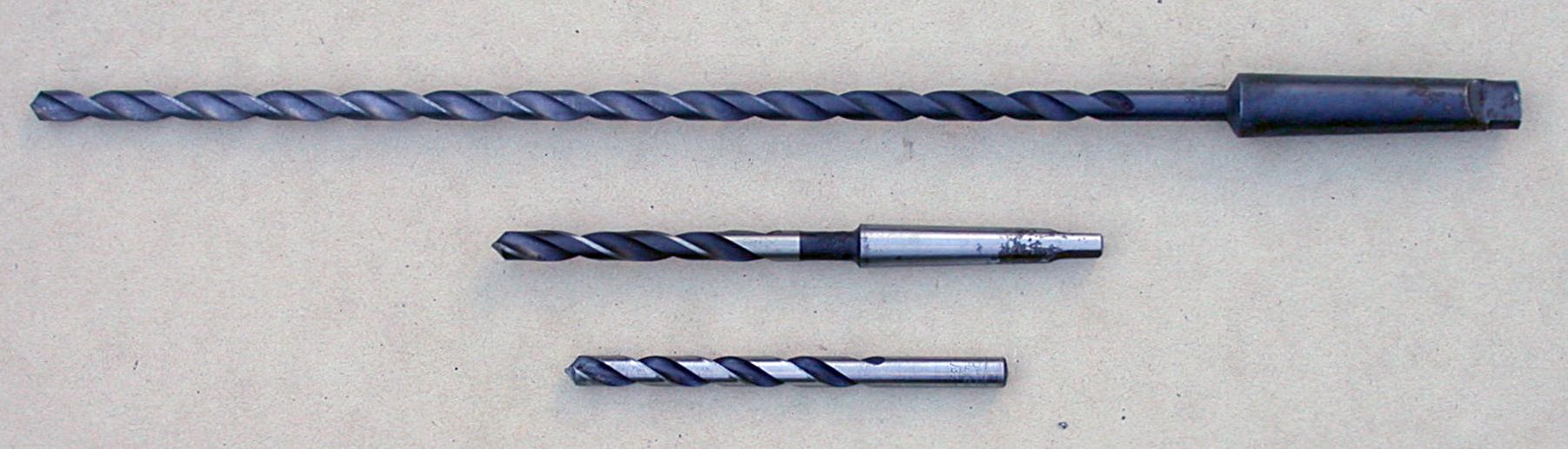
The image shows a long-series drill compared to its diametric equivalents, all are 11/32 in in diameter. The equivalent Morse taper drill shown in the middle is of the usual length for a taper-shank drill. The lower drill bit is the jobber or parallel shank equivalent.
Center drill bit sizes

Center drills are available with two different included angles; 60 degrees is the standard for drilling centre holes (for example for subsequent centre support in the lathe), but 90 degrees is also common and used when locating holes prior to drilling with twist drills. Center drills are made specifically for drilling lathe centers, but are often used as spotting drills because of their radial stiffness.
| Size | |
|---|---|
| designation | Drill diameter |
| [inches (mm)] | |
| 5/0 | 0.010 in |
| 4/0 | 0.015 in |
| 3/0 | 0.020 in |
| 2/0 | 0.025 in |
| 0 | 1/32 in |
| 1 | 3/64 in |
| 2 | 5/64 in |
| 3 | 7/64 in |
| 4 | 1/8 in |
| 4½ | 9/64 in |
| 5 | 3/16 in |
| 6 | 7/32 in |
| 7 | 1/4 in |
| 8 | 5/16 in |
| Gauge | Body diameter |
|---|---|
| [inches (mm)] | |
| BS1 | 1/8 in |
| BS2 | 3/16 in |
| BS3 | 1/4 in |
| BS4 | 5/16 in |
| BS5 | 7/16 in |
| BS5A | 1/2 in |
| BS6 | 5/8 in |
| BS7 | 3/4 in |
Spotting drill bit sizes
Spotting drills are available in a relatively small range of sizes, both metric and imperial, as their purpose is to provide a precise spot for guiding a standard twist drill. Commonly available sizes are 1/8", 1/4", 3/8", 1/2", 5/8", 3/4", 4 mm, 6 mm, 8 mm, 10 mm, 12 mm, 14 mm, 16 mm and 18 mm. The drills are most ordinarily available with either 90° or 120° included angle points.
References
References
- (2 February 2017). "Preferred sizes in engineering".
- Pöll, J. S.. (June 1999). "The story of the gauge". Anaesthesia.
- DrillBitCalculator.com. "DrillBitCalculator.com".
- "Jobber Length Twist Drill Sizes".
This article was imported from Wikipedia and is available under the Creative Commons Attribution-ShareAlike 4.0 License. Content has been adapted to SurfDoc format. Original contributors can be found on the article history page.
Ask Mako anything about Drill bit sizes — get instant answers, deeper analysis, and related topics.
Research with MakoFree with your Surf account
Create a free account to save articles, ask Mako questions, and organize your research.
Sign up freeThis content may have been generated or modified by AI. CloudSurf Software LLC is not responsible for the accuracy, completeness, or reliability of AI-generated content. Always verify important information from primary sources.
Report