From Surf Wiki (app.surf) — the open knowledge base
Discoverer 13
American reconnaissance satellite

American reconnaissance satellite
| Field | Value |
|---|---|
| name | Discoverer 13 |
| image | KH-1_CORONA.jpg |
| mission_type | Optical reconnaissance |
| operator | US Air Force / NRO |
| Harvard_designation | 1960-Theta 1 |
| SATCAT | S00048 |
| spacecraft_type | CORONA KH-1 |
| spacecraft_bus | Agena-A |
| manufacturer | Lockheed |
| launch_mass | 772 kg |
| launch_date | GMT |
| launch_rocket | Thor DM-21 Agena-A |
| (Thor 231) | |
| launch_site | Vandenberg LC 75-3-5 |
| decay_date | 14 Nov |
| landing_date | 11 Aug |
| landing_site | Pacific Ocean 610 km NNW of Honolulu |
| orbit_epoch | 10 Aug 1960 20:38:00 |
| orbit_reference | Geocentric |
| orbit_regime | Low Earth |
| orbit_periapsis | 258 km |
| orbit_apoapsis | 683 km |
| orbit_inclination | 82.850° |
| orbit_period | 94.04 minutes |
| orbit_eccentricity | 0.03101 |
| apsis | gee |
| programme | Discoverer |
| previous_mission | Discoverer 12 |
| next_mission | Discoverer 14 |
| programme2 | KH-1 Test Series |
| previous_mission2 | Discoverer 12 |
(Thor 231)
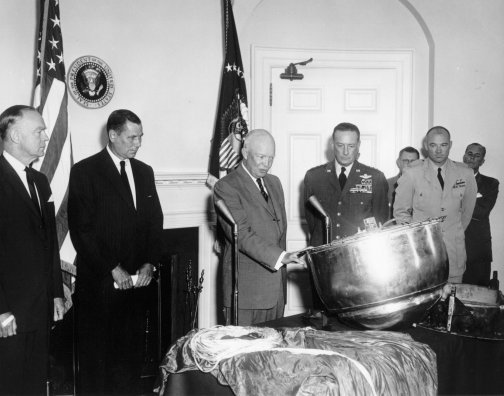
Discoverer 13 was an American optical reconnaissance satellite launched on 10 Aug 1960 at 20:37:54 GMT. The last of five test flights of the Corona KH-1 spy satellite series, it was the first fully successful flight in the Discoverer series. On 11 Aug, after 17 orbits, the satellite's reentry capsule was recovered in the Pacific Ocean by the Haiti Victory. Its payload, an American flag, was presented to President Eisenhower four days later.
Background
"Discoverer" was the civilian designation and cover for the Corona satellite photo-reconnaissance series of satellites managed by the Advanced Research Projects Agency of the Department of Defense and the U.S. Air Force. The primary goal of the satellites was to replace the U-2 spyplane in surveilling the Sino-Soviet Bloc, determining the disposition and speed of production of Soviet missiles and long-range bombers assess. The Corona program was also used to produce maps and charts for the Department of Defense and other US government mapping programs.
The first series of Corona satellites were the Keyhole 1 (KH-1) satellites based on the Agena-A upper stage, which not only offered housing but whose engine provided attitude control in orbit. The KH-1 payload included the C (for Corona) single, vertical-looking, panoramic camera that scanned back and forth, exposing its film at a right angle to the line of flight. The camera, built by Fairchild Camera and Instrument with a f/5.0 aperture and 61 cm focal length, had a ground resolution of 12.9 m. Film was returned from orbit by a single General Electric Satellite Return Vehicle (SRV) constructed by General Electric. The SRV was equipped with an onboard small solid-fuel retro motor to deorbit at the end of the mission. Recovery of the capsule was done in mid-air by a specially equipped aircraft.
The Discoverer program began with a series of three test flights whose satellites carried no cameras, all launched in the first half of 1959. There followed eight operational Discoverer satellites, all of them partial or complete failures,
Spacecraft
Discoverer 13 was a diagnostic test satellite identical to Discoverer 12, Like, Discoverer 12, Discoverer 13 carried a newly developed gas motor for spin stabilization to replace the system that had caused the loss of Discoverer 11. Discoverer 13 also carried an American flag in its SRV.
Mission
Launched 10 Aug 1960 at 20:37:54 GMT from Vandenberg LC 75-3-5 by a Thor DM-21 Agena-A rocket, Discoverer 13 performed according to plan. On 11 August, after 17 orbits, Discoverer 13 received a command from a ground station on Kodiak Island to start the reentry. After the Agena pitched itself down 60 degrees, the recovery vehicle was ejected by small springs, and the new spin engine, utilizing cold gas, spun the SRV for stability. Its retrorocket fired, reducing the capsule's velocity by 400 m per second, and then the spin system despun the spacecraft. Just before it started to heat up on reentry, the orbit ejection subsystem dropped off the capsule and its heat shield. At 15,000 m a small parachute was deployed, strobe lights and a radio beacon were activated, and the heat shield was released. After stabilization a larger parachute was deployed.
Though the SRV was supposed to have been caught in midair, the recovery airplane went off in the wrong direction, and the capsule splashed down in 610 km NNW of Honolulu in the Pacific Ocean. A naval vessel, The Haiti Victory, sent out a helicopter which dropped divers into the water to attach a collar to the capsule for helicopter retrieval. The SRV was brought back to the ship and then taken to Pearl Harbor in Oahu.
Four days later, on 15 Aug, the American flag that Discoverer 13 carried instead of a camera was presented to President Eisenhower, the public celebration reinforcing the Corona program's civilian cover. Lockheed employees celebrated the successful flight with a party at a hotel in East Palo Alto, California, during which they threw program manager James Plummer into the pool and then jumped in, themselves.
The Agena portion of Discoverer 13 reentered on 14 November.
Legacy
The success of Discoverer 13 paved the way for the first fully successful operational flight, Discoverer 14, launched on August 18, 1960. The CORONA program went on to comprise 145 flights in eight satellite series, the last mission launching on 25 May 1972. CORONA was declassified in 1995, and a formal acknowledgement of the existence of US reconnaissance programs, past and present, was issued in September 1996.
References
References
- "Discoverer 1". NASA Space Science Data Coordinated Archive.
- (1995). "Corona: America's First Satellite Program". Central Intelligence Agency.
- Krebs, Gunter. "KH-1 Corona". Gunter's Space Page.
- (1998). "Eye in the Sky: The Story of the Corona Spy Satellites". Smithsonian Institution Press.
- McDowell, Jonathan. "Launch Log". Jonathon's Space Report.
This article was imported from Wikipedia and is available under the Creative Commons Attribution-ShareAlike 4.0 License. Content has been adapted to SurfDoc format. Original contributors can be found on the article history page.
Ask Mako anything about Discoverer 13 — get instant answers, deeper analysis, and related topics.
Research with MakoFree with your Surf account
Create a free account to save articles, ask Mako questions, and organize your research.
Sign up freeThis content may have been generated or modified by AI. CloudSurf Software LLC is not responsible for the accuracy, completeness, or reliability of AI-generated content. Always verify important information from primary sources.
Report