From Surf Wiki (app.surf) — the open knowledge base
Dichlorodiphenyldichloroethylene
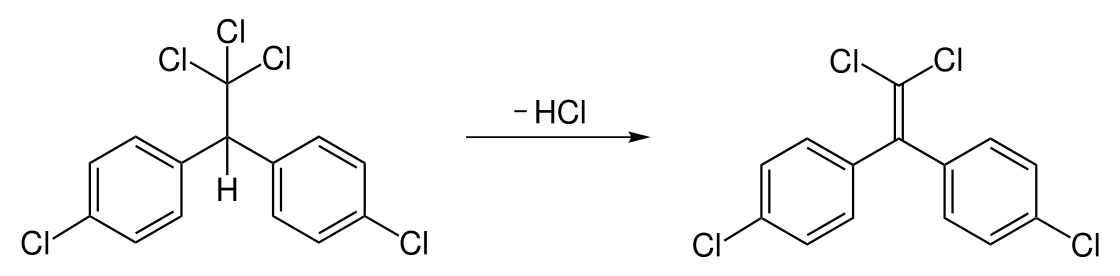
Dichlorodiphenyldichloroethylene (DDE) is a chemical compound formed by the loss of hydrogen chloride (dehydrohalogenation) from DDT, of which it is one of the more common breakdown products. Due to DDT's massive prevalence in society and agriculture during the mid 20th century, DDT and DDE are still widely seen in animal tissue samples. DDE is particularly dangerous because it is fat-soluble like other organochlorines; thus, it is rarely excreted from the body, and concentrations tend to increase throughout life. The major exception is the excretion of DDE in breast milk, which transfers a substantial portion of the mother's DDE burden to the young animal or child. Along with accumulation over an organism's lifetime, this stability leads to bioaccumulation in the environment, which amplifies DDE's negative effects.
Synthesis
DDE is created by dehydrohalogenation of DDT. The loss of HCl results in a double bond on the central (previously quaternary) carbon atoms.
Toxicity
DDE has been shown to be toxic to rats at 79.6 mg/kg. DDE and its parent, DDT, are reproductive toxicants for certain birds species, and major reasons for the decline of the bald eagle, brown pelican peregrine falcon, and osprey. These compounds cause egg shell thinning in susceptible species, which leads to the birds' crushing their eggs instead of incubating them, due to the latter's lack of resistance. Birds of prey, waterfowl, and song birds are more susceptible to eggshell thinning than chickens and related species, and DDE appears to be more potent than DDT.
Research shows that an elevated blood levels of DDEs (also of other toxic molecule from nonstick cookware, and fire retardants) have been tied to an increased risk for celiac disease in young people. DDE has also been shown to be present in increased concentrations in the tumors of patients with primary hyperparathyroidism.
Mechanism
The biological mechanism for the thinning is not entirely known, but it is believed that p,p'-DDE impairs the hen's gland's ability to excrete calcium carbonate onto the developing egg. Multiple mechanisms may be at work, or different mechanisms may operate in different species. Some studies have shown that although DDE levels have fallen dramatically, eggshell thickness remains 10–12 percent thinner than before DDT was first used.
Some studies have indicated that DDE is an endocrine disruptor and contributes to breast cancer, but more recent studies provide strong evidence that there is no relationship between DDE exposure and breast cancer. What is more clear is that DDE is a weak androgen receptor antagonist and can produce male genital tract abnormalities.
References
References
- "ATSDR – Public Health Statement: DDT, DDE, and DDD".
- (1954). "Pesticide Residues in Foods, Dichlorodiphenyltrichloroethane and Dichlorodiphenyldichloroethylene Content in Prepared Foods". Journal of Agricultural and Food Chemistry.
- (2009). "Breast milk excretion Kinetic of b-HCH, pp'DDE and pp'DDT". Bull Environ Contam Toxicol.
- "NIST DDE MSDS".
- (2007). "Species conservation. Can the bald eagle still soar after it is delisted?". Science.
- "Endangered and Threatened Wildlife and Plants; 12-Month Petition Finding and Proposed Rule To Remove the Brown Pelican (Pelecanus occidentalis) From the Federal List of Endangered and Threatened Wildlife; Proposed Rule," Fish and Wildlife Service, U.S. Department of the Interior, February 20, 2008. {{USFR. 73. 9407
- "California Wild Spring 1994 – Peregrine Falcons".
- "ATSDR - Toxicological Profile: DDT, DDE, DDD".
- "Celiac disease linked to common chemical pollutants".
- (2021-01-01). "Environmental chemicals and metabolic disruption in primary and secondary human parathyroid tumors". Surgery.
- [http://ecos.fws.gov/docs/recovery_plans/1996/960425.pdf Recovery Plan for the California Condor] {{Webarchive. link. (2006-12-07 , U.S. Fish and Wildlife Service, April 1996, page 23)
- "DDE concentration and percent eggshell thinning in Double-crested Conmorant eggs(North Channel, Lake Huron, Ont.)".
- Guillette, Louis J. Jr.. (2006). "Endocrine Disrupting Contaminants".
- Lundholm, C.E.. (1997). "DDE-Induced eggshell thinning in birds". Comp Biochem Physiol C.
- [http://www.fws.gov/contaminants/examples/AlaskaPeregrine.cfm Division of Environmental Quality] {{webarchive. link. (2008-03-03)
- link. (2006-10-09)
- "Questions about Endocrine Disruptors".
- (2007). "In utero exposure to the antiandrogen 1,1-dichloro-2,2-bis(p-chlorophenyl)ethylene (DDE) in relation to anogenital distance in male newborns from Chiapas, México". American Journal of Epidemiology.

This article was imported from Wikipedia and is available under the Creative Commons Attribution-ShareAlike 4.0 License. Content has been adapted to SurfDoc format. Original contributors can be found on the article history page.
Ask Mako anything about Dichlorodiphenyldichloroethylene — get instant answers, deeper analysis, and related topics.
Research with MakoFree with your Surf account
Create a free account to save articles, ask Mako questions, and organize your research.
Sign up freeThis content may have been generated or modified by AI. CloudSurf Software LLC is not responsible for the accuracy, completeness, or reliability of AI-generated content. Always verify important information from primary sources.
Report