From Surf Wiki (app.surf) — the open knowledge base
Desert farming
Practice of developing agriculture in deserts
Practice of developing agriculture in deserts
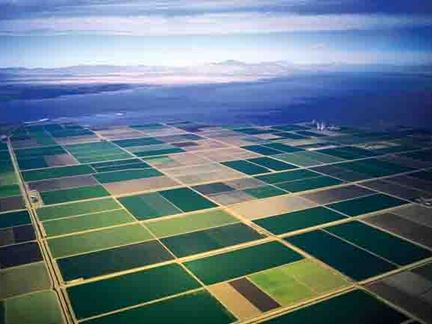
Desert farming is the practice of developing agriculture in deserts. As agriculture depends upon irrigation and water supply, farming in arid regions where water is scarce is a challenge. However, desert farming has been practiced by humans for thousands of years. In the Negev, there is evidence to suggest agriculture as far back as 5000 BC. Today, the Imperial Valley in southern California, Australia, Saudi Arabia, and Israel are examples of modern desert agriculture. Water efficiency has been important to the growth of desert agriculture. Water reuse, desalination, and drip irrigation are all modern ways that regions and countries have expanded their agriculture despite being in an arid climate.
History
Humans have been practicing and refining agriculture for millennia. Many of the earliest civilizations such as ancient Assyria, Ancient Egypt, and the Indus Valley Civilization were founded in irrigated regions surrounded by desert. As these civilizations grew, the ability to rear crops in the desert became of increasing importance. There are also instances of civilizations that subsisted primarily in the desert with little irrigation or rainfall, such as various western American indigenous tribes.
Negev desert
Byzantine rule in the 4th century gave rise to agriculture-based cities in the Negev desert and the population grew exponentially, with water harvesting efforts and general prosperity reaching a peak in the 6th century under Justinian, after which a sharp decline followed. German-Israeli researcher Michael Evenari has shown how novel techniques were developed, such as runoff rainwater collection and management systems, which harvested water from larger areas and directed it onto smaller plots. This allowed the cultivation of plants with much higher water needs than the given arid environment could provide for.
A massive rise in grape production in the northwestern Negev for the needs of the wine industry was documented for the early 6th century, by studying ancient trash mounds at the settlements of Shivta, Elusa and Nessana. There is a sharp peak in the presence of grape pips and broken "Gaza jars" used to export local sweet wine and other Levantine goods from the port of Gaza, after a slower rise during the fourth and fifth centuries, and followed in the mid-6th century by a sudden fall. Two major calamities occurring in those days strike the empire and large parts of the world: the Late Antique Little Ice Age (536-545), caused by huge volcanic eruptions, resulting in the extreme weather events of 535–536; and the first outbreak of bubonic plague in the Old World, the Justinianic Plague of the 540s. These events likely resulted in almost a cessation of the international trade with luxury goods such as Gaza wine, grape production in the Negev settlements again giving way to subsistence farming, focused on barley and wheat. This seems to show that the wine industry of the semiarid region of the Negev could well be sustained over centuries through appropriate agricultural techniques, but that the grape monoculture was economically unsustainable in the long run.
Native Americans
The Native Americans practicing this agriculture included the ancient and no longer present Anasazi, the long-present Hopi, the Tewa people, Zuni people, and many other regional tribes, including the relatively recently arriving (about 1000 to 1400 CE) Navajo. These various tribes were characterized generally by the Spanish occupiers of the region as Sinagua Indians, sinagua meaning "without water", although this term is not applied to the modern Native Americans of the region.
Owing to the great dependence upon weather, an element considered to be beyond human control, substantial religious beliefs, rites, and prayer evolved around the growing of crops, and in particular the growing of the four principal corn types of the region, characterized by their colors: red, yellow, blue, and white. The presence of corn as a spiritual symbol can often be seen in the hands of the "Yeh" spirit figures represented in Navajo carpets, in the rituals associated with the "Corn Maiden" and other kachinas of the Hopi, and in various fetish objects of tribes of the region.
American Indians in the Sonoran Desert and elsewhere relied both on irrigation and "Ak-Chin" farming—a type of farming that depended on "washes" (the seasonal flood plains by winter snows and summer rains). The Ak-Chin people employed this natural form of irrigation by planting downslope from a wash, allowing floodwaters to slide over their crops.
In the Salt River Valley, now characterized by Maricopa County, Arizona, a vast canal system was created and maintained from about 600 AD to 1450 AD. Several hundred miles of canals fed crops of the area surrounding Phoenix, Tempe, Chandler and Mesa, Arizona. Unfortunately, the intense irrigation increased the salinity of the topsoil, making it no longer fit for the growing of crops. This seems to have contributed to the abandonment of the canals and the adoption of Ak-Chin farming.
The ancient canals served as a model for modern irrigation engineers, with the earliest "modern" historic canals being formed largely by cleaning out the Hohokam canals or being laid out over the top of ancient canals. The ancient ruins and canals of the Hohokam Indians were a source of pride to the early settlers who envisioned their new agricultural society rising as the mythical phoenix bird from the ashes of Hohokam society, hence the name Phoenix, Arizona. The system is especially impressive because it was built without the use of metal implements or the wheel. It took remarkable knowledge of geography and hydrology for ancient engineers to lay out the canals, but it also took remarkable socio-political organization to plan workforce deployment, including meeting the physical needs of laborers and their families as well as maintaining and administering the water resources.
Contemporary desert farming
Desert agriculture is more important than ever before as global population rises. Countries and regions that are not water-secure are no exception to increasing population and thus increasing demand for food. The Middle East and North Africa is perhaps the largest example of growing nations with little to no water security or food security. By 2025, it is estimated that 1.8 billion people will live in countries or regions with absolute water scarcity.
Israel
Agriculture in modern-day Israel has pioneered several techniques for desert agriculture. The invention of drip irrigation by Simcha Blass has led to a large expansion of agriculture in arid regions, and in many places drip irrigation is the de facto irrigation technique utilized. Studies have consistently shown large water use reduction with drip irrigation or fertigation, with one study returning an 80% decrease in water use and 100% increase in crop yields. The same study (conducted on a sub-Saharan African village) found that this resulted in an improvement in the standard of living in the village by 80%.
Another hurdle for many water-scarce nations is consumption of water. Israel has chosen to take a focus on wastewater reuse to combat losing its water resources. The small desert nation reuses 86% of its wastewater as of 2011, and 40% of the total water used by agriculture was reclaimed wastewater. Desalination, brackish, or effluent water also accounts for 44% of Israel's water supply, and the world's largest seawater desalination plant is the Sorek Desalination Plant located in Tel Aviv. The plant is able to produce 624,000 m3 of water per day.
The agricultural output of Israel has increased sevenfold since the country's independence in 1948, and total farmland has increased from 165,000 hectares to 420,000 hectares. The country produces 70% of its own food (in dollar value).
Imperial Valley
Australia
Despite Australia being a vastly arid nation, agriculture has been a staple of the Australian economy since its founding. Australia produces cattle, wheat, milk, wool, barley, poultry, lamb, sugar cane, fruits, nuts, and vegetables. Agriculture provides 2.2% of Australia's total employment, and 47% of the total area in Australia is occupied by farms or stations.
Notes
References
- "Holy Land Farming Began 5,000 Years Earlier Than Thought". Live Science.
- Shahin, Mariam (2005). ''Palestine: A Guide''. Interlink Books. {{ISBN. 1-56656-557-X
- (1982). "The Negev: The Challenge of a Desert". Harvard University Press.
- [https://globalearthrepairfoundation.org/michael-evenari/ "Michael Evenari"] profile at [[Global Earth Repair Foundation]], [[Port Hadlock. Port Hadlock, WA]], 14 March 2022. Accessed 4 Dec 2023.
- Other techniques included [[wadi]] [[Fluvial terrace
- "How Volcanoes and Plague Killed the Byzantine Wine Industry in Israel". Ariel David for Haaretz, 29 July 2020.
- "Comparing Papago and Hohokam irrigation".
- "International Decade for Action 'Water for Life' 2005-2015. Focus Areas: Water scarcity".
- (2010-02-02). "Solar-powered drip irrigation enhances food security in the Sudano–Sahel". Proceedings of the National Academy of Sciences.
- "The Wastewater and Treated Effluents Infrastructure Development in Israel".
- "The State of Israel - National Water Efficiency Report".
- "Sorek Desalination Plant - Water Technology". Water Technology.
- (December 24, 2002). "Focus on Israel: Israel's Agriculture in the 21st century". Israel Ministry of Foreign Affairs.
- Stevens, Joseph E.. (1990-09-01). "Hoover Dam: An American Adventure". University of Oklahoma Press.
- "Quick Facts About Imperial Valley Agriculture". Imperial County.
- "Australian Industry Report 2016, Chapter 2: Economic Conditions".
- "Agricultural land (% of land area) {{!}} Data".
This article was imported from Wikipedia and is available under the Creative Commons Attribution-ShareAlike 4.0 License. Content has been adapted to SurfDoc format. Original contributors can be found on the article history page.
Ask Mako anything about Desert farming — get instant answers, deeper analysis, and related topics.
Research with MakoFree with your Surf account
Create a free account to save articles, ask Mako questions, and organize your research.
Sign up freeThis content may have been generated or modified by AI. CloudSurf Software LLC is not responsible for the accuracy, completeness, or reliability of AI-generated content. Always verify important information from primary sources.
Report