From Surf Wiki (app.surf) — the open knowledge base
Demographics of Crimea
none

none
According to the 2021 Russian census, the total population of the Republic of Crimea and Sevastopol was at 2,482,450 (Crimea: 1,934,630, Sevastopol: 547,820). This is up from the 2001 Ukrainian census figure, which was 2,376,000 (Autonomous Republic of Crimea: 2,033,700, Sevastopol: 342,451), and the local census conducted by Russia in December 2014, which found 2,248,400 people (Republic of Crimea: 1,889,485, Sevastopol: 395,000). According to the Ukrainian census, Perekop and Pervomaisky districts had a Ukrainian ethnic plurality, while the rest of Crimea had a simple or absolute majority of ethnic Russians.
History
The Crimean interior has been ethnically diverse throughout its recorded history, changing hands numerous times, while the south coast was held continuously for most of the last two millennia by various Roman (and Eastern Roman) states. The interior was dominated by a succession of Scytho-Sarmatian, Gothic, Hunnic, Turkic, Mongol and Slavic conquests. Its south coast was Greek speaking first as Greek colonies (7th or 6th century BC and following), then under the Bosporan Kingdom (480 BC - 63 BC), Romans (47 BC -330 AD) and their successor states, the Byzantine Empire (330 AD - 1204 AD), the Empire of Trebizond (1204 AD - 1461 AD), and the independent Principality of Theodoro (1461 AD - 1475 AD). In 1475 the region was conquered by the Ottoman Turks. During the late Middle Ages a few coastal cities were ruled by Italian city states. A number of Englishmen, fleeing England after the Norman Conquest, were said to have settled in Crimea with the Byzantine Emperor’s permission, and comprised a majority of his Varangian Guard until the Empire’s collapse.
The Crimean Tatars emerged as a Turkic-speaking ethnic group native to Crimea in the early modern period, during the lifetime of the Crimean Khanate, and by the annexation of the Crimean Khanate by the Russian Empire in 1783, they formed the clear majority of Crimean population. The colonization "New Russia" (the Novorossiysk Governorate, of which the later Taurida Governorate formed a part) at the end of the 18th century was led by Prince Grigori Potemkin who was granted the powers of an absolute ruler over the area by Catherine the Great. The lands were generously given to the Russian dvoryanstvo (nobility), and the enserfed peasantry mostly from Ukraine and fewer from Russia were transferred to cultivate what was a sparsely populated steppe. Catherine the Great also invited European settlers to these newly conquered lands: Crimea Germans, Poles in Russia, Italians of Crimea, and others. Crimea is geographically and demographically divided into three regions, the steppe interior, the mountains, and the coast. The Tatars were the predominant portion of the population in the mountainous area and about half of the steppe population, while Russians were concentrated most heavily in the Feodosiya district. Germans and settled in the Crimea at the beginning of the 19th century, receiving a large allotment and fertile land. Wealthy colonists later bought substantial portions of land, mainly in Perekopsky and Yevpatoria districts.
At the beginning of the 19th century, Italian emigration to the Crimea came from various Italian regions (Liguria, Campania, Apulia), with immigrants settling mainly in the coastal cities of the Black Sea and the Sea of Azov, as well as in Odesa, Mykolaiv, Sevastopol, Mariupol, Berdiansk and Taganrog. With the October Revolution of 1917, with which the Russian Empire became the Soviet Union, a bitter period began for minorities in Russia. Italians of Crimea therefore faced much repression. Between 1936 and 1938, during Joseph Stalin's Great Purge, many Italians were accused of espionage and were arrested, tortured, deported or executed. The few survivors were allowed to return to Kerch in the 1950s and 1960s during Nikita Khrushchev's administration. The descendants of the surviving Italians of Crimea currently account for people, mainly residing in Kerch.
By the 1897 Russian Empire Census, Crimean Tatars continued to form a slight plurality (35%) of Crimea's still largely rural population, but there were large numbers of Russians (33%) and Ukrainians (11%), as well as smaller numbers of Germans, Jews (including Krymchaks and Crimean Karaites), Bulgarians, Belarusians, Turks, Armenians, Greeks and Roma (gypsies).
The upheavals and ethnic cleansing of the 20th century vastly changed Crimea's ethnic composition. In 1944, 200,000 Crimean Tatars were deported from Crimea to Central Asia and Siberia, along with 70,000 Greeks and 14,000 Bulgarians and other nationalities. By the latter 20th century, Russians and Ukrainians made up almost the entire population. However, with the fall of the Soviet Union, exiled Crimean Tatars began returning to their homeland and accounted for 10% of the population by the beginning of the 21st century.
Ethnicities and languages
Crimean Gothic, an East Germanic language, became extinct around the 18th century, while the Crimean Goths diffused into other ethnicities much earlier on. Old English was also spoken by settlers from England, who were eventually absorbed into the Tatar population. According to Ukraine's 2001 census, the ethnic makeup of Crimea's population consisted primarily of the following self-reported groups: Russians (1.450 million, 60.4%), Ukrainians (576,600; 24.0%), Crimean Tatars (258,400; 10.8%), Belarusians (25,000; 1.5%), Armenians (10,000; 0.4%), and Jews (5,500; 0.2%).
| Taurida Governate | Berdyansk District | Dneiper District | Melitopol District | Crimea |
|---|---|---|---|---|
| Russians | 404,463 | 55,303 | 42,180 | 126,017 |
| Ukrainians | 611,121 | 179,177 | 156,151 | 211,090 |
| Tatars | 196,854 | 770 | 506 | 1,284 |
| Belarusians | 9,726 | 1,323 | 3,005 | 3,340 |
| Armenians | 8,938 | 201 | 47 | 373 |
| Jews | 55,418 | 8,889 | 6,298 | 16,063 |
| Other | 161,270 | 59,055 | 4,054 | 26,072 |
| Total Population | 1,447,790 | 304,718 | 212,241 | 384,239 |
|180,963 |33.11% |194,294 |35.6% |64,703 |11.8% |2,058 |0.4% |8,317 |1.5% |24,168 |4.4% |72,089 |13.2%
| 546,592 |
|---|
| !1926 |
| 301,398 |
| 42.2% |
| 179,094 |
| 25.1% |
| 77,405 |
| 10.6% |
| 3,842 |
| 0.5% |
| 10,713 |
| 1.5% |
| 45,926 |
| 6.4% |
| |
| 713,823 |
|---|
| !1939 |
| 558,481 |
| 49.6% |
| 218,879 |
| 19.4% |
| 154,123 |
| 13.7% |
| 6,726 |
| 0.6% |
| 12,923 |
| 1.1% |
| 65,452 |
| 5.8% |
| |
| 1,126,429 |
|---|
| !1959 |
| 858,273 |
| 71.4% |
| | |267,659 |22.3% |21,672 |1.8% | | |26,374 |2.2% | |
| 1,201,517 |
|---|
| !1970 |
| 1,220,484 |
| 67.3% |
| | |480,733 |26.5% |39,793 |2.2% |3,091 |0.2% |25,614 |1.4% | |
| 1,813,502 |
|---|
| !1979 |
| 1,460,980 |
| 66.9% |
| 5,422 |
| 0.2% |
| 547,336 |
| 25.1% |
| 45,000 (e) |
| 2.1% |
| | | | | |
| 2,184,000 |
|---|
| !1989 |
| 1,629,542 |
| 67.0% |
| 38,365 |
| 1.6% |
| 625,919 |
| 25.8% |
| 50,045 |
| 2.1% |
| 2,794 |
| 0.1% |
| 17,371 |
| 0.7% |
| |
| 2,430,495 |
|---|
| !20011 |
| 1,450,394 |
| 60.4% |
| 258,893 |
| 10.8% |
| 576,647 |
| 24.0% |
| 35,157 |
| 1.5% |
| 10,088 |
| 0.4% |
| 5,531 |
| 0.2% |
| 64,499 |
| 2.7% |
| 2,401,209 |
| - |
| !20142 |
| 1,492,078 |
| 67.9% |
| 277,336 |
| 12.6% |
| 344,515 |
| 15.7% |
| 21,694 |
| 1.0% |
| 11,030 |
| 0.5% |
| 3,144 |
| 0.1% |
| |
| 2,284,769 |
|---|
| !2021 |
| 1,706,662 |
| 76.4% |
| 284,522 |
| 12.7% |
| 171,160 |
| 7.7% |
| 10,599 |
| 0.5% |
| 9,016 |
| 0.4% |
| 2,455 |
| 0.1% |
| 48,257 |
| 2.2% |
| 2,482,450 |
| - |
-
The 2014 percentage is based on total number responding to the question on nationality (not total population). Census breakdown is Crimean Tatars 232,340 (10.6%), Tatars 44,996 (2.1%).
-
The Russian percentage in the 1864 census includes Ukrainians. |}
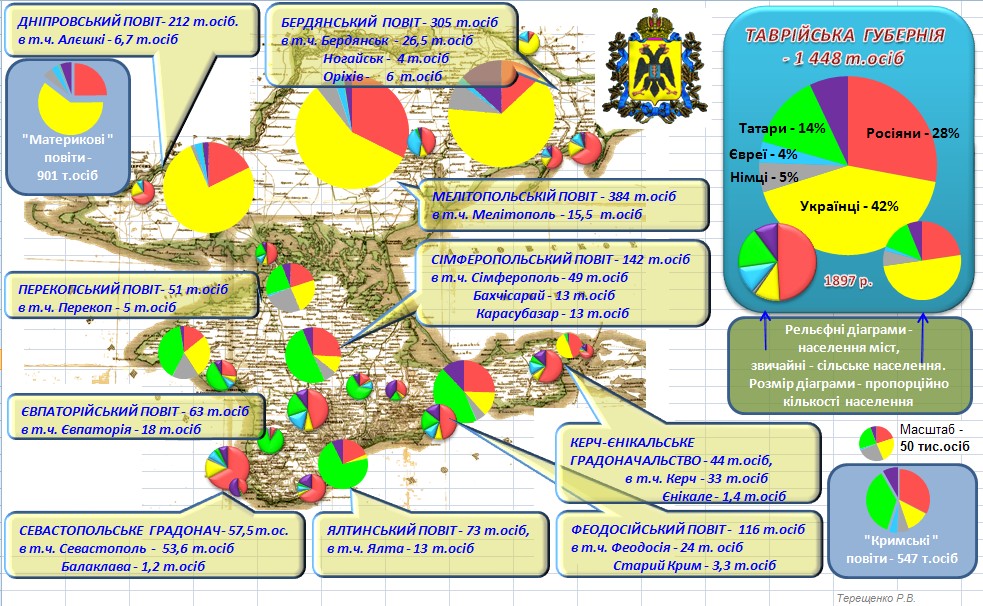
Other minorities are Black Sea Germans, Roma, Bulgarians, Poles, Azerbaijanis, Koreans, Greeks and Italians of Crimea. The number of Crimea Germans was 45,000 in 1941. In 1944, 70,000 Greeks and 14,000 Bulgarians from the Crimea were deported to Central Asia and Siberia, along with 200,000 Crimean Tatars and other nationalities.
According to the 2001 census, 77% of Crimean inhabitants named Russian as their native language, 11.4% – Crimean Tatar, and 10.1% – Ukrainian. Of the Ukrainians in Crimea, 40% gave Ukrainian as their native language, with 60% identifying as ethnic Ukrainians while giving Russian as their primary language. 93% of Crimean Tatars gave Crimean Tatar as their native language, 6% were Russophone. In 2013, however, the Crimean Tatar language was estimated to be on the brink of extinction, being taught in Crimea only in around 15 schools at that point of time. Turkey has provided the greatest support to Ukraine, which has been unable to resolve the problem of education in the mother tongue in Crimea, by bringing the schools to a modern state. Ukrainian was until 2014 the single official state language countrywide, but in Crimea government business was carried out mainly in Russian. Attempts to expand the usage of Ukrainian in education and government affairs have been less successful in Crimea than in other areas of the nation. [[File:Ukrainians2001Crimea.PNG|thumb|right|300px|Percentage of [[Ukrainians]]]]
Currently two thirds of migrants into Crimea are from other regions of Ukraine; every fifth migrant is from elsewhere in the former Soviet Union and every 40th from outside of it. Three quarters of those leaving Crimea move to other areas in Ukraine. Every 20th migrates to the West.
The number of Crimean residents who consider Ukraine their motherland increased sharply from 32% to 71.3% from 2008 through 2011; according to a poll by Razumkov Center in March 2011, Surveys of regional identities in Ukraine have shown that around 30% of Crimean residents claim to have retained a self-identified "Soviet identity".
Since the independence of Ukraine in 1991, 3.8 million former citizens of Russia have applied for Ukrainian citizenship.
In 2014 after Russian annexation of Crimea ocupational authorities conducted a census. According to the census result the population of the Crimean Federal District is 2.2844 million people. The ethnic composition is as follows: Russians: 1.49 million (65.3%), Ukrainians: 0.35 million (15.1%), Crimean Tatars: 0.24 million (12.0%). Official Ukrainian authorities and Mejlis of the Crimean Tatar People claimed doubts that the results of population census in Crimea represent the facts.
A survey in May 2013, asked respondents what language they spoke at home:
- 82% Russian
- 10% Crimean Tatar
- 3% Russian and Ukrainian equally
- 3% Russian and another language equally
- 2% Ukrainian Note that the proportion of people in the survey who gave their ethnicity as Ukrainian was 20%, Crimean Tatar 15%.
Birth rate, death rate, total fertility rate, life expectancy
;Vital statistics for 2015
- Births: 29 422 (12.8 per 1000)
- Deaths: 35 151 (15.3 per 1000) ;Vital statistics for 2020
- Births: 31 105 (13.6 per 1000)
- Deaths: 29 890 (13.3 per 1000) ;Fertility rate
| 2014 | 2015 | 2020 |
|---|---|---|
| Republic of Crimea | 1.82 | |
| Sevastopol | 1.65 | |
| **Crimean Federal District** | 1.79 |
;Life expectancy Life expectancy at birth for Crimea as a whole, calculated as weighted average between the Republic of Crimea and the federal city of Sevastopol, according to number of population.
| 2019 | 2021 |
|---|---|
| Average: | 72.9 years |
| Male: | 67.9 years |
| Female: | 77.5 years |
File:Life expectancy in Russian subject -Crimea.png|Life expectancy in Crimea File:Life expectancy in Russian subject -Crimea -diff.png|Life expectancy with calculated differences File:Life expectancy in Russian subject -Republic of Crimea -diff.png|Life expectancy in File:Life expectancy in Russian subject -Sevastopol -diff.png|Life expectancy in Sevastopol File:Life expectancy in Russia -Crimea.png|Life expectancy in Crimea and neighboring regions of the country
Education
The 2001 Ukrainian census for the Autonomous Republic of Crimea cites the following figures for the population of "able-to-work age" (men 16–59 years, women 16–54 years):
- total population 1,203,789
- completed higher education: 175,838 (14.6%)
- higher education (partial or complete): 476,793 (39.6%)
- completed secondary education: 507,881 (49.7%)
- secondary education (partial or complete): 685,855 (57.0%)
- no primary education: 1,945 (0.16%)
- illiterate: 1,413 (0.11%)
Religion
Main article: Religion in Crimea
The Crimean peninsula was Christianised at an early time, via Gothic Christianity, in the 4th century. In the 9th century, the Goths in Crimea turned to the Greek Orthodox Church, under the Metropolitanate of Gothia. In 988, Prince Vladimir I of Kyiv also captured the Byzantine town of Chersonesos (presently part of Sevastopol) where he later converted to Christianity. Christianity was mostly swept away by the Mongol invasion of Rus' in the 1230s. Islam becomes the state religion of the Golden Horde in the early 14th century. The first mosque in Crimea was built by Ozbeg Khan in Eski Qırım in 1314. Christianity returned with the annexation of the Crimean Khanate by the Eastern Orthodox Russian Empire in 1783.
A survey of residents of the Autonomous Republic of Crimea in May 2013 found that:
- 58% Orthodox
- 15% Muslim
- 13% Do not know, or not applicable
- 10% believed in God but did not belong to any religion
- 2% Atheist
- 2% Other The proportion of the population in the survey who were Crimean Tatar was 15%.
Respondents to the same survey said that they attended a religious service:
- 3% Several times a week
- 7% Weekly
- 10% Monthly
- 37% Several times a year
- 43% Never
References
References
- "Таблица 5. Численность населения России, федеральных округов, субъектов Российской Федерации, городских округов, муниципальных районов, муниципальных округов, городских и сельских поселений, городских населенных пунктов, сельских населенных пунктов с населением 3000 человек и более. Итоги Всероссийской переписи населения 2020 года". Rosstat.
- "Regions of Ukraine / Autonomous Republic of Crimea". [[2001 Ukrainian census]].
- "Results of Census: Population of Crimea is 2.284 Million People - Information agency "Krym Media"".
- (2015-05-24). "Another New England — in Crimea".
- "Europa e Mediterraneo d'Italia. L'italiano nelle comunità storiche da Gibilterra a Costantinopoli - 10. Gli italiani di Crimea {{!}} Treccani, il portale del sapere".
- "[http://jrs.oxfordjournals.org/cgi/reprint/4/4/372.pdf The Persecution of Pontic Greeks in the Soviet Union]{{dead link. (May 2021)
- (June 24, 2009). "Crimean Tatars Divide Ukraine and Russia.". The Jamestown Foundation..
- "Autonomous Republic of Crimea". [[Ukrainian Census (2001).
- O'Neill, Kelly Ann. (2017). "Claiming Crimea : a history of Catherine the Great's southern empire".
- These numbers exclude the population numbers for Berdyansky, Dneprovsky and Melitopolsky Uyezds, which were on mainland. See the [[Taurida Governorate#Administrative divisions. administrative divisions of the Taurida Governorate]]
- "Демоскоп Weekly - Приложение. Справочник статистических показателей". Demoscope.ru.
- "Демоскоп Weekly - Приложение. Справочник статистических показателей". Demoscope.ru.
- Crimea - Dynamics, challenges and prospects / edited by Maria Drohobycky. Page 73
- Crimea - Dynamics, challenges and prospects / edited by Maria Drohobycky. Page 72
- (2001). "Національний склад населення України та його мовні ознаки". [[2001 Ukraine Census]].
- (2015). "Итоги переписи населения в крымском федеральном округе". Federal State Statistics Service of Russia.
- "Only 3.3% of Crimeans Mention Ukrainian as Their Native Language - Information agency "Krym Media"".
- "Катастрофический фактор | Все блоги | Блоги | Каспаров.Ru". Kasparov.ru.
- "Russian Census of Crimea: Nationality Results | eurasianstudies".
- ru
- "[http://lib.ndsu.nodak.edu/grhc/history_culture/history/people.html A People on the Move: Germans in Russia and in the Former Soviet Union: 1763 – 1997] {{Webarchive. link. (2013-08-08 ". North Dakota State University Libraries.)
- "Results / General results of the census / Linguistic composition of the population / Autonomous Republic of Crimea". [[Ukrainian Census (2001).
- [http://2001.ukrcensus.gov.ua/eng/results/general/language/Crimea/ Linguistic composition of population Autonomous Republic of Crimea. 2001 Ukrainian census]
- [https://www.avrupatimes.com/culture/3676-crimean-tatar-language-in-danger.html Crimean Tatar language in danger], Avrupa Times, 02/19/2013
- Bondaruk, Halyna. (March 3, 2007). "Yushchenko Appeals to Crimean Authority Not to Speculate on Language". [[Ukrayinska Pravda]].
- although this is the lowest number in all Ukraine (93% on average across the country).[http://www.kyivpost.com/news/nation/detail/102113/ Poll: Most Crimean residents consider Ukraine their motherland], [[Kyiv Post]] (11 April 2011)
- [http://www.taraskuzio.net/Comparative%20Politics_files/SovietCulture_Conspiracy_Yanukovych.pdf Soviet conspiracy theories and political culture in Ukraine:Understanding Viktor Yanukovych and the Party of Region] {{webarchive. link. (2014-05-16 by [[Taras Kuzio]] (23 August 2011))
- "Ukrinform News". Ukrinform.ua.
- (14 October 2014). "Crimea to Hold First Census Since Russian Annexation". Themoscowtimes.com.
- (2015-03-24). "Mejlis doubts preliminary results of Crimean census | Crimean News Agency". Qha.com.ua.
- (2016-01-29). "Естественное движение населения в разрезе субъектов Российской Федерации". Gks.ru.
- "Суммарный коэффициент рождаемости, единица".
- "Демографический ежегодник России". [[Federal State Statistics Service (Russia).
- "Ожидаемая продолжительность жизни при рождении".
- (2013). "Public Opinion Survey Residents of the Autonomous Republic of Crimea May 16 – 30, 2013". Baltic Surveys Ltd. and The Gallup Organization.
This article was imported from Wikipedia and is available under the Creative Commons Attribution-ShareAlike 4.0 License. Content has been adapted to SurfDoc format. Original contributors can be found on the article history page.
Ask Mako anything about Demographics of Crimea — get instant answers, deeper analysis, and related topics.
Research with MakoFree with your Surf account
Create a free account to save articles, ask Mako questions, and organize your research.
Sign up freeThis content may have been generated or modified by AI. CloudSurf Software LLC is not responsible for the accuracy, completeness, or reliability of AI-generated content. Always verify important information from primary sources.
Report