From Surf Wiki (app.surf) — the open knowledge base
Demagnetizing field
Internal magnetic field generated by a magnet
Internal magnetic field generated by a magnet
The demagnetizing field, also called the stray field (outside the magnet), is the magnetic field (H-field) generated by the magnetization in a magnet. The total magnetic field in a region containing magnets is the sum of the demagnetizing fields of the magnets and the magnetic field due to any free currents or displacement currents. The term demagnetizing field reflects its tendency to act on the magnetization so as to reduce the total magnetic moment. It gives rise to shape anisotropy in ferromagnets with a single magnetic domain and to magnetic domains in larger ferromagnets.
The demagnetizing field of an arbitrarily shaped object requires a numerical solution of Poisson's equation even for the simple case of uniform magnetization. For the special case of ellipsoids (including infinite cylinders) the demagnetization field is linearly related to the magnetization by a geometry dependent constant called the demagnetizing factor. Since the magnetization of a sample at a given location depends on the total magnetic field at that point, the demagnetization factor must be used in order to accurately determine how a magnetic material responds to a magnetic field. (See magnetic hysteresis.)
Magnetostatic principles
Maxwell's equations
Main article: Maxwell's equations
In general the demagnetizing field is a function of position H(r). It is derived from the magnetostatic equations for a body with no electric currents. These are Ampère's law
and Gauss's law
The magnetic field and flux density are related by
where \mu_0 is the permeability of vacuum and M is the magnetisation.
The magnetic potential
Main article: magnetic scalar potential
The general solution of the first equation can be expressed as the gradient of a scalar potential U(r):
Inside the magnetic body, the potential Uin is determined by substituting () and () in ():
Outside the body, where the magnetization is zero,
At the surface of the magnet, there are two continuity requirements:
- The component of H parallel to the surface must be continuous (no jump in value at the surface).
- The component of B perpendicular to the surface must be continuous. This leads to the following boundary conditions at the surface of the magnet: U_\text{in} &= U_\text{out}\ \frac{\partial U_\text{in}}{\partial n} &= \frac{\partial U_\text{out}}{\partial n} + \mathbf{M}\cdot\mathbf{n}. \end{align}|}} Here n is the surface normal and \partial/ \partial n is the derivative with respect to distance from the surface.
The outer potential Uout must also be regular at infinity: both r U and r2 U must be bounded as r goes to infinity. This ensures that the magnetic energy is finite. Sufficiently far away, the magnetic field looks like the field of a magnetic dipole with the same moment as the finite body.
Uniqueness of the demagnetizing field
Main article: Uniqueness theorem for Poisson's equation
Any two potentials that satisfy equations (), () and (), along with regularity at infinity, have identical gradients. The demagnetizing field Hd is the gradient of this potential (equation ).
Energy
The energy of the demagnetizing field is completely determined by an integral over the volume V of the magnet:
Suppose there are two magnets with magnetizations M1 and M2. The energy of the first magnet in the demagnetizing field Hd(2) of the second is
The reciprocity theorem states that
Magnetic charge and the pole-avoidance principle
Formally, the solution of the equations for the potential is
{|\mathbf{r}-\mathbf{r}'|}dV' + \frac{1}{4\pi}\int_\text{surface} \frac{\mathbf{n}\cdot\mathbf{M\left(r'\right)}}{|\mathbf{r}-\mathbf{r}'|}dS',|}} where r′ is the variable to be integrated over the volume of the body in the first integral and the surface in the second, and ∇′ is the gradient with respect to this variable.
Qualitatively, the negative of the divergence of the magnetization − ∇ · M (called a volume pole) is analogous to a bulk bound electric charge in the body while n · M (called a surface pole) is analogous to a bound surface electric charge. Although the magnetic charges do not exist, it can be useful to think of them in this way. In particular, the arrangement of magnetization that reduces the magnetic energy can often be understood in terms of the pole-avoidance principle, which states that the magnetization affects poles by limiting the poles (tries to reduce them as much as possible).
Effect on magnetization
Single domain
File:SingleDomainMagneticCharges.svg|thumb|right|Illustration of the magnetic charges at the surface of a single-domain ferromagnet. The arrows indicate the direction of magnetization. The thickness of the colored region indicates the surface charge density. default direct SVG link One way to remove the magnetic poles inside a ferromagnet is to make the magnetization uniform. This occurs in single-domain ferromagnets. This still leaves the surface poles, so division into domains reduces the poles further. However, very small ferromagnets are kept uniformly magnetized by the exchange interaction.
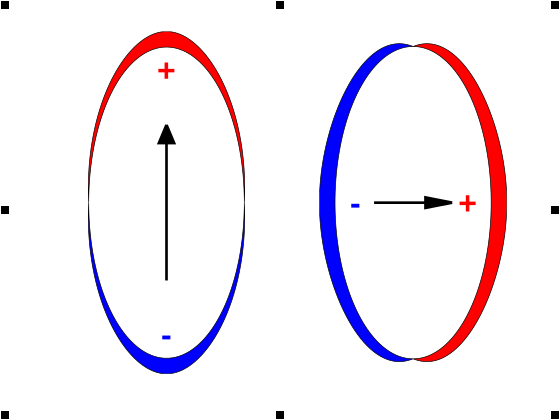
The concentration of poles depends on the direction of magnetization (see the figure). If the magnetization is along the longest axis, the poles are spread across a smaller surface, so the energy is lower. This is a form of magnetic anisotropy called shape anisotropy.
Multiple domains

If the ferromagnet is large enough, its magnetization can divide into domains. It is then possible to have the magnetization parallel to the surface. Within each domain the magnetization is uniform, so there are no volume poles, but there are surface poles at the interfaces (domain walls) between domains. However, these poles vanish if the magnetic moments on each side of the domain wall meet the wall at the same angle (so that the components n · M are the same but opposite in sign). Domains configured this way are called closure domains.
Demagnetizing factor
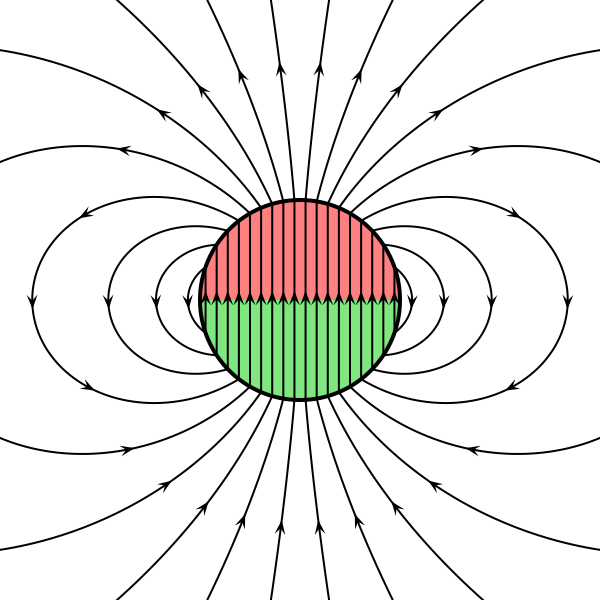
An arbitrarily shaped magnetic object has a total magnetic field that varies with location inside the object and can be quite difficult to calculate. This makes it very difficult to determine the magnetic properties of a material such as, for instance, how the magnetization of a material varies with the magnetic field. For a uniformly magnetized sphere in a uniform magnetic field H0 the internal magnetic field H is uniform:
where M0 is the magnetization of the sphere and γ is called the demagnetizing factor, which assumes values between 0 and 1, and equals 1/3 for a sphere in SI units. Note that in cgs units γ assumes values between 0 and 4π.
This equation can be generalized to include ellipsoids having principal axes in x, y, and z directions such that each component has a relationship of the form:
Other important examples are an infinite plate (an ellipsoid with two of its axes going to infinity) which has (SI units) in a direction normal to the plate and zero otherwise and an infinite cylinder (an ellipsoid with one of its axes tending toward infinity with the other two being the same) which has along its axis and 1/2 perpendicular to its axis.For tables or equations for the magnetizing factors of the general ellipsoid see {{cite journal |article-number = 20160197
References
- In this article the term 'magnetic field' is used for the magnetic 'H field' while 'magnetic flux density' is used for the magnetic 'B-field'.
- If there are electric currents in the system, they can be [[linear superposition. calculated separately and added]] to the solutions of these equations.
- In words, the [[curl (mathematics). curl]] of the [[magnetic field]] is zero.
- In words, the [[divergence]] of the [[magnetic flux density]] is zero.
- {{harvnb. Jackson. 1975
- {{harvnb. Nayfeh. Brussel. 1985
- [[SI units]] are used in this article.
- The symbol {{math. ∇2 ≡ ∇ · ∇ is the [[Laplace operator]].
- {{harvnb. Aharoni. 1996
- {{harvnb. Brown. 1962
- Griffiths. 1999
This article was imported from Wikipedia and is available under the Creative Commons Attribution-ShareAlike 4.0 License. Content has been adapted to SurfDoc format. Original contributors can be found on the article history page.
Ask Mako anything about Demagnetizing field — get instant answers, deeper analysis, and related topics.
Research with MakoFree with your Surf account
Create a free account to save articles, ask Mako questions, and organize your research.
Sign up freeThis content may have been generated or modified by AI. CloudSurf Software LLC is not responsible for the accuracy, completeness, or reliability of AI-generated content. Always verify important information from primary sources.
Report