From Surf Wiki (app.surf) — the open knowledge base
Daria-i-Noor
Large cut diamond

Large cut diamond
| Field | Value |
|---|---|
| image | The Daria-e Noor (Sea of Light) Diamond from the collection of the national jewels of Iran at Central Bank of Islamic Republic of Iran.jpg |
| caption | The Daria-i-Noor diamond from the collection of the Iranian National Jewels |
| name | Daria-i-Noor |
| carats | 182 |
| grams | 36 |
| color | Pale pink |
| cut | |
| mine | Kollur Mine, present-day Andhra Pradesh, India |
| country | India |
| owner | Central Bank of Iran, Tehran, Iran |
the famous diamond
The Daria-i-Noor (), also spelled Darya-ye Noor and Daria-i-Nur, is one of the largest cut diamonds in the world, weighing an estimated 182 carats (36 g). Its colour, pale pink, is one of the rarest to be found in diamonds. The diamond is currently in the Iranian National Jewels collection of the Central Bank of Iran in Tehran. During the reign of Naser al-Din Shah Qajar, an elaborate frame was crafted from 457 smaller diamonds and four rubies, crowned by Iran's imperial insignia.
Dimensions
It is 41.40 x and weighs around 182 metric carats. It is the world's largest known pink diamond. Originally, it may have been cut from an even larger stone.
History
This diamond, as is also presumed for the Koh-i-Noor, was mined in Kollur Mine in the Golconda region of Andhra Pradesh, India. Its early origins are shrouded in mystery, but it is believed to have been one of the eyes of the Mughal Peacock Throne.
In 1739, Nader Shah of Iran invaded Northern India and occupied Delhi. As payment for returning the crown of India to the Mughal emperor Muhammad Shah, he took possession of the entire fabled treasury of the Mughals, including the Daria-i-Noor, the Koh-i-Noor, and the Peacock Throne.
After Nader Shah's death in 1747, the diamond was inherited by his grandson, Shahrokh Shah. From there, it fell into the hands of Lotf Ali Khan. After Lotf Ali Khan's defeat at the hands of Agha Mohammad Khan Qajar, who established the ruling Qajar dynasty of Iran, the Daria-i-Noor entered the Qajar treasury. During this time, Naser al-Din Shah Qajar was said to be very fond of the diamond, often wearing it as an arm band, an aigrette, or a brooch, and maintenance of the diamond was an honour bestowed upon higher ranking individuals.
Possible association
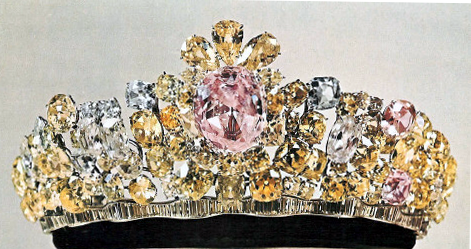
In 1965, a Canadian team conducting research on the Iranian Crown Jewels concluded that the Daria-i-Noor may well have been part of a large pink diamond that had been studded in the throne of the Mughal emperor Shah Jahan, and had been described in the journal of the French jeweller Jean-Baptiste Tavernier in 1642, who called it the Great Table diamond ("Diamanta Grande Table"). This diamond may have been cut into two pieces; the larger part is the Daria-i-Noor; the smaller part is believed to be the 60 carat Noor-ul-Ain diamond, presently studded in a tiara also in the Iranian Imperial collection.
Namesake
A different, much smaller, diamond has occasionally been called "Daria-i-Noor" in Bangladeshi reporting, and is reportedly kept in a bank vault in Dhaka; see Daria-i-Noor (Dhaka).
References
References
- Malecka, Anna. (2017). "Daryā-ye Nur: History and Myth of a Crown Jewel of Iran". Iranian Studies.
- "Collections". cbi.ir.
- (2016-10-06). "The Darya-i-Noor Diamond - Israeli Diamond".
- Staff. (2009-09-22). "Darya-i-noor Pink Diamond: World Famous Diamonds".
- (28 July 2022). "Largest pink diamond in 300 years discovered in Angola". The Tribune.
- (2000). "Deccan Heritage". [[Indian Academy of Sciences.
- Bhatia, Shyam. (28 March 2012). "Meet Daria-i-Noor, the Koh-i-Noor's little-known sibling". The Tribune.
- (27 October 2022). "Darya-e Nur".
- (27 January 2023). "Dariya-i-Noor: The myth and the mystery of the country's most precious diamond". The Business Standard.
- (3 September 2025). "Bangladesh eyes end to treasure trove bank vault mystery". France 24.
This article was imported from Wikipedia and is available under the Creative Commons Attribution-ShareAlike 4.0 License. Content has been adapted to SurfDoc format. Original contributors can be found on the article history page.
Ask Mako anything about Daria-i-Noor — get instant answers, deeper analysis, and related topics.
Research with MakoFree with your Surf account
Create a free account to save articles, ask Mako questions, and organize your research.
Sign up freeThis content may have been generated or modified by AI. CloudSurf Software LLC is not responsible for the accuracy, completeness, or reliability of AI-generated content. Always verify important information from primary sources.
Report