From Surf Wiki (app.surf) — the open knowledge base
Dandong

| Field | Value | |
|---|---|---|
| <!-- Basic info ----------------> | name | Dandong |
| other_name | Andong | |
| native_name | 丹东市 | |
| native_name_lang | zh-Hans | |
| settlement_type | Prefecture-level city | |
| total_type | ||
| motto | ||
| image_skyline | 江边 bank of Yalu River in Dandong.jpg | |
| image_caption | View of Dandong's skyline on the Yalu River | |
| image_map | Location of Dandong Prefecture within Liaoning (China).png | |
| map_caption | Location of Dandong City jurisdiction in Liaoning | |
| pushpin_map | Liaoning | |
| pushpin_map_caption | Location of the city center in Liaoning | |
| pushpin_mapsize | ||
| subdivision_type | Country | |
| subdivision_name | People's Republic of China | |
| subdivision_type1 | Province | |
| subdivision_name1 | Liaoning | |
| subdivision_name2 | ||
| seat_type | Municipal seat | |
| seat | Zhenxing District | |
| parts_type | Districts and Counties | |
| parts_style | coll | |
| parts | ||
| p1 | Zhenxing District | |
| p2 | Yuanbao District | |
| p3 | Zhen'an District | |
| p4 | Fengcheng City | |
| p5 | Donggang City | |
| p6 | Kuandian Manchu Autonomous County | |
| leader_title | CCP Secretary | |
| leader_name | Pei Weidong | |
| leader_title1 | Congress Chairperson | |
| leader_name1 | Yu Bing | |
| leader_title2 | Mayor | |
| leader_name2 | Hao Jianjun | |
| leader_title3 | Prefectural CPPCC Chairperson | |
| leader_name3 | Song Liyue | |
| established_title | ||
| established_date | ||
| unit_pref | ||
| area_total_km2 | 14782 | |
| area_urban_km2 | 995.2 | |
| area_metro_km2 | 1184.2 | |
| area_urban_footnotes | ||
| elevation_footnotes | tags-- | |
| elevation_m | 8 | |
| elevation_ft | 27 | |
| elevation_min_ft | ||
| population_as_of | 2020 census | |
| population_footnotes | ||
| population_total | 2188436 | |
| population_density_km2 | auto | |
| population_urban | 815858 | |
| population_metro | 1175199 | |
| population_density_urban_km2 | auto | |
| population_density_metro_km2 | auto | |
| demographics_type2 | GDP | |
| demographics2_title1 | Prefecture-level city | |
| demographics2_info1 | CN¥ 89 billion | |
| US$ 15.8 billion | ||
| demographics2_title2 | Per capita | |
| demographics2_info2 | CN¥ 40,791 | |
| US$ 6,549 | ||
| <!-- General information ---------------> | timezone | China Standard |
| utc_offset | +8 | |
| coor_pinpoint | Dandong Customs | |
| coordinates | ||
| blank3_name | Licence plates | |
| blank3_info | 辽F | |
| blank4_name | Administrative division code | |
| blank4_info | 210600 | |
| iso_code | CN-LN-06 | |
| postal_code_type | Postal code | |
| postal_code | 118000 | |
| area_code | 415 | |
| website |
US$ 15.8 billion US$ 6,549
Antung (until 1965) Dandong is a coastal prefecture-level city in southeastern Liaoning, in the northeastern region of China.
It is the largest Chinese border city, facing Sinuiju, North Korea, across the Yalu River, which demarcates the Sino-North Korean border. To the southwest of the city, the river flows into Korea Bay. Dandong has therefore had a dynamic history because of its strategic location for the northeast's rich natural resources and because of its convenient access to the ocean. It is designated as a major export production centre for the province, and is a port city connected by rail with Shenyang and Sinuiju. A significant amount of trade with North Korea flows through the city. Kanto, Dick K. and Mark E. Manyin. China-North Korea Relations. DIANE Publishing. December 28, 2010. 10. Retrieved from Google Books on October 23, 2012. , 9781437985115.
The size of the administrative city (prefecture) is 14981.4 km2. As of the 2020 census, its population was 2,188,436 inhabitants and the built-up area made of 3 urban districts is 830 km2 (815,576 inhabitants) and Sinuju, the North Korean neighboring city (359,341 inhabitants), was home to 1,175,199 inhabitants in 2020.
Geography
| Dandong | -11.4 | -2.3 | 7.1 | - 8.6 | 1.1 | 9.5 | - 2.4 | 7.2 | 18.1 | 4.1 | 14.6 | 46.2 | 10.2 | 20.0 | 73.1 | 15.9 | 24.1 | 107.5 | 20.3 | 26.7 | 251.6 | 20.1 | 27.8 | 217.8 | 13.7 | 23.8 | 104.6 | 6.3 | 16.9 | 49 | - 1.2 | 7.7 | 28.4 | - 8.3 | .1 | 12.7
Dandong is located on the western border of North Korea and the northwest (right) shore of the Yalu River, facing Sinuiju to the southeast. It is situated on the southeast corner of the Liaodong Peninsula, near the mouth of the Yalu River, which empties into the Korea Bay, which is part of the Yellow Sea. There are 120 km of coastline and islands including Dalu Island (大鹿岛; lit. "great deer island") and Xiaomai Island (小麦岛; lit. "wheat island").
Dandong City ranges in latitude from 39° 43' to 41° 09' N and in longitude from 123° 22' to 125° 41' E, and at its greatest spans 196 km from east to west and 160 km from south to north. Bordering prefectures are Dalian (SW), Anshan (W), Liaoyang (NW), and Benxi (N).
Climate
The area has long winters, and humid, somewhat hot summers belonging to the humid continental climate regime (Köppen Dwa). Winter usually begins in late November and continues until the end of March (about 4 months), with the most severe cold only lasting for around three weeks in December, January, or February. The coldest month, January, averages −7.3 °C. Spring, though a period of quick warming, is delayed by one month compared to more inland parts of the province, and is somewhat dry until May. Summer heat is moderated by proximity to the coast; the city's warmest month, August, averages 23.6 °C. With monthly percent possible sunshine ranging from 35% in July to 67% in February, the city receives 2,459 hours of sunshine annually and is, outside of the summer months, generally sunny.
For the city proper, the annual mean temperature is 9.20 °C, and the total precipitation is 926 mm, but within the prefecture, annual means can be as low as 6.8 °C, while precipitation ranges from 881.3 to.
|Jan record high C= 9.5 |Feb record high C= 15.2 |Mar record high C= 21.9 |Apr record high C= 27.3 |May record high C= 30.3 |Jun record high C= 34.5 |Jul record high C= 36.5 |Aug record high C= 37.3 |Sep record high C= 32.2 |Oct record high C= 30.4 |Nov record high C= 22.4 |Dec record high C= 13.0 |Jan record low C = −27.8 |Feb record low C = -28.0 |Mar record low C = −25.2 |Apr record low C = −7.0 |May record low C = 1.5 |Jun record low C = 5.3 |Jul record low C = 12.1 |Aug record low C = 9.5 |Sep record low C = 2.6 |Oct record low C = −5.8 |Nov record low C = −14.9 |Dec record low C = -23.8 |year record low C = -28.0
Administrative divisions
Dandong is divided into 3 districts, 2 towns, and one autonomous county:
| Map | # | Name | Chinese | Hanyu Pinyin | Population (2003 est.) | Area (km2) | Density (/km2) |
|---|---|---|---|---|---|---|---|
| 1 | Zhenxing District | 振兴区 | zh | 380,000 | 80 | 4,750 | |
| 2 | Yuanbao District | 元宝区 | zh | 180,000 | 81 | 2,222 | |
| 3 | Zhen'an District | 振安区 | zh | 190,000 | 669 | 284 | |
| 4 | Fengcheng City | 凤城市 | zh | 580,000 | 5,518 | 105 | |
| 5 | Donggang City | 东港市 | zh | 640,000 | 2,496 | 256 | |
| 6 | Kuandian Manchu | ||||||
| Autonomous County | 宽甸满族自治县 | zh | 440,000 | 6,186 | 71 |
History
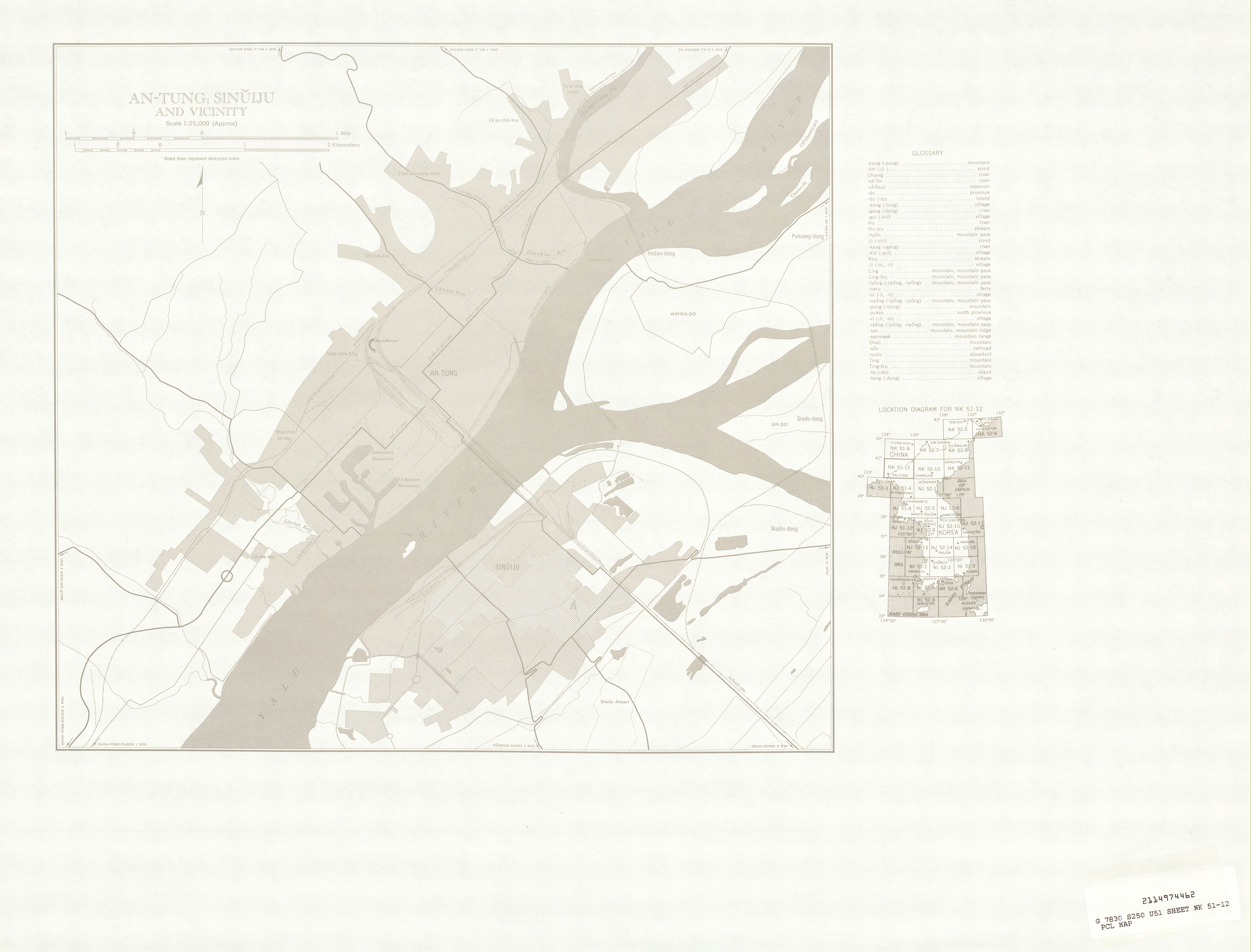
Maps and artifacts suggest that the area has been settled since the Gojoseon kingdom period.
During the Han dynasty (221 BC–220 AD), the Dandong region was under the jurisdiction of west Anping county. During the Goguryeo kingdom period, the region was the site for Bakjak Fortress. After the fall of the Goguryeo, in the early Tang dynasty (618–907), the Dandong region was under the jurisdiction of Andong Prefecture. In the 8th century, the area was conquered by King Mun of Balhae (r. 737–793). In Liao dynasty (916–1125), it was under the jurisdictions of the states Xuan, Kai, and Mu.
It fell under the jurisdiction of the state of Po-Su in the Jin dynasty, the state of Po-Sha in the Yuan dynasty, and the state of Liaodong in the Ming dynasty.
The area became known as Andong County (安東縣) in 1876. "安東" means "pacifying the east", reflecting the power that China had over Korea at the time. After the start of the first Sino-Japanese War in 1894, Andong County was occupied by Japan. During the Manchukuo era, it was the capital of Andong Province, one of the fourteen provinces established by Manchukuo. It was opened as an American treaty port in 1903. It was opened as a treaty port in 1907.
From November 1950 to February 1951, Dandong's Sino–Korean Friendship Bridge was bombed by the United States during the Korean War, as was an older iron bridge leading to North Korea. Even though the Sino–Korean Friendship Bridge was rebuilt, the remains of the Japanese-built iron bridge were left and now serve as a war monument.
On 20 January 1965, the city adopted its present name of Dandong, which means "red east," to avoid the connotations of its previous name, which was considered imperialistic by some. Recently, the city has been gaining influence in this region of China because of its market with North Korea and the government's future plans to develop the city into a special "Border Economic Cooperation Zone" for export and import in order to expand the country's ability to conduct trade.
In 2001, Dandong was granted the "Best Tourist Destination City" award by the National Tourism Administration. Four years later, the same administration granted it the award of "National Clean City."
Demographics
Per the 2020 Chinese Census, Dandong has a total population of 2,188,436. The population of Dandong's urban core totals 1,090,680 (49.84%), while another 416,791 people (19.05%) live in other urban areas in Dandong. 680,965 people (31.12%) live in rural areas.
Per 2020 Census data, there are 928,784 households in Dandong, with an average size of 2.36 people. The sex ratio in Dandong is 98.88 males per 100 females. 9.80% of the population is 0–14 years old, 70.20% of the population of 15–64 years old, and 20.02% is age 65 and older.
Floating population
In 2005, the resident population was approximated to be 751,914 with a floating population of 176,926, for a total of 928,840. However, the non-agricultural (urban) population is said to consist of only 79.52% of the resident population (597,930).
Ethnic composition
Dandong is a multi-ethnic area, with at least 48 ethnic groups, including the Han, Manchus, Mongols, Koreans, the Hui, and the Sibe. As of 2020, Han Chinese people comprise 64.59% of Dandong's population (1,413,438 people). The city's second largest ethnic group is the Manchu, who make up 32.43% of its population (709,719 people). The Manchu minority group has become so acculturated into the Han majority that there remains little or no distinction between the two, although a number of Manchu words have remained in the local lexicon. Ethnic Mongols comprise the city's third largest ethnic group, accounting for 1.14% of its population (24,873 people). The city's fourth largest ethnic group is Koreans, who make up 0.77% of its total population (16,859 people). In Dandong, the Korean language is used in a number of signs and advertisements, as well as in public services. The city is home to many Korean restaurants, shops, churches, schools, and other cultural institutions. The Hui make up the city's fifth largest community, at 0.59% of its population (12,983 people). The Sibe people comprise Dandong's sixth largest ethnic group, at 0.33% of its population (7,259 people).
Economy

The total GDP of the city of Dandong is CN¥89.07 billion ($15.81 billion) in the year 2022. The GDP per capita of the city of Dandong is CN¥41,730 ($6,549) in 2022.
A substantial portion of North Korea's international trade, both legal and illegal, passes through Dandong and Sinuiju, across the Yalu River in North Korea. China handles roughly 40% of North Korea's worldwide export trade ($1.58 of US$4 billion) and roughly half of the bilateral commerce with China goes through Dandong which imports $468 million [USD worth of product], according to its Ministry of Commerce. Dandong's annual resident per capita wage income for 2004 was somewhere between ¥9,500 and ¥12,237 RMB and the city's GDP was US$3.77 billion.
Dandong is widely known in China for producing the Dandong Yellow Sea brand buses. The port of Dandong is being developed into the second major international logistics centre of Liaoning and has become a notable alternative to the port of Dalian.
The city had "5.86 million tourists" in 2004, of which 16,000 of those travelled into North Korea; another 81,000 of those were from overseas and contributed US$27.54 million to the economy. During 2004, "the total tourism income was 4.02 billion Yuan [RMB]," and this was an increase of almost 33% from the previous year.
Memory cards and teddy bears are among the most popular items for North Koreans shopping in Dandong.
Development zones
Dandong Border Economic Corporation Zone was approved as a national-level development zone in 1992. It is located on the bank of Yalu River, opposite the North Korean city of Sinuiju. It encourages the following industries: electronic information, machine manufacturing, biopharmaceuticals, among others.
Dandong Qianyang Economic Development Zone was first approved by Dandong City as a Special Economic Zone, in 1994 by Liaoning Province as Liaoning Dandong Qianyang Economic Development Zone (LDQEDZ). In July 2009, the development of the Liaoning Coastal Economic Belt was listed as a national strategy. Qianyang Town, situated at the eastern tip of the Belt is now an important component of Dandong's coastal development, and has an opportunity to demonstrate its strategic position.
Infrastructure
Railways
- Shenyang–Dandong intercity railway
Trains from Dandong to Shenyang are available several times a day with night trains to Beijing, Dalian, Changchun, Qingdao and Shanghai. From Dalian, the high speed train takes less than 3 hours, or from Beijing, less than 7 hours.
International trains link Dandong with Pyongyang daily. Both Chinese and North Korean carriages operating the through train from Beijing to Pyongyang (trains K27 and K28) are attached to the daily overnight train from Beijing to Dandong. In addition there are North Korean carriages which form a daily dedicated Dandong Pyongyang train.
Road
- China National Highway 201
- China National Highway 304
- G11 Hegang–Dalian Expressway
- G1113 Dandong–Fuxin Expressway
From the long-distance bus station, it takes about 10 hours to get to Beijing, four hours to Dalian and Tonghua, and three hours to Shenyang.
Air
Flights to and from Dandong Langtou Airport are limited, but one can always fly in/out of Dalian or Shenyang and then take the train or bus to/from Dandong. The airport is located 13 miles west of town and an airport shuttle is available. Domestic flights are available to Beijing, Qingdao, Sanya, Shanghai and Shenzhen.
Ports and waterways
The Port of Dandong is located on the right bank at the mouth of the Yalu River. It is bordered by the Yellow Sea in the south and is separated from the North Korea in the east. It was set up as a trading port in 1907. Since large-scale construction began in the mid-1980s, the Port, together with the ports at Dalian and Yingkou, has become an important distributing centre in northeast China.
In October 2011, the Chinese government announced a $7.1 billion expansion over five years to expand Dandong Port. Dai Yulin, secretary of the Dandong City Committee of the Chinese Communist Party noted that Dandong's unique geography ensures that the city is a hub for land-sea transportation, connecting 90 ports in over 70 countries. Several multinational companies including US-owned Harman, have made Dandong the location for their northeast Asian headquarters.
The waterways near the port have become an important tourist attraction in the region and include the Yalu River Park.
Landmarks

The city is across the river from Sinŭiju, North Korea. The two cities are connected by the Sino–Korean Friendship Bridge. Less than 100 meters downstream is the Yalu River Broken Bridge which was destroyed by American bombing during the Korean War. Tourists can rent speed boats or passenger boats to approach the border and get a closer look at the North Korean city of Sinŭiju. There is a ferris wheel in Sinŭiju visible from across the Yalu River.
Other tourist attractions include the Memorial of the War to Resist US Aggression and Aid Korea, also known as the Korean War Museum, and the Jinjiang Mountain (锦江山) which used to be a Chinese army lookout and is now the city's largest park.
Outside of central Dandong, there are other landmarks such as: the Dagushan Scenic Area in Donggang, and Shuifeng Dam in Kuandian Manchu Autonomous County, and Fenghuang Mountain in Fengcheng.
Wulong mountain scenic area is located in Dandong City, 25 km northwest of the town of old village Zhen'an District, is located in Zhen'an District within Fengcheng's city borders and includes five Longshan and Wulongbei spa.
Black Creek Reservoir is located in the Yuanbao District), located in 304 State Road (Danhuo highway) on the left side, 10 km away from Dandong. Dandong is the only city in the area of the reservoir. The Black Creek Reservoir near the Shou artillery battalion has spas, sanatoriums and a summer resort to cater to tourism.
Culture
Cuisine
Dandong fried fork seeds noodle (丹东炒叉子) is the most characteristic snack in Dandong, which is made of rice fork seeds as the main ingredient and yellow clam meat, leek, carrot, and round onion as the auxiliary ingredients, stir-fried with seasonings such as minced garlic and sesame oil. Rice fork is a Manchu food in the early days, made from corn, fermented and ground into watery noodles, and then made into smooth strips of chopstick thickness by hand or mold after settling.
Specialty
Dandong yellow clams (丹东黄蚬子) are grown at the mouth of the Yalu River, where nutrients are abundant and the water temperature is suitable. Therefore, the yellow clams produced here are bigger and fatter than those from other places, and their nutritional value is also higher. Yellow clams have become the golden sign of Dandong seafood and were registered as a national geographical indication by the Chinese Ministry of Agriculture in 2011.
Friendship cities
Dandong is a Sister City with the following cities:
- France Paris, France (2008)
- South Korea Uijeongbu, Gyeonggi-do, South Korea (1997)
- Russia Astrakhan, Astrakhan Oblast, Russia (1993)
- Japan Tokushima, Tokushima, Japan (1991)
- United Kingdom Doncaster, South Yorkshire, United Kingdom (1988)
- United States Wilmington, North Carolina, United States (1986)
References
Notes
References
- "China: Liáoníng (Prefectures, Cities, Districts and Counties) - Population Statistics, Charts and Map".
- 辽宁省统计局、国家统计局辽宁调查总队. (October 2016). "《辽宁统计年鉴-2016》". [[China Statistics Press]].
- Rogers, Jenny. "[http://www.goldcoast.com.au/article/2012/10/02/439048_gold-coast-business.html New group reaches out to China] {{Webarchive. link. (2012-10-06 ." ''[[Gold Coast Bulletin]]''. October 2, 2012. Retrieved on October 23, 2012.)
- link. Dandong Municipal Government. (15 June 2005)
- link. [[China Meteorological Administration]]
- Heidi English. "A Brief Introduction to Heidi English School".
- HKTDC. (2011-09-12). "Dandong ( Liaoning ) City Information".
- "". link. Liaoning Provincial Statistics Bureau
- Hwang, Seok-Joo. (2017-07-13). "China's Dandong begins Korean-language service in buses".
- (2023-10-06). "China's North Korean eateries refuse South Korean diners".
- "". link. Liaoning Provincial Ethnic and Religious Affairs Commission
- "二〇二二年丹东市国民经济和社会发展统计公报-统计公报-丹东市人民政府".
- (March 31, 2016). "A Hole in North Korean Sanctions Big Enough for Coal, Oil and Used Pianos". The New York Times.
- Rabinovitch, Simon. (15 May 2013). "Cooling China-N Korea ties hit border town". Financial Times.
- (2005). "China Briefing Guide". Dandong Municipal People's Government.
- (4 December 2016). "Thanks for the memory cards; North Koreans return from China".
- [http://rightsite.asia/en/industrial-zone/dandong-border-economic-corporation-zone/ RightSite.asia. Dandong Border Economic Corporation Zone] {{webarchive. link. (2010-04-18)
- "China Liaoning Business Guide".
- "K27 and K28 {{!}} Beijing to Pyongyang train {{!}} TrainReview".
- "Train 51 and 52 {{!}} Dandong to Pyongyang train {{!}} TrainReview".
- (April 2018). "China Briefing Business Reports". Asia Briefing.
- (2008). "China Expat city Guide Dalian". China Expat.
- "China to Invest Billions in Dandong Port Expansion". World Maritime News.
- (28 October 2011). "China planning $7.1 billion expansion of Dandong Port".
- "HARMAN Expands to Northern China with New Technology Center".
- (2017-09-05). "Places to Visit in China". The London Economic.
- 网易. (2021-10-31). "丹东十大特色美食小吃 丹东特色小吃排行榜 丹东吃美食有哪些".
This article was imported from Wikipedia and is available under the Creative Commons Attribution-ShareAlike 4.0 License. Content has been adapted to SurfDoc format. Original contributors can be found on the article history page.
Ask Mako anything about Dandong — get instant answers, deeper analysis, and related topics.
Research with MakoFree with your Surf account
Create a free account to save articles, ask Mako questions, and organize your research.
Sign up freeThis content may have been generated or modified by AI. CloudSurf Software LLC is not responsible for the accuracy, completeness, or reliability of AI-generated content. Always verify important information from primary sources.
Report