From Surf Wiki (app.surf) — the open knowledge base
Danake
Persian Empire coin
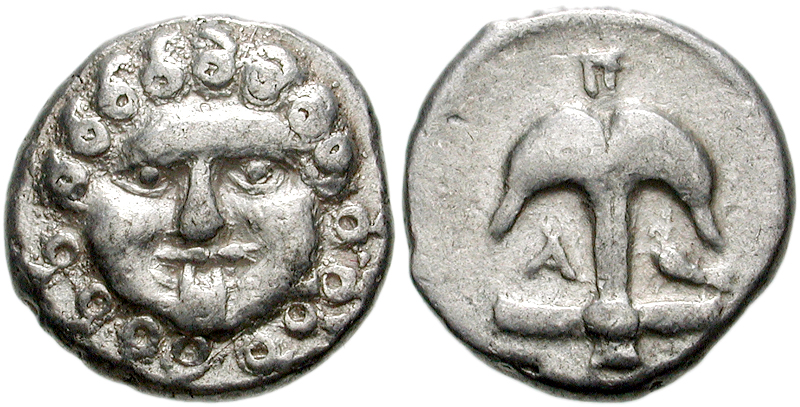
Persian Empire coin
The danake or grc (Greek: δανάκη) was a small silver coin of the Persian Empire (Old Persian grc), equivalent to the Greek obol and circulated among the eastern Greeks. Later it was used by the Greeks in other metals. The 2nd-century AD grammarian Julius Pollux gives the name as danikê or danakê or danikon and says that it was a Persian coin, but by Pollux's time this was an anachronism.
The term as used by archaeologists is vague in regard to denomination. A single coin buried with the dead and made of silver or gold is often referred to as a grc and presumed to be a form of Charon's obol. Numismatists have also found the grc an elusive coin to identify, speculating that the Greeks used the term loosely for a demonetized coin of foreign origin.
In Persia, the grc was originally a unit of weight for bulk silver, representing one-eighth of a shekel (1.05 gm). This use of the word became obsolete. In the Hellenistic period and later it designated the silver Attic obol, which originally represented the sixth part of a drachma; in New Persian dâng means "one sixth".
Customary use
Main article: Charon's obol
The grc is one of the coins that served as the so-called Charon's obol, which was placed on or in a dead person's mouth to pay the ferryman who conveyed souls across the river that divided the world of the living from the world of the dead. Charon's obol is sometimes specifically called a naulum (Greek ναῦλον, "boat fare"). The Christian-era lexicographer Hesychius gives "the obol for the dead" as one of the meanings of δανάκη, and the Suda defines the grc as a coin traditionally buried with the dead for paying the ferryman to cross the Acheron. In literary sources, the smallness of the denomination was taken as a reminder that death is an equalizer of rich and poor.
Although Charon's obol is usually regarded as Hellenic, archaeology indicates that the rite of placing of a coin in the mouth of the deceased was practiced also during Parthian and even Sasanian times in the region that is present-day Iran. The coin, however, was customarily a drachma. In his entry on the δανάκη, Hesychius implies that the coin was mentioned by Heracleides of Cyme in his lost work Persica around 350 BC, placing its use (perhaps erroneously) in the Achaemenid period.
Funerary context
Gold grc are frequently found in graves. In a Thessalian burial of the 4th century BC, a gold grc had been placed on the lips of a woman, presumed from her religious paraphernalia to be an initiate into the Orphic or Dionysiac mysteries. The coin was stamped with a Gorgon's head.

In archaeological investigations of Greece since the mid-1990s, grc have tended to be found in cemeteries. At a necropolis at Hephaisteia on Lemnos, exploration of which began in 1995, the many finds in unlooted graves included a gold grc. In the late 1990s, a cemetery in northwest Greece yielded objects dating from the mid-4th to the early 3rd centuries BC, including oinochoai, unguentaria, a wreath with thin gold leaves (sometimes associated with Orphic religion), a gold grc, and a silver obol with a winged Pegasus. A gold grc of Geta dating 199–200 A.D. was among objects – including potsherds, animal bones and shells, and bronze coins – retrieved from a well in the center of a cemetery in central Macedonia. The well was surrounded by a paved floor and housed by a stone structure. It is thought that the deposition followed funerary meals and offerings to the dead.
In investigations reported 2004–2005, a single gold grc was found along with bronze coins and glassware in an Achaian cemetery where both adults and children had been buried in wooden coffins. Graves in Euboia yielded pottery and glassware, small bone tools, iron strigils, and gold jewelry and grc. In Epiros, graves and funerary chests yielded gold grc along with kantharoi, lamps, pyxides, figurines, gold rings, gold oak leaves, iron strigils, a bone flute, fragments of funerary stelae and a marble head of a young man. The items dated from the 4th to the 2nd century BC. Excavations at a Hellenistic cemetery in the same area uncovered five gold grc along with seventeen perfume flasks, twenty-six vessels, a bronze strigil, an iron spearhead, terracotta figurines and a funerary pelike with gorgoneia at the base of the handles.
Later use
The word "grc" continued in use into the Middle Ages as Arabic ar, Persian or fa, and post-classical Sanskrit sa. The name has been connected to the silver tangka of India, which had the same weight.
References
References
- Albert R. Frey, ''A Dictionary of [[Numismatics. Numismatic]] Names'' (New York 1917), p. 60; A.D.H. Bivar, "[[Achaemenid Empire. Achaemenid]] Coins, Weights and Measures", in ''The Cambridge History of Iran'' (Cambridge University Press, 1993), vol. 2, p. 635.
- A. Cunningham, "Relics from Ancient Persia in Gold, Silver, and Copper", ''Journal of the Asiatic Society of Bengal'' 50 (1881), p. 167.
- A.D.H. Bivar, "Achaemenid Coins, Weights and Measures", in ''The Cambridge History of Iran'' (Cambridge University Press, 1985), vol. 2, p. 622.
- [[Ernest Babelon]], entry on "Danaké", ''Traité des monnaies grecques et romaines'', vol. 1 (Paris: Leroux, 1901), pp. 514–518 [https://books.google.com/books?id=TmcCAAAAYAAJ&dq=danaké+%22ce+nom%22+inauthor:Babelon&pg=PA522 full text online.]
- A.D.H. Bivar, "Achaemenid Coins, Weights and Measures", in ''The Cambridge History of Iran'' (Cambridge University Press, 1985), vol. 2, p. 622, citing the evidence of the [[Persepolis#Ancient texts. Persepolis tablets]].
- Albert R. Frey, ''A Dictionary of [[Numismatics. Numismatic]] Names'' (New York 1917), p. 60.
- [[Aristophanes]], [[The Frogs. ''Frogs'']] 270; [[Juvenal]] 8.97; [[Apuleius]], ''Metamorphoses'' 6.18; Albert R. Frey, ''A Dictionary of Numismatic Names'' (New York 1917), p. 158.
- Hesychius, entry on {{lang. grc. δανάκη, ''Lexicon'', edited by M. Schmidt (Jena 1858–68), I 549, as cited by Gregory Grabka, "Christian Viaticum: A Study of Its Cultural Background", ''Traditio'' 9 (1953) p. 8.
- Entry on {{lang. grc. δανάκη, ''[[Suda. Suidae]] Lexicon'', edited by A. Adler (Leipzig 1931) II 5f., cited by Gregory Grabka, "Christian Viaticum", ''Traditio'' 9 (1953) p. 8.
- Susan T. Stevens, "Charon's Obol and Other Coins in Ancient Funerary Practice," ''Phoenix'' 45 (1991), pp. 217, 219–220.
- A.D.H. Bivar, "Achaemenid Coins, Weights and Measures", in ''The Cambridge History of Iran'' (Cambridge University Press, 1985), vol. 2, pp. 622–623, with citations on the archaeological evidence in note 5.
- A.D.H. Bivar, "Achaemenid Coins, Weights and Measures", in ''The Cambridge History of Iran'' (Cambridge University Press, 1985), vol. 2, p. 622. Bivar calls it a "bookman's notion" that {{Transliteration. grc. danake was the correct name for the boat fare and blames a misunderstanding of a line in Callimachus.
- K. Tasntsanoglou and George M. Parássoglou, "Two Gold Lamellae from Thessaly," ''Hellenica'' 38 (1987) 3–16. For more on this particular burial, see article [[Totenpass]].
- David Blackman, "Archaeology in Greece 2001–2002", ''Archaeological Reports'' 48 (2001–2002), p. 91.
- David Blackman, "Archaeology in Greece 1999–2000", ''Archaeological Reports'' 46 (1999–2000), p. 67.
- David Blackman, ''Archaeological Reports'' 45 (1998–1999), p. 78, with photograph of coin fig. 93.
- James Whitley, "Archaeology in Greece 2004–2005", ''Archaeological Reports'' 46 (2004–2005), p. 37.
- James Whitley, "Archaeology in Greece 2004–2005", ''Archaeological Reports'' 46 (2004–2005), p. 49.
- [[Typology of Greek Vase Shapes. Typical vase shapes]] for holding perfume oils are the [[lekythos]] and [[alabastron]]; but see also "[[Unguentarium]]."
- James Whitley, "Archaeology in Greece 2004–2005", ''Archaeological Reports'' 46 (2004–2005), p. 64.
- Albert R. Frey, ''A Dictionary of Numismatic Names'' (New York 1917), p. 60.
- A. Cunningham, "Relics from Ancient Persia in Gold, Silver, and Copper", ''Journal of the Asiatic Society of Bengal'' 50 (1881), p. 168.
This article was imported from Wikipedia and is available under the Creative Commons Attribution-ShareAlike 4.0 License. Content has been adapted to SurfDoc format. Original contributors can be found on the article history page.
Ask Mako anything about Danake — get instant answers, deeper analysis, and related topics.
Research with MakoFree with your Surf account
Create a free account to save articles, ask Mako questions, and organize your research.
Sign up freeThis content may have been generated or modified by AI. CloudSurf Software LLC is not responsible for the accuracy, completeness, or reliability of AI-generated content. Always verify important information from primary sources.
Report