From Surf Wiki (app.surf) — the open knowledge base
Cytochrome c oxidase subunit III
Enzyme of the respiratory chain encoded by the mitochondrial genome
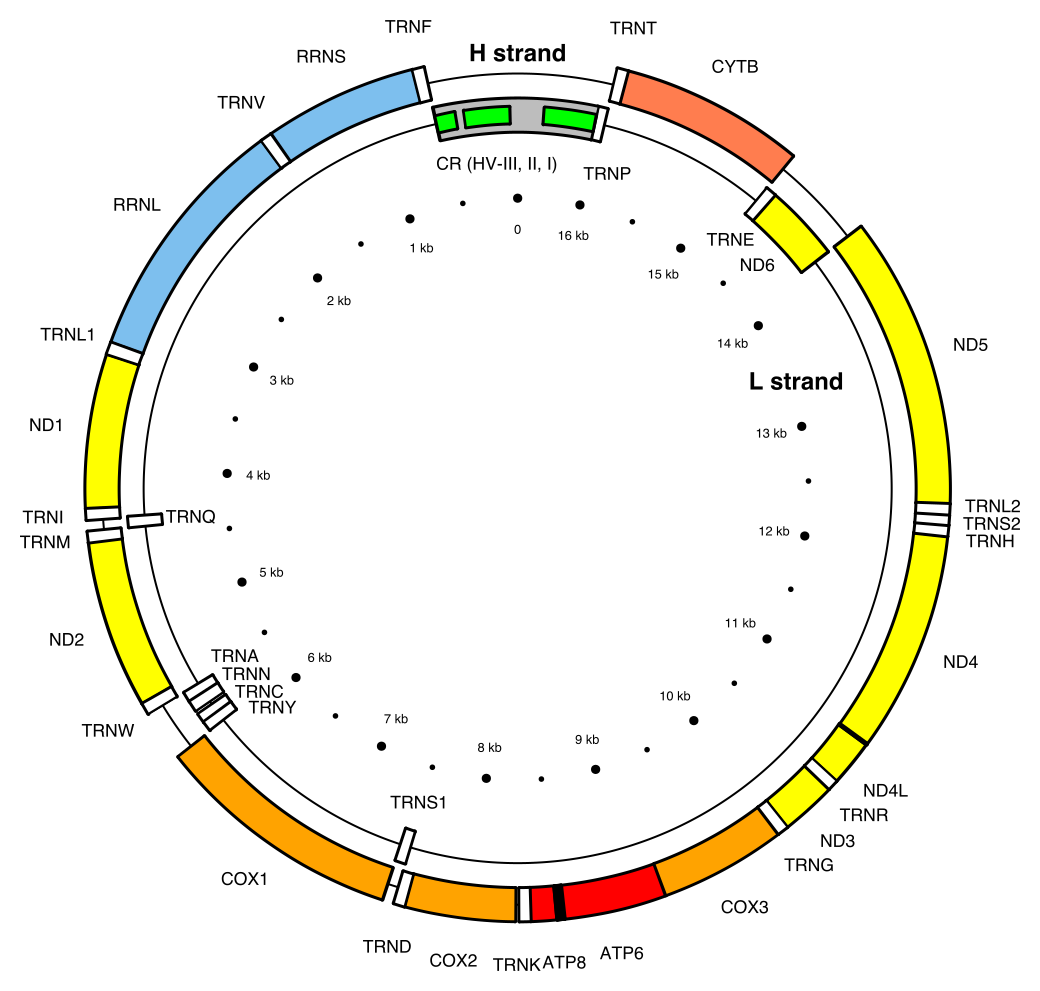
Enzyme of the respiratory chain encoded by the mitochondrial genome
Cytochrome c oxidase subunit III (COX3) is an enzyme that in humans is encoded by the MT-CO3 gene. It is one of main transmembrane subunits of cytochrome c oxidase. It is also one of the three mitochondrial DNA (mtDNA) encoded subunits (MT-CO1, MT-CO2, MT-CO3) of respiratory complex IV. Variants of it have been associated with isolated myopathy, severe encephalomyopathy, Leber hereditary optic neuropathy, mitochondrial complex IV deficiency, and recurrent myoglobinuria .
Structure
The MT-CO3 gene produces a 30 kDa protein composed of 261 amino acids. COX3, the protein encoded by this gene, is a member of the cytochrome c oxidase subunit 3 family. This protein is located on the inner mitochondrial membrane. COX3 is a multi-pass transmembrane protein: in human, it contains 7 transmembrane domains at positions 15–35, 42–59, 81–101, 127–147, 159–179, 197–217, and 239–259.
Function
Cytochrome c oxidase () is the terminal enzyme of the respiratory chain of mitochondria and many aerobic bacteria. It catalyzes the transfer of electrons from reduced cytochrome c to molecular oxygen:
: 4 cytochrome c+2 + 4 H+ + O2 \rightleftharpoons 4 cytochrome c+3 + 2 H2O
This reaction is coupled to the pumping of four additional protons across the mitochondrial or bacterial membrane.
Cytochrome c oxidase is an oligomeric enzymatic complex that is located in the mitochondrial inner membrane of eukaryotes and in the plasma membrane of aerobic prokaryotes. The core structure of prokaryotic and eukaryotic cytochrome c oxidase contains three common subunits, I, II and III. In prokaryotes, subunits I and III can be fused and a fourth subunit is sometimes found, whereas in eukaryotes there are a variable number of additional small subunits.
As the bacterial respiratory systems are branched, they have a number of distinct terminal oxidases, rather than the single cytochrome c oxidase present in the eukaryotic mitochondrial systems. Although the cytochrome o oxidases do not catalyze the cytochrome c but the quinol (ubiquinol) oxidation they belong to the same haem-copper oxidase superfamily as cytochrome c oxidases. Members of this family share sequence similarities in all three core subunits: subunit I is the most conserved subunit, whereas subunit II is the least conserved.
Clinical significance
Mutations in mtDNA-encoded cytochrome c oxidase subunit genes have been observed to be associated with isolated myopathy, severe encephalomyopathy, Leber hereditary optic neuropathy, mitochondrial complex IV deficiency, and recurrent myoglobinuria .
Leber hereditary optic neuropathy (LHON)
LHON is a maternally inherited disease resulting in acute or subacute loss of central vision, due to optic nerve dysfunction. Cardiac conduction defects and neurological defects have also been described in some patients. LHON results from primary mitochondrial DNA mutations affecting the respiratory chain complexes. Mutations at positions 9438 and 9804, which result in glycine-78 to serine and alanine-200 to threonine amino acid changes, have been associated with this disease.
Mitochondrial complex IV deficiency (MT-C4D)
Complex IV deficiency (COX deficiency) is a disorder of the mitochondrial respiratory chain with heterogeneous clinical manifestations, ranging from isolated myopathy to severe multisystem disease affecting several tissues and organs. Features include hypertrophic cardiomyopathy, hepatomegaly and liver dysfunction, hypotonia, muscle weakness, exercise intolerance, developmental delay, delayed motor development, mental retardation, lactic acidemia, encephalopathy, ataxia, and cardiac arrhythmia. Some affected individuals manifest a fatal hypertrophic cardiomyopathy resulting in neonatal death and a subset of patients manifest Leigh syndrome. The mutations G7970T and G9952A have been associated with this disease.**
Recurrent myoglobinuria mitochondrial (RM-MT)
Recurrent myoglobinuria is characterized by recurrent attacks of rhabdomyolysis (necrosis or disintegration of skeletal muscle) associated with muscle pain and weakness, and followed by excretion of myoglobin in the urine. It has been associated with mitochondrial complex IV deficiency.
Subfamilies
- Cytochrome o ubiquinol oxidase, subunit III
- Cytochrome aa3 quinol oxidase, subunit III
Interactions
COX3 has been shown to have 15 binary protein-protein interactions including 8 co-complex interactions. COX3 appears to interact with SNCA, KRAS, RAC1, and HSPB2.
References
References
- (May 1994). "Application of an automatic molecular-replacement procedure to crystal structure analysis of cytochrome c2 from Rhodopseudomonas viridis". Acta Crystallographica Section D.
- "Entrez Gene: COX3 cytochrome c oxidase subunit III".
- "MT-CO3 - Cytochrome c oxidase subunit 3 - Homo sapiens (Human) - MT-CO3 gene & protein".
- (January 2017). "UniProt: the universal protein knowledgebase". Nucleic Acids Research.
- Yao, Daniel. "Cardiac Organellar Protein Atlas Knowledgebase (COPaKB) —— Protein Information".
- (October 2013). "Integration of cardiac proteome biology and medicine by a specialized knowledgebase". Circulation Research.
- (November 1999). "Cytochrome c oxidase: catalytic cycle and mechanisms of proton pumping--a discussion". Biochemistry.
- (April 2006). "Proton-coupled electron transfer drives the proton pump of cytochrome c oxidase". Nature.
- (March 1993). "Cytochrome oxidase genes from Thermus thermophilus. Nucleotide sequence of the fused gene and analysis of the deduced primary structures for subunits I and III of cytochrome caa3". The Journal of Biological Chemistry.
- (May 1992). "Molecular cloning, sequencing, and physiological characterization of the qox operon from Bacillus subtilis encoding the aa3-600 quinol oxidase". The Journal of Biological Chemistry.
- (July 1990). "The sequence of the cyo operon indicates substantial structural similarities between the cytochrome o ubiquinol oxidase of Escherichia coli and the aa3-type family of cytochrome c oxidases". The Journal of Biological Chemistry.
- (September 1994). "The superfamily of heme-copper respiratory oxidases". Journal of Bacteriology.
- (December 2005). "Mutations in mtDNA-encoded cytochrome c oxidase subunit genes causing isolated myopathy or severe encephalomyopathy". Neuromuscular Disorders.
- (October 1993). "Cytochrome c oxidase mutations in Leber hereditary optic neuropathy". Biochemical and Biophysical Research Communications.
- (July 1998). "Cytochrome c oxidase deficiency associated with the first stop-codon point mutation in human mtDNA". American Journal of Human Genetics.
- (April 1996). "A microdeletion in cytochrome c oxidase (COX) subunit III associated with COX deficiency and recurrent myoglobinuria". Nature Genetics.
- "2 binary interactions found for search term COX3". EMBL-EBI.
This article was imported from Wikipedia and is available under the Creative Commons Attribution-ShareAlike 4.0 License. Content has been adapted to SurfDoc format. Original contributors can be found on the article history page.
Ask Mako anything about Cytochrome c oxidase subunit III — get instant answers, deeper analysis, and related topics.
Research with MakoFree with your Surf account
Create a free account to save articles, ask Mako questions, and organize your research.
Sign up freeThis content may have been generated or modified by AI. CloudSurf Software LLC is not responsible for the accuracy, completeness, or reliability of AI-generated content. Always verify important information from primary sources.
Report