From Surf Wiki (app.surf) — the open knowledge base
Cyanogen
| NFPA-H = 4 | NFPA-F = 4 | NFPA-R = 2
Cyanogen is the chemical compound with the formula . Its structure is . The simplest stable carbon nitride, it is a colorless and highly toxic gas with a pungent odor. The molecule is a pseudohalogen. Cyanogen molecules are linear, and consist of two CN groups ‒ analogous to diatomic halogen molecules, such as Cl, but far less oxidizing. The two cyano groups are bonded together at their carbon atoms, though other isomers have been detected. The name is also used for the CN radical, and hence is used for compounds such as cyanogen bromide () (but see also Cyano radical). When burned at increased pressure with oxygen, it is possible to get a blue tinted flame, the temperature of which is about 4800 C (a higher temperature is possible with ozone). It is as such regarded as the gas with the second highest temperature of burning (after dicyanoacetylene).
Cyanogen is the anhydride of oxamide: :
Oxamide is manufactured from cyanogen by hydration:
:
Preparation
Cyanogen is typically generated from cyanide compounds. One laboratory method entails thermal decomposition of mercuric cyanide: : Or, one can combine solutions of copper(II) salts (such as copper(II) sulfate) with cyanides; an unstable copper(II) cyanide is formed which rapidly decomposes into copper(I) cyanide and cyanogen. :
Industrially, it is created by the oxidation of hydrogen cyanide, usually using chlorine over an activated silicon dioxide catalyst or nitrogen dioxide over a copper salt. It is also formed when nitrogen and acetylene are reacted by an electrical spark or discharge.
Reactions
For the two less stable isomers of cyanogen, the order of the atoms differs. Isocyanogen (or cyanogen cyanide) is . It has been detected in the interstellar medium.
Addition of disulfur dichloride to cyanogen gives 3,4-dichloro-1,2,5-thiadiazole.
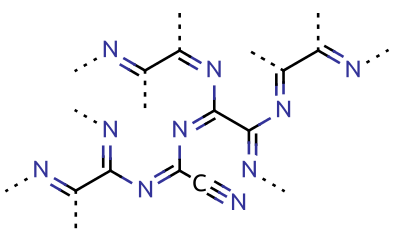
Paracyanogen
History
Cyanogen was first synthesized in 1815 by Joseph Louis Gay-Lussac, who determined its empirical formula and named it. Gay-Lussac coined the word "cyanogène" from the Greek words κυανός (kyanos, blue) and γεννάω (gennao, to create), because cyanide was first isolated by Swedish chemist Carl Wilhelm Scheele from the pigment Prussian blue. It attained importance with the growth of the fertilizer industry in the late 19th century and remains an important intermediate in the production of many fertilizers. It is also used as a stabilizer in the production of nitrocellulose.
Cyanogen is commonly found in comets. In 1910 a spectroscopic analysis of Halley's Comet found cyanogen in the comet's tail, which led to public fear that the Earth would be poisoned as it passed through the tail. People in New York wore gas masks, and merchants sold quack "comet pills" claimed to neutralize poisoning. Because of the extremely diffuse nature of the tail, there was no effect when the planet passed through it.
Safety
Like other cyanides, cyanogen is very toxic, as it readily undergoes reduction to cyanide, which poisons the cytochrome c oxidase complex, thus interrupting the mitochondrial electron transfer chain. Cyanogen gas is an irritant to the eyes and respiratory system. Inhalation can lead to headache, dizziness, rapid pulse, nausea, vomiting, loss of consciousness, convulsions, and death, depending on exposure. Lethal dose through inhalation typically ranges from 100 to.
Cyanogen produces the second-hottest-known natural flame (after dicyanoacetylene aka carbon subnitride) with a temperature of over 4525 C when it burns in oxygen.
References
References
- (2014). "Nomenclature of Organic Chemistry : IUPAC Recommendations and Preferred Names 2013 (Blue Book)". [[Royal Society of Chemistry]].
- (27 October 2006). "oxalonitrile (CHEBI:29308)". European Bioinformatics Institute.
- (1983). "The Merck Index". Merck & Co..
- {{PGCH. 0161
- (2008). "Low-lying singlet excited states of isocyanogen". International Journal of Quantum Chemistry.
- (2011). "Encyclopedia of Astrobiology".
- Hartman, W. W.. (1931). "Cyanogen Bromide".
- {{Greenwood&Earnshaw2nd
- (1959). "The Synthesis And Chemistry Of Cyanogen". [[Chemical Reviews]].
- Breneman, A. A.. (January 1889). "The Fixation of Atmospheric Nitrogen". [[Journal of the American Chemical Society]].
- (1992). "Central Bond in the Three CN.cntdot.dimers NC-CN, CN-CN and CN-NC: Electron Pair Bonding and Pauli Repulsion Effects". The Journal of Physical Chemistry.
- (2018). "Discovery of Interstellar Isocyanogen (CNCN): Further Evidence that Dicyanopolyynes Are Abundant in Space". The Astrophysical Journal Letters.
- Bircumshaw, L. L.. (1954). "Paracyanogen: its formation and properties. Part I". J. Chem. Soc..
- Maya, Leon. (1993). "Paracyanogen Reexamined". Journal of Polymer Science Part A.
- Gay-Lussac, J. L.. (1815). "Recherches sur l'acide prussique". Annales de Chimie.
- (2010-11-02). "Cometary Poison Gas Geyser Heralds Surprises".
- (1910-02-08). "Comet's Poisonous Tail". New York Times.
- (2010-05-25). "Halley's Comet 100 years ago".
- (1971). "Hazards in the Chemical Laboratory". The Royal Institute of Chemistry.
- (1952). "Cyanogen Flames and the Dissociation Energy of N2". The Journal of Chemical Physics.
- (1953). "The Temperature of the Cyanogen-Oxygen Flame". Journal of the American Chemical Society.
This article was imported from Wikipedia and is available under the Creative Commons Attribution-ShareAlike 4.0 License. Content has been adapted to SurfDoc format. Original contributors can be found on the article history page.
Ask Mako anything about Cyanogen — get instant answers, deeper analysis, and related topics.
Research with MakoFree with your Surf account
Create a free account to save articles, ask Mako questions, and organize your research.
Sign up freeThis content may have been generated or modified by AI. CloudSurf Software LLC is not responsible for the accuracy, completeness, or reliability of AI-generated content. Always verify important information from primary sources.
Report