From Surf Wiki (app.surf) — the open knowledge base
Cultural appropriation
Adoption of culture and cultural identity perceived as inappropriate
Adoption of culture and cultural identity perceived as inappropriate
Cultural appropriation is the adoption of an element or elements of culture or identity by members of another culture or identity in a manner perceived as inappropriate or unacknowledged. Charges of cultural appropriation typically arise when members of a dominant culture borrow from minority cultures.{{efn|Attributed to multiple references:
Indigenous peoples working for cultural preservation, advocates of collective intellectual property rights of the originating cultures, and some who have lived or are living under colonial rule have all criticized cultural appropriation. According to American anthropologist Jason Jackson, cultural appropriation differs from other modes of cultural change such as acculturation, assimilation, or diffusion. Jackson describes cultural appropriation as something that is thought of as focused outward and done to a certain party. According to Jackson, cultural appropriations can be sources of pain and can bring about feelings of loss or violation for the community affected.
Opponents of cultural appropriation see cultural appropriation as an exploitative means in which cultural elements are lost or distorted as they are removed from their originating cultural contexts. Cultural elements that may have deep meaning in the original culture may be reduced to "exotic" fashion or toys by those from the dominant culture.
The concept of cultural appropriation has also been subject to heavy criticism, debate, and nuance. Critics note that the concept is often misunderstood or misapplied in popular and academic discourse. Others state that the act of cultural appropriation, usually defined, does not meaningfully constitute social harm or that the term lacks conceptual coherence. Critics also say that the concept sets arbitrary limits on intellectual freedom and artists' self-expression, reinforces group divisions, and promotes enmity or grievance rather than liberation.
Overview
Cultural appropriation can involve the use of ideas, symbols, artifacts, or other aspects of human-made visual or non-visual culture. As a concept that is controversial in its applications, the propriety of cultural appropriation has been the subject of much debate. Opponents of cultural appropriation view many instances as wrongful appropriation when the subject culture is a minority culture or is subordinated in social, political, economic, or military status to the dominant culture or when there are other issues involved, such as a history of ethnic or racial conflict. Linda Martín Alcoff writes that this is often seen in cultural outsiders' use of an oppressed culture's symbols or other cultural elements, such as music, dance, spiritual ceremonies, modes of dress, speech, and social behaviour, when these elements are trivialised and used for fashion, rather than respected within their original cultural context. Opponents view the issues of colonialism, context, and the difference between appropriation and mutual exchange as central to analysing cultural appropriation. They argue that mutual exchange happens on an "even playing field", whereas appropriation involves pieces of an oppressed culture being taken out of context by a people who have historically oppressed those they are taking from and who lack the cultural context to properly understand, respect, or utilise these elements.
Academic discourse
The Oxford English Dictionarys earliest citation for the phrase was a 1945 essay by Arthur E. Christy, which discussed Orientalism. The term became widespread in the 1980s in discussions of post-colonial critiques of Western expansionism, though the concept of "cultural colonialism" had been explored earlier, such as in "Some General Observations on the Problems of Cultural Colonialism" by Kenneth Coutts‐Smith in 1976.
Cultural and racial theorist George Lipsitz has used the term "strategic anti-essentialism" to refer to the calculated use of a cultural form outside of one's own to define oneself or one's group. Strategic anti-essentialism can be seen in both minority and majority cultures and is not confined only to the use of the other. However, Lipsitz argues that when the majority culture attempts to strategically anti-essentialize itself by appropriating a minority culture, it must take great care to recognize the specific socio-historical circumstances and significance of these cultural forms so as not to perpetuate the already existing majority vs. minority unequal power relations.
Historically, some of the most hotly debated cases of cultural appropriation have occurred in places where cultural exchange is the highest, such as along the trade routes in southwestern Asia and southeastern Europe. Some scholars of the Ottoman Empire and ancient Egypt argue that Ottoman and Egyptian architectural traditions have long been falsely claimed and praised as Persian or Arab.
Among critics, the misuse and misrepresentation of indigenous cultures are seen as an exploitative form of colonialism and one step in the destruction of indigenous cultures.
The results of this appropriation of indigenous knowledge have led some tribes and the United Nations General Assembly to issue several declarations on the subject. The Declaration of War Against Exploiters of Lakota Spirituality includes the passage:
In writing about indigenous intellectual property for the Native American Rights Fund (NARF), board member Professor Rebecca Tsosie stresses the importance of these property rights being held collectively, not by individuals:
In 2017, Mehgan Gallagher spoke about what exactly the debate concerning cultural appropriation entails within the modern age, specifically within the United States. She used contemporary examples of cultural appropriation to highlight cases of controversy. In particular, the Washington Redskins of the National Football League provided an example that led into a broader conversation regarding the representation of Native Americans when it came to sports mascots.
In 2021, Jason Baird Jackson, attempted to create a model by which instances of cultural appropriation could be understood systematically. He argues that understanding the modes of cultural change most similar to cultural appropriation is key to discussing the outcomes and implications of instances of appropriation as their meaning are often used interchangeably. Jackson offers his definition of appropriation as the "structural inversion of assimilation", being that it is an instance in which "a powerful group takes aspects of the culture of a subordinated group, making them its own."
In 2023, Jonas R. Kunst, Katharina Lefringhausen, and Hanna Zagefka set about to determine what were the differences between cultural appropriation and genuine cultural change. They detailed what they determined as the "dilemma of cultural ownership", a concept that challenges the idea that "cultures are [not] discrete entities owned by specific groups" and therefore do not have the ability to be stolen or appropriated, and instead offers the rationale that the "impact of power disparities" is too large to ignore in cases of cultural appropriation.
In 2024, Angela Gracia B Cruz, Yuri Seo, and Daiane Scaraboto released the results of a study that went about determining strategies consumers used to "self-authorize" how they consumed media that could be considered to be culturally appropriated. They performed a six-yearlong study on international K-Pop fans concerning how they felt when it came to determining what was cultural appreciation vs appropriation. One comment they chose to highlight from redditor named Sam said "Based on my experience, I've observed both. It depends on the context. As an Asian-American, K-Pop fans in America is more appreciation, as opposed to Koreaboos who just use Korean names for comedy are appropriating."
Examples
Art, literature, iconography, and adornment
A common example of cultural appropriation is the adoption of the iconography of another culture and its use for purposes that are unintended by the original culture or even offensive to that culture's mores.
For example, the use of Native American tribal names or images as mascots. Author Kevin Bruyneel writes that the presence of these symbols causes harm to indigenous communities, as they often reinforce colonial dynamics and perpetuate stereotypical Euro-American perspectives. Other examples include non-Native Americans wearing jewelry or fashion that incorporates Native American religious symbols, such as the medicine wheel, or wearing items of deep cultural significance and status that traditionally must be earned, such as a war bonnet, without having earned the right.
Copying iconography from another culture's history, such as Polynesian tribal tattoos, Chinese characters, or Celtic art, and wearing them without regard to their original cultural significance may also be considered appropriation. Critics of the practice of cultural appropriation contend that divorcing iconography from its cultural context or treating it as kitsch risks offending people who venerate and wish to preserve their cultural traditions. A term among Irish people for someone who imitates or misrepresents Irish culture is Plastic Paddy.
During the 1920s the works of artists like Frances Derham, Allan Lowe, Olive Nock appropriated Aboriginal Australian motifs. In 1930, Margaret Preston advocated the use of Indigenous Australian motifs in contemporary art. In 2017, Canadian visual artist Sue Coleman garnered negative attention for appropriating and amalgamating styles of indigenous art into her work. Coleman, who has been accused of "copying and selling indigenous-style artwork," has described herself as a "translator" of indigenous art forms, which drew further criticism. In an open letter to Coleman, Kwakwak'awakw/Coast Salish artist Carey Newman wrote that artists being accountable to indigenous communities is the antidote to appropriation. In Australia, Aboriginal artists have discussed an "authenticity brand" to ensure consumers are aware of artworks claiming false Aboriginal significance. The movement for such a measure gained momentum after the 1999 conviction of John O'Loughlin for selling paintings that he falsely described as the work of Aboriginal artist Clifford Possum Tjapaltjarri.
Religious practice
Native American Indian ceremonies
Many Native Americans have criticized what they deem to be the cultural appropriation of their sweat lodge and vision quest ceremonies by non-Natives, and even by Native tribes which have not traditionally held these ceremonies. They contend that there are serious safety risks whenever these events are conducted by those who lack the many years of training and cultural immersion required to lead them safely, mentioning the deaths or injuries in 1996, 2002, 2004, and several high-profile deaths in 2009.
The modern New Age movement frequently adopts spiritual ideas and practices from non-Western cultures; according to York, these may include "Hawaiian Kahuna magic, Australian Aboriginal dream-working, South American Amerindian ayahuasca and San Pedro ceremonies, Hindu Ayurveda and yoga, Chinese Feng Shui, Qi Gong, and Tai Chi." The movement has faced criticism for cultural imperialism exploiting intellectual and cultural property of indigenous peoples.

For some members of the South Asian community, the wearing of a bindi dot as a decorative item by a non-Hindu can be seen as cultural appropriation.
Fashion
Cultural appropriation is controversial in the fashion industry, with critics contending that some trends commercialise and cheapen the heritage of indigenous cultures. There is debate about whether designers and fashion houses understand the history behind the clothing they appropriate from other cultures, and whether appropriating constitutes a violation of the appropriated-from cultures' shared intellectual property without consent, acknowledgement, or compensation. According to Minh-Ha T. Pham, writing for The Atlantic, accusations of cultural appropriation in fashion are often countered with claims of cultural appreciation instead.
In 2016, the University of East Anglia prohibited the wearing of sombreros to parties on campus in the belief that these could offend Mexican students, a move that was widely criticised.
In 2017, Topshop caused controversy by selling Chinese-made playsuits that imitated the keffiyeh pattern, which social media commentators decried as cultural appropriation.
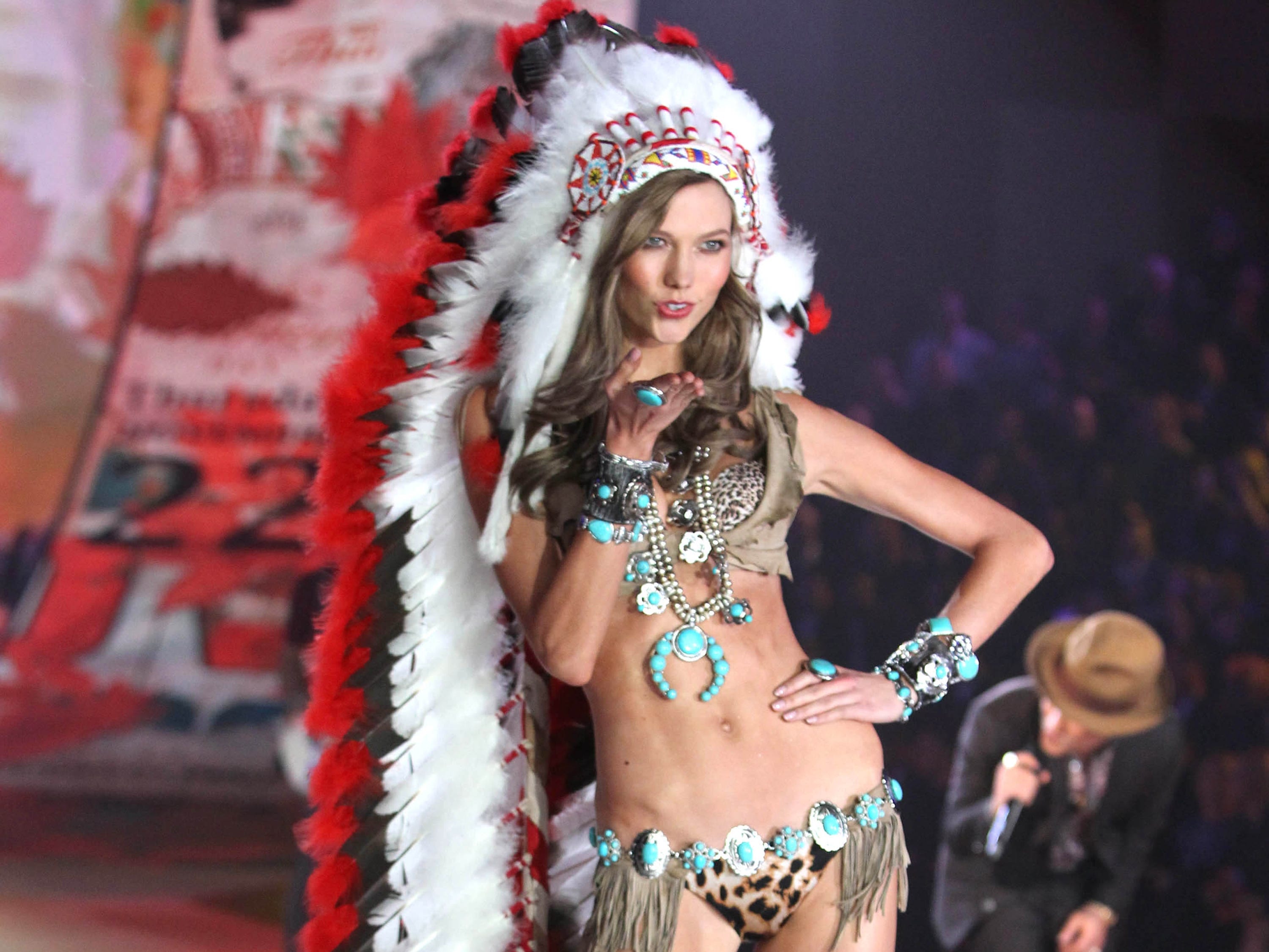
Several fashion designers and models have featured imitations of Native American warbonnets in their fashion shows, such as Victoria's Secret in 2012, when model Karlie Kloss wore one during her walk on the runway; a Navajo Nation spokesman called it a "mockery". Cherokee academic Adrienne Keene wrote in The New York Times:
Both Victoria's Secret and Kloss issued apologies stating that they had no intentions of offending anyone.
Musician Pharrell Williams and Adidas collaborated in 2018 to create a line of apparel inspired by the Hindu festival Holi, called "Hu Holi." Raja Zed, president of the Universal Society of Hinduism, called the collection a "trivialization of traditions-concepts-symbols-beliefs of Hinduism." The collection included many items which contained leather, a violation of Hindu beliefs.
In 2018, Gucci designers were criticised for sending white models for a catwalk at Milan fashion week wearing a Sikh religious headpiece. Thousands online criticized Gucci for "using the Sikh religious symbol for profit". Sikh Canadian actor Avan Jogia called it "offensive" and "irresponsible" for a white model to be wearing a Sikh turban.
In June 2019, Kim Kardashian launched a line of shapewear lingerie called "Kimono". The name, which Kardashian said was "a nod to the beauty and detail that goes into a garment", was a riff on her first name. The name sparked backlash, and the mayor of Kyoto wrote Kim Kardashian an open letter asking her to drop the name. Kardashian changed the name the next day, writing on Instagram: "I am always listening, learning and growing... When I announced the name of my shapewear line, I did so with the best intentions in mind." An article in Savvy Tokyo interviewed Japanese people about the controversy, with some criticizing Kardashian and others expressing indifference and skepticism at the notion of cultural appropriation and its applicability to Japanese culture.
Since the early 2000s, it has become increasingly popular for people not of East Asian or South Asian descent to get tattoos of Devanagari, Korean letters, or Han characters (traditional, simplified, or Japanese), often without knowing the actual meaning of the symbols being used. In 2000, footballer David Beckham received a tattoo in Hindi. Beckham does not have Indian heritage.
There is debate about non-black people wearing dreadlocksa hairstyle many associate with African and African diaspora cultures such as Jamaican Rastafariand whether their doing so is cultural appropriation. In 2016 a viral video was published of a young black student arguing with a young white student and accusing him of cultural appropriation. In 2018, white actor Zac Efron was accused of cultural appropriation when he posted a picture of himself in dreadlocks.
Sports
Sports teams in the United States and Canada commonly derive team names, imagery, and mascots from Native American cultures, despite protests from indigenous groups. Cornel Pewewardy, professor and director of Indigenous Nations Studies at Portland State University, cites indigenous mascots as an example of dysconscious racism which, by placing images of Native American or First Nations people into an invented media context, maintains the superiority of the dominant culture. It is argued that such practices maintain the power relationship between the dominant culture and the indigenous culture and can be seen as a form of cultural imperialism.
In 2001, the United States Commission on Civil Rights released a statement calling for an end to the practice. In recognition of the responsibility of higher education to eliminate behaviours that create a hostile environment for education, in 2005, the NCAA initiated a policy against "hostile and abusive" names and mascots that led to the change of many derived from Native American culture, with the exception of those that established an agreement with particular tribes for the use of their specific names. Other schools retain their names because they were founded for the education of Native Americans and continue to have a significant number of indigenous students. The trend towards the elimination of indigenous names and mascots in local schools has been steady, with two-thirds having been eliminated over the past 50 years, according to the National Congress of American Indians (NCAI).
In contrast, the Seminole Tribe of Florida, in what the Washington Post called an unusual move, approved of the Florida State Seminoles use of their historical leader, Osceola, and his Appaloosa horse as the mascots Osceola and Renegade. After the NCAA attempted to ban the use of Native American names and iconography in college sports in 2005, the Seminole Tribe of Florida passed a resolution offering explicit support for FSU's depiction of aspects of Florida Seminole culture and Osceola as a mascot. The university was granted a waiver, citing the close relationship with, and ongoing consultation between, the team and the Florida tribe. In 2013, the tribe's chairman objected to outsiders meddling in tribal approval, stating that the FSU mascot and use of Florida State Seminole iconography "represents the courage of the people who were here and are still here, known as the Unconquered Seminoles". Conversely, in 2013, the Seminole Nation of Oklahoma expressed disapproval of "the use of all American Indian sports-team mascots in the public school system, by college and university level and by professional sports teams".
African American culture
BlackfishingWriter Wanna Thompson popularized the term "blackfishing" in 2018 when describing female white social media influencers who adopt a look perceived to be associated with black people, including braided hair, dark skin from tanning or make-up, full lips, and large thighs. Critics argue they take attention and opportunities from black influencers by appropriating their aesthetics and have likened the trend to blackface. Florida State University's Alisha Gaines, author of Black for a Day: Fantasies of Race and Empathy, said blackfishing allowed non-Black people to appropriate what is commonly considered "cool" about Blackness while still avoiding the negative consequences, such as "racism and state violence". According to Health.com, it is an "inverse form" of passing.
.jpg)
Music Industry
The K-pop music industry has been identified as a key player in the appropriation of African American culture, especially pertaining to outfits, hairstyles, language, and style of music. Recent studies have concerned themselves with understanding the origination of the industry's use of African American culture. One of the most recent episodes that ignited debates of cultural appropriation in K-pop occurred in April of 2025 with new group Kiss of Life at the forefront. In a livestream video celebrating American member Julie Han's birthday, the four-member girl group dressed up in outfits evocative of a "hip-hop vibe." The members were pictured wearing cornrows, snapback hats, large hoop earrings, and oversized chains. The group's popularity plummetted, and they were even removed from musical festival KCON LA as a result. The debate that followed discussed the inside and outside groups of a culture and awareness surrounding offensive behavior and action.
K-pop is not the only musical industry/genre that faces criticism on the basis of cultural appropriation. Many a genre, including but not limited to pop music, white rap, white rock and roll, white rhythm and blues, have all been subjected to conversations of appropriation of Black culture and music. Much of the outrage surrounds the lack of acknowledgment and/or financial compensation.
Language
A recent phenomena surrounding the debate around cultural appropriation concerns the widespread use of African American Vernacular English (AAVE) on social media platform TikTok. The use of AAVE spreads easily on platforms like TikTok because the platform itself creates an easy and accessible flow of ideas between different social and cultural groups. Critics of the use of the term Gen Z slang to categorize words "slay," "lit," "finna," "sybau," "ts," and others as directly originating from the African American Vernacular English tradition. Jason Parham, a senior writer at WIRED Magazine, expands on this idea and writes "Tiktok is a video-first platform, and on it, creators embody Blackness with an amateur-drive virtuosity—taking on Black rhythms, gestures, affects, slangs." Rachel Elizabeth Laing of Illinois State University states that "[t]his usage of slang by White inidviuals [on TikTok and in real-life applications] can serve as an intrusion into cultural and personal-enacted-communal identity gaps. This can also be perceived as offensive or disrespectful to the ingroup, increasing the power imbalance between the linguistic majority and minority groups."
Martial arts
In China, there is longstanding resentment of the Japanese schools of karate for its "colonial appropriation" of kung fu. In the mid-20th century, American soldiers appropriated Japanese karate itself. As mixed martial arts gained popularity in the 21st century, practitioners have appropriated and combined Chinese, Japanese and Thai techniques with Western-style boxing, wrestling, and kickboxing.
Some authors have expressed the opinion that the study of martial arts by members of other countries and nationalities is not a form of negative 'appropriation', but rather of appreciation. In Okinawa for example, unlike in China, the locals considered the Chinese origins of Karate to be an honorable thing to mention, and not a form of cultural theft.
During the 2023 Southeast Asian Games (SEA) in Cambodia, a controversy emerged when Cambodian martial arts competitions adopted Muay Thai rules, leading to allegations of cultural appropriation. Critics argued that this disrespected Thai cultural heritage and overshadowed Cambodian martial arts like Bokator. The International Federation of Muaythai Associations (IFMA) intervened, threatening fines and bans for countries participating in the Kun Khmer events under these rules. This prompted Thailand to boycott the SEA Games, further straining relations between the two countries. The popularity of Bokator has been partly influenced by international media, such as Tony Jaa's portrayal of martial arts in the "Tom Yum Goong" movie series. Tony Jaa, a renowned Thai martial artist, showcased traditional techniques that have inspired martial arts enthusiasts globally, including in Cambodia. This highlights the complex interplay of cultural pride and appropriation in the region.
Holidays
During Halloween, some people buy, wear, and sell Halloween costumes based on cultural or racial stereotypes. In some cases, theme parties have been held where attendees are encouraged to dress up as stereotypes of a certain racial group. There have been public protests calling for the end to the manufacture and sales of costumes depicting Native Americans and First Nations peoples.
The government of Ghana has been accused of cultural appropriation in adopting the Caribbean Emancipation Day and marketing it to African American tourists as an "African festival".
Dance and performance
The Boy Scouts of America-associated Koshare Indian Museum and Dancers were noted in Playing Indian by Native American historian Philip J. Deloria, referring to them as an example of "object hobbyists" who adopt the material culture of indigenous peoples of the past ("the vanishing Indian") while failing to engage with contemporary native peoples or acknowledge the history of conquest and dispossession. In the 1950s, the head councilman of the Zuni Pueblo saw a performance and said: "We know your hearts are good, but even with good hearts you have done a bad thing". In Zuni culture, religious objects and practices are only for those who have earned the right to participate, following techniques and prayers that have been handed down for generations.
The objections from some Native Americans towards such dance teams centre on the idea that the dance performances are a form of cultural appropriation that places dance and costumes in inappropriate contexts devoid of their true meaning, sometimes mixing elements from different tribes. In contrast, the dance teams state that "[their] goal is to preserve Native American dance and heritage through the creation of dance regalia, dancing, and teaching others about the Native American culture".
In 2013, pop star Katy Perry drew criticism for her "geisha-style" performance at the American Music Awards, in which she and her backup dancers donned kimonos, heavy powdered face makeup, and colourful parasols, among other East Asian cultural items. Online commentators declared Perry's actions appropriative and harmful to East Asian cultures.
Food
Main article: Politics of food in the Arab–Israeli conflict
Israel has been accused of appropriating the Arab culture, particularly in the context of food due to the political power imbalance and the historical displacement of Palestinians. Critics argue that prominent Arab dishes like hummus and falafel are rebranded as Israeli without acknowledging their origins, which critics argue serves to erase Palestinian identity and create a new national narrative connected to the land. This was described as "food colonialism," where a dominant culture claims the culture of another group for profit or to establish roots.
EED appropriation and non-EED appropriation
In her book Outspoken: A Decade of Transgender Activism and Trans Feminism (2016), Julia Serano defines cultural appropriation as problematic only when it involves at least one of three interrelated harms: erasure, exploitation, or denigration (EED). According to her analysis, appropriation becomes harmful (what she calls “EED appropriation”) when members of a dominant or majority group adopt aspects of a marginalized group’s identities, culture, or expressions — while simultaneously:
- Erasing the context in which those identities or cultural forms emerged, ignoring or obscuring the voices and lived experiences of the original community.
- Exploiting those cultural forms for material, symbolic, or commercial gain — benefiting appropriators financially or socially without returning value to the marginalized group.
- Denigrating the marginalized group by treating those borrowed identities or cultural elements as trivial, exotic, or disrespectful — reducing them to stereotypes or mocking them, rather than respecting their meaning and significance.
Serano further distinguishes these harmful “EED appropriations” from what she calls “non-EED appropriation” — cases where adoption or borrowing does not result in erasure, exploitation, or denigration, and may even positively support or amplify the minority community. She argues that not all acts of borrowing or cultural exchange are inherently oppressive; rather, the ethical problem lies in whether the action inflicts structural harm through erasure, exploitation, or denigration.
Criticism of the concept and discourse
In his book The People vs Democracy (2018), Yascha Mounk criticized the concept. According to his analysis, the problem with cultural appropriation necessarily acknowledges a purist conception of culture, it being linked to the building of a mono-ethnical common identity, which appropriates itself of some rites and traits. He argues that no symbols or traditions minoritarian culture should be denigrated or mocked. But it does open the door to what he calls "historical nonsense". However, cultures have never been completely defined, as they have inspired from one and another, and have thus enriched their own. The segmentation in well-defined cultures works the same way as far right leaders in their views of identity and the defence of their nation, that should not include "foreign influences on their national cultures".
Another critic of the concept, Chris Berg, argues that culture is "just the current manifestation of a long evolutionary process" in which cultural elements constantly evolve when is contact with other cultures. His assertion then is that opponents of cultural appropriation are actually involved in "a deeply conservative project", one that "first seeks to preserve... the content of an established culture and second tries [to] prevent others from interacting with that culture" ultimately inhibiting the positive relationships created by cultural exchange.
In 2018, conservative columnist Jonah Goldberg described cultural appropriation as a positive thing and dismissed opposition to it as a product of some people's desire to be offended.
Legal professor Mike Rappaport writes that "there is so much wrong with the idea [of cultural appropriation] that it is hard to know where to start." He contests the notion that people have a special claim to cultural practices historically developed in the territories in which they live, and writes that the concept of cultural appropriation is "inconsistent with the cultural development and enrichment that a free society promotes".
Kwame Anthony Appiah, ethics columnist for the New York Times, said that the term cultural appropriation incorrectly labels contemptuous behaviour as a property crime. According to Appiah, "The key question in the use of symbols or regalia associated with another identity group is not: What are my rights of ownership? Rather it's: Are my actions disrespectful?"
Byung-Chul-Han distinguishes between "colonial exploitation" and appropriation, which he calls "an essential part of education and identity" which "only an idiot or a god" could live without. He writes that the notion of appropriation as "sinful" is derivative of "the paradigm of the 'Other' or the 'radically Other' [in] many humanities disciplines", which also tabooizes interest in understanding the 'Other'. Markus Tauschek writes that the notion of appropriation "essentializes cultural difference" by implying that a supposedly appropriated element is the exclusive property of one group. Tauschek says that the concept of cultural appropiation relies on a commodified notion of culture that is at odds with science.
Ezedimbu at al. write that popular discourse on cultural appropriation misuses the concept and enables cancel culture. In 2019, Ash Sarkar called cultural appropriation "an imperfect term mobilised in imperfect contexts", writing that charges of cultural appropriation by young people of color in Britain are often partially motivated by a precarious sense of connection to their heritage. Afua Hirsch called discourse on cultural appropriation in the media unsophisticated, telling writer George Chesterton in 2020: "I’m often asked to come on TV whenever a pop star wears cornrows and defend the idea that I would like to police their hairstyle. There is little interest in the broader picture of imperial racism and white supremacy that forms the context. So it ends up being a reductive conversation about whether it’s OK for white people to do something, which is not my business."
Mathias Siems says that cultural appropriation as a concept presents problems in legal and ethical reasoning. He writes that the notion of intellectual property rights as applied to cultural appropriation is complicated by the fact that some supposed cultural "properties" belong to groups "too large to have any reliable mechanism that would operationalise ... a consent procedure [by which the group could collectively agree to an instance of appropriation]", citing women as an example. He also writes that "a general rejection of any form of cultural appropriation would be harmful for societies", impeding the benefits of cultural mixing.
In art
Kenan Malik defends cultural appropriation as being a form of "messy interaction" necessary to writers and artists, rather than a form of theft. He writes: "Nobody owns a culture, but everyone inhabits one, and in inhabiting a culture, one finds the tools for reaching out to other cultures." Malik also writes that those who levy the charge of appropriation on behalf of their minority communities "appropriate for themselves the authority to license certain forms of cultural engagement, and in doing so, entrench their power," and compares critics of cultural appropriation to historical racist radio stations who refused to broadcast records by black performers to a white audience. Brian Morton writes similarly that "imagining the lives of others is a crucial form of solidarity." Morton criticizes "much of the literature on cultural appropriation" as "spectacularly unhelpful" on the question of what exactly constitutes appropriation. He says that the notion of "taking" from a culture is broad to the point of incoherence, and that the charge of "writing responsibly" when writing fiction about persons outside of one's own culture deprives writers of the freedom to write offensively and satirically, which Morton considers essential to the artistic value of fiction.
In 1994, American professor of ethnomusicology Timothy Rice argued that there has to be a more nuanced idea of viewing human affairs in his book titled May It Fill Your Soul: Experiencing Bulgarian Music. While not directly speaking towards the idea of cultural appropriation, he advocated that people in the scholarly tradition, when studying musical cultures of the world, should make sure to not present themselves as an objective voice that generalizes a culture.
In 2012, Pakistani writer Kamila Shamsie criticized the notion of cultural appropriation as a taboo in fiction, saying: "The moment you say, a male American writer can’t write about a female Pakistani, you are saying, Don’t tell those stories. Worse, you’re saying, as an American male you can’t understand a Pakistani woman. She is enigmatic, inscrutable, unknowable. She’s other. Leave her and her nation to its Otherness. Write them out of your history."
In 2016, author Lionel Shriver said that authors from a cultural majority have a right to write in the voice of someone from a cultural minority, attacking the idea that this constitutes cultural appropriation. Referring to a case in which U.S. college students were facing disciplinary action for wearing sombreros to a "tequila party", she said: "The moral of the sombrero scandals is clear: you're not supposed to try on other people's hats. Yet that's what we're paid to do, isn't it? Step into other people's shoes, and try on their hats."
In 2019, English author Bernadine Evaristo said "This whole idea of cultural appropriation, which is where you are not supposed to write beyond your own culture and so on, is ridiculous ... there is this idea that when it comes to fiction that you are supposed to stay in your lane. It is a total nonsense."
In 2020, American literary theorist Walter Benn Michaels wrote that both enthusiasm and disapproval for cultural appropriation make little sense, as they "both require that we distinguish between one version of our culture (what we actually believe and do) and another version (what we’re supposed to believe and do), and both derive the things we’re supposed to believe and do from our race." He also criticizes the assumption of cultural "belonging" and the validation of "identity crimes" such as cultural appropriation.
Notes
References
References
- (20 August 2003). "A right royal rip-off". The Age.
- "cultural appropriation". [[Lexico]], [[Oxford University Press]].
- Baker, KaDeidra. (16 August 2018). "Indigenous Appropriation and Protection Provided by Intellectual Property Law". [[North Carolina Central University School of Law]].
- Bauer, Matthias. (2018). "Online platforms, economic integration and Europe's rent-seeking society: Why online platforms deliver on what EU governments fail to achieve PDF Logo". [[ECIPE]].
- (2021). "Cultural appropriation: What it is and why it matters?". Sociology Compass.
- (2024). "Cultural Tariffing: Appropriation and the Right to Cross Cultural Boundaries". American Sociological Review.
- Fourmile, Henrietta L.. (1996). "Making Things Work: Aboriginal and Torres Strait Islander Involvement in Bioregional Planning : Draft Consultant's Report". Biodiversity Group, Department of the Environment, Sport, and Territories.
- Young, James O.. (1 February 2010). "Cultural Appropriation and the Arts". [[John Wiley & Sons]].
- Young, James O.. (1 February 2010). "Cultural Appropriation and the Arts". [[John Wiley & Sons]].
- "'I Didn't Know' Doesn't Cut It Anymore".
- (14 November 2014). "Our cultures are not your costumes".
- Mesteth, Wilmer, et al (10 June 1993) "[http://www.thepeoplespaths.net/articles/ladecwar.htm Declaration of War Against Exploiters of Lakota Spirituality]". {{webarchive. link. (9 February 2016. "At the Lakota Summit V, an international gathering of US and Canadian Lakota, Dakota and Nakota Nations, about 500 representatives from 40 different tribes and bands of the Lakota unanimously passed a 'Declaration of War Against Exploiters of Lakota Spirituality'. The following declaration was unanimously passed.")
- Constable, Anne. (3 January 2016). "Hopis say Boy Scout performances make mockery of tradition, religion".
- (1997). "Indigenous Peoples and Intellectual Property Rights – Indigenous Peoples and Cultural Appropriation". Parliament of Australia – Social Policy Group.
- "[https://www.wipo.int/tk/en/databases/tklaws/articles/article_0107.html Special System for the Collective Intellectual Property Rights of Indigenous Peoples] {{Webarchive. link. (2019-04-18 at World Intellectual Property Organization. Accessed 18 April 2019.)
- link. (2019-04-18". Indigenous Knowledge (IK) Notes; No. 95. World Bank, Washington, DC. Accessed 18 April 2019.)
- [[Henrietta Marrie. Fourmile, Henrietta]] (1996). "Making things work: Aboriginal and Torres Strait Islander Involvement in Bioregional Planning" in ''Approaches to bioregional planning. Part 2. Background Papers to the conference; 30 October – 1 November 1995, Melbourne''; Department of the Environment, Sport and Territories. Canberra. pp. 268–269: "The [western] intellectual property rights system and the (mis)appropriation of indigenous knowledge without the prior knowledge and consent of indigenous peoples evoke feelings of anger, or being cheated"
- Working Group on Indigenous Populations, accepted by the [[United Nations General Assembly]], ''[http://daccess-dds-ny.un.org/doc/UNDOC/GEN/N06/512/07/PDF/N0651207.pdf?OpenElement Declaration on the Rights of Indigenous Peoples]''. {{webarchive. link. (26 June 2015; UN Headquarters; New York City (13 September 2007).)
- Rainforest Aboriginal Network (1993) ''Julayinbul: Aboriginal Intellectual and Cultural Property Definitions, Ownership and Strategies for Protection''. Rainforest Aboriginal Network. Cairns. Page 65.
- Jackson, Jason Baird. (April 2021). "On Cultural Appropriation". Journal of Folklore Research.
- Jackson, Jason. (January-April 2021). "On Cultural Appropriation". [[Journal of Folklore Research]].
- "'I Didn't Know' Doesn't Cut It Anymore".
- (14 November 2014). "Our cultures are not your costumes".
- Johnson, Kjerstin (25 October 2011) "[http://bitchmagazine.org/post/costume-cultural-appropriation Don't Mess Up When You Dress Up: Cultural Appropriation and Costumes]". {{webarchive. link. (June 29, 2015; at ''[[Bitch Magazine]]''. Accessed 4 March 2015. "Dressing up as 'another culture', is racist, and an act of privilege. Not only does it lead to offensive, inaccurate, and stereotypical portrayals of other people's culture ... but is also an act of appropriation in which someone who does not experience that oppression is able to 'play', temporarily, an 'exotic' other, without experience any of the daily discriminations faced by other cultures.")
- Frum, David. (8 May 2018). "Every Culture Appropriates". The Atlantic.
- Young, Cathy. (21 August 2015). "To the new culture cops, everything is appropriation". Washington Post.
- Chen, Anna. (4 May 2018). "An American woman wearing a Chinese dress is not cultural appropriation".
- Friedersdorf, Conor. (3 April 2017). "What Does 'Cultural Appropriation' Actually Mean?".
- Soave, Robby. (5 May 2019). "Cultural Appropriation: Don't Let the Woke Scolds Ruin Cinco de Mayo". Reason: Free Minds and Free Markets.
- (15 July 2014). "You Can't 'Steal' A Culture: In Defense of Cultural Appropriation".
- (13 September 2016). "Lionel Shriver's full speech: 'I hope the concept of cultural appropriation is a passing fad'". The Guardian.
- Mali, Malhar. (29 March 2017). "I Am a Minority and I Prohibit You". Areo.
- Patterson, Steve. (20 November 2015). "Why Progressives Are Wrong to Argue Against Cultural Appropriation". Observer.
- (25 May 2017). "Canada's war over 'cultural appropriation'". The Economist.
- Mamedov, Mikail. "[https://www.jstor.org/stable/20620748 'Going Native' in the Caucasus: Problems of Russian Identity, 1801–64] {{Webarchive. link. (2021-06-03". ''[[The Russian Review]]'', vol. 67, no. 2, 2008, pp. 275–295. Accessed 27 April 2020.)
- link. (3 March 2016 ; published in Social Anthropology (2003), 11:2:215–229, Cambridge University Press.)
- Scafidi, Susan. (2005). "Who Owns Culture?: Appropriation and Authenticity in American Law (Rutgers Series: The Public Life of the Arts)". Rutgers University Press.
- (29 March 2018). "New words notes March 2018". [[Oxford English Dictionary]].
- (1945). "The Asian Legacy and American Life". John Day.
- "Cultural appropriation – Oxford Reference".
- (1992). "The Myth of Primitivism". Circa.
- (2009). "Technoliteracy, Discourse, and Social Practice: Frameworks and Applications in the Digital Age". IGI Global.
- link. (13 June 2006 Muqarnas Volume XII: An Annual on Islamic Art and Architecture. Leiden: E.J. Brill. 1995. Retrieved 3 January 2010.)
- Wernitznig, Dagmar, ''Europe's Indians, Indians in Europe: European Perceptions and Appropriations of Native American Cultures from Pocahontas to the Present''. University Press of America, 2007: p.132. "What happens further in the [[Plastic Shaman]]'s [fictitious] story is highly irritating from a perspective of cultural hegemony. The Injun elder does not only willingly share their spirituality with the white intruder but, in fact, must come to the conclusion that this intruder is as good an Indian as they are themselves. Regarding Indian spirituality, the Plastic Shaman even out-Indians the actual ones. The messianic element, which Plastic Shamanism financially draws on, is installed in the Yoda-like elder themselves. They are the ones – while melodramatically parting from their spiritual offshoot – who urge the Plastic Shaman to share their gift with the rest of the world. Thus Plastic Shamans wipe their hands clean of any megalomaniac or missionizing undertones. Licensed by the authority of an Indian elder, they now have every right to spread their wisdom, and if they make (quite more than) a buck with it, then so be it.—The neocolonial ideology attached to this scenario leaves less room for cynicism."
- Taliman, Valerie (1993) [http://www.thepeoplespaths.net/articles/warlakot.htm Article On The 'Lakota Declaration of War']". {{webarchive. link. (February 9, 2016.)
- Tsosie, Rebecca. (June 25, 2017). "Current Issues in Intellectual Property Rights to Cultural Resources". Native American Rights Fund.
- developer. (2017-09-22). "The Debate About Cultural Appropriation".
- (August 2023). "Delineating the boundaries between genuine cultural change and cultural appropriation in majority group acculturation". International Journal of Intercultural Relations.
- (2024). "Between Cultural Appreciation and Cultural Appropriation: Self-Authorizing the Consumption of Cultural Difference". Journal of Consumer Research.
- Bruyneel, Kevin. (2016). "Race, Colonialism, and the Politics of Indian Sports Names and Mascots: The Washington Football Team Case". Native American and Indigenous Studies.
- (July 30, 2014). "This means war: why the fashion headdress must be stopped". [[The Guardian]].
- (May 2017). "Cultural Appropriation and the Plains' Indian Headdress". [[Virginia Commonwealth University]] - VCU Scholars Compass.
- Freda, Elizabeth (28 July 2014) "[http://www.eonline.com/news/563845/music-festival-is-banning-cultural-appropriation-aka-hipsters-wearing-native-american-headdresses Music Festival Is Banning Cultural Appropriation, aka Hipsters Wearing Native American Headdresses] {{webarchive. link. (May 7, 2016 " for ''EOnline''.)
- Zimmerman, Amy (4 June 2014) "[http://www.thedailybeast.com/articles/2014/06/04/pharrell-harry-styles-and-native-american-appropriation.html Pharrell, Harry Styles, and Native American Appropriation] {{webarchive. link. (April 9, 2016 " for [[The Daily Beast]].)
- Arrowsmith, Aidan. (1 April 2000). "Plastic Paddy: Negotiating Identity in Second-generation 'Irish-English' Writing". Irish Studies Review.
- Mcloughlin, Anya. (2017). "How to be as a plastic paddy this St Patrick's day". The Nottingham Tab.
- Moore, Johnny. (17 March 2017). "Raise a glass, thank the Irish on Paddy's Day". The Press Reader.
- Derham, Frances. (June 1929). "Cover". Arts and Crafts Society of Victoria.
- Parsons, Jonathon. (Autumn 1989). "Aboriginal Motifs In Design: Frances Derham And The Arts And Crafts Society Of Victoria". La Trobe Library Journal.
- Preston, Margaret. (1 March 1930). "The Application Of Aboriginal Designs". Art in Australia.
- Spennemann, D.H.R.. (15 August 2022). "Appropriating "Aboriginal" Australian Art in the Atomic Age". retrospect.
- (8 December 2017). "Open letter accuses non-indigenous artist of cultural appropriation". CBC/Radio-Canada.
- James, Marianne. [http://www.aic.gov.au/documents/9/2/9/%7B9296EF8C-47F0-4B90-95BF-2A4466B5E863%7Dti170.pdf "Art Crime."] {{webarchive. link. (11 January 2016 ''Trends and Issues in Crime and Criminal Justice'', No. 170. Australian Institute of Criminology. October 2000. Retrieved 3 January 2010.)
- [http://www.eniar.org/news/artdot.html "The Aboriginal Arts 'fake' controversy."] {{webarchive. link. (20 April 2012 European Network for Indigenous Australian Rights. 29 July 2000. Retrieved 3 January 2010.)
- [https://news.bbc.co.uk/2/hi/entertainment/3246474.stm "Aboriginal art under fraud threat."] BBC News. 28 November 2003. Retrieved 3 January 2010.
- Byard, RW. (26 September 2005). "Dehydration and heat-related death: sweat lodge syndrome". [[Hearst Communications]].
- York, Michael. (October 2001). "New Age Commodification and Appropriation of Spirituality". Journal of Contemporary Religion.
- Mesteth, Wilmer. (June 10, 1993). "Declaration of War Against Exploiters of Lakota Spirituality".
- Hobson, G.. (1978). "The Remembered Earth". Red Earth Press.
- (20 September 1999). "Hindus and Kubrick".
- "New York Apparel » Cultural Appropriation".
- O'Neil, Lauren. (April 14, 2014). "Celebrity bindis at Coachella: Fashion trend or cultural appropriation? – Your Community".
- (Nov 2, 2013). "Is Cultural Appropriation in Fashion Offensive? Part – II".
- Varagur, Krithika. (5 November 2015). "Is This The Right Way For Fashion To Do Cultural Appropriation?".
- Pham, Minh-Ha T.. (15 May 2014). "Why We Should Stop Talking About "Cultural Appropriation"".
- (21 December 2015). "Is cultural appropriation the bogeyman it's made out to be?".
- (7 February 2016). "Is anyone at UEA really that offended by sombreros?".
- "UEA's sombrero ban is no joke".
- "Topshop pulls festival playsuit from sale after row comparing it to Palestinian keffiyeh design".
- Keene, Adrienne. (August 2, 2015). "The Benefits of Cultural Sharing are Usually One-Sided". The New York Times.
- (1 April 2016). "Owning Red: A Theory of Indian (Cultural) Appropriation". Texas Law Review.
- "Victoria's Secret apologizes for using headdress".
- "(This is a link to the photo of Karlie Kloss wearing a Native American headdress during the Victoria's Secret Fashion show.)".
- Gertner, Rosane K.. (2019). "The impact of cultural appropriation on destination image, tourism, and hospitality". Thunderbird International Business Review.
- (2018). "Gucci accused of culturally appropriating Sikh turban". Aljazeera.
- Petter, Olivia. (2018). "Gucci criticised for putting turbans on white models". Independent UK.
- Kaur, Harmeet. (2018). "Here's why Sikhs were offended by this $790 Gucci turban". CNN.
- Friedman, Vanessa. (2019-06-27). "Kim Kardashian West and the Kimono Controversy (Published 2019)". [[The New York Times]].
- Ilchi, Layla. (2019-06-28). "Mayor of Kyoto Asks Kim Kardashian to Drop Kimono Trademark".
- (2019-07-01). "Kim Kardashian West drops Kimono brand name". [[British Broadcasting Corporation]].
- Kalled, Jes. (2019-08-15). "The #KimOhNo Conversation: How Do Japanese People Feel About It Now?".
- "Cultural appropriation of Japanese tattoos, 2008".
- Pages, The Society. "Lost in Translation: Tattoos and Cultural Appropriation – Sociological Images".
- (28 November 2000). "Tattooists own goal leaves Beckham a marked man".
- "why that tribal tattoo won't work in a woke world".
- Gabbara, Princess. (18 October 2016). "The History of Dreadlocks". [[Ebony (magazine).
- (2 April 2016). "Is it OK for white people to have dreadlocks?". [[BBC]].
- Heller, Susanna. (6 July 2018). "Zac Efron wore his hair in dreadlocks and he's being accused of cultural appropriation".
- Pewewardy, Cornel. (1999). "From enemy to mascot: The deculturation of Indian mascots in sports culture". Canadian Journal of Native Education.
- Longwell-Grice, Robert. (2003). "Chiefs, Braves, and Tomahawks: The Use of American Indians as University Mascots". NASPA Journal (National Association of Student Personnel Administrators, Inc.).
- Riley, Angela. (2005). "Straight Stealing: Towards an Indigenous System of Cultural Property Protection". Washington Law Review.
- (13 April 2001). "Statement of the U.S. Commission on Civil Rights on the Use of Native American Images and Nicknames as Sports Symbols". The United States Commission on Civil Rights.
- "Anti-Defamation and Mascots". National Congress of American Indians.
- Lyden, Jacki. (28 November 2015). "Osceola At The 50-Yard Line". NPR.org.
- Culpepper, Chuck. (29 December 2014). "Florida State's Unusual Bond with Seminole Tribe Puts Mascot Debate in a Different Light". The Washington Post.
- Billie, James E.. (24 October 2013). "Like the old Florida flag: 'Let us alone!'". The Seminole Tribune.
- (5 December 2018). "Blackfishing: The women accused of pretending to be black". BBC News.
- Chen, Tanya. (13 November 2018). "A White Teen Is Denying She Is "Posing" As A Black Woman On Instagram After Followers Said They Felt Duped". BuzzFeed News.
- Rasool, Amira. (16 November 2018). "Some White Influencers Are Being Accused of "Blackfishing", or Using Makeup to Appear Black". Teen Vogue.
- Washington-Harmon, Taylyn. (17 August 2020). "What Is Blackfishing and Why Would Anyone Do It?".
- (3 October 2015). "Between Diasporic Consciousness and Cultural Appropriation".
- Tucci, Sherry. (2016-04-02). "When K-pop culturally appropriates".
- Um, Hae-Kyung. (2013). "The poetics of resistance and the politics of crossing borders: Korean hip-hop and 'cultural reterritorialisation'". Popular Music.
- "K-Pop Group Kiss of Life Apologizes to Fans After Hip-Hop-Themed Live Stream Draws Backlash as a 'Cultural Mockery'".
- (2025-05-17). "KISS OF LIFE dropped from KCON LA just 5 days after announcement following fan backlash over cultural appropriation controversy".
- Hoskins, Ian. (1991). "Colonising the Margin: The Historiography of African-American Music and Dance". Australasian Journal of American Studies.
- Hogan, Harper G.. "The Girls That Get It, Get It”: The Power of Digital Parlance on TikTok [honors thesis]". Muhlenberg College.
- Hogan, Harper G.. "The Girls That Get It, Get It”: The Power of Digital Parlance on TikTok [honors thesis]". Muhlenberg College.
- "Gen Z 'slang': A blatant appropriation of AAVE". Voice Magazine.
- Parham, Jason. "TikTok and the Evolution of Digital Blackface". Wired.
- Laing, Rachel. (2021-04-01). "Who Said It First? : Linguistic Appropriation of Slang Terms within the Popular Lexicon". Theses and Dissertations.
- "Kung fu and Japanese imperialism".
- "the Feet of the Master: Three Stages in the Appropriation of Okinawan Karate Into Anglo-American Culture".
- "Japanisation of Karate".
- Frantzis, Bruce. (2007). "The Power of Internal Martial Arts and Chi: Combat and Energy Secrets of Ba Gua, Tai Chi and Hsing-I". Blue Snake Books.
- Bluestein, Jonathan. (2024). "Martial Arts Politics Explained". Amazon Digital Services LLC - Kdp.
- Higaonna, Morio. (1998). "The History of Karate: Okinawan Goju-Ryu".
- Cohen, Itzik. (2017). "Karate Uchina-Di: Okinawan Karate: An Exploration of its Origins and Evolution". CreateSpace Independent Publishing Platform.
- McCarthy, Patrick. (2018). "Legend of the Fist". CreateSpace Independent Publishing Platform.
- "Muay Thai Sea Games". Yahoo News.
- (3 February 2023). "Energy Ministry closely monitoring electricity costs".
- "Sea Games Told To Choose Either Muay Thai Or Kun Khmer".
- (25 January 2023). "Muay Thai or Kun Khmer? Cambodia and Thailand clash again".
- "Combined "Kun Khmer (Muay)" for 32nd SEA Games draw ires".
- Mueller, Jennifer. (11 April 2007). "Unmasking Racism: Halloween Costuming and Engagement of the Racial Other". Qualitative Sociology.
- Escobar, Samantha (17 October 2014) "[http://www.thegloss.com/2014/10/17/culture/dear-white-people-review-racist-college-parties-blackface-mexican-stereotypes/ 13 Racist College Parties That Prove Dear White People Isn't Exaggerating At All]{{Dead link. (October 2025 {{webarchive). link. (May 18, 2016" at ''The Gloss''. Accessed 4 March 2015)
- (25 October 2018). "Protesters call for end to 'hottie' Native American costumes based on stereotypes". [[KAET.
- "Poster Campaign". Ohio University.
- (26 October 2011). "'We're a culture, not a costume' this Halloween". CNN.
- Hasty, J. (2002). "Rites of Passage, Routes of Redemption: Emancipation Tourism and the Wealth of Culture". Africa Today.
- Deloria, Philip J.. (1998). "Playing Indian". Yale University Press.
- "Playing Indian". Yale University Press.
- Kristen Dobbin. (10 September 2014). "Appropriation (?) of the Month: The Boy Scout Shalako".
- Robert Desjarlait. (15 December 2015). "The Koshares and the Appropriation of Native American Dance".
- "Who are We?".
- (25 November 2013). "Katy Perry's 'Geisha-Style' Performance Needs to Be Called Out". The Atlantic Monthly Group.
- Ari Ariel, "The Hummus Wars", ''Gastronomica'' '''12''':1:34–42 (Spring 2012) {{doi. 10.1525/GFC.2012.12.1.34
- Mitnick, Joshua. (25 July 2007). "Hummus brings Israelis, Palestinians to the table". Christian Science Monitor.
- Salim Nuqul. (Aug 27, 2024). "Palestinian Cultural Resistance in the Service of the National Project". [[Arab Center for Research and Policy Studies]].
- (12 September 2021). "The Appropriation of Palestinian Culture". FFIPP EUROPE.
- Serano, Julia. (2013-10-01). "Considering Trans and Queer Appropriation".
- Mounk, Yascha. (2018). "The people vs Democracy". Harvard University Press.
- Berg, Chris. (21 December 2015). "Is cultural appropriation the bogeyman it's made out to be?". The Drum.
- (6 May 2018). "Cultural-appropriation outrage shows people are desperate to be offended". Chicago Tribune.
- Rappaport, Mike. (2019-02-26). "The Illogic of Cultural Appropriation - Mike Rappaport".
- Kwame Anthony Appiah. (21 January 2020). "Should I Tell My Aunt That Her Costume Is Racist?". The New York Times.
- Kwame Anthony Appiah. (August 17, 2021). "I'm an Art Therapist. Am I Guilty of Cultural Appropriation?". The New York Times.
- Han, Byung-Chul. (2022). "Hyperculture: culture and globalization". Polity press.
- Tauschek, Markus. (June 2024). "Writing Against Essentialization. Cultural Appropriation as a Problem". Zeitschrift für Empirische Kulturwissenschaft.
- Sarkar, Ash. (2019-04-29). "Why we need to pause before claiming cultural appropriation". The Guardian.
- Chesterton, George. (2019-01-15). "Cultural appropriation: everything is culture and it's all appropriated".
- Siems, Mathias. (December 2019). "The law and ethics of 'cultural appropriation'". International Journal of Law in Context.
- Malik, Kenan. (2017-06-14). "Opinion {{!}} In Defense of Cultural Appropriation (Published 2017)". [[The New York Times]].
- Morton, Brian. (Fall 2020). "All Shook Up: The Politics of Cultural Appropriation".
- Rice, Timothy. (1994). "May it fill your soul: experiencing Bulgarian music". Univ. of Chicago Press.
- Shamsie, Kamila. (2012-02-01). "The Storytellers of Empire".
- (15 September 2016). "We need to talk about cultural appropriation: why Lionel Shriver's speech touched a nerve". [[The Guardian]].
- (2019-12-02). "Bernardine Evaristo claims cultural appropriation a 'total nonsense'". The Telegraph.
- Michaels, Walter Benn. (2017-07-02). "The Myth of 'Cultural Appropriation'".
This article was imported from Wikipedia and is available under the Creative Commons Attribution-ShareAlike 4.0 License. Content has been adapted to SurfDoc format. Original contributors can be found on the article history page.
Ask Mako anything about Cultural appropriation — get instant answers, deeper analysis, and related topics.
Research with MakoFree with your Surf account
Create a free account to save articles, ask Mako questions, and organize your research.
Sign up freeThis content may have been generated or modified by AI. CloudSurf Software LLC is not responsible for the accuracy, completeness, or reliability of AI-generated content. Always verify important information from primary sources.
Report