From Surf Wiki (app.surf) — the open knowledge base
Crossing-based interface
Type of graphical user interface
Type of graphical user interface
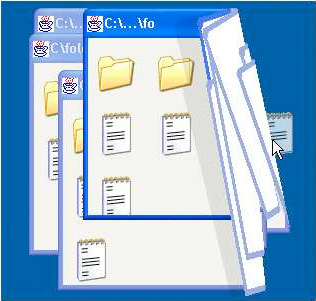
Crossing-based interfaces are graphical user interfaces that use crossing gestures instead of, or in complement to, pointing. Where a pointing task involves moving a cursor inside a graphical object and pressing a button, a goal-crossing task involves moving a cursor beyond a boundary of a targeted graphical object to trigger an effect.
Goal-crossing tasks
Goal crossing has been little investigated, despite sometimes being used on today's interfaces (e.g., mouse-over effects, hierarchical menus navigation, auto-retractable taskbars and hot corners). Still, several advantages of crossing over pointing have been identified:
- Elongated objects such as hyperlinks are faster to cross than to point.
- Several objects can be crossed at the same time within the same gesture.
- Crossing allows triggering actions when buttons are not available (e.g., while an object is being dragged).
- Crossing-based widgets can be designed to be more compact than pointing-based ones. This may be useful for small display devices.
- Goal crossing is particularly natural on stylus-based devices. On these devices, crossing an object back and forth is easier than double-clicking.
- Crossing can be a good alternative for users who have difficulties with clicking or double-clicking.
There are several other ways of triggering actions in user interfaces, either graphic (gestures) and non-graphic (keyboard shortcuts, speech commands).
Laws of crossing
Variants of Fitts' law have been described for goal-crossing tasks (Accot and Zhai 2002). Fitts' law is seen as a Law of pointing, describing variability in the direction of the pointer's movement. The Law of crossing describes the allowed variability in the direction perpendicular to movement, and the steering law describes movement along a tunnel.
References
- Original work
- Accot, J. and Zhai, S. (2002). More than dotting the i's - foundations for crossing-based interfaces, in Proc. of CHI'2002: ACM Conference on Human Factors in Computing Systems, Minneapolis, Minnesota, April 2002. pp 73–80.
- Selected subsequent work
- Apitz, G. and Guimbretière F. (2004). CrossY: a crossing-based drawing application. In Proceedings of the 17th Annual ACM Symposium on User interface Software and Technology (Santa Fe, NM, USA, October 24–27, 2004). UIST '04. ACM Press, New York, NY, 3-12.
- Dragicevic, P. (2004). Combining crossing-based and paper-based interaction paradigms for dragging and dropping between overlapping windows. In Proceedings of the 17th Annual ACM Symposium on User interface Software and Technology (Santa Fe, NM, USA, October 24–27, 2004). UIST '04. ACM Press, New York, NY, 193-196.
This article was imported from Wikipedia and is available under the Creative Commons Attribution-ShareAlike 4.0 License. Content has been adapted to SurfDoc format. Original contributors can be found on the article history page.
Ask Mako anything about Crossing-based interface — get instant answers, deeper analysis, and related topics.
Research with MakoFree with your Surf account
Create a free account to save articles, ask Mako questions, and organize your research.
Sign up freeThis content may have been generated or modified by AI. CloudSurf Software LLC is not responsible for the accuracy, completeness, or reliability of AI-generated content. Always verify important information from primary sources.
Report