From Surf Wiki (app.surf) — the open knowledge base
County of Geneva
Of the Holy Roman Empire
Of the Holy Roman Empire
| Field | Value | ||
|---|---|---|---|
| native_name | *Comté de Genève* (fr) | ||
| *Grafschaft Genf* (de) | |||
| conventional_long_name | County of Geneva | ||
| common_name | Genevois | ||
| era | Middle Ages | ||
| status | County | ||
| empire | Holy Roman Empire | ||
| year_start | 10th century | ||
| year_end | 1401 | ||
| event_start | County established | ||
| event1 | Line extinct | ||
| date_event1 | 1394 | ||
| event_end | Purchased by Savoy | ||
| event_post | Genevois province | ||
| date_post | 1659 | ||
| p1 | Kingdom of Arles | ||
| s1 | County of Savoy | ||
| image_s1 | [[File:Blason duché fr Savoie.svg | 24px | County of Savoy]] |
| image_flag | |||
| image_coat | Arms of the House of Geneva.svg | ||
| image_map | Map Kingdom Arelat EN.png | ||
| image_map_caption | Arelat (yellow) with Geneva, about 1200 | ||
| capital | La Roche | ||
| Annecy (1219–1320) | |||
| footnotes |
Grafschaft Genf (de) | | | | | | | Annecy (1219–1320) | The County of Geneva, largely corresponding to the later Genevois province, originated in the tenth century, in the Burgundian Kingdom of Arles (Arelat) which fell to the Holy Roman Empire in 1032.
History
Several nobles had held the title of a Count of Geneva in Upper Burgundy (Bourgogne transjurane) from the 9th century. The progenitor of the Counts of Geneva was Conrad I, possible count palatine of Burgundy, in Vienne. Count Cono/Conrad died about 1003 in exile, during the Hermann II's rebellion (his brother duke of Swabia, of Conradines lineage). Their son, Robert, count of Geneva, was born about 970 and died about 1020.
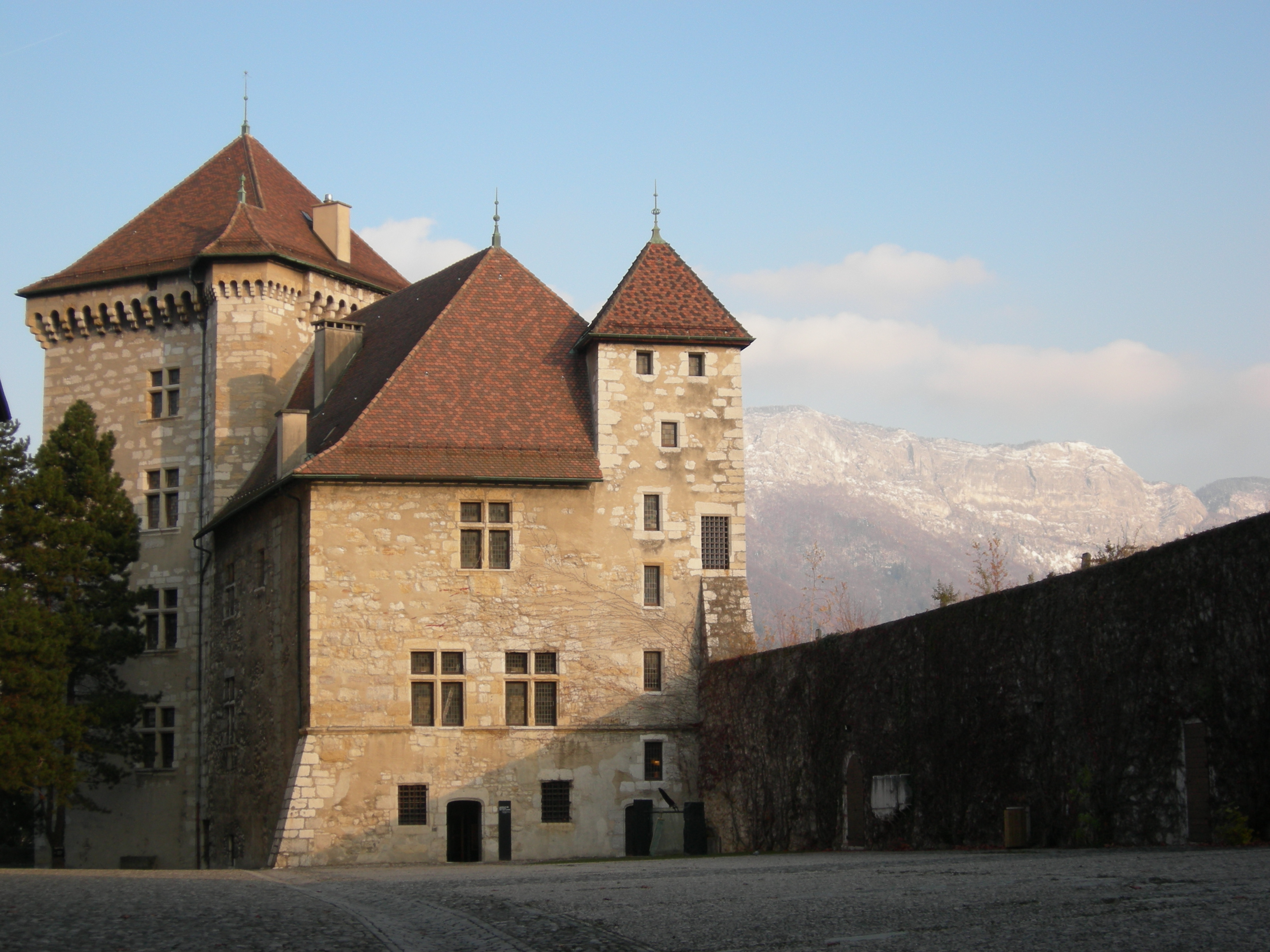
The county never played a major part as a feudal entity. The city of Geneva and its environs were retained, but the approaches to the western end of Lake Geneva, which had made the position strategic, were soon lost. In 1124, the Bishops of Geneva had their rule over the city acknowledged and continued to make themselves an independent force, while the Counts of Savoy encircled the territory and controlled the trade routes. From 1219 on, the counts' stronghold and capital was Annecy.
At a moment when the male line of the counts was near exhaustion, Robert of Geneva was raised to a shadow papacy by the French cardinals who seceded from the College of Cardinals and wished to rescind their part in the election of the irascible Urban VI; elected 20 September 1378, Robert took the title of Clement VII. Unexpectedly, with the death of his brother, he succeeded as count in 1392. As count, Robert was virtually dependent on the cooperative graces of the count of Savoy. With his death in 1394, the House of Geneva was extinguished and the title passed to the husband of the heiress, Humbert VII of Thoire and Villars who died in 1400.
Eventually in 1401, the year after Humbert's death, his heir Odo of Thoire-Geneva sold the comté to Count Amadeus VIII of Savoy. Though other members of the Genevan House protested, and the House of Chalons (and, after its extinction, the House of Orange-Nassau) remained the strongest claimant, Amadeus successfully completed the integration of the county with his territories, which were raised to a duchy by Emperor Sigismund of Luxembourg. The title Count of Geneva passed securely into the House of Savoy, where it is maintained as a courtesy title.
List of counts
Legendary counts
Medieval historians connected the literary figures of Reynier and Olivier from the late-12th-century Girart de Vienne to the Genevois, but this is pure fiction.
- c. 770 : Reynier
- c. 770–800 : Oliver, his son
Early counts
- c. 890 : Manasses, may be count of Geneva
- ...
- c. 1002 : Manasses
- c. 1012 : Robert, his nephew, son of count Cono/Conrad I (possible Cono count palatine of Burgundy)
Unconfirmed counts
By Samuel Guichenon, in Histoire généalogique de la royale maison de Savoie (1660)
- 880 (?) : Ratbert (870/880 – † 901)
- 931 (?) : Albitius (900 – † 931/932), his son
- (?) : Conrad (930 – † 963), his son
- c. 963–974 (?) : Robert († 974), his son
- 974–1001 (?) : Albert
- 1004 (?) : Renaud
- 1016 (?) : Aymon
- c. 1060 : Robert
House of Geneva
- c. 1045–c.1061 : Gerold of Geneva
- c. 1061–1080: Conrad, his son
- c. 1080–1128 : Aymon I, his brother
- 1128–1178 : Amadeus I, his son
- 1178–1195 : William I his son
- 1195–1220 : Humbert I, his son
- 1220–1252 : William II, his brother
- 1252–1265 : Rudolf, his son
- 1265–1280 : Aymon II, his son
- 1280–1308 : Amadeus II, his brother
- 1308–1320 : William III, his son
- 1320–1367 : Amadeus III, his son
- 1367–1367 : Aymon III, his son
- 1367–1369 : Amadeus IV, his brother
- 1369–1370 : John I, his brother
- 1370–1392 : Peter, his brother
- 1392–1394 : Robert, his brother as Clement VII he was Antipope at Avignon from 1378
House of Thoire
.svg)
- 1394–1400 : Humbert VII of Thoire and Villars (died 1400), son of Humbert VI, Lord of Thoire and Villars, and Maria of Geneva, daughter of Amadeus III
- 1400–1401 : Odo of Thoire and Villars
In 1401, Odo sold the County to Amadeus VIII of Savoy. His heirs, however, contested this and the legal processes were not completed until 1424.
House of Savoy
From 1424 the County of Geneva was joined to the House of Savoy, although at times it was granted as appanage to cadet branches of the family.
- 1424–1434 : Amadeus VIII, Duke of Savoy
- 1434–1444 : Philip of Savoy (1417–1444), his son, apanagiste Count
- : 1444–1460 : Louis (1413–1465), Duke of Savoy, his brother
- 1460–1482 : Louis (1436 † 1482), his son, apanagiste Count, also King of Cyprus
- 1482–1491 : John of Savoy (1440–1491), his brother, apanagiste Count
- 1491–1496 : Charles II (1489–1496), Duke of Savoy
- : 1496–1497 : Philipp II the Landless (1438–1497), Duke of Savoy, great-uncle of the previous, son of Louis I
- : 1497–1504 : Philibert II the Handsome (1480–1504), Duke of Savoy, his son
- : 1504–1514 : Charles III (1486–1553), Duke of Savoy, his brother
- 1514–1533 : Philippe, Duke of Nemours (1490 † 1533), apanagiste Count of Geneva, Duke of Nemours, his brother
- 1533–1585 : Jacques, Duke of Nemours (1531–1585), Duke of Geneva 1564, his son
- 1585–1595 : Charles Emmanuel, Duke of Nemours (1567–1595), his son
- 1595–1632 : Henri I, Duke of Nemours (1572–1632), his brother
- 1632–1641 : Louis, Duke of Nemours (1615–1641), his son
- 1641–1652 : Charles Amadeus of Savoy (1624–1652), his brother
- 1652–1659 : Henri II, Duke of Nemours (1625–1659), his brother, Archbishop of Reims
- 1659–1724 : Marie Jeanne of Savoy (1644–1724), daughter of Charles Amadeus, married
- : Charles Emmanuel II, Duke of Savoy (1634–1675) husband of the above
Subsequently, the County of Geneva was joined to the Duchy of Savoy.
References
References
- Donald C. Jackman, ''The Konradiner: a study in genealogical methodology'', Frankfurt am Main: Klostermann, 1990, p. 206.
- Henri Baud, Jean-Yves Mariotte, Jean-Bernard Challamel, Alain Guerrier, ''Histoire des communes savoyardes. Le Genevois et Lac d'Annecy'' (Tome III), Roanne, Éditions Horvath, 1981, 422 p. ({{ISBN. 2-7171-0200-0), p.11.
- Henri Baud, Jean-Yves Mariotte, Jean-Bernard Challamel, Alain Guerrier, ''Histoire des communes savoyardes. Le Genevois et Lac d'Annecy'' (Tome III), Roanne, Éditions Horvath, 1981, 422 p. ({{ISBN. 2-7171-0200-0), p.11.
- Régeste genevois, acte de 1002, « ''Manasaeus comes, Rotbertus nepos ejus'' », [http://www.digi-archives.org/fonds/edit-gen/index.php?action=show&session=public&lang=fr&ref=CH%20EDIT%20REG%20000%20000%20001%200144 REG 0/0/1/144], Fondation des Archives historiques de l'Abbaye de Saint-Maurice (Suisse) - digi-archives.org.
- Régeste genevois, acte de 1002, « ''Manasaeus comes, Rotbertus nepos ejus'' », [http://www.digi-archives.org/fonds/edit-gen/index.php?action=show&session=public&lang=fr&ref=CH%20EDIT%20REG%20000%20000%20001%200144 REG 0/0/1/144], Fondation des Archives historiques de l'Abbaye de Saint-Maurice (Suisse) - digi-archives.org.
- Samuel Guichenon, ''Histoire généalogique de la Royale Maison de Savoie ou Histoire généalogique de la Royale Maison de Savoie justifiée par titres, foundations de monastères, manuscrits, anciens monumens, histoires, et autres preuves authentiques'', chez Jean-Michel Briolo, 1660, {{pp.
- Jean-Yves Mariotte « Du bon usage des faux » (p. 346), paru dans l'ouvrage de Barbara Roth-Lochner, Marc Neuenschwander et François Walter, Des archives à la mémoire : mélanges d'histoire politique, religieuse et sociale offerts à Louis Binz, Librairie Droz, 1995, p. 503 ({{ISBN. 978-2-88442-007-5).
This article was imported from Wikipedia and is available under the Creative Commons Attribution-ShareAlike 4.0 License. Content has been adapted to SurfDoc format. Original contributors can be found on the article history page.
Ask Mako anything about County of Geneva — get instant answers, deeper analysis, and related topics.
Research with MakoFree with your Surf account
Create a free account to save articles, ask Mako questions, and organize your research.
Sign up freeThis content may have been generated or modified by AI. CloudSurf Software LLC is not responsible for the accuracy, completeness, or reliability of AI-generated content. Always verify important information from primary sources.
Report